





The MLB trade deadline has come and gone. Many contenders pushed their chips in and strengthened their roster by addressing areas of need, while others left their fanbases scratching their heads, wondering how their favorite club will fare down the stretch without reinforcements in tow. Last week, we analyzed the swing decisions of some recently dealt players, in particular those who were traded in the days leading up to the deadline. In this piece, we’ll focus solely on some of the notable hitters who were moved specifically on deadline day.
Our swing decision analysis hinges on one of our very own statistics here at Pitcher List, Decision Value. If you’re unfamiliar, Decision Value grades a hitter’s ability to recognize the pitches he can turn into favorable contact and then make the appropriate swing decision. It’s measured on a scale where 100 is the league average, and every 15 points above or below 100 is one standard deviation. We can even break Decision Value down a little bit further to specifically look at pitches thrown inside (zDV) and outside (oDV) the strike zone.
For a more in-depth description of Decision Value, check out the intro to this piece. You can support Pitcher List and get access to full leaderboards for Decision Value and other PLV statistics by joining PL Pro.
Carlos Correa, Houston Astros (94 Decision Value)
Perhaps the most surprising move of the trade deadline was Correa’s return to Houston. It was less than two years ago that the three-time All-Star signed a six-year deal to remain in Minnesota, so even with the Twins’ slide down the standings, Correa’s name wasn’t one featured in many pre-deadline rumors.
Correa’s put up an uncharacteristically mediocre season so far. He slashed just .267/.319/.386 as a Twin in 2025, good for just a 97 wRC+. His move back to Houston is surely a welcome one for the 30-year-old. He had a career .837 OPS and 128 wRC+ during his initial seven-year stint with the Astros.
Decision Value is a relatively new stat, so the only full-season numbers we have from Correa’s time in Houston are from his 2021 season, during which he posted a 101 Decision Value. Since moving north, Correa’s Decision Value has slipped. He’s posted values below league average in each of his last three seasons, with his current 94 mark being the lowest we’ve seen from him, although he’s started making some headway with his swing choices over the last month.
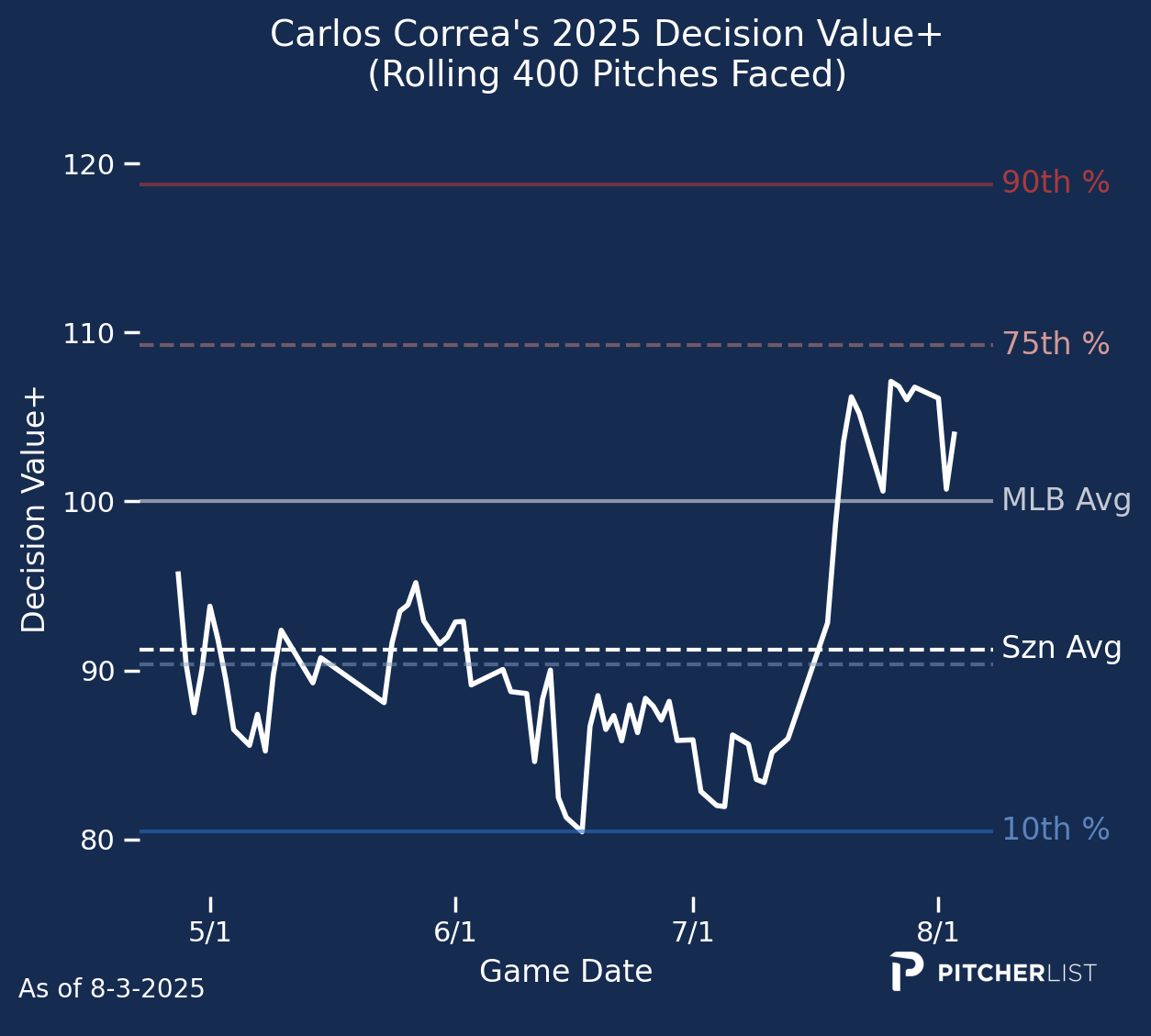
Correa’s been very aggressive on pitches away from him and off the plate, and PLV is giving him harsh grades for those swings which is knocking down his overall Decision Value. On pitches inside, he’s been much more passive. You can see below that his Swing Aggression and Decision Runs heatmaps are pretty much polar opposites.
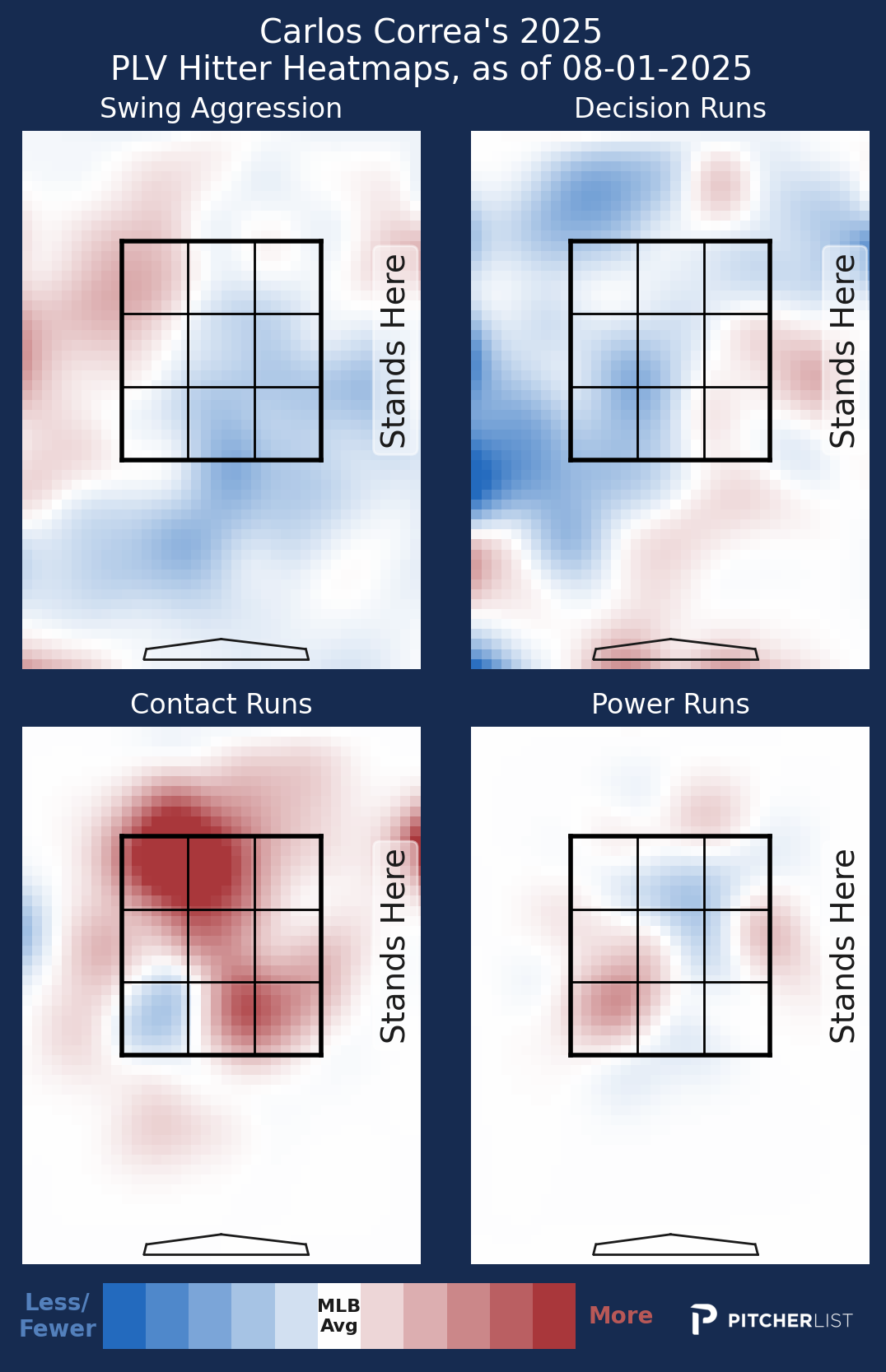
Now that Correa’s back in Houston with the Crawford Boxes tantalizingly looming in left field, you have to wonder if he’ll flip his swing approach and up the aggression on those inside pitches that he can more easily pull for home runs down the left field line. That potential change could help him boost his power numbers down the stretch and turn him into a more interesting fantasy option, albeit one with a low ceiling thanks to literally zero stolen base potential.
Ryan O’Hearn, San Diego Padres (102 Decision Value)
In his final year under contract with the scuffling Orioles, O’Hearn was one of the most obvious trade candidates at the deadline. He and his .278/.369/.453 slash landed in San Diego where he should see the starting lineup more often than not, but with a crowded infield depth chart the early returns are looking like he won’t be an every day player for the Padres.
Since his 2023 breakout in Baltimore, O’Hearn has greatly improved his plate discipline. In his debut season with the Orioles, O’Hearn punched out at a 22.3% clip while walking just 4.1% of the time. Now, those numbers have improved greatly to a 17.5% strikeout rate and an 11.3% walk rate. With those strong numbers, you’d expect O’Hearn’s Decision Value to clock in higher than his 102 mark, but although he’s been near league average overall, it’s been a season of peaks and valleys.
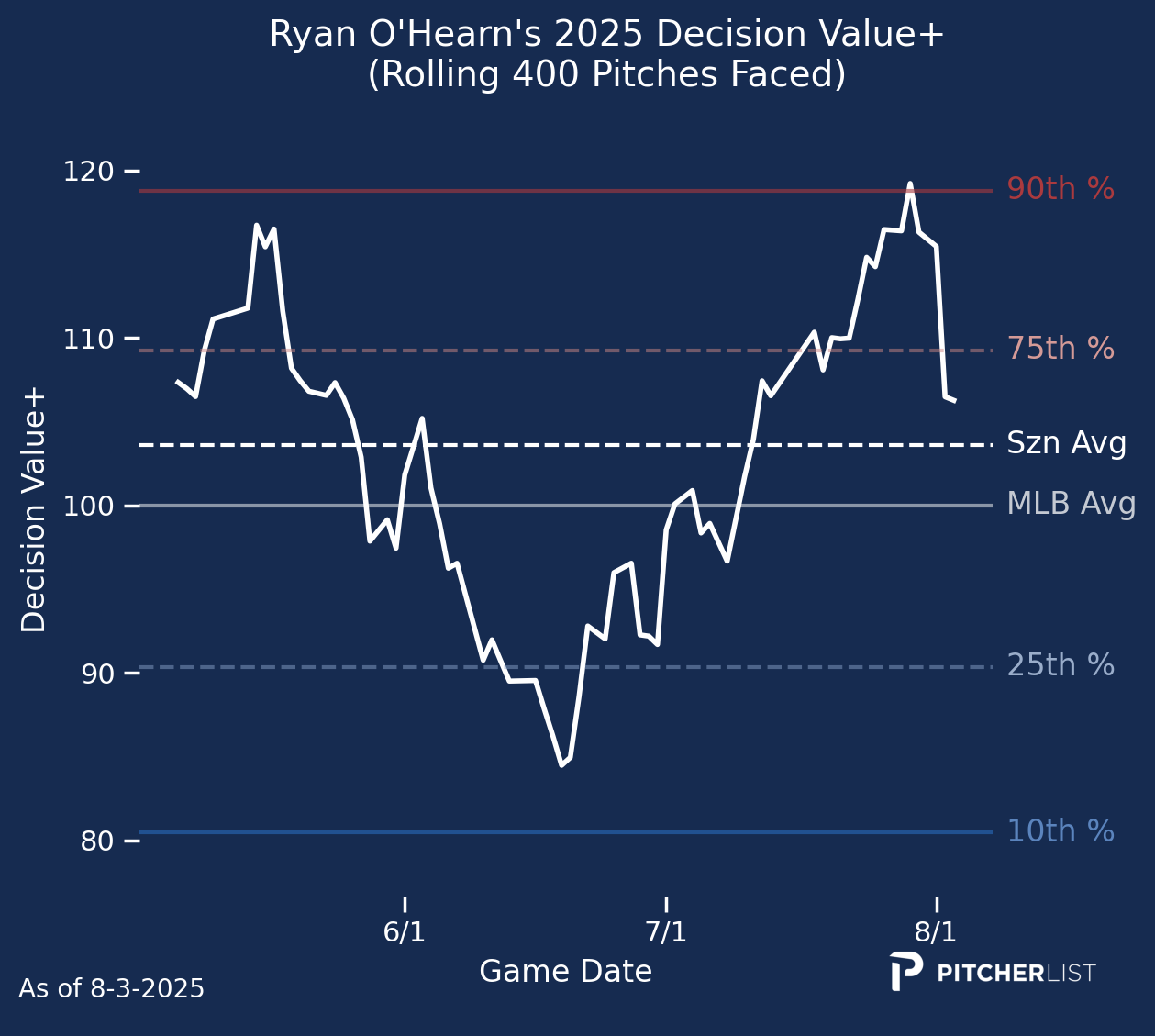
That rolling chart sure looks like the epitome of a streaky hitter, and his overall results reflect that. O’Hearn struggled to swing at good pitches to hit in June, but both before and after that early summer downturn, he’s been well above average in making swing decisions. His month-to-month results reflect that Decision Value rolling chart almost perfectly.
If the Padres get the version of O’Hearn that’s making good swing decisions, that’s a monster bat to add to their lineup. He may not carry big-name value, but his results speak for themselves. Each of his xwOBA, xBA, xSLG, Hard-Hit%, LA Sweet-Spot%, Squared-Up%, K%, and BB% is 70th percentile or better. From a fantasy perspective, let’s hope that O’Hearn performs well and earns himself a full-time starting gig. If he does, hitting in the middle of that already potent lineup should make him a worthy corner infield option regardless of league type.
Jesús Sánchez, Houston Astros (85 Decision Value)
The Astros didn’t stop after their Correa acquisition. They also made a deal with Miami, acquiring Statcast darling Sánchez and his perplexing hitter profile. Since his 2021 rookie campaign, Sánchez has been putting up eye-popping Statcast metrics. His swing speed and max exit velocities are always among the game’s elite. Only seven hitters surpassed Sánchez’s 117.2 mph max exit velocity last year, and almost all of them are the game’s biggest boppers — Oneil Cruz, Giancarlo Stanton, Shohei Ohtani, William Contreras, Vladimir Guerrero Jr., Aaron Judge, and Yandy Díaz. That’s some nice company
Despite Sánchez flirting with the top of power metric leaderboards, he’s never been able to turn his immense raw power into gaudy home run totals. His 18 big flies last year were a career high; he has 10 bombs through 358 plate appearances so far this season.
Decision Value may help us shine a light on Sánchez’s mismatched underlying power numbers and his actual results. Although he has an overall 85 Decision Value, Sánchez has made average swing decisions on strikes (101 zDV) but well below average swings on balls (85 oDV). Sánchez is a free swinger. He offers at 50.1% of the pitches he sees, which makes his swing rate fall in the 67th percentile despite the fact that he sees fewer pitches in the strike zone than 88 percent of batters. With so many of the pitches he sees landing out of the strike zone, he has fewer good pitches to drive.
When Sánchez is getting to his power, he’s often doing it against pitches located low and inside. Here’s a look at his slugging percentage broken down by zone.
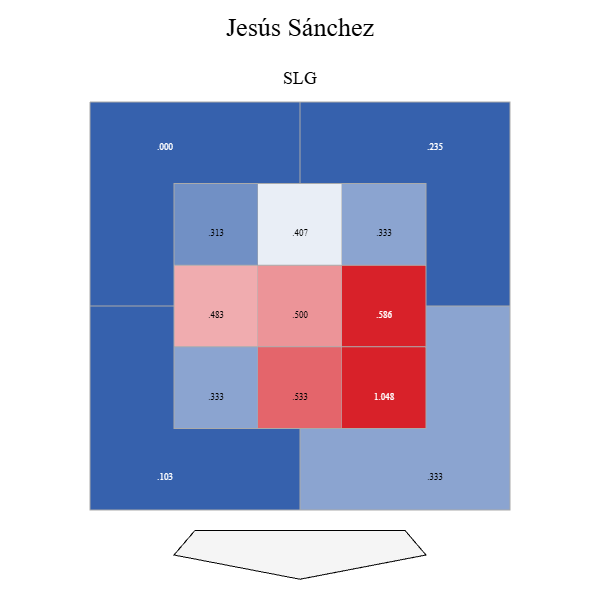
Although that low and inside area of the strike zone is Sánchez’s bread and butter, that’s not where he swings the most often. Of course, it’s also an area that opposing pitchers have done a reasonably good job of avoiding when Sánchez is standing in the batter’s box.
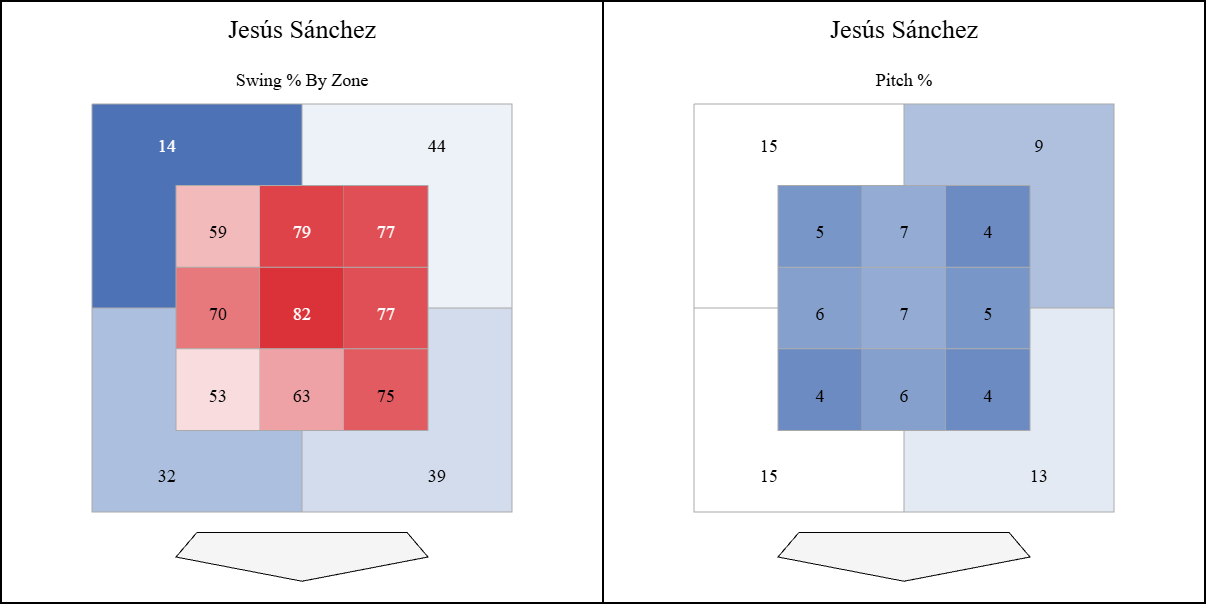
Could Sánchez make a simple adjustment by simply keying in more on that low and inside pitch? Perhaps. This kind of armchair analysis is tricky. A whole lot more goes into a big league hitting approach than saying “let me just swing more often at pitches in this very specific area.” The Astros have been one of the better analytical teams for the last decade, so perhaps they can help Sánchez hone in on some changes to maximize his swings. At the very least, getting to spend time with and run ideas by elite hitters like Jose Altuve and Yordan Alvarez won’t hurt.
Willi Castro, Chicago Cubs (91 Decision value)
The Cubs didn’t address the black hole that is their starting pitching need at the trade deadline, but they did need a good utility bench bat, and they got the best one on the market. Castro has been phenomenal in filling in where needed over recent years while putting up better-than-average production at the plate. In the last week, he’s already started games at second base, third base, right field, and center field for his new club, and that’s while slashing .242/.328/.401 on the season.
Castro isn’t going to win any Decision Value awards with his score of 91, but he’s at least been good at identifying which pitches in the strike zone he should attack (104 zDV). The picture outside of the zone is less rosy with an 89 oDV, but that poor grade doesn’t exactly come as a surprise with his 18th percentile 33.2% chase rate. Castro swings a lot — 53.1% of the time, to be exact. That rate is in the 85th percentile of qualified hitters, and he’s been particularly aggressive on pitches low and out of the zone. His PLV heatmaps offer a good look at both his propensity to swing at offerings under the zone, as well as his poorly graded decisions all around the chase areas just off the plate.
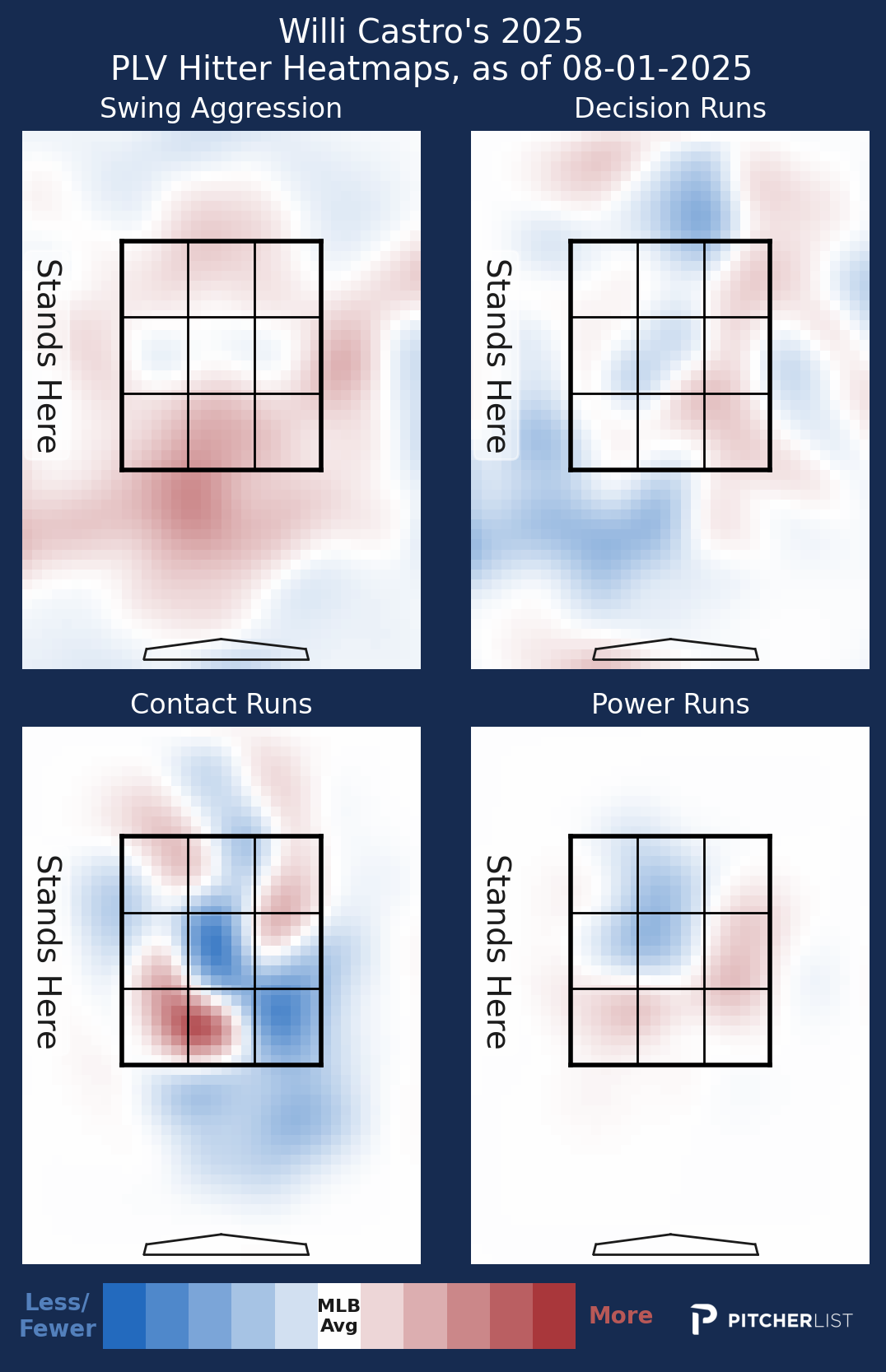
While Castro is swinging often on the edges of the plate, he’s actually achieved reasonably good results on those pitches. He has a .342 wOBA on pitches that have landed in the Chase zone. That’s good for 122nd among batters who have seen at least 100 pitches there, and while that placement doesn’t sound impressive, it puts him in the top third of the league in Chase wOBA.
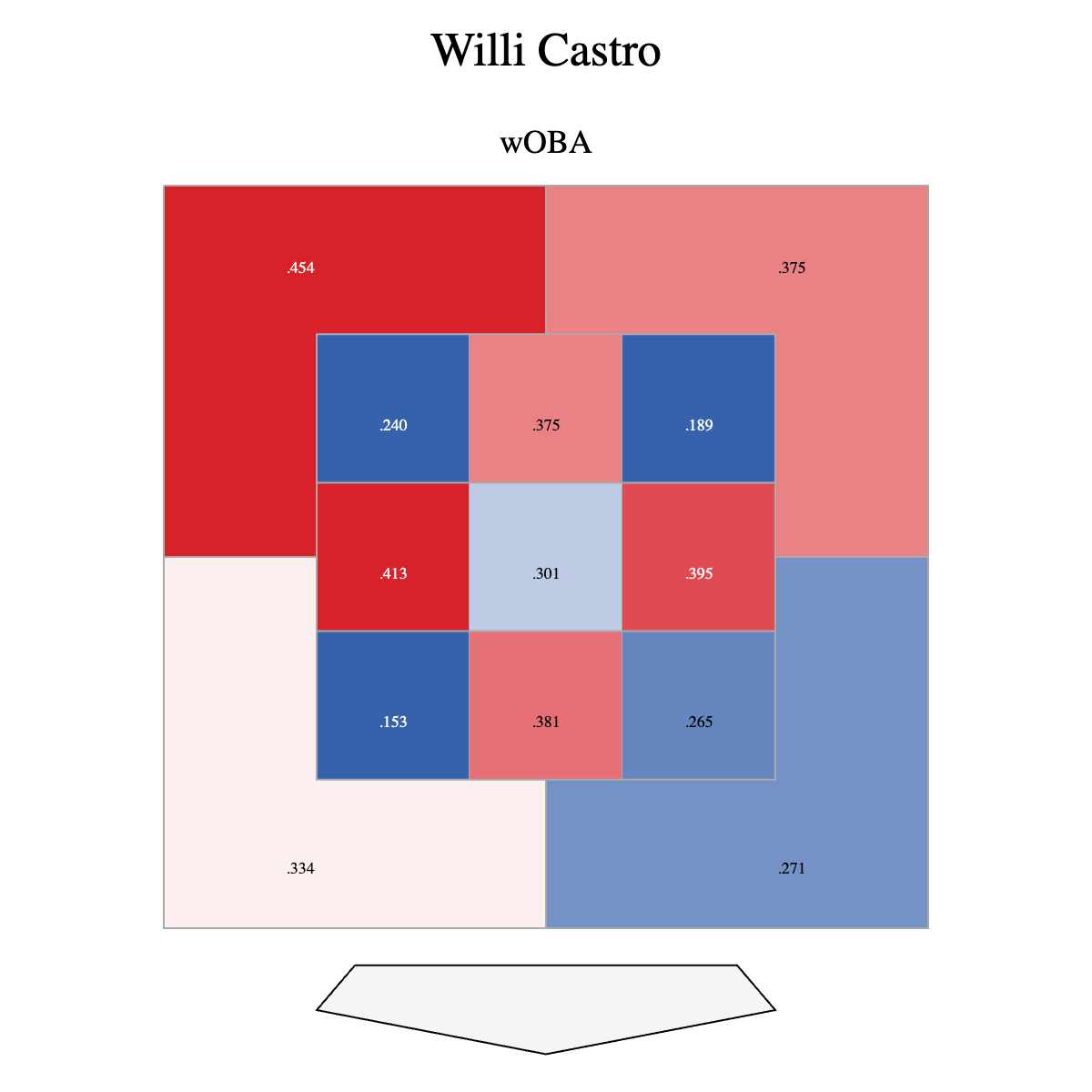
Castro’s Savant page doesn’t light up bright red with loud contact, but that’s nothing new. He’s never popped in many of the Statcast metrics, but that hasn’t stopped him from being a useful player for both his actual team and his fantasy squads. He’s currently sporting a 107 wRC+, and if that’s the mark he finishes 2025 with, it’d be the third straight season he does so. Production that’s seven points above average coming from a hitter who can be plugged into nearly any position is a luxury any team would love to have.
Cedric Mullins, New York Mets (103 Decision Value)
Mullins joined O’Hearn as another impending free agent Oriole who was destined for a move at the deadline. The 30-year-old center fielder got off to a great start at the plate this year, but since he came back from a short IL stint due to a hamstring strain in early June, he hasn’t been as good.
Mullins’ 103 Decision Value is a little better than average, but it’s been up and down this year and has largely followed the same track as his actual results.
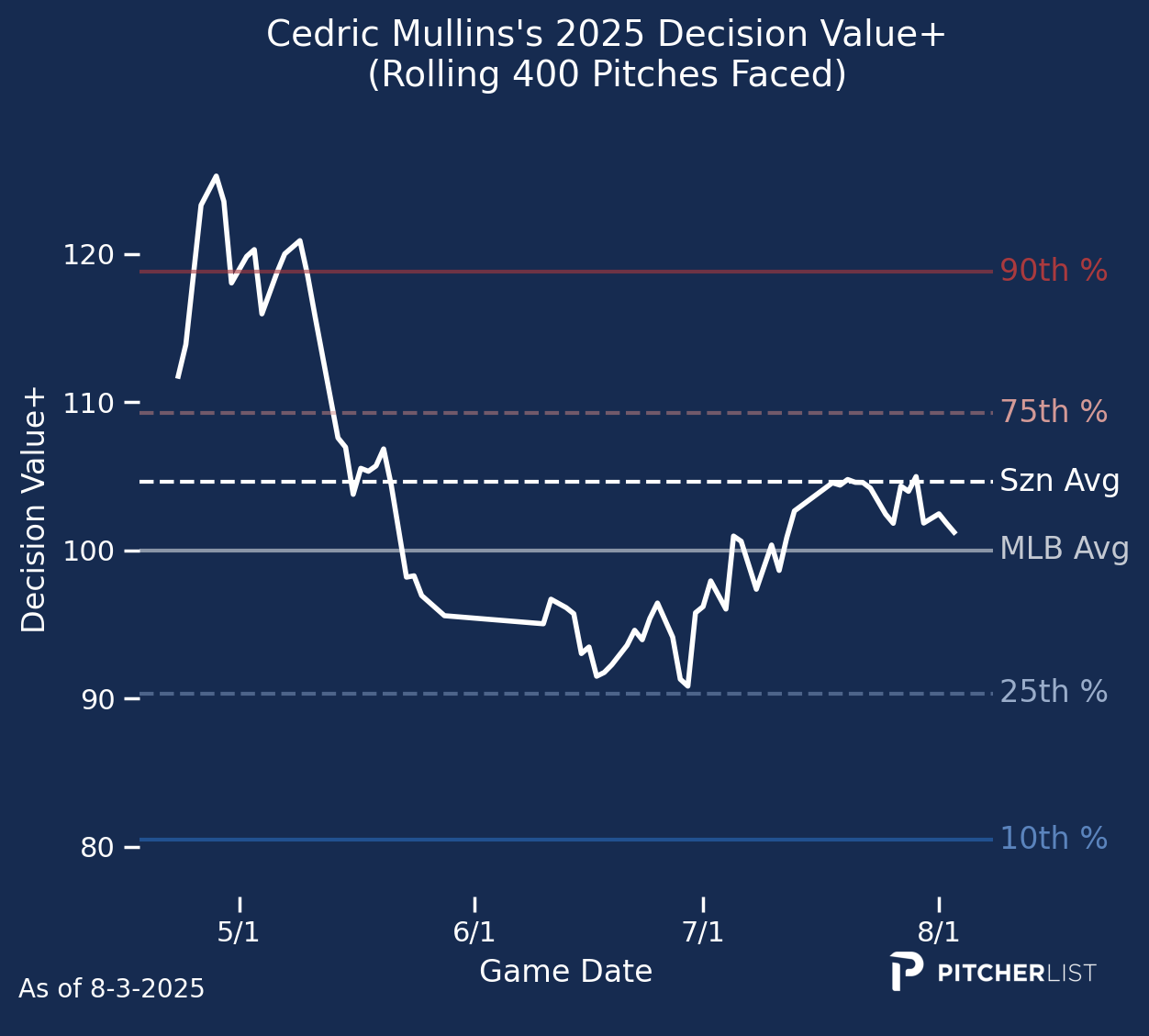
Mullins’ Decision Value has started to tick back up in recent weeks, and perhaps his actual results will follow. His 103 Decision Value is the lowest mark he’s posted since 2021, so the track record for better swing choices is certainly there.
With five years of MLB service time under his belt, Mullins has turned down his aggression ever so slightly. His 49.4% swing rate is almost two points lower than last year’s mark, and his lowest in the last four seasons. He hasn’t just swung less often, but he’s become more efficient with his swings. Mullins is swinging at more pitches in the zone while simultaneously swinging at fewer pitches outside of the zone.
Good swing decisions don’t always correlate with strong offensive production, but so far this year, Mullins’ have been seemingly tied very closely together. If that trend line on his rolling chart keeps moving up, the results at the plate may follow. With a nearly everyday job for a good team down the stretch, Mullins should continue to provide strong fantasy value over the season’s final two months. Be sure to keep your eye on the Mets’ upcoming schedule before locking Mullins in your weekly lineups, though. It looks like he’s on the strong side of a platoon with Tyrone Taylor, so if there are many lefties on the docket, he may be worth benching for a series or two.
Adapted by Kurt Wasemiller (@kurt_player02 on Instagram & Threads, @kuwasemiller.bksy.social on BlueSky)
