





One of the most exciting times of the MLB calendar is here: trade deadline season! With plenty of players changing teams over recent days, it feels like a great time to put some of the more notable names under the PLV Decision Value microscope to see how strong of swing choices these recently moved players have been making.
If you’re not familiar with PLV’s Decision Value, it grades a hitter’s ability to recognize the pitches he can turn into favorable contact and then make the appropriate swing decision. It’s measured on a scale where 100 is the league average, and every 15 points above or below 100 is one standard deviation. We can even break Decision Value down a little bit further to specifically look at pitches thrown inside (zDV) and outside (oDV) the strike zone.
For a more in-depth description of Decision Value, check out the intro to this piece. You can support Pitcher List and get access to full leaderboards for Decision Value and other PLV statistics by joining PL Pro.
Josh Naylor, Seattle Mariners (82 Decision Value)
The newest Mariner does a lot of things really well at the plate, but making his swing choices isn’t one. Naylor’s 82 Decision Value is over a standard deviation below the league average, and it’s not the first time he’s struggled in this area. In fact, he’s pretty much lived in this range throughout his career. If he finishes 2025 with a Decision Value in the 80s, it’ll be the fourth straight season he does so.
Naylor’s been able to find success at the dish in spite of PLV disapproving of the pitches he attacks. He’s hitting .294/.360/.451 this season, and in that previously mentioned four-year stretch, he’s posted a 122 wRC+. With that kind of track record, I don’t think his new team has any worry that he’ll be able to keep up his strong production at the plate.
If we go a little bit deeper, Naylor’s swing profile is surprising. Although he’s known for his strong plate discipline — his 0.72 BB/K ratio is the 19th best in baseball — he has just a 72 oDV. With a 53.9% swing rate, Naylor offers at more pitches than 89 percent of hitters, and that happens even outside of the strike zone. His 37.9% O-Sw% is in the 10th percentile, and that’s where his poor oDV grade is coming from. Regardless of the results, PLV generally does not want to see a hitter offer at pitches off the plate. Despite swinging at so many pitches out of the zone, Naylor’s been able to turn some of those swings into production. On pitches he swings at in the Chase zone, He has a .185 wOBA. That’s not a good number at first glance, but it’s actually the 53rd best since good results on pitches that far out of the zone are almost non-existent.
In the season’s early going, it seemed like Naylor may have finally been taking a step forward in making better swing decisions, but that improvement proved to be short-lived. By mid-June, Naylor was back in his old Decision Value range, and has only continued to sink as we’ve gotten further into the summer months.
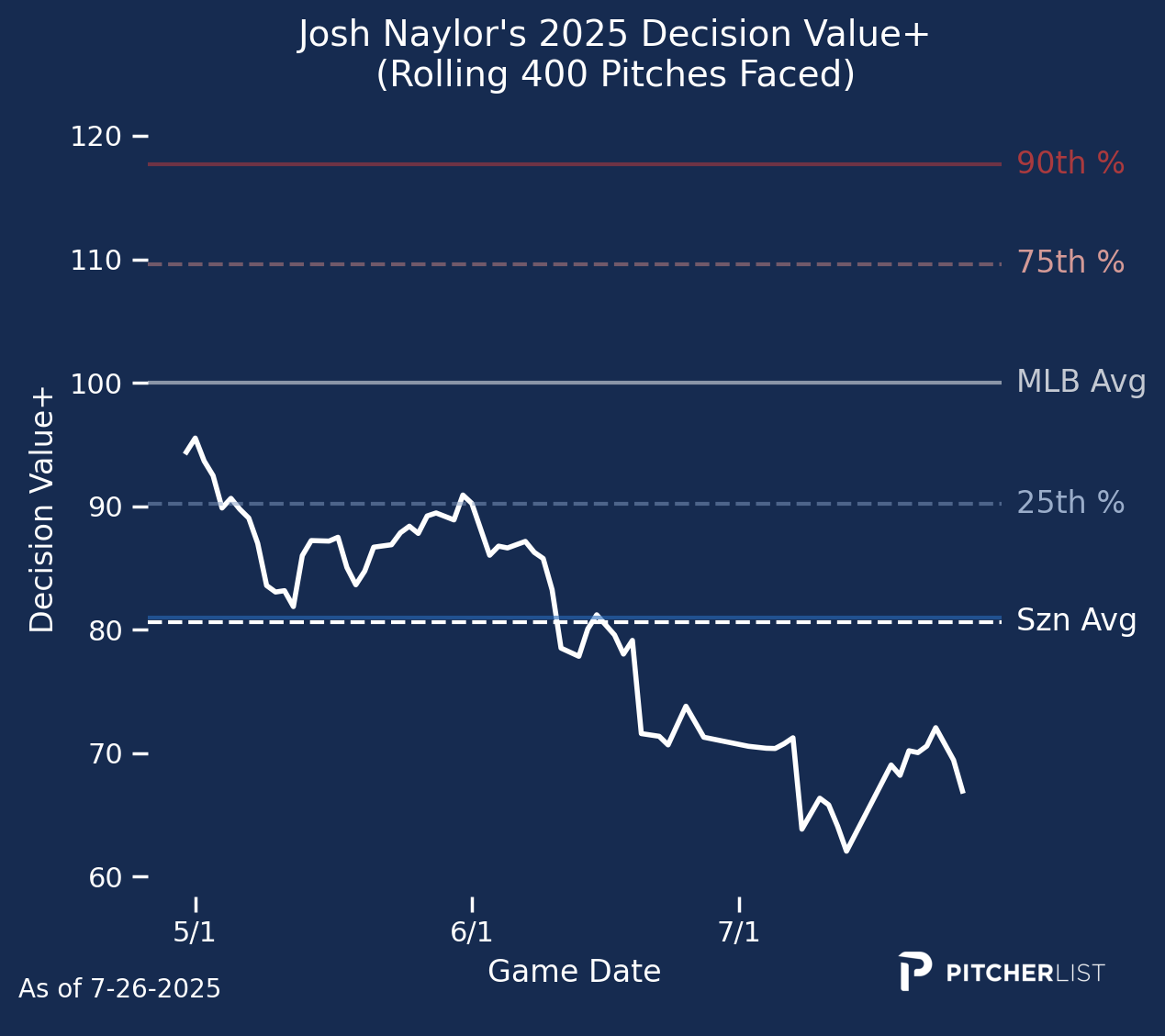
Hitters often struggle in a move to Seattle and T-Mobile Park, so it’ll be interesting to keep an eye on both Naylor’s overall production and his Decision Value over the season’s final two months. His results as a Mariner will certainly play a role in just how big a contract he’ll sign when he reaches free agency this winter.
Eugenio Suárez, Seattle Mariners (107 Decision Value)
One deal wasn’t enough for Seattle and Arizona. They linked up again to send Suárez back to the Mariners, the club he hit 53 homers with in 2022 and 2023. The fact that Suárez has a track record of success in Seattle probably went a long way in pushing this deal over the edge. It’s notably hard for hitters to adjust to hitting in T-Mobile, so Suárez’s familiarity should make him more comfortable there than any other difference-making bat on the market.
Suárez is having another monster power season. Both his 36 home runs and .577 SLG place fifth in the league, and part of that success has to be due to his good Decision Value. Not only is the number good overall at 107, but with a 113 zDV, he’s been even better at choosing which strikes to swing at, and he’s absolutely hammering the ones he attacks.
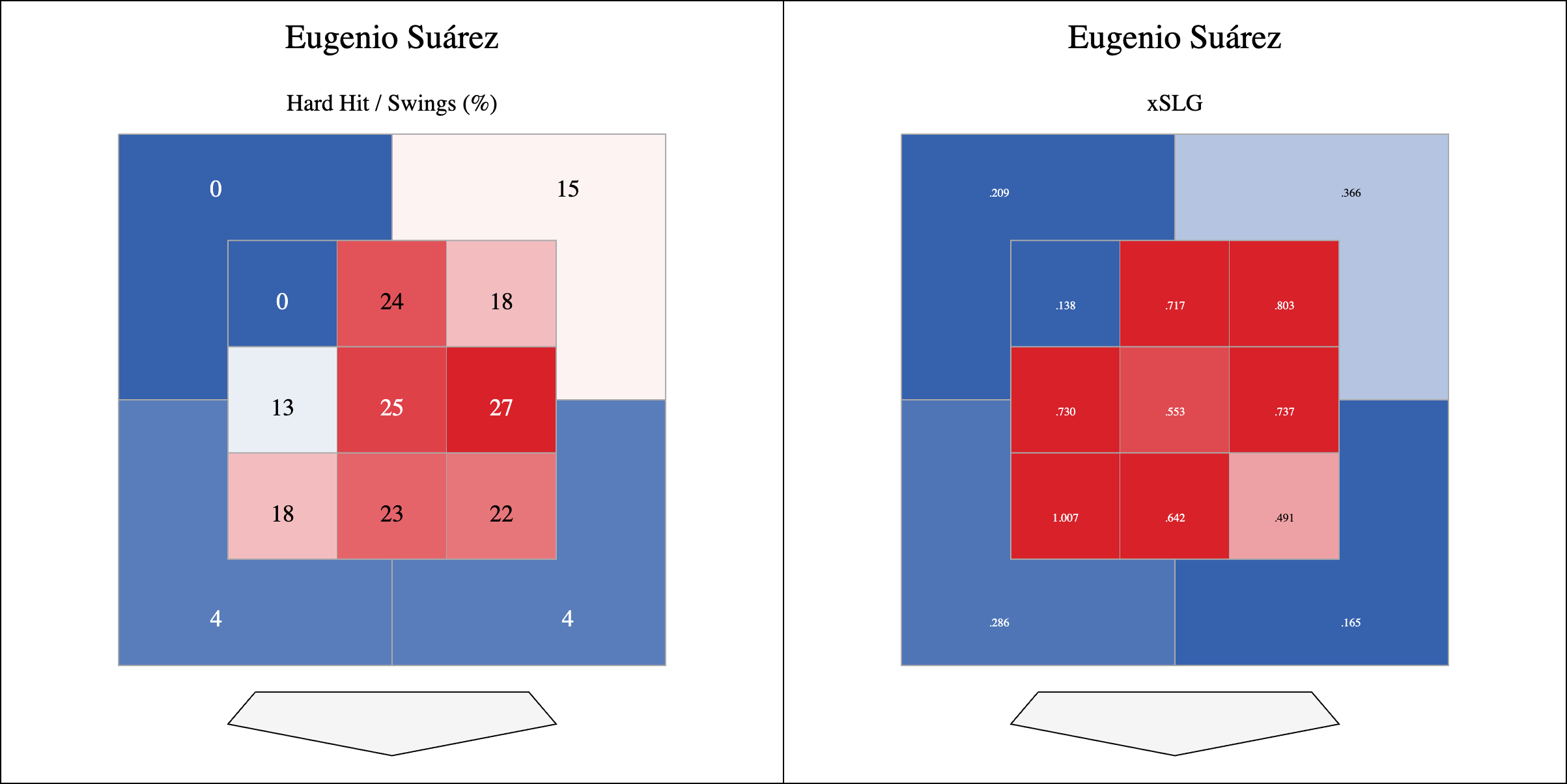
Like most big-time sluggers, Suárez struggles with laying off pitches out of the zone. With a 31.6% chase rate (27th percentile), it’s astonishing that his oDV is still above average at 102. When he swings out of the zone, he misses more often than most batters. Suárez’s O-Con% of 42.2% is in just the 7th percentile. That generally isn’t an encouraging sign, but as long as he isn’t in a two-strike count, you’d almost prefer the whiff over poor contact to keep the at-bat alive and give Suárez another shot to get to his patented power stroke.
Ryan McMahon, New York Yankees (104 Decision Value)
A move to the Bronx has to be a bit of a shellshock for McMahon. Not only is he moving from the most defunct franchise in baseball to the one with high World Series aspirations, but he’s also going from one of the least covered teams to being continually analyzed with the infamous New York media scrutiny. His fielding prowess may be the biggest thing that Yankees’ fans notice about their new man at the hot corner, but he should be more than serviceable with the bat, too.
McMahon’s hovered around league average in Decision Value for most of his career, but with a disproportionate amount of swing-and-miss in his profile, McMahon is going to post painfully high strikeout rates. Despite having relatively standard values in zDV (94) and oDV (106), McMahon’s punched out at a 31.7% clip thanks to his league-worst 35.4% whiff rate. Fun fact — he’s tied at the “top” of the whiff leaderboards with new teammate Aaron Judge. With that kind of company, clearly, a hitter can swing and miss while still producing, so there’s some hope that McMahon can turn his considerable power metrics into more consistent output in New York. A 12.7% barrel rate and 49.8% hard-hit rate will play anywhere, but those should be particularly interesting metrics with Yankee Stadium’s short porch.
Although he’s only hitting .223/.322/.407, McMahon’s approach and decisions at the plate are primed for success with his new home park. Not many hitters want to leave Coors, but McMahon may be one of the few who could benefit from it.
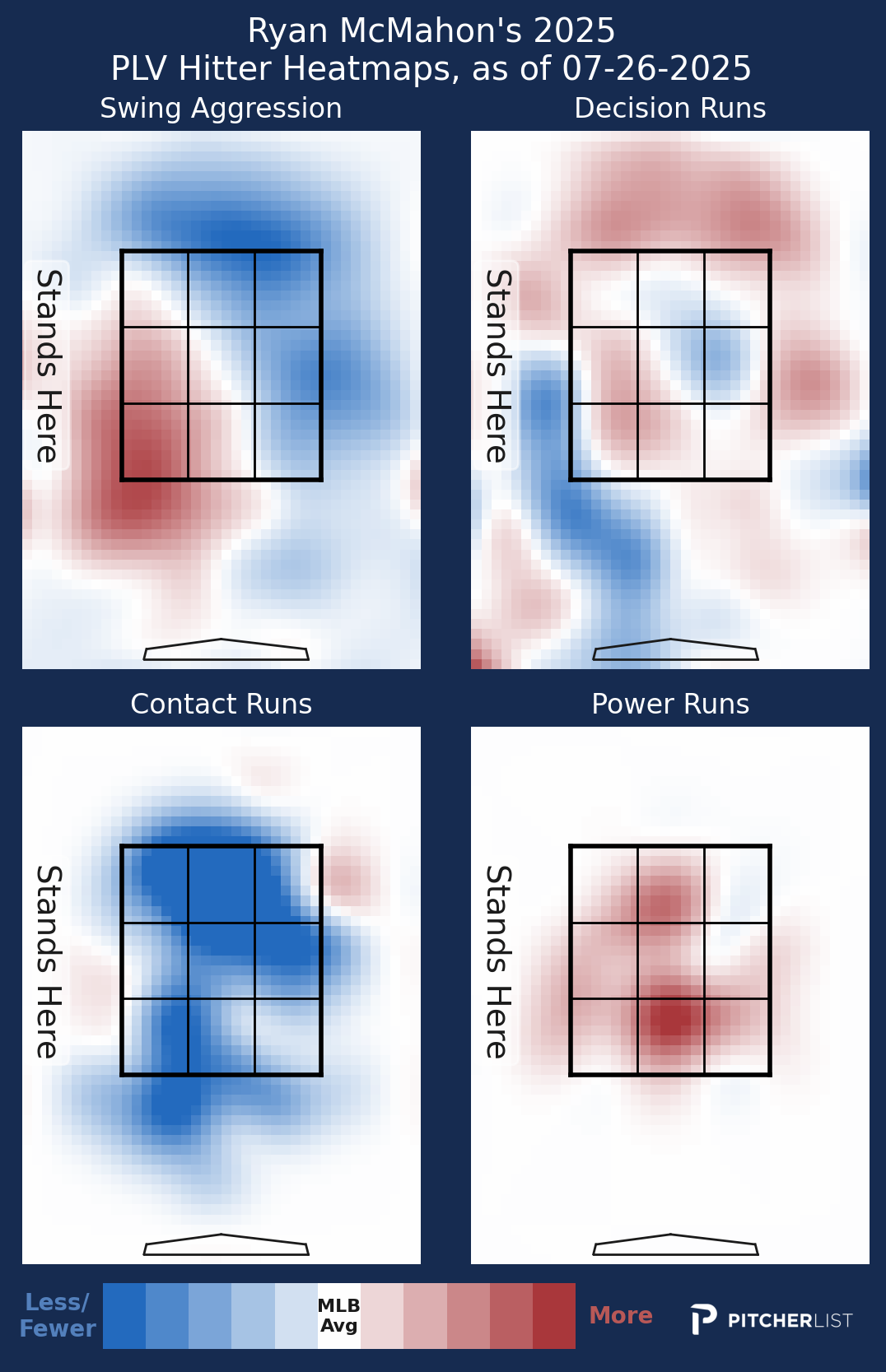
McMahon’s been very aggressive at pitches located low and inside, where he can use his 79th percentile bat speed and turn on them, pulling and driving them for extra-base hits. This kind of approach has bumped up McMahon’s Pull AIR% to 18.8%, by far the highest mark of his career, and one that should play well in the Bronx.
Amed Rosario, New York Yankees (88 Decision Value)
Another new Yankee, Rosario should slot into a bench job and likely won’t have the impact on how successful the rest of the Yankees’ season is in the same way McMahon will. Still, Rosario will play an important role mixing and matching around the diamond, and his offensive performance has been better than you’d expect from a guy playing that super utility role off the bench.
Rosario hit .270/.310/.426 in 158 plate appearances as a National. That comes out to a 105 wRC+, and although he has a below-average Decision Value, it’s an area in which he’s improved each of the last four seasons, increasing from a 76 in 2022 to this year’s 88.
With one of the game’s more aggressive approaches at the plate, it’s not a surprise that PLV grades Rosario very strongly at making choices in the strike zone. His 120 zDV is tied for 21st among qualified hitters. Rosario’s 91st percentile swing rate isn’t limited to pitches thrown inside the zone, though, and his propensity to go after the pitches outside of the strike zone hurts him massively. His 35.1% chase rate ranks in just the 9th percentile of batters, so his 80 oDV isn’t just surprising, but drags down his overall Decision Value score significantly.
Danny Jansen, Milwaukee Brewers (131 Decision Value)
There aren’t many metrics that you’ll find Jansen near the top of the leaderboard in, but Decision Value is one of them. The Brewers’ new backup catcher has been a Decision Value darling practically his entire career. His current 131 mark matches his score from last year and ranks him ninth in baseball. Jansen has posted a Decision Value grade above 120 in each season since 2021, and that makes him an incredible fit in Milwaukee. When we recently broke down the Decision Value team leaderboards, the Brew Crew ranked third, and it appeared that they’d been focusing on instilling a patient approach in their young hitters.
Jansen already has patience at the plate as part of his game. He’s swung at just 43.1% of the pitches he’s seen this year, a rate that ranks in the 13th percentile of all hitters. He’s been great at limiting hacks at pitches out of the zone, dropping his swing rate even further on those offerings to just 21.7% and the 93rd percentile.
As catchers go, Jansen’s a good hitter. He’s slashing .204/.314/.389 this season with 11 home runs. That’s good for a 98 wRC+, which, although that number is below the league-average mark for all hitters, it’s a few points better than the league average for backstops (95 wRC+). Decision Value is truly the carrying tool of his offensive profile, and his Process+ chart shows that well.
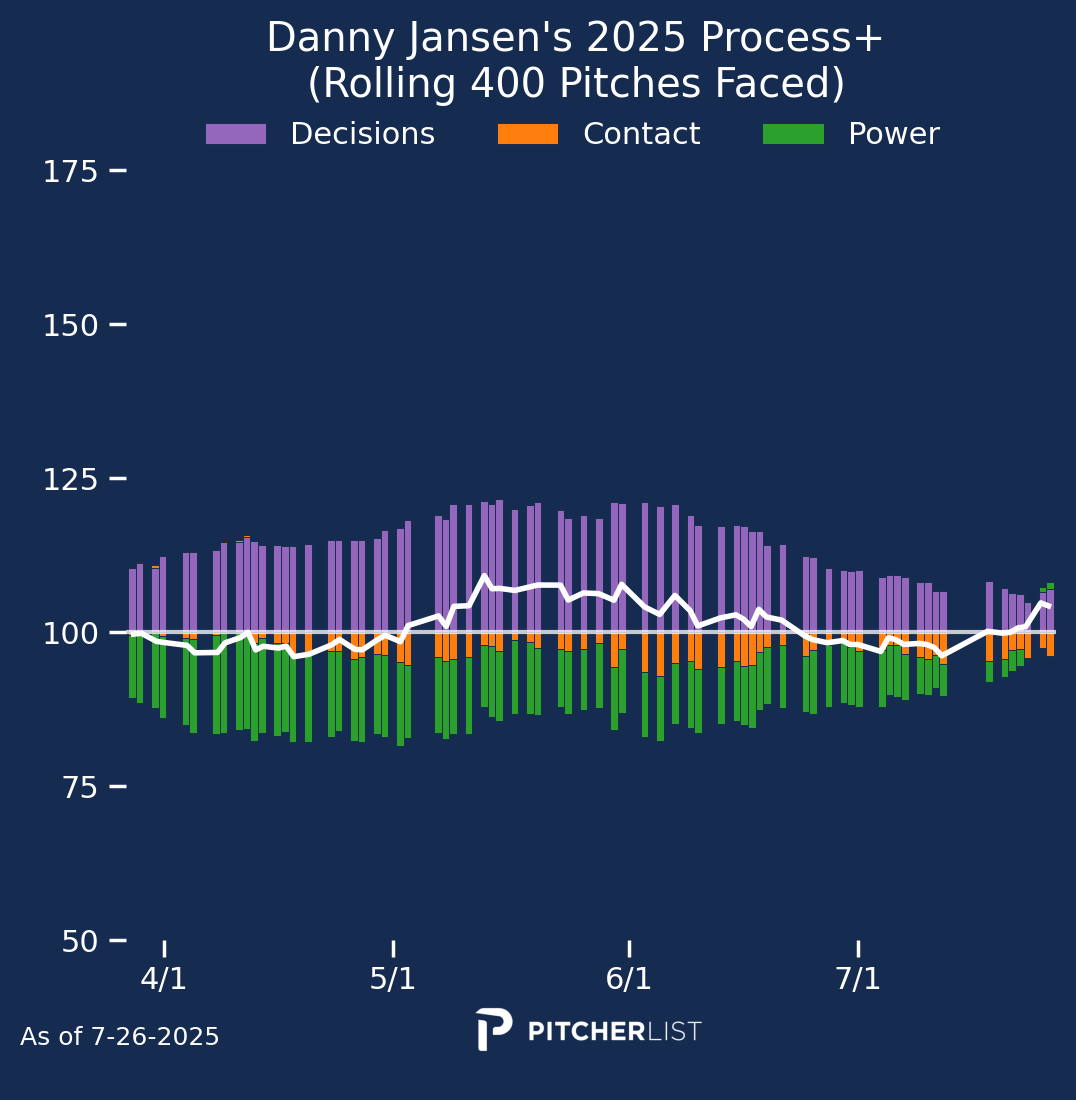
Despite his 11 homers, PLV views his power output rather negatively, and that makes more sense when you see that all of his Statcast power metrics — xSLG, Barrel%, Bat Speed, and more — are all ranked below average. With poor underlying power indicators, Jansen’s still been able to get to double-digit bombs thanks to his sky-high 33.5% Pull AIR%. All but one of his homers have been pulled, and his elite Decision Value is certainly helping him with that, allowing him to identify pitches he can get the bat head around on and send flying down the left field line.
Ke’Bryan Hayes, Cincinnati Reds (93 Decision Value)
One of the more surprising moves of the deadline was the Pirates’ dealing Hayes to the division rival Reds. By now, Hayes exploits are well known. He’s simultaneously one of the very best fielders in baseball, but also one of the worst hitters. Since making his debut in 2020, Hayes’ 73 Outs Above Average lead MLB. On the flip side, his hitting has not just been unremarkable, but has become borderline unplayable. Hayes began his career as an average hitter, slashing .264/.320/.409 with a 97 wRC+ from 2020 through 2023. Since the start of the 2024 season, he’s cratered to a .234/.281/.290 line and a league-worst 58 wRC+.
On the Decision Value front, things are a little brighter for Cincinnati’s new third baseman. Hayes owns a 93 Decision Value so far, breaking down to a more granular 81 zDV and 100 oDV. A large part of Hayes’ poor zDV score comes through his passivity in the batter’s box. Every year, Hayes’ has posted a swing rate between 43.3% and 45.6%. Talk about consistency. His 45.1% clip this year is in the 26th percentile of swing rates, and that means he watches a lot of strikes go by. His called strike rate of 19.8% is higher than all but 14 percent of hitters.
With such a similar profile year-over-year, you have to wonder if a more aggressive approach would be of some benefit to Hayes. He has a good hit tool, but poor batted ball results. Perhaps attacking earlier in counts would let him get to more of his power before switching to a contact-oriented approach in deeper counts.
Nick Fortes, Tampa Bay Rays (94 Decision Value)
The Rays needed to replace Danny Jansen on their roster, and with Agustín Ramírez and Liam Hicks both emerging as contributors, the Marlins had little need for Fortes, so he was sent just a few hours north to Tampa Bay.
Like many catchers, when Fortes is crouching behind the plate, he shines. Not so much when he’s standing next to it. Fortes has made a career off his framing and fielding prowess, but his offensive contributions leave a lot to be desired. He’s hitting .237/.289/.344, a line that’s producing runs well below average at a 75 wRC+. His 94 Decision Value isn’t great, but it’s a lot closer to the league norm than his overall production is.
Fortes chases too often — at a 33.2% clip, which falls in the 30th percentile — but he at least makes up for it with good contact ability. His 16.8% whiff rate is his only offensive metric that really leaps off the page in bright red. That’s good for the 87th percentile. Unfortunately, he doesn’t do a lot with that contact, but he’s putting the ball in play often and forcing the opposing team to make a play. He only punches out at a 15.3% clip, the fifth-best mark among catchers with at least 100 plate appearances.
Adapted by Kurt Wasemiller (@kurt_player02 on Instagram & Threads, @kuwasemiller.bksy.social on BlueSky)
