





Baseball is a game of adjustments. One of the most consequential adjustment periods we see during a player’s career is often their sophomore season. After getting their first look at big league pitching as a rookie, opposing pitchers can formulate strong game plans against these young hitters, so seeing what changes a hitter makes in year two can be an important clue in how they’ll develop throughout what will hopefully be a lengthy big-league career.
One of the hardest things for any hitter to do, but particularly for young hitters facing the game’s best pitching for the first time, is making swing decisions. We have our very own stat here at Pitcher List that can help us measure a hitter’s ability to recognize which pitches he should and shouldn’t swing at, called PLV Decision Value. It may sound a lot like plate discipline, and it’s a related statistic for sure, but it’s more than that. If a batter takes a nasty slider that dots the corner of the strike zone in an 0-0 count, that’s a good take. A great pitch with precise placement is not going to produce good outcomes on contact very often. In that scenario, the batter is better suited to take that pitch and fall behind in the count 0-1 rather than making weak contact for an easy out.
That scenario is a prime example of what Decision Value is measuring. It’s deeper than whether a hitter can recognize the strike zone. It’s whether he can correctly identify the pitches that he has a good chance of turning into favorable contact. We can also break this down further by looking at pitches both in (zDV) and out (oDV) of the strike zone.
Like many metrics, Decision Value is graded on a scale where 100 represents the league average. Every 15 points above or below 100 is one standard deviation.
With that background out of the way, in this piece we’ll be analyzing some of the notable second-year players to see how their swing decisions have changed since their rookie season. If you’re interested in seeing how this year’s rookies are faring in Decision Value, you can find that analysis here.
You can support Pitcher List and get access to full leaderboards for Decision Value and other PLV statistics by joining PL Pro.
Jackson Chourio – 2024: 93 Decision Value | 2025: 80 Decision Value
It’s been a bit of a disappointing season for Chourio. After a strong 20/20 rookie campaign that ended with a .275/.327/.464 slash line and 117 wRC+, the 21-year-old has seen his ratio stats slip to .257/.287/.445 which is good for a narrowly-below-average 99 wRC+. Fantasy managers can still be thankful for his counting stats, though, as he’s already up to 12 home runs and 15 steals.
Chourio’s slash line dip may be partly attributable to worse swing decisions. His Decision Value has fallen from a below-average 93 to over a standard deviation lower than league average at 80. Not only has Chourio made worse decisions, but he’s also made worse decisions more frequently. He’s bumped up his swing rate from 48.8% to 55.5% and his chase rate from 32.8% to 40.7%. Those 2025 rates placed him in the 93rd percentile for swing aggression as well as just the 5th percentile for chasing pitches out of the zone. It’s not exactly the combination you want to see from a young player in year two, and it’s led to a measly 3.9% walk rate.
Although he hasn’t made the leap to fantasy superstardom as some hoped he would, Chourio’s maintained good enough production to not drag down his manager’s fantasy squads too much. I think better days are ahead for the Brewers’ franchise cornerstone. He could be in store for a huge second half like we saw from him a year ago.
Colton Cowser – 2024: 101 | 2025: 102
A fractured thumb has severely limited Cowser’s opportunity in 2025 – he’s been available for just 26 of Baltimore’s 80 games thus far. When he’s been on the field, Cowser’s looked similar to his rookie self. His 111 wRC+ and .324 wOBA are in the same ballpark as his 120 wRC+ and .331 wOBA from his debut campaign.
Last year, Cowser’s Decision Value cratered in the season’s closing weeks, so the fact that in limited playing time he’s returned to his overall mark from last year is an encouraging sign.
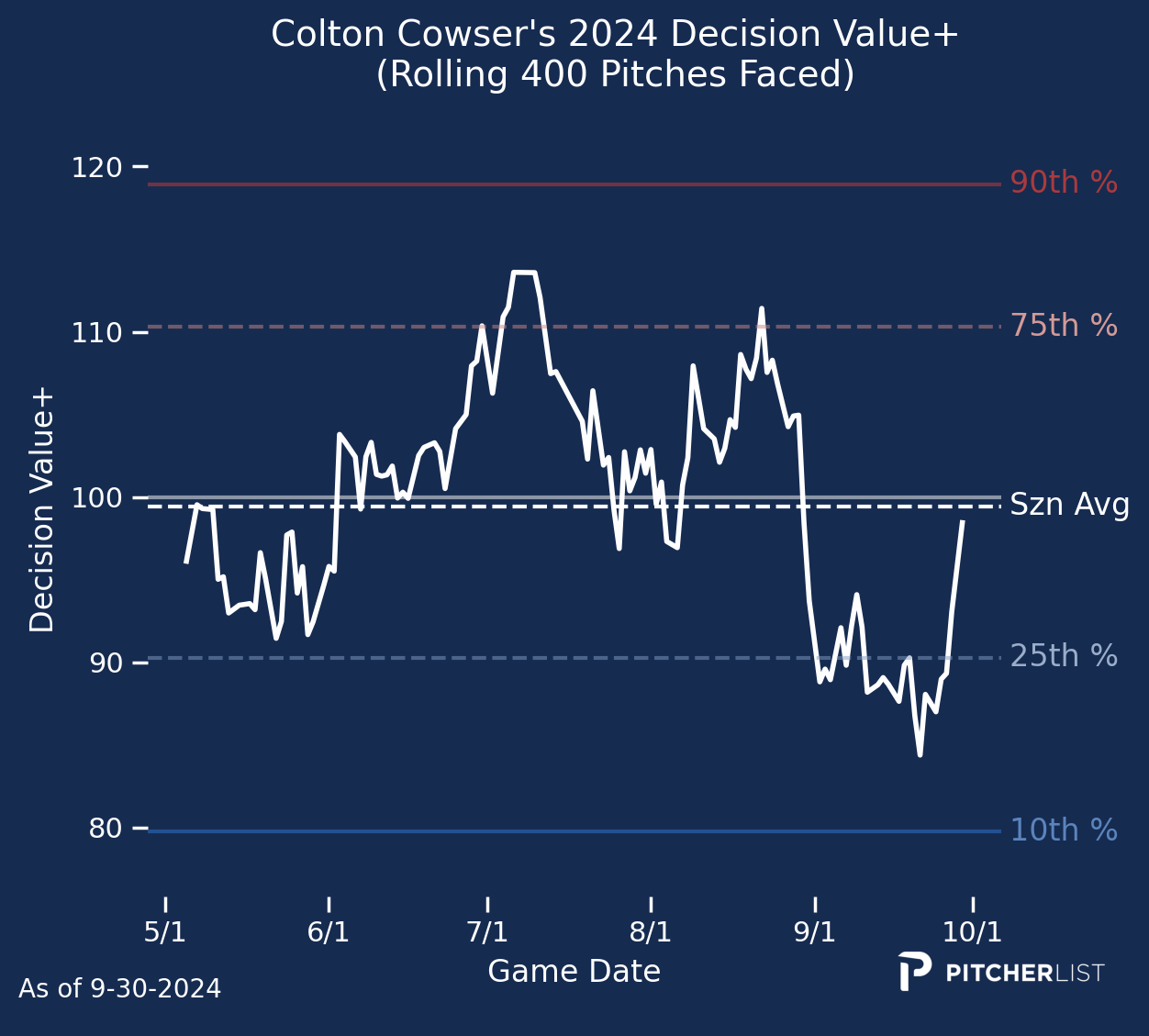
Although Cowser’s Decision Value is nearly identical to his 2024 level, his strikeout rate is slightly up to 32.9% while his walk rate has tumbled nearly six points to a minuscule 3.5%.
It’s hard to judge Cowser’s 2025 season with such a small sample size. We typically want at least 400 pitches for Decision Value to stabilize, and Cowser’s sitting below that threshold at 331. He’s a name worth watching during the second half to see how he develops with more time on the field during his second full season.
Jackson Merrill – 2024: 86 | 2025: 82
Merrill joins his first-name-friend Chourio as a disappointing NL second-year player, but in a different way. While Chourio’s slash line leaves some to be desired, Merrill’s slash line looks almost identical to his stellar 2024 rookie campaign in terms of wRC+, but it’s the lack of counting stats that’s frustrating his fantasy managers. The Padres’ centerfielder is slashing .301/.350/.462 but has just five home runs and one steal through 203 plate appearances.
In terms of Decision Value, Merrill looks much the same as he did in 2024. Both his marks fall about a standard deviation below league average, but his swing choices have been very different in and out of the strike zone. His 134 zDV is the second best among qualified hitters, while his 70 oDV is the 10th worst.
With such poor decisions outside the zone, it’s not surprising to see that Merrill’s 37.5% Chase rate falls in just the 7th percentile. That’s a step back from his rookie chase rate of 34.4%, making this a clear area where even a small improvement would represent an outsized boon to Merrill’s hitter profile.
Masyn Winn – 2024: 99 | 2025: 106
In year two, Winn looks to be about the same hitter production-wise. He posted a .730 OPS and 103 wRC+ in 2024 and has marks of .712 and 102, respectively, in 295 plate appearances in 2025. He has improved both his walk rate (8.2%) and swinging-strike rate (7.1%) in his second full season against big league pitching.
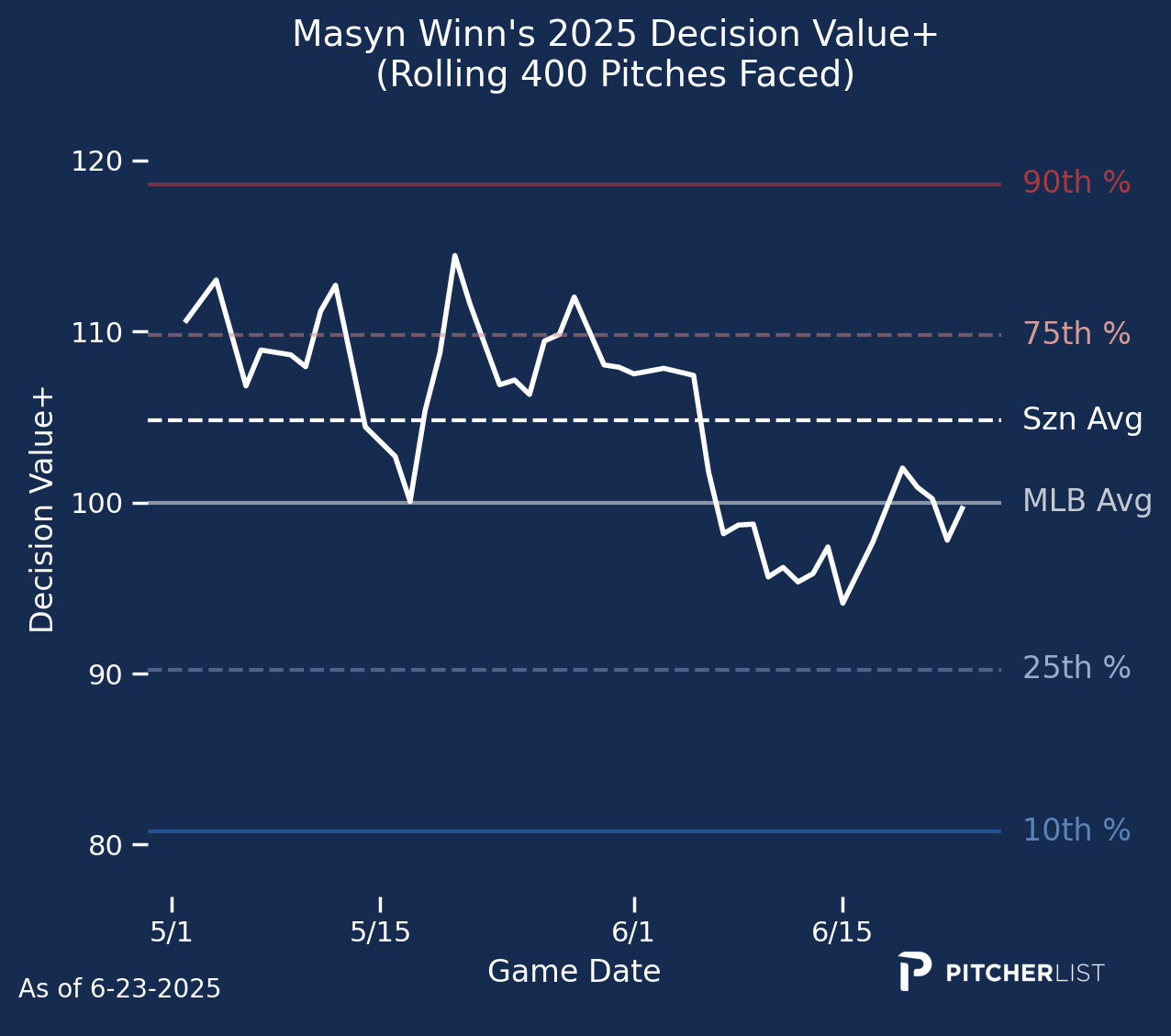
In the early going, it looked like Winn was really making a big leap in his Decision Value, but those gains have started to peter out over the last three weeks. Still, his overall Decision Value has improved by seven points, and he has plenty of season left to recapture swing choices that fell in the 75th percentile of batters through the season’s first two months.
Wilyer Abreu – 2024: 95 | 2025: 108
I covered Abreu’s swing decisions much more in-depth back in mid-May. His breakout season has cooled off significantly since then, and his swing decisions are a huge reason why.
The drop off has not just been steep, but consistent. There’s hardly any leveling out of his graph at all.
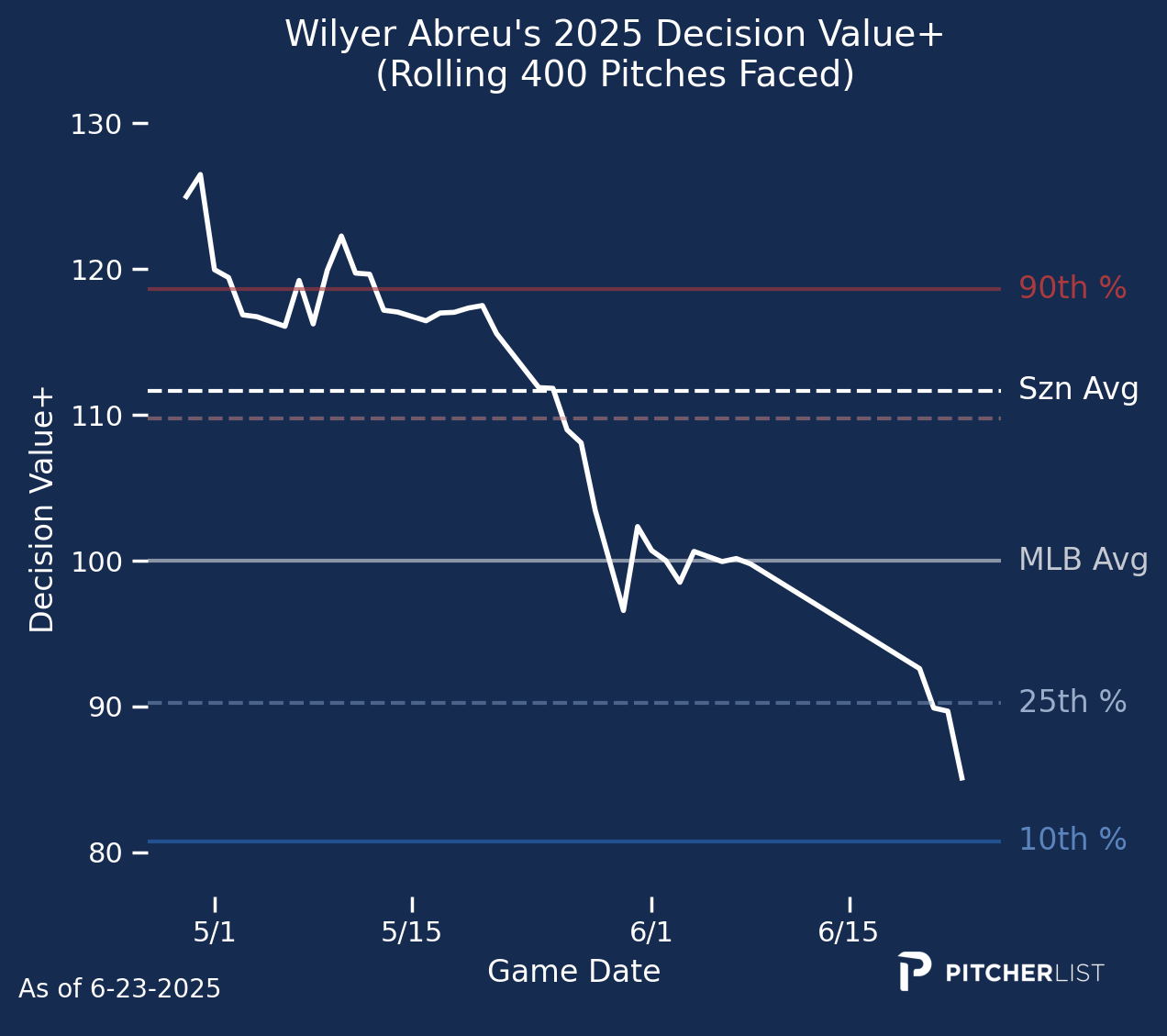
You’re not going to see many players with this level of change in their Decision Value. Abreu’s gone from one of the best hitters in the statistic to nearly in the bottom 10th percentile of performers.
Despite the steep Decision Value drop off, Abreu’s overall season total of 108 is a marked improvement from last year’s 95, so this should still be an overall encouraging sign for Boston’s right fielder. As Abreu’s Decision Value has declined, so has his production at the plate. His monthly wRC+ has gone from 161 in March/April to 83 in May and now 39 in June. I’m excited to watch Abreu the rest of the way, because if he starts making better choices again, he may enjoy another big hot streak like he did in the early going.
Wyatt Langford – 2024: 108 | 2025: 101
Langford’s clearly making some adjustments in his second season, and given his prowess at the plate, it seems like the decrease in Decision Value may be a conscious choice. The 23-year-old left fielder has upped his aggression at the plate, and although it has increased his chase rate, it’s also resulted in some better contact results. Each of Langford’s barrel rate, hard-hit rate, and fly ball exit velocity is up. Those improved metrics haven’t done much to Langford’s rate statistics – both his wOBA and wRC+ are actually down this year.
Langford’s mixed bag profile is tricky to read into, but my takeaway is that this is an elite talent who’s still making adjustments and finding his groove at the game’s highest level. Not many players enter the league with Langford’s prospect pedigree, so I’m still a believer that he turns into a difference-making bat long term, even if his Decision Value has slipped a bit in his sophomore season.
Andy Pages – 2024: 106 | 2025: 95
Pages has had the biggest second-year breakout of any 2024 rookie. He went from a .248/.305/.407 slash line and a 100 wRC+ to .297/.333/.514 and a 135 wRC+, but it’s not due to swinging at better pitches to hit. His Decision Value has actually fallen 11 points in 2025.
The Dodgers’ newest fiercesome bat has done an excellent job choosing which pitches to attack inside the strike zone. Here’s a look at his rolling zDV graph.
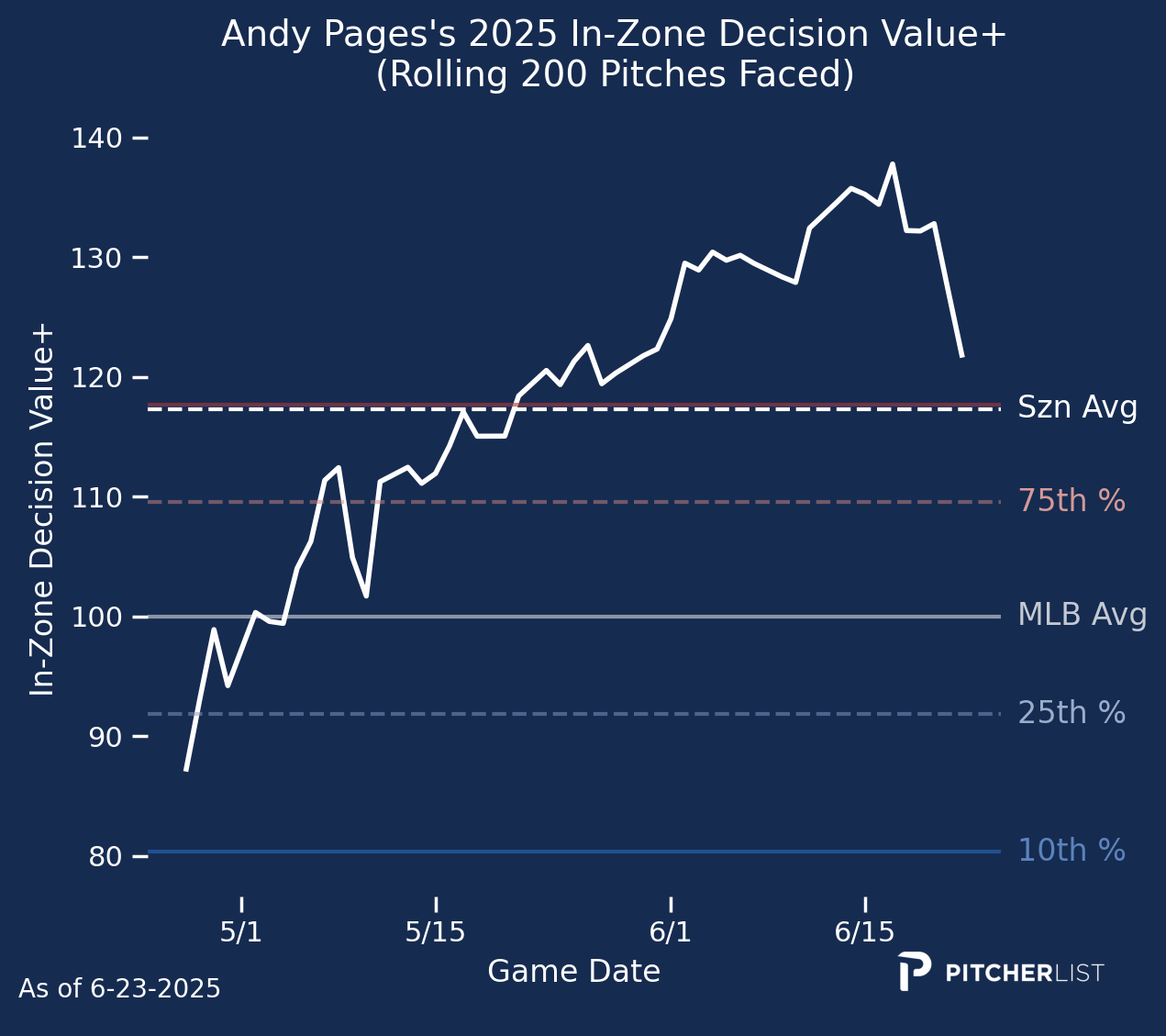
Pages has absolutely obliterated pitches left in the zone this year. His Statcast Run Value on pitches left over the heart of the plate is 10, coincidentally, that’s the 10th best mark in baseball and a huge increase from the 0 he posted in 2024.
For as good as Pages has been at punishing pitches left in the middle of the zone, he’s done an almost equally bad job at swinging at too many pitches out of the zone. His oDV is 91, fueled largely by an 11th percentile chase rate.
James Wood – 2024: 100 | 2025: 100
In his second year, Wood’s swing decisions have stayed exactly league average, but his production at the plate has been anything but. The 22-year-old is already looking like a superstar with his .277/.373/.554 slash line that accompanies 22 home runs and nine stolen bases. His 3.3 fWAR is the 11th highest among qualified position players.
Digging a little deeper, Wood has an odd Decision Value profile. He’s been miserable at picking which strikes to swing at – his 65 zDV is the 7th lowest in baseball. This appears partly due to his passivity at the plate. His 38.7% swing rate is 3rd percentile, so naturally his 20.2% called strike rate is among the highest 11 percent of batters. Wood lets a lot of hittable pitches go by, and Decision Value is punishing him for that.
On the flip side, Wood has been good on pitches outside of the zone with a 112 oDV. He doesn’t chase often, and that’s let him get to a 13.2% walk rate, the 19th best mark in the bigs. That’s a large part as to why his .373 OBP is nearly 100 points above his .277 batting average.
Jackson Holliday – 2024: 102 | 2025: 106
Holliday’s one of the youngest players in their second season, so it’s great to see the 21-year-old second baseman have an improving Decision Value, especially just 511 plate appearances into his MLB career. Unlike most lefty hitters, Holliday doesn’t have much of a platoon disadvantage. He hits both lefties and righties almost equally well, and it’s earned him the leadoff job in Baltimore.
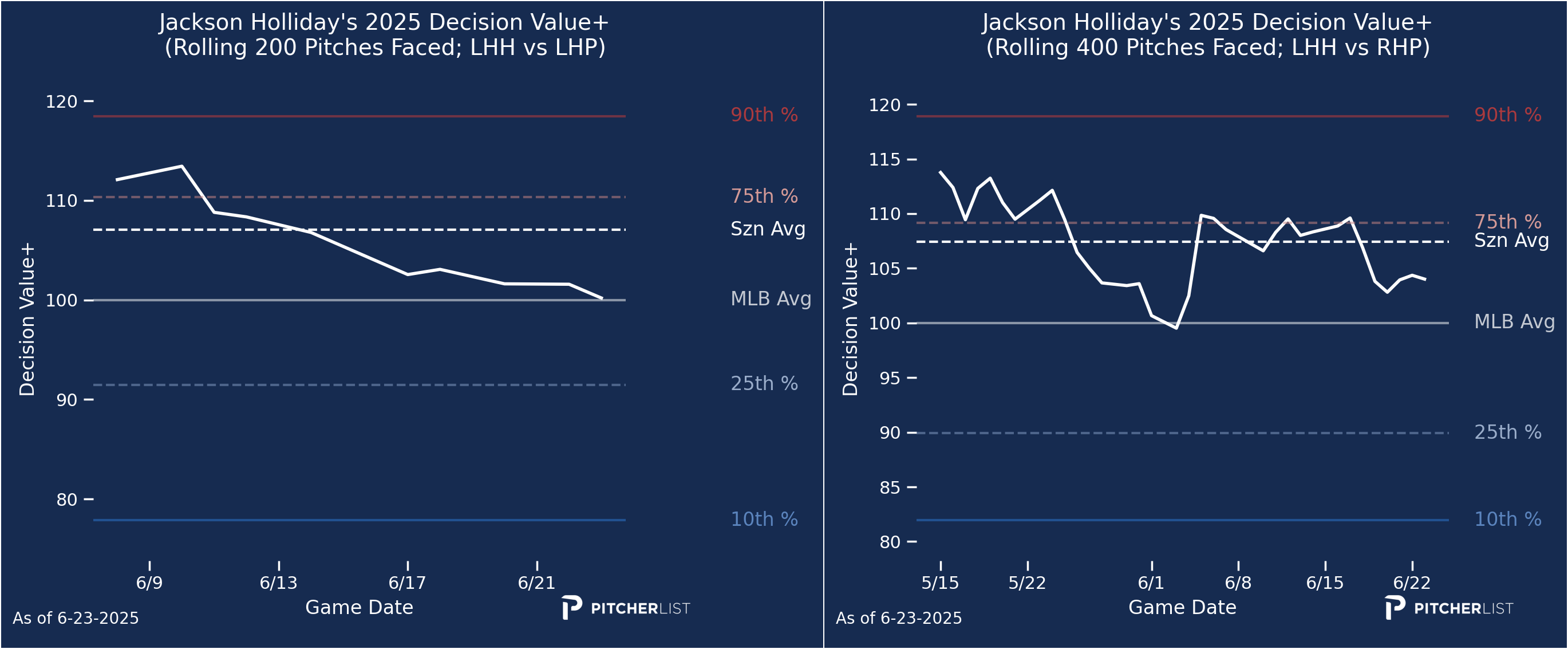
Decisions on pitches inside the strike zone have been Holliday’s strong point – he has a 115 zDV compared to an exactly average 100 oDV. He’s not just swinging at better pitches; he’s doing it more often. Holliday has jumped his Zone Swing% from 65.6% to 72.3% and importantly, his contact rate has followed. His overall contact rate is up eight percentage points, and his zone contact rate is up almost five.
Those swing and contact improvements have fueled a surge in production for the former top prospect. Holliday has cut his strikeout rate nearly 10 full percentage points, and it’s led to an improvement in overall production from 63 wRC+ as a rookie to a 106 wRC+ as a sophomore.
Adapted by Kurt Wasemiller (@kurt_player02 on Instagram & Threads, @kuwasemiller.bksy.social on BlueSky)
