





It’s tough being a rookie. Analysts across the industry have been saying for years that the gap between the quality of pitching that hitters see in the big leagues versus the minor leagues has never been wider, so it’s not surprising at all if we see young hitters come up and struggle in their first taste of MLB action.
Whether the results are good or bad, one way we can learn about how a rookie is adapting to seeing the game’s best arms every day is with one of our very own metrics, PLV Decision Value. In brief, Decision Value is a plate discipline statistic that shows more than a hitter’s ability to judge balls and strikes, but to recognize the pitches he can turn into favorable contact and then make the appropriate swing decision. Decision Value is graded on a scale where 100 is the league average, and every 15 points above or below 100 is one standard deviation.
For a more in-depth description of Decision Value, check out the initial piece in this series. You can support Pitcher List and get access to all of our PLV statistics by joining PL Pro.
Let’s take a quick look at how some of the league’s notable rookies are faring early in their big league careers.
Jacob Wilson, Athletics — 99 Decision Value
Wilson has taken the league by storm. He sits alone at the top of the rookie fWAR leaderboard with his 2.8 fWAR, which is almost a full win higher than his nearest peer. That’ll happen when you slash .355/.393/.504 through 245 plate appearances. With Wilson’s high batting average, it’s somewhat surprising to see him have just a league-average Decision Value so far, but he owes a lot of his success to his elite contact ability. His 129 PLV Contact is the 10th highest in baseball.
The 99 Decision Value is so close to league average that it somewhat hides a more complex Decision Value profile. Wilson’s been very good at identifying which strikes he should attack — he has a 118 zDV — but has struggled much more on pitches outside of the zone. Wilson’s 92 oDV is worse than you may expect to see from a hitter with his skill set, but it’s backed up by his 34% chase rate, which falls in just the 15th percentile.
Carlos Narváez, Boston Red Sox — 106 Decision Value
Perhaps the biggest rookie surprise so far this season has been Narváez. He’s not just hit the ground running, he’s been so good that he’s taken the starting catcher job in Boston away from Connor Wong, and for good reason. Narváez is slashing .288/.356/.456, good for a 126 wRC+, the 4th best mark among his fellow rookies.
Narváez came up in the Yankees system with little prospect pedigree before the Red Sox acquired him in a rare trade between the two arch rivals over the winter. At the time, the move seemed minor, but Narváez’s production has made it anything but. The 26-year-old backstop has recently been hitting cleanup for the injury-riddled Sawx, and we’ve seen his swing decisions improve as the season has progressed.
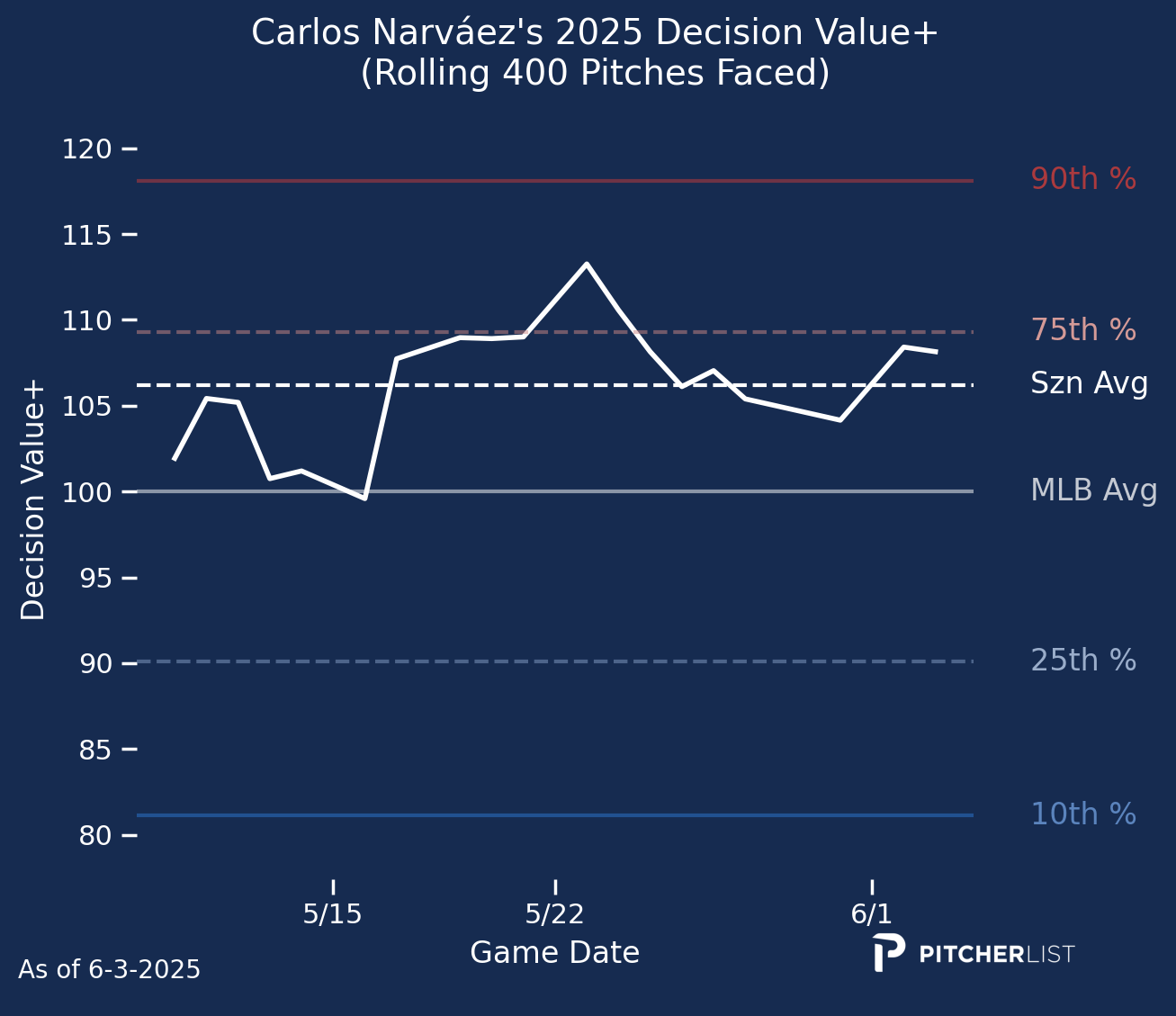
Breaking things down a bit further, Narváez has been very good against breaking balls. He has a 111 Decision Value against breakers which I expect would be the toughest pitch types for rookies to acclimate to in the show. If we move even further into pitch classification, Savant gives Narváez a 3 Run Value against curveballs thanks to a remarkable .567 wOBA and 15.4% whiff rate against them. Getting this far into pitch types causes the sample to be so small that it’s hard to put too much stock into that level of production continuing, but it’s certainly something to keep an eye on with Narváez moving forward.
Drake Baldwin, Atlanta Braves – 101 Decision Value
From one rookie starting catcher to another. Baldwin has taken Sean Murphy’s strong hold on the Braves’ backstop role and turned it into a timeshare with the two practically trading off starts every other day. Baldwin’s hitting .318/.364/.518 with six home runs through 118 plate appearances.
Baldwin’s overall 101 Decision Value isn’t very notable, but his swing choices inside the strike zone are a sign that he’s seeing the ball really well — his 113 zDV is almost a whole standard deviation above average. Without a full-time role, Baldwin won’t qualify for any leaderboards, but don’t let that overshadow his excellent results.
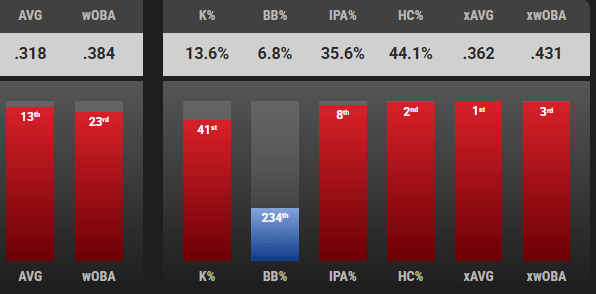
Aside from the below-average walk rate, Baldwin ranks in the upper echelons of big league hitters in most rate statistics, and his strong ability to identify which strikes he should swing at has to be a big reason why those bars are so beautifully red.
Cam Smith, Houston Astros — 106 Decision Value
Smith’s rapid ascent to the major leagues, in addition to being the centerpiece in the Kyle Tucker trade, made him one of the most notable rookie debuts earlier this year. While there have been flashes of promise from the 22-year-old right fielder, his actual production has left a lot to be desired. Smith is hitting .250/.335/.372 through his first 176 career plate appearances.
One of the encouraging things we’ve seen from the Astros’ rookie is his 106 Decision Value. It’s nothing to write home about, but amidst a high-profile debut and learning a new position (he came up as a third baseman but has taken well to right field), it’s certainly a major positive that he’s keeping his head above water when it comes to swing decisions.
Digging deeper into Smith’s swing profile shows that he’s making great choices on pitches outside of the zone (115 oDV), but is struggling mightily to identify which strikes he should attack (79 zDV). Smith hasn’t been very aggressive yet against big league pitching, which is hurting him quite a bit. His 25th percentile zone rate is accompanied by an 84th percentile strike rate, which means he’s seeing way more called strikes than the average hitter (18.5% CS%). That’s a recipe for falling behind in counts and seeing fewer good pitches to attack.
Baseball is a game of constant adjustments, and it seems like a good one for Smith would be upping his aggression in the box. With Yordan Alvarez, Zach Dezenzo, and Chas McCormick all on the IL, Smith’s starting job looks pretty secure, but when that trio gets healthy, if Smith hasn’t improved, a demotion to work things out at Triple-A may be on the docket.
Liam Hicks, Miami Marlins — 136 Decision Value
I certainly didn’t go into writing this article thinking Hicks would deserve a write up, but his 136 Decision Value is the highest of any rookie and the fourth best in baseball. If you’re not familiar with Hicks, he’s a 26-year-old catcher who was selected in the ninth round by the Rangers in the 2021 draft. He was traded to the Tigers last summer and is finally getting his shot in the bigs after the Marlins selected him in December’s Rule 5 draft. Hicks is making the most of his opportunity, slashing .283/.357/.485 with four home runs.
Despite the strong results at the plate, Hicks is only seeing about three starts each week since Agustín Ramírez and Nick Fortes are splitting most of the time behind the plate, although you’d think Miami would be pretty interested in giving Hicks more of a run at consistent playing time with Fortes scuffling.
Hicks has been equally good at making swing decision on pitches in and out of the strike zone, and that shows up in his traditional plate discipline metrics. His 13.3% K% and 6.7% SwStr% are both 89th percentile or better. His 8.9% walk rate is less impressive, but still a few points above league average. If he ever gets more run in the starting nine, Hicks could become a sneaky good add in deep fantasy formats.
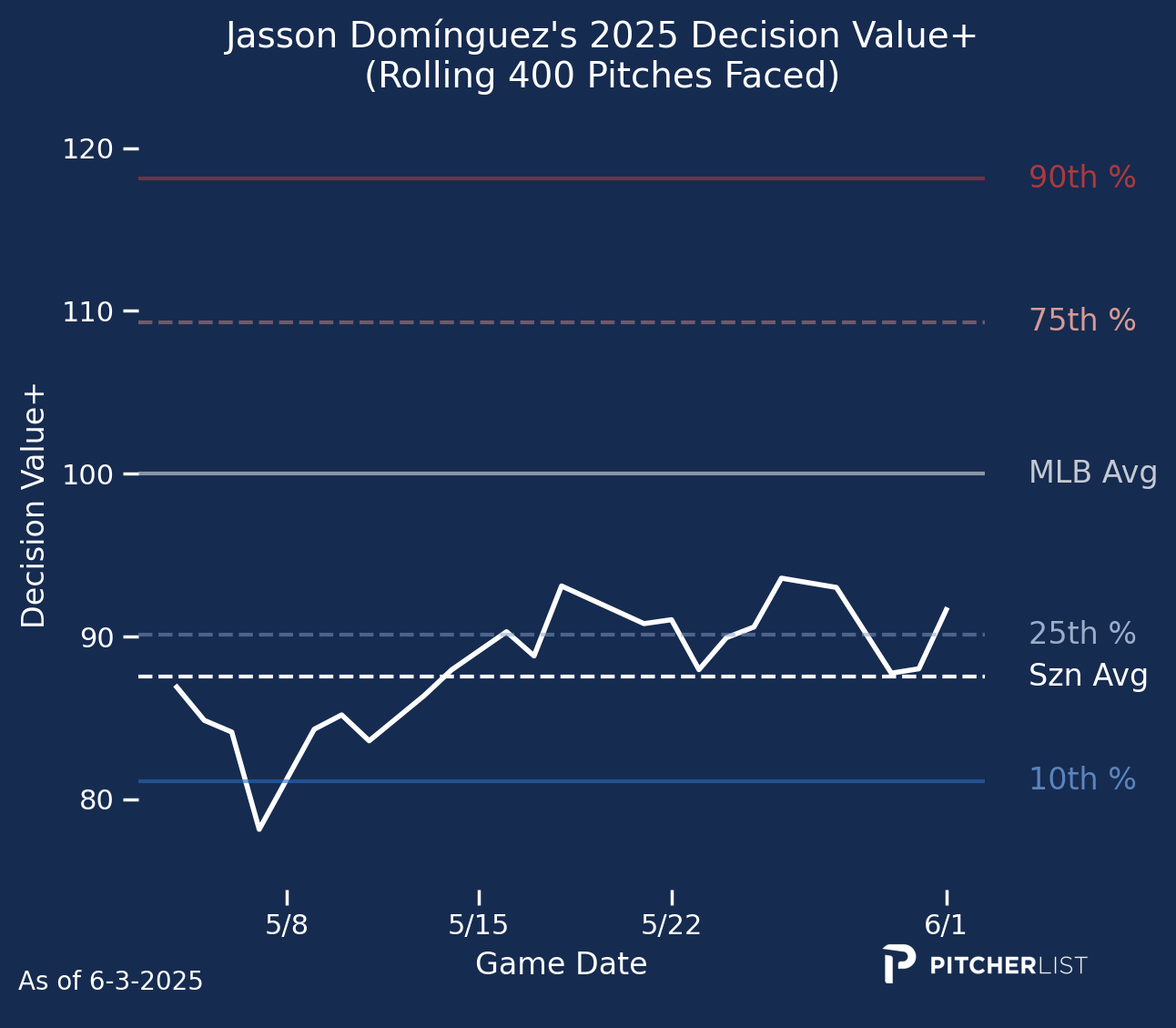
Jasson Domínguez, New York Yankees — 92 Decision Value
The Martian may be making underwhelming swing decisions so far, but his overall production has been well above average. Domínguez is slashing .247/.346/.420 with six home runs and eight steals. That line comes out to a 119 wRC+, good for the seventh-best mark among rookie-eligible players.
Domínguez’s poor swing decisions have extended beyond our PLV metrics into actual results on the field. Each of his Chase%, Whiff%, and K% is all 27th percentile or below. The good news for Domínguez is that when he’s making contact with the ball, he’s doing damage. He has a 76th percentile bat speed that’s allowed him to get to a 50.9% hard-hit rate.
As Domínguez becomes more comfortable facing the game’s top pitchers, he should start making better swing decisions. You can already see an upward trajectory in his season-long Decision Value rolling chart.
One final note on Domínguez: PLV’s Pitch Runs statistic estimates that he’s faced the second-easiest set of pitches to hit among all hitters in the big leagues. It’ll be worth watching how that stat changes over the coming months and whether or not Domínguez can keep his production up if he sees more difficult offerings.
Luisangel Acuña, New York Mets – 79 Decision Value
Acuña checks in with one of the lowest Decision Values of any rookie, and it’s not particularly surprising looking at the numbers he’s putting up so far. The younger Acuña brother is slashing just .246/.298/.292 so far. That’s a very rare case of OBP being higher than SLG, especially this far into the season. Acuña still has a goose egg in the homer column, and his poor swing decisions aren’t helping his case.
A scalding-hot 14-game cup of coffee late last year drew a lot of attention to Acuña and likely unfairly raised expectations for the 23-year-old second baseman. Acuña’s playing time has cratered since Jeff McNeil’s return from the IL, so it wouldn’t be surprising to see him sent down to get more consistent at-bats with the Triple-A squad.
Matt Shaw, Chicago Cubs – 93 Decision Value
Another rookie that entered the season with sky-high expectations, Shaw struggled enough that he was demoted for just over a month, but he’s been a much better hitter since returning to the big-league club. Shaw slashed a dismal .172/.294/.241 through April 14th, but has turned things around with a line of .319/.373/.447 since his promotion on May 19th. While the results at the plate have been much improved, Shaw’s turnaround seems more due to a change with his leg kick than it does his making better choices in the batter’s box. He had a 94 Decision Value before his demotion, compared to a 91 since being recalled.
There’s still ample room for Shaw to improve his Decision Value, but as is, he’s making it work. Shaw’s 22.7% strikeout rate is just a hair below average while his 11.8% walk rate would rank around 80th percentile if he had enough plate appearances to qualify for leaderboards.
Nick Kurtz, Athletics – 120 Decision Value
I went more in-depth with Kurtz in my buy-low article a few weeks ago, so I’ll keep things brief here. Kurtz has been making great swing decisions since making his big league debut in late April. Although his actual production at the plate took a while to come around, he was up to a .245/.315/.447 slash line prior to being placed on the IL with a strained left hip flexor.
You never want to see a player hit the IL, but the good news is that the injury seems relatively minor, and it likely extended the buy-low opportunity on Kurtz a little while longer. If you need first base or corner infield help, now’s the time to make an offer on Kurtz. He has legitimate star upside, especially playing half his games in the hitter-paradise that is Sacramento.
Kristian Campbell, Boston Red Sox – 104 Decision Value
Not much has gone right for Campbell to start his MLB career. The 22-year-old second baseman is hitting just .222/.314/.343 through his first 226 plate appearances, but there’s a small silver lining.
While Campbell hasn’t been able to get to much power (.122 ISO), his 104 Decision Value is above average, and he’s been especially good at making decisions on pitches outside of the strike zone (111 oDV). As he gets more big league experience, his in-zone decisions should get better — his current 78 zDV is 28th worst in the sport — and that should help him start to drive pitches much more effectively.
Adapted by Kurt Wasemiller (@kurt_player02 on Instagram & Threads, @kuwasemiller.bksy.social on BlueSky)
