





Since the beginning of the 2020 season, Corbin Burnes has been one of the best pitchers in Major League Baseball. Since replacing his four-seam fastball with a cutter, one of the prominent early examples of pitch design being used effectively to elevate a pitcher’s level of performance, Burnes won the NL Cy Young Award in 2021 and has been an innings workhorse, with at least 180 innings pitched in each of the past three seasons. After spending the 2024 season in Baltimore, Burnes signed a 6-year, $210M contract (opt-out after 2026) with the Arizona Diamondbacks, and was anticipated to headline a solid rotation alongside Zac Gallen and Brandon Pfaadt. While Burnes and the Diamondbacks entered the season with high expectations, Burnes has struggled to begin the 2025 season, with his strikeout rate continuing to decline (35.6% in 2021, 22.6% so far this season) and his K-BB% (11.1%) at a career-low. This article will attempt to identify the factors that have contributed to Burnes’ consistent decline in strikeout rate and seek to identify how Burnes can improve his level of production over the remainder of the season.
Overview
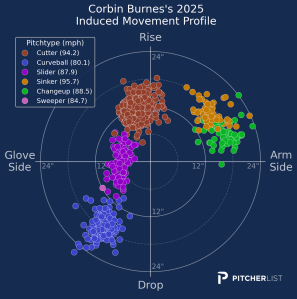
Burnes’ pitch arsenal consists primarily of five pitches: a cutter, a slider, a sweeper, a curveball, and a changeup. Burnes scraps the changeup when facing right-handed hitters while dropping the slider and sinker against hitters of the opposite handedness, resulting in a cutter-curveball-changeup mix against left-handed hitters. This mix leaves Burnes with a platoon-neutral arsenal against hitters of both handedness, as changeups perform better against opposite-handed hitters due to their “fading” nature, and sinkers perform better against same-handedness hitters as the pitch’s movement can induce sub-optimal contact. As mentioned in the introduction, Burnes’ fastball transformation from a four-seamer to a cutter was one of the notable early examples of pitch design being used to improve a pitcher’s performance, with Burnes leaning into his supination bias (natural tendency to cut a fastball) to create one of the best pitches in Major League Baseball. Five years after its introduction, the cutter is still the best-performing pitch in Burnes’ arsenal.
The addition of the cutter to his arsenal led to Burnes having a dominant 2021 season, resulting in him winning the National League Cy Young Award that season. Over 167.0 innings pitched, Burnes produced a 35.6% strikeout rate, 5.2% walk rate, 2.61 SIERA, and 7.5 fWAR during his outstanding 2021 season. Over the past handful of seasons, however, Burnes’ strikeout has steadily declined, with Burnes producing a 23.1% strikeout rate in 2024 and a 22.6% strikeout rate so far this season. This consistent decline in strikeout rate caused some concern among analysts heading into his free agency, and these concerns have proven to be largely correct with Burnes K-BB% and SIERA ranking as the highest in his career. Let’s take a deeper look at Burnes’ arsenal to attempt to identify the factors behind Burnes’s slow start to the 2025 season.
Pitch Quality
One contributing factor to Burnes’ decline in strikeout rate so far this season has been a slight decline in the quality of his “stuff”. Burnes’ cutter, the best pitch in his arsenal, has experienced fluctuations in its average velocity over the past three seasons, while his slider has lost a few ticks of “stuff” according to pitch quality models, resulting in opposing hitters making more contact against the offering.
The table above contains the “stuff” grades that are assigned to the pitches in Burnes’ arsenal according to four notable pitch models (FanGraphs’s Stuff+, PLV, my aStuff+ model, and StuffBot). Each model agrees that Burnes has experienced a decline in the quality of his cutter, with FanGraphs assigning the pitch a below-average grade of 98. Given the pitch’s consistent movement profile, it is likely that this decline in pitch quality can be attributed to the pitch’s fluctuating average velocity, with the pitch averaging 94.4 MPH in 2023, 95.3 MPH in 2024, and 94.2 MPH in 2025.
It is difficult on the public side to pin down a specific reason as to why Burnes has experienced these velocity fluctuations over the past three seasons. While some variance in velocity is expected year-to-year, a 1 MPH change in consecutive seasons is quite notable, and seems to indicate that there has to be a particular reason as to why this phenomenon is occurring. Could fatigue be a factor? Is Burnes simply pacing himself early in the season to preserve velocity for later in the year? Is this the aging curve in action? There are a lot of potential factors that could explain the decline in velocity, and it has likely been a contributing factor as to why the cutter is currently producing its worst RV/100 since its introduction to Burnes’ arsenal. Attempting to increase the velocity of the cutter closer to 95 MPH would likely be an effective means to improve the results of the offering moving forward.

Perhaps more notable than the fluctuating cutter velocity, the pitch quality of Burnes’ slider has declined from last season, with all pitch quality models reporting a notable decline in the offering’s “stuff” grade. While the pitch still grades as above-average according to “stuff” models, the slider graded as 133 FGStuff+, 72 StuffBot, and 113 aStuff+ in 2024, compared to 114 FGStuff+, 55 StuffBot, and 107 aStuff+ so far this season. Initially, I was surprised to see the pitch quality models report such a notable regression in the quality of the pitch, given that the pitch’s average velocity has been stable year-over-year, however, as shown by the movement plots above, there has been a change in the shape of the offering. In 2024, the slider averaged 1.1 inches of drop and 8.3 inches of glove-side movement, while in 2025, the pitch averaged 1.4 inches of ride and 6.2 inches of glove-side movement. While this might seem to be a minor change at first glance, it has led to a large swing in his slider’s performance.
As shown by the table above, Burnes’ whiff rate on the slider has decreased from 46.0% in 2024 to 22.0% in 2025. Granted, Burnes has only thrown 75 sliders so far this season (a relatively small sample size), however, the combination of reduced whiff rate and lower stuff grades raises concerns that this pitch has regressed compared to last season. Should this regression in slider quality continue, this would leave Burnes with his curveball as his primary swing-and-miss offering to right-handed hitters. Granted, the curveball has been performing well this season compared to 2024 (36.4% whiff rate, .216 xwOBA, on 18.5% usage this season) and perhaps Burnes should consider increasing the usage of this offering, however, it will then be easier for hitters to anticipate which breaking ball Burnes will utilize in a count state where he needs a swing and miss. Altogether, Burnes’ fluctuating average velocity on his cutter along with the decline in stuff quality on his slider has led to a reduced strikeout rate so far this season, leading to a lower level of overall production.
Predictability
Another contributing factor to Burnes’ decline in overall production so far this season has been his predictability when he is behind in the count. “Throw your best pitch most often” has been one of the most commonly used phrases in the modern pitch design era, which makes intuitive sense as the pitcher should frequently utilize the pitches that return the best results. There is a balance to be struck, however, between throwing your best pitch most often and being “unpredictable” as a pitcher, and while Burnes’ cutter should be thrown at a high usage rate, it is perhaps being utilized too frequently in count states where Burnes is behind (2-0, 2-1, 3-0, 3-1).
As shown by the table above, Burnes throws his cutter a lot when he is behind in the count. Against left-handed hitters, Burnes utilizes the offering 75.5% of the time, while against right-handed hitters, Burnes utilizes the cutter 79.4% of the time. Opposing hitters still swing-and-miss at the offering in these count states (~23% whiff rate for each handedness), however, left-handed hitters are currently producing a .655 xwOBAcon against the cutter in these counts. It seems likely that opposing hitters are “sitting” on this pitch during these counts, allowing them to produce higher-quality contact against an offering that they are likely “hedging their bets” on.
As mentioned earlier, there is a balance to be struck between throwing your best pitch most often and being unpredictable in your pitch selection as a Major League pitcher. Burnes should be throwing his cutter most frequently when he’s behind in the count and he has done so in the past, with a 60.9% usage rate against right-handed hitters and a 72.8% usage rate against left-handed hitters in these count states in 2024. It appears that Burnes is relying too heavily on the offering when he’s behind in counts this season, and perhaps mixing in more sinkers against right-handed hitters and curveballs against left-handed hitters will keep opposing hitters “on their toes” and make Burnes less predictable in these count states.
It also can’t be ruled out that Burnes is intentionally relying on his cutter heavily in these count states to throw off the opposing team’s scouting reports against him later in the season. Burnes is a bit of a tinkerer with his pitch arsenal, and over the past two seasons, he has added a sweeper to his arsenal late in the season, around August. This offering typically ranks among the best sweepers in Major League Baseball, with the pitch generating a whiff rate of greater than 45% in each of the past two seasons, raising questions about why Burnes doesn’t utilize the pitch throughout the entirety of the season. I hypothesize that Burnes makes this late-season adjustment to throw off scouting reports, resulting in opposing hitters being unaware of what count states Burnes will be utilizing the offering, since there is no prior information on the pitch available to inform their decision-making. Could Burnes be attempting a similar strategy with the heavy usage of his cutter when he’s behind the count? Possibly. Perhaps Burnes will begin using his slider more often in these counts to generate swing-and-miss, or (admittedly, less likely) maybe he will reintroduce his lost four-seamer to surprise opposing hitters. Identifying the changes in Burnes’ usage patterns when he’s behind in the count will be something that I and presumably many teams will be keeping an eye on, as the improvement of his performance in these count states will go a long way in determining his overall level of production this season.
Concluding Thoughts
While the consistent decline in strikeout rate over the past few seasons is a concerning trend in Burnes’ profile, I am more optimistic than pessimistic regarding his outlook over the remainder of the season. First off, Burnes is the modern-day definition of a “workhorse”, posting at least 180 innings pitched in each of the past three seasons. The quantity of innings that Burnes can provide to the Diamondbacks rotation this season is inherently valuable on its own, even if Burnes’ current level of production stays consistent throughout the remainder of the season. Second, as mentioned in the previous section, Burnes has a track record of tinkering with his arsenal, and I am confident that will make the necessary changes to his pitch arsenal to stave off further regression in the future. I expect the sweeper to be re-introduced to his arsenal later this summer, and I would not be surprised if he can reclaim the prior shape on his slider with some in-season adjustments.
Burnes may no longer be the overwhelming strikeout machine he was during his peak season of 2021, but it would be unwise to bet against a pitcher with his track record of adaptability. The early-season struggles have exposed some real issues, with a continued regression in strikeout rate and some predictability in sequencing, however, Burnes has shown throughout his career that he’s capable of evolving. With a couple of adjustments to the shape of his slider and his pitch usage when behind in counts, Burnes could experience a second-half resurgence and be a major piece of the Diamondbacks’s postseason push.
Statistics as of the end of play on May 20th, 2025.
Photo courtesy of Icon Sportswire | Adapted by Aaron Polcare (@abeardoesart on Bluesky and X)
