





Over the last 30 days, Bryce Eldridge has been the sixth-best hitter in all of baseball. His 201 wRC+ in that time is more than twice as good as the average hitter.
For a player who struggled mightily in his first shot in the big leagues last year, this feels like the coming-out party for the consensus top 15 prospect. The stats across his full 2026 so far are as good as it gets.
Everything looks to be in line with his expectations for “what could he be” as a prospect: a good amount of power and exceptional batted ball quality. However, the 21% strikeout rate stands out significantly, in a way that no one expected nearly 150 plate appearances into his season.
Eldridge has a career 27% strikeout rate in the minor leagues and ran a 35% strikeout rate in his first stint with the Giants last year. Turning around and posting a strikeout rate this strong is quite a rare occurrence. Given his 6’7″ frame and long levers, his approach naturally lends itself to high whiff rates and big power. Additionally, moving up from Triple-A to MLB usually results in higher strikeout rates, and Eldridge has found a way to reduce it over a substantial sample.
Among all hitters 6’5″ and taller, their average strikeout rate since 2015 is 25%, above the league-average 22% strikeout rate in that same timeframe. Mix that with his minor league numbers, and it’s easy to bucket Eldridge into a specific archetype. Is his start to 2026 actually him breaking that mold? Or is this going to regress with a harsh “Welcome to the big leagues” adjustment?
Getting to the Contact
Eldridge is setting himself up for success with strong swing decisions. He’s always been able to get on base with strong walk rates, as pitchers generally like to stay out of the zone with him.
He sees around 42% of pitches in the strike zone, which is in the 8th percentile. Despite so many pitches out of the zone, Eldridge isn’t an overly aggressive hitter.
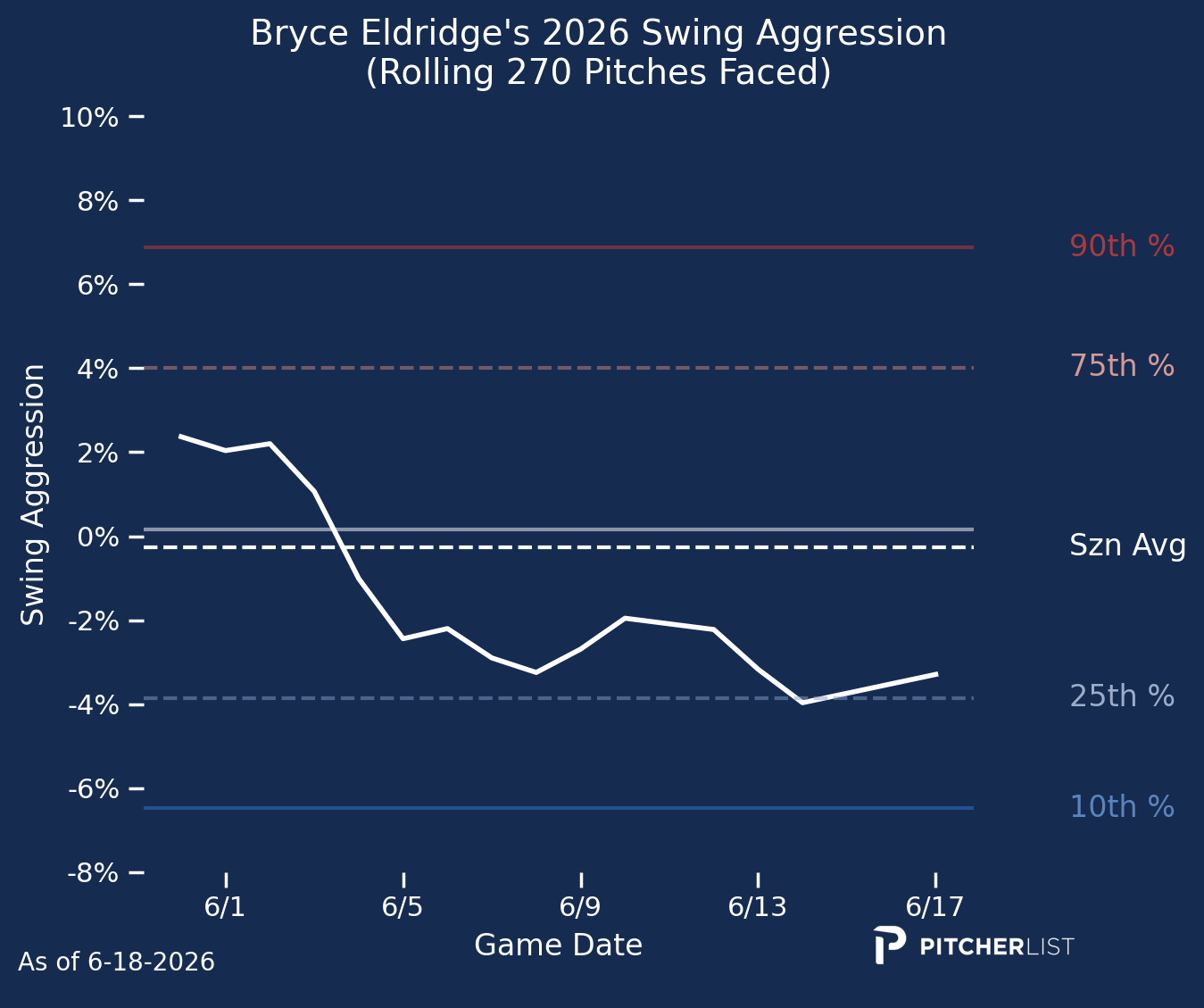
His chase rate coming into this year was slightly above average at the minor league level, but he docked an additional point off of it to make it a 70th percentile mark. His good eye for the zone and his ability to make sure he can’t be taken advantage of because of his huge frame are essential to his success.
The good swing decisions extend into the most critical part of his at-bats: two strikes. Eldridge’s chase rate is even better in two-strike situations — his 21% 2-str chase rate is in the 84th percentile. As a fastball hitter (which we’ll get to), he’s seeing a lot of secondaries in these situations, and avoiding bad swings on them is helping keep his strikeout rate down. Across the board, his decision value looks exceptional.
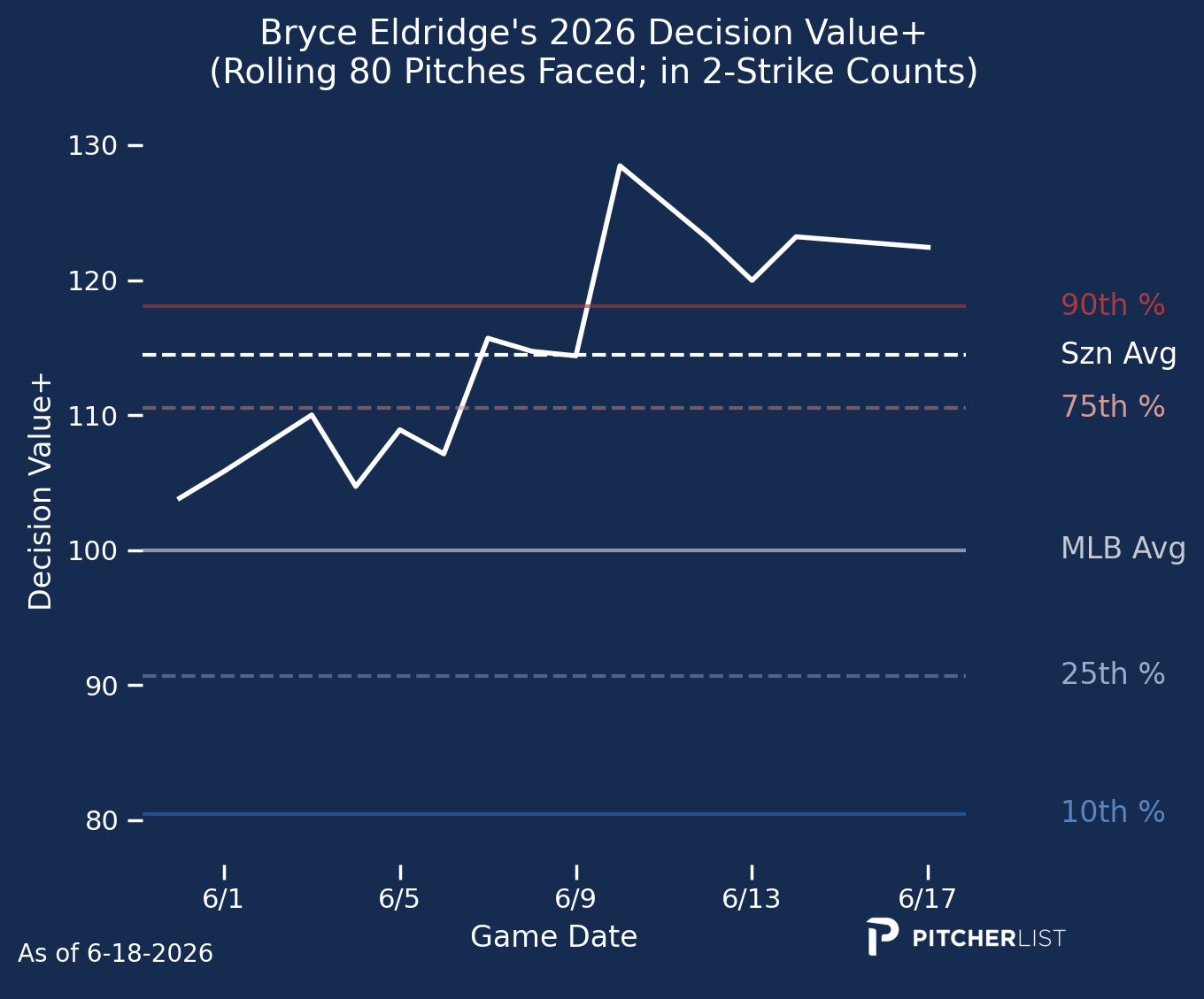
The decisions have taken a slight step forward across the board, which looks sustainable. As a 21-year-old, this is only going to improve. Having a solid base with minimal professional experience is a sign of good things to come.
All Sorts of Contact Gains
The biggest part of Eldridge’s improvements comes from more contact. After posting a 76% Z-Con% in his brief 2025 cup of coffee — a number that was a flashing warning sign — he’s jumped to 88% this year, clearing the MLB average of 85%. Not only is this overcoming a small sample, but it’s going above where his minor league numbers sat.
It looks like a complete aberration, but enough of a sample has passed that it is starting to look legitimate. Last year, in AAA, his zone contact% against fastballs was 90%. In his time at AAA this year, it was 83%.
It may be something that varies over time, but he’s already showing how it can be in a healthy place in his first real chance in the big leagues. The legitimacy appears in the pitch plot, where there’s only a small hole in the zone.
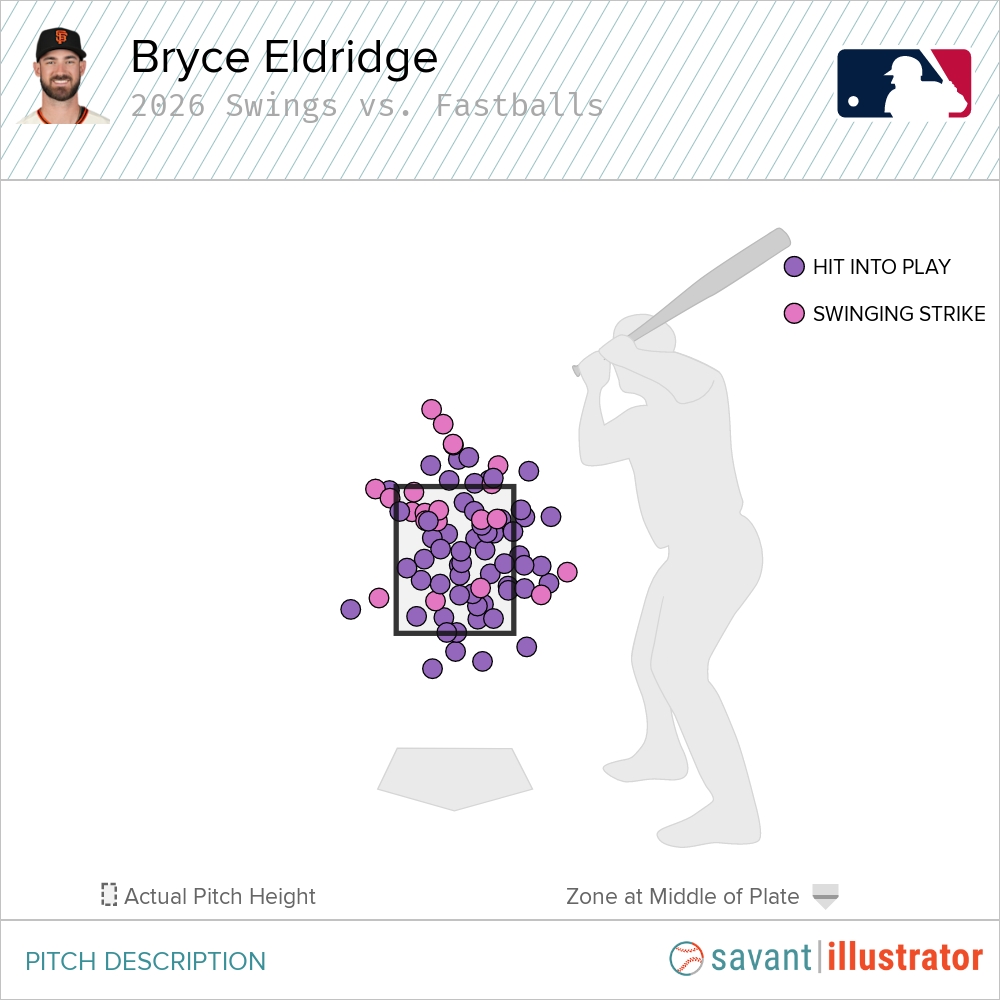
He’s mostly covered the top of the zone, except for up-and-away. However, it’s mostly cutters that have caused him issues there. Almost half of all of his in-zone whiffs have come against cutters, all in that location. These aren’t pitches that are finishing him off, but instead, he’s putting fastball swings on pitches that are moving a bit too much. Only one of these cutters is in a two-strike count as well.
While this strong contact in the zone is driving Eldridge’s run value, the strikeout rate story is based on his out-of-zone contact. He’s currently running a 64% O-Contact%, an above-average league figure and around 20% more than his career minor league totals.
I believe this will come back down, but, for now, he’s capitalizing in two places: offspeed pitches down and fastballs up. He currently has a 50% contact rate on offspeed pitches out of the zone, compared to a 53% league average. None of these have been pretty, but making contact is doing him more good than bad. Against fastballs, Eldridge’s out-of-zone contact is an incredible 78%. This figure ranks 35th out of 222 hitters who have seen as many pitches as he has. While it’s a lot of foul balls up, he’s happy to do damage out of the zone in a variety of places.
Being able to hit a pitch like this out of the park on a swing like that is absurd. Only four players have hit a ball harder than Eldridge and have a better O-Contact% on fastballs than him: Ketel Marte, Yandy Díaz, Vladimir Guerrero Jr.., and Bo Bichette. Not bad company.
These out-of-zone numbers can come down as pitchers throw him fewer fastballs, but he’s clued into just about any high velocity pitch and is ready for anything.
The Power Is Always There
Eldridge’s power is his calling card, and it’s performing as expected with gains across the rest of the profile. His six home runs are a strong start, but it’s the consistency of batted ball quality that is exciting right now.
He’s only making poor contact 55% of the time, an 87th percentile figure. He currently has a 12.7% barrel rate and is pulling the ball in the air at an above-average rate, showing that the launch angles and types of contact are already optimized. The lack of weak contact and an additional high amount of flares and burners is helping keep his BABIP (and average) up for the time being.
Eldridge thrives on getting four-seam fastballs and is still seeing enough of them to do significant amounts of damage. He’s hitting .308 with an .821 xSLG on four-seam fastballs — the xSLG ranks second in baseball behind Ben Rice (min. 150 FF faced). The performance on everything else is serviceable, but it doesn’t need to be anything more than that. He’s going to get his pitches to hit, and, as long as he keeps this up, he’ll do enough damage on those to be a feared hitter for years to come.
While the near-.300 level hitter might not stick, Eldridge is here to stay. He’s created a significant amount of wiggle room for the strikeout rate to creep up, but the gains in zone contact show that he’ll be able to get to his power regardless. This is a profile for a 30 home run bat with good on-base ability, and even a .260 average would be perfectly acceptable for a guy like this.
