






Hello deep leaguers, and welcome to a Devers-trade-discussion-free zone. It’s a heck of a story, but Hicks is on the IL, and Harrison is in the minors, along with the two outfield prospects included in the deal. Maybe we’ll get to talk about members of that quartet later this year, but none of them are helpful to us today. It’s a strange day in Baseball when a long time Pirate fan feels bad for Red Sox fans. At least Roman Anthony slugged his first MLB dinger, that should ease the pain just a bit. Let’s get to the…
Fallers
Nick Gonzales, Second Base and Short Stop, Pittsburgh Pirates – 2% Rostered
I am a big Nick Gonzales fan. He battles every at-bat, puts balls in play, and is generally fun to watch. He batted .270 last season, his first full year in the league, and then got me all excited when he homered on opening day, only to fracture his ankle in the same game! Nicky Sticks returned to action earlier the month and has slashed just .244/.289/.341 with no homers and one caught stealing over 41 at-bats. He has 3 walks and seven strikeouts over that same time frame. Add that opening-day homer and Nicky G’s entire stat line on the season is .250/.292/.409 with a dinger.
Gonzales has just 48 total plate appearances this season, so while I like his 18.8 percent K rate and lament his 6.8% walk rate, both of those will likely shift a bit before they stabilize. I’m gonna include his process chart, mostly because it’s very funny. and because he does not have enough swings yet to generate the contact ability chart on its own.
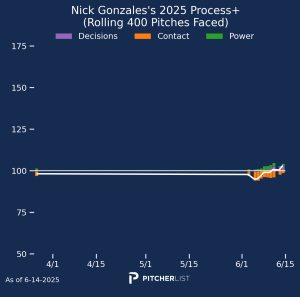
See, it’s a very funny chart. Just say “enhance” matter-of-factly until you make out the colored bars on the end. When you do, you’ll notice that Gonzales is trending in the right direction, making better decisions and more contact over the two weeks since his return. He also has better bat speed, a lower K rate, a better walk rate and better exit velocity and barrel rates than he did last year.
He’s also batted no lower than sixth in the order since his return. The Buccos are not going to be a high scoring team, heck they probably won’t be an average offense for the remainder of the year, but Gonzales and Horwitz (who landed here last week) should eventually get up to speed and provide a boost or at least some length to that lineup. There won’t be much power, but he should provide a solid batting average and with his spot in the lineup likely secure, he could be a better bet for the second half than someone like Kristian Campbell, who has been relegated to the ninth spot of a recently depleted lineup…
Lars Nootbar, Outfield, St Louis Cardinals – 46% Rostered
Everything is trending the wrong way for Noot. He had a .839 OPS through April, then a .665 OPS in May, and now a .349 OPS halfway through June. Typically a free pass connoisseur, Noot managed a 25:21 BB:K ratio in April, followed by an 8:28 split in May, and 6:19 in June. He’s 1 for his last 30 and 0 for his 23 at-bats as of this very moment.
Nootbar still has an exit velocity of over 91 MPH, and a hard hit rate in the league’s top 10%. He also still has a healthy walk rate, even if his strikeout rate is only average. But his overall rates belay his recent trends.
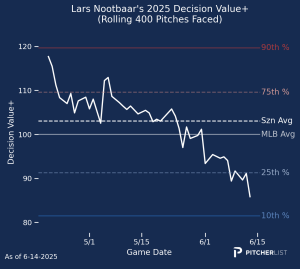
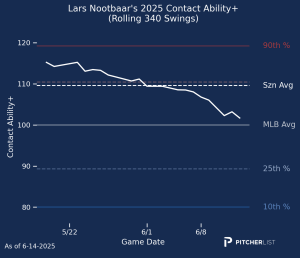
Those are just absolutely brutal downward-sloping lines, but Nootbar possesses such great contact ability, that even with this rough stretch, he’s still above average at getting the bat on the ball. His decision value is getting into scary territory though. What I take away from these charts is that it’s an approach or pitch recognition issue more than a contact problem.
The Cardinals just gave Nootbar a couple of consecutive games off to clear his head. I’m willing to exercise patience here since his underlying rates have held up, and if he looks like his old self in his next few games, I feel pretty comfortable. However, his downward trend has been so sharp that if he’s still striking out at an increased rate, I’d be prepared to cut ties as well.
Thairo Estrada, Second Base, Colorado Rockies – 6% Rostered
Estrada was not very good last year, finishing the season with 9 homers, 2 steals and a sub .600 OPS. But prior to that, he posted back to back 14 homerin 20+ stolen base seasons with batting averages north of .260. Those numbers absolutely play at the keystone and with the move from San Francisco to Colorado, there was some optimism he could benefit from playing in a home park that was extremely offense friendly.
Like Gonzales, Estrada has missed time due to injury this season, so has just 66 plate appearances on the year. So far, he’s making plenty of contact and batting a solid .281, but it’s been a hollow average. Estrada has struck out just 11 times, but he has yet to draw a walk or homer and has been caught stealing in his lone attempt. He’s also hitting ground balls at a rate 10% higher than the league average, which won’t help him take advantage of the thin air.
He’s produced a better exit velocity this year than he did back in 2023, but it’s still a lackluster 87.6 MPH, and his 1.9% barrel rate and 31% hard-hit rate are both scraping the bottom of the MLB barrel. The Rockies are one of the league’s worst offenses this season, even with half their games at Coors. So, if Estrada isn’t running, isn’t homering and isn’t walking, and there is no tangible benefit coming from his team context, what is there?
Risers
Nolan Gorman, Second and Third Base, St Louis Cardinals – 3% Rostered
Gorman batted .189 with a single homer through the first two months of the season but has slashed .344/.432/.688 with 3 homers in the first half of June. He had a 13:29 walk-to-strikeout ratio at the end of May, but a slightly better 5:10 ratio this month. He still has a whiff rate over 30% and a K rate over 27%, but his strong walk rate could help mitigate his streakiness a bit.
Gorman definitely has power. He clocked 27 dingers in just 406 at-bats back in 2023, and 19 in just over 400 at-bats last year. That’s a 30-homer pace over a full season, but his swing-and-miss tendency has held him back. That 27% K rate is a lot better than the 37% mark he posted last year, or the 31% he posted in 2023. His whiff rate is also much improved over his 38.7% pace last season. But are those gains legitimate?
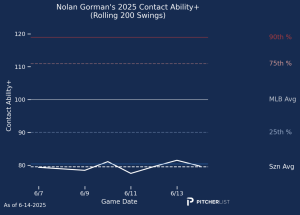
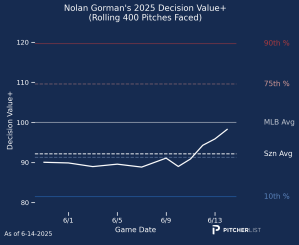
Yes and no. We are seeing real improvement in Gorman’s decision quality. His chase rate is better than the league average for the first time in his career, as is his walk rate, and we can see that reflected in the chart above. However, we can also see that while his strike out rate is much improved, it’s still not good and his contact ability remains well below average even during his recent hot streak.
I think Gorman could be a decent power and RBI source if he keeps getting consistent playing with Brendan Donavan returning from his toe injury, but I think he’ll still be streaky and provide a .240ish average if everything breaks right, but that’s the ceiling. If he sticks in the lineup, I would rank him above the other two middle infielders featured this week.
Max Muncy, Second Base, Third Base, and Short Stop, Athletics – 9% Rostered
First, how weird is it that there are two Max Muncys in MLB? How many Max Muncys could there possibly be? Max Price Muncy, of the Athletics, slashed just .176/.211/.279 with one homer over 71 plate appearances in March and April and was sent back to the minors until early June. Since he was recalled, he has slashed .279/.289/.545 with four homers and a steal in just 45 plate appearances. That OBP leaves something to be desired, but I’ll take the rest of that line any day of the week.
Through his first 116 MLB plate appearances, Muncy has produced an 88.2 MPH exit velocity, a 9% barrel rate and a 32% hard-hit rate. Those are all below-average metrics, and his 3:34 BB:K ratio is particularly concerning. None of those 3 walks have come since he was recalled, so I can’t point to that as trending positively. His AAA line of .325/.397/.504 paints a rosier picture, but that came in the hitter-friendly PCL.
I’m not going to suggest being super aggressive with Muncy, but he does have 42 homers and 39 steals in 346 minor-league contests, so there could be some category juice. He’s also batted in the middle third of the lineup since his recent promotion. The A’s have a better lineup than either the Pirates or Rockies, so I would rank Muncy above both Nick Gonzales and Thairo Estrada, but below Gorman, assuming he retains his role with Donovan back.
Brooks Lee, Second Base, Third Base, and Short Stop, Minnesota Twins – 11% Rostered
Lee batted .276 in April, then fell off in May, struggling to a .219 average. But he has been on fire since the start of June. In fact, Lee has in hit safely in all 12 of the games in which he’s played this month, even one in which he came off the bench. The 24-year-old switch hitter has slashed .378/.404/.622 with 3 homers 9 RBI and a stolen base in those dozen contests and should continue to see playing time as long as Royce Lewis remains on the IL, which he tends to do.
But I would not expect the offensive outburst to continue. Lee has mustered just an 88.8 MPH average exit velocity, a 7% barrel rate and a 39% hard-hit rate. His plate discipline is a little more impressive, as he whiffs a bit less than 25% of the time and carries a strike-out rate under 20%. However, he’s walked just 10 times in 208 plate appearances and just once during his hot streak.
It also isn’t the case that his slow start is clouding his overall line as his process chart suggests he’s actually dropped off a bit in terms of power, contact and decision quality. Those are all of the things the chart charts!
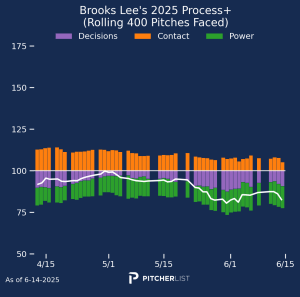
Lee is also not much of a stolen base threat with his sprint speed sitting in the bottom 20% of the league. Simply put, this looks like a hot streak, and not a break out. Lee does play a lot of positions, which can make him a helpful bench bat if your league has the roster space, but I don’t see much upside here. So for all the infielders I’ve covered today, my final ranking is: Gorman, Muncy, Nicky G, Lee and Estrada, although its extremely close after Muncy.
Thanks as always for reading, and good luck out there deep leaguers!
