





Welcome to Week 20 of our Patience or Panic series! If you don’t get what we’re doing by now, you might not ever.
Bryan Reynolds, OF, Pittsburgh Pirates
When the Pittsburgh Pirates were at their worst, outfielder Bryan Reynolds was at his best. From 2021 to 2023, seasons where the Pirates went a combined 189-299, Reynolds averaged an .836 OPS. He was an All-Star, finished 11th in NL MVP voting in 2021, and did something even more extraordinary: Sign an extension with the Pirates. In a way, it felt like the curse of a wood’s witch. So long as he excelled, the Pirates could not. “You shall shine like gold, while your team plays and smell of mold.” Something like that.
The last two seasons, the first of the Paul Skenes era, haven’t seen Reynolds best ball. He’s posted a .756 OPS and hasn’t been the boat that rises all tides. 2026, though, saw the Pirates bring in help. Ryan O’Hearn and Marcell Ozuna came aboard — one a far better boatswain’s mate than the other. Brandon Lowe followed the Atlantic up into the Alleghany; Konnor Griffin came up from below deck. Reynolds was no longer the only oarsman.
And as the Pirates took to the seas in 2026, they all rowed in one direction. Mostly. By the All-Star Break, Reynolds had an .878 OPS and the team was 50-47. The witch was thrown down the well, undrowned but unable to hurt the Buccos.
Fast forward to now. The Pirates are in the stretch run. They need to be at their best. Yet Reynolds has not been. Over the last 30 days, Reynolds is hitting .224/.321/.327 with a .648 OPS and an 81 wRC+. He’s been good for -0.1 fWAR. In other words, he’s been the polar opposite of who he’d been earlier this season, and of what the Pirates need. What’s happening? Is it more sorcery? Bad luck? Or what happens when he’s the only one left to man the craft?
Let’s address the first. Right now, Pittsburgh is without one of its sharpest harpoons, its most exciting, and its most explosive. O’Hearn is the first. He’s hit .270/.334/.454 this season and led the team with 69 RBIs. Nice. Not so nice? He’s hurt. O’Hearn suffered a quad injury at the start of August that will cost him most, if not the rest of the season. Griffin is the second. He’s missed the last month and change with a torn sagittal band. There goes a 102 wRC+ into the drink. Cruz is the last. After years and years of waiting, he finally found his footing. In 64 games, he had a career-high .822 OPS and 124 wRC+. So naturally, he fractured two metacarpals in his hand in early June.
Everyone’s gone overboard. And it’s left Reynolds and Lowe the lone surviving Ishmael’s stranded in the Pacific.
As for the second, luck, Reynolds isn’t suffering from a lack of it. Statcast gives him a .206 xBA over the last 30 days. Bear in mind, he has a .224 average in actuality. He’s overperforming expectations and still struggling. As for xSLG and xWOBA, there is some bad luck there, however. He touts a xSLG of .347 versus a .327 mark. A marginal difference. Hardly enough to sink a ship.
So, if it’s partly a lack of bodies, but not bad luck, nor sorcery, because let’s be real, it doesn’t exist, what is it? Partly, Reynolds is getting himself out. A career 22 K%, Reynolds has a 32.1 K% over the last month or so. It’s incredibly out of character. Curveballs lashed him like a whale’s tale in July with a 36.4 K%. Sweepers hit him like a sea breeze, too, with a 42.9 K% in July and an even higher 50 K% so far in August. Four-seamers also did their damage in July with a 40.7 K%. This last one is the strangest of them all. This season, even with a down month, Reynolds is hitting .323 on four-seamers. His +11 run value on them is tied for 12th-highest in baseball. Yet there he was striking out against them in July.
Regardless, Reynolds isn’t helping himself. He’s had an anchor around his neck and has let it drag him down to Davey Jones‘ locker.
Accompanying all this is a drop in Reynolds’ HardHit%. In June, he totaled a 56.2 HardHit%. He was smoking the ball. In July, he had a 41.9 HardHit%. It’s obviously a drop from his June total, but it’s just as much a drop from his HardHit% entering July of 47.8%. It all matches with another stat. Before July, his Soft% was 9.6%. As of late, it’s 15.3%. Oddly, though, Reynolds has been barreling balls more often over the last 30 days than he had in the four months beforehand. From the season’s start through June, he had a 10 Barrel%. Over the last 30 days? A 14.5 Barrel%.
One last quirk: Reynolds is going to the opposite field much less as of late. Before July, his Oppo% was 30.5. Over the last 30 days, it’s 24.8%. Reynolds might be in front of more balls than he used to be. His swing might be off. He may be overcompensating. And with a lack of bodies and Pittsburgh’s season potentially going down the drain, who could blame him?
None of this is to say Reynolds is anything other than exemplary. He’s having his best season since 2021. Y’know, where he somehow finished 11th in MVP voting despite the Pirates winning just 61 games. That’s how good he was. And it’s how good he’s been this campaign. What it is to say is that Reynolds is slumping at the wrong time, understandable as it may be.
The Verdict: Trust in the long run. Monitor in the short-term. Doing the first is a hard thing for any Pirates fan. Thankfully, unlike the team, Reynolds is always good for his word.
Colson Montgomery, SS, Chicago White Sox
Here’s a stat for you: Since July 4, 2025, Kyle Schwarber has the most home runs in baseball. Junior Caminero has the second, Shohei Ohtani the third, Hunter Goodman the fourth. Tied with Matt Olson for fifth at 46 home runs is White Sox shortstop Colson Montgomery. For Montgomery, July 4, 2025, isn’t just another National holiday, however. It marks his MLB debut. All of this is to say that Montgomery has the thump. The question is, is that all he has?
Last year, the answer was a muddled kind of. Perhaps a shoulder shrug and a furrowed brow. In his 71 games, Montgomery hit .239/.311/.529 with 21 home runs, nine doubles, an .840 OPS and a 129 wRC+. Power, of course, carried him. But he was hitting for some average, walking some, and doing his part. And as a 23-year-old rookie, there was room for growth.
Now at 24, there’s just as much room. It just comes with even more data that says Montgomery might be a one-trick pony rather than a complementary stallion. In 111 games, the shortstop is hitting .215/.296/.445 with a .741 OPS and 105 wRC+. Broadly, he’s hitting for less average, walking less, and, well, doing less. He’s even hitting fewer long balls, with his HR% dropping from a staggering 7.4% as a rookie to today’s 5.5%.
Let’s add some context while we’re on this track. Of 142 qualified players, Montgomery ranks 131st in batting average and 124th in OBP. And while he ranks 53rd in slugging percentage, the difference between his 2025 and 2026 numbers is stark. If Montgomery had enough qualified AB’s, he’d have the 23rd-highest drop-off from season to season at -0.90.
Other declines have followed. Montgomery’s Barrel% is still strong. It still ranks him in the 82nd percentile of all hitters. But like its brethren, it’s also dropped, falling from 14.5% in 2025 to 12.5% in 2026. Correspondingly, his Barrel/PA has gone from 8.8% to 7%. These last three stats, each power-related, feel like the strongest confirmation that Montgomery might not be a thoroughbred. His value, originally, was in the thunder in his hooves. Now, he’s trotting a quieter sound.
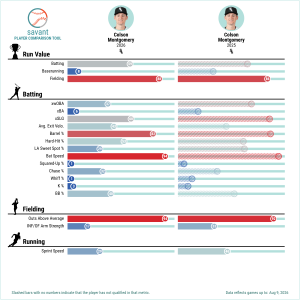
Circling back to the opening question, it would seemingly provide an answer. Montgomery isn’t just a power hitter. He’s a power hitter in active decline. He, at 24, has already been solved by Major League pitching. That much feels extremely evident given his numbers over the last month. In the last 30 days, Monty is hitting .190/.271/.321 with a .592 OPS and 38 strikeouts in 22 games. 38 in 22! His 39.2 K% during that time is fourth-highest in baseball.
A root cause of this is, in part, Montgomery’s inability to handle heat. This season, he’s hitting .159 with a .318 slug against fastballs with a 37.3 K% and a -10 run value. They’re blowing by him like Secretariat would lesser riders and lesser jockeys. He’s equally as troubled by sliders, totaling a 39.7 K% and 43.3 Whiff% against. But at least there he’s slugging .463 with a 41.9 HardHit%, an improvement compared to his 33 HardHit% on fastballs.
His issues here are what have made him one of the least disciplined hitters in baseball. Seriously. Despite his 8.4 BB%. Montgomery ranks in the first percentile in Whiff%. The only hitters to whiff just as much as him are Luke Raley, Oneil Cruz, and teammate Munetaka Murakami. Likewise, he’s in the third percentile in K%. There, his stablemates are the already-mentioned Kyle Schwarber, Coby Mayo, Owen Caissie, Eugenio Suárez, and Jorge Soler.
In these players, you see shades of the player Montgomery might become. He might become someone like Suárez or Schwarber, to a lesser degree: A bruising masher who runs his race how he wants to, for better or worse. He’ll hang around as a power-first hitter and not much else. Or, he could become someone whose faults are too great to outrun his strengths.
Make no mistake about it. Montgomery’s power is legit. One doesn’t luck into the fifth-most homers in baseball over the last 11 months. But he needs to either improve upon it, return it to what it once was, or round out his game.
The Verdict: If Montgomery doesn’t do either, he might be shipped off to the glue factory in a few years.
Heliot Ramos, OF, New York Yankees
New York Yankees fans went into last week’s trade deadline with hopes and dreams. Maybe they could pluck Joe Ryan from the Twins, or [insert unrealistic trade target here]. Instead, they got Luis García Jr. from the Washington Nationals and outfielder Heliot Ramos from the San Francisco Giants. That’s it.
Garcia’s profile is established enough. A seven-year veteran enjoying a career year at age 26, what’s not to like? Not another star, not another Yankee great, but a true blue quality bat for a team in need of them with so many already injured. Ramos is more of a question mark. A former top prospect, the 26-year-old’s yet to cement himself as anything more than average. He peaked in 2024 with an All-Star appearance, only to regress in back-to-back seasons. By the time he was flipped across coasts, he had a .716 OPS in 79 games. So, who is this new face? And what might he provide?
So far, the answer is not much. As a Yankee, Ramos is hitting .118/.286/.235 with a .521 OPS. He’s yet to homer or record an RBI. George Lombard Jr., who’s played in two fewer games than Ramos has as a Yankee and is a rookie, already has two home runs and two rib-eyes. If the first impression is a lasting one, fans might rue Ramos. That said, he has two doubles. Sadly, those two doubles account for his only two hits as a Bronx Bomber.
Forgoing this small sample size, let’s look at Ramos as a whole. What does he offer? Where has he struggled? Is that top prospect just buried somewhere deep, wishing to break out?
Maybe. Despite his middling season, Ramos admittedly has some tantalizing stats underground: His 13.6 Barrel%, 8.9 Barrel/PA, his 49.3 HardHit%, and his 92.2 MPH average exit velocity, for example. Due to them, Ramos is in the 90th percentile in exit velo, the 88th in Barrel%, and the 89th in Hard-Hit%. It’s enough to see at least a hand breaking through the dirt. What’s more, these are all steps in the right direction. His exit velocity and HardHit% are career-bests. His Barrel/PA is the second-best of his career. And while his Barrel% is only his third-highest mark, it’s up 4.8%, the third-biggest year-to-year increase in baseball.
Sadly, that’s where his strengths stop. For every positive percentile finish, there’s a negative: A 19th percentile ranking in Chase%, 23rd in Whiff%, 16th in K%, and 11th in BB%. He’s not a great fielder; he’s about average in terms of bat speed, and his launch angle is ideal maybe a third of the time. Put all this together in a Ramos-sized vase, and an average player sprouts from its roots. Such is evident in his season slash of .256/.303/.413. When things go right, he looks ready to bloom. When they don’t, he’s wilting.
Ramos’ power is especially wilting. In 2024 and 2025, Ramos hit 22 and 21 homers, respectively. His 2024 total was particularly impressive, with Ramos hitting 22 in just 121 games. That’s good enough for a 4.2 HR%. Ramos then hit one fewer homer the next season despite playing 26 more games. As a result, his HR% dipped to 3.0%. Still, Ramos seemed good for 20+ homers a season, even if his petals won’t peel.
Yet through 79 games this year, Ramos has just nine dingers. Nine. Not counting a short 2023 season, his 2.8 HR% this season is a career-worst.
What happened? Mainly, Ramos isn’t elevating. In 2024 and 2025, he posted a AIR% of 56.7 and 55.6, in part explaining his homers and his 20+ doubles in each season. This year, his AIR% is 46.5%. He’s hit 74 fewer flyballs compared to 2025 and has seen his FB% shrink by 4.7%. Where’d they go? Into the ground. Ramos’ GB% is up 9.7% compared to 2025, the third-biggest year-to-year jump in baseball. All of those balls he used to put into the stands or into the gap have instead gone into the dirt.
This is, well, a problem. Compounding it is that Ramos, a right-handed hitter, has always excelled at hitting flyballs toward the opposite field. In Yankee Stadium, that’s the short porch. Ramos needs to get back to his old ways. The Yankees traded for him, betting that he could. To them, they see a hitter with strong barrel metrics and a past penchant for hitting to right for power. It’s not hard to see what they want out of Ramos. Pulling it out of him, however, will be a struggle. It already is. Through five games as a Yankee, Ramos has a 0.0 FB%. His only two hits were line drives.
The Verdict: Climb aboard if, and only if, the Yankees’ re-growth starts working. If Ramos can do what he needs to, he could be a great buy-low option. If not, he’s another ho-hum acquisition for a club that prefers heroes.
