





Welcome to Week 12 of our Patience or Panic series!
Kyle Tucker, OF, Los Angeles Dodgers
When the Los Angeles Dodgers signed outfielder Kyle Tucker in late January, the baseball world lost its collective mind. Fans raged. Pundits posted articles about the pros and cons. People panicked. And for good reason. Tucker was a year removed from his seventh-straight season with an .800 OPS or better, a Silver Slugger, and his fourth All-Star appearance. The dynasty added another king to a roundtable already crowded with royalty and knights, and paladins.
Now, the court whispers a different ballad. Tucker is not having an abysmal season. Let’s make that clear. Through 67 games, the 29-year-old is hitting .239/.337/.388 with a .725 OPS and a barely-above-league-average 106 wRC+. He has 16 doubles, 39 RBIs, six home runs, and 99 total bases. He is no jester. But he’s no prince, either. With that realization, the storm of rage and scorn has died, and the tenor trebled.
What’s connoted this different sound? Simply, Tucker isn’t barreling balls. Go back to his days as Houston’s quiet knight, the fourth-fiddle behind Jose Altuve, Carlos Correa, Yordan Alvarez, and a litany of pitchers with arms like trebuchets. Then, Tucker always did an excellent job barreling balls, finishing in the 78th, 70th, and 68th percentile in Barrel%. This year, he’s in the 24th percentile among all hitters in Barrel%. He’s gone from a 10.8 Barrel% last season to a 5.2 Barrel% this season, the 15th-highest year-to-year drop in baseball.
Correspondingly, Tucker is seeing his Barrel/PA more than halved, going from 7.5 to 3.5, another drastic drop-off. This is, in part, the explanation behind Tucker’s power numbers. It helps explain why he’s seeing career-worst numbers in slugging percentage, ISO, HR%, and HardHit%. Another stat worth mentioning in all of this is Tucker’s Squared-Up%. It too is in decline, dropping from the 84th percentile in 2025 to the 58th in 2026. His bat is no Excalibur. It’s little more than a wooden sword, capable of poking and prodding and little else.
Of that bunch, his HardHit% is especially noteworthy and perhaps the greatest sign of trouble. At 38.2%, it’s not too different from his 40.4 HardHit% in 2025. But it is quite different from where Tucker used to average. From 2018, his debut season, to 2024, his final season as an Astro, Tucker averaged a 44.9 HardHit%, 69th of 425 qualified hitters. That metric has steadily declined year-by-year since 2023, dropping from 45.9% to 44.9% to 40.4% to today’s 38.2%. As he’s aged, he’s doing less and less damage to the ball in terms of pure impact.
What’s the explanation? Pitchers have started to attack Tucker differently over the last two seasons. From 2020 to 2024, he saw the same kind of volleys. Almost 50% or more fastballs, nearly 30% breaking balls, and 13-15% offspeed pitches. That was the pitched battle opponents set against Tucker. Tactics have since changed. Gone is the fastball-heavy attack. Replacing it is one more focused on breakers and offspeed pitches. It’s a change founded particularly on Tucker’s 2022 and 2023 seasons, where he hit .215 and .216 against all offspeed pitches.
Last season, Tucker’s first with this new pitch percentage, saw him hit .231 against all offspeed pitches and .272 against all breaking pitches. The weakness was still there, especially regarding the former. That’s only remained doubled this season. Thus far, Tucker is hitting .203 on offspeed pitches with a .185 xBA. He’s whiffing through 31% and slugging just .241, a career-worst for Tucker against any pitch type. The change in strategy would make Henry V proud.
Tucker’s failures mostly come against changeups. Right now, he’s hitting .152 on the pitch and has a .196 slug. As such, it’s become the pitch he’s seen second-most, at 17% of the time. Likewise, he has a 27.3 HardHit% against it, a .161 xBA, and .205 xWOBA. That xWOBA is the ninth-worst, and xSLG is eighth-worst in all of baseball. The changeup is to Tucker what the charges were to Anne Boleyn: Damning and impossible to escape.
That is the chief problem. Tucker’s problem is obvious. Clear as day. Opponents will continue to feed him this repertoire until it stops working. And it’s not a one-pitch problem. For as much as he’s struggling against changeups, he’s also seeing slider 15.6% of the time and hitting .179 against them. It is a two-pronged problem exacerbated by an increasing lack of power.
The Verdict: As William Wallace once said: “HOLD!” It’s unlikely that Tucker is truly on the chopping block. He still ranks as an above-average bat, and that’s with all these problems.
Alex Bregman, 3B, Chicago Cubs
Chicago Cubs third baseman Alex Bregman’s done it all through his 11-year career. Win a World Series? Been there, done that. Twice. Make an All-Star game? How about three of them? Get a Gold Glove? Bingo. A Silver Slugger? Uh-huh. He’s even won All-Star MVP. In a game of unpredictability and an era of madness, Bregman’s been a metronome. He’s going to have an OPS of .800 or better, man the hot corner every day, and help get to the postseason.
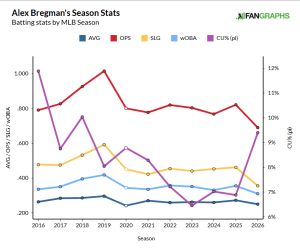
Yet this season, the cogs are wrong. Time isn’t ticking. Bregman isn’t himself. Through 71 games, the 32-year-old is hitting .253/.338/.358 with a career-worst .696 OPS and 99 wRC+. And his counting numbers aren’t all that impressive either, with just six home runs, 22 RBIs, and 10 doubles.
Much of that manifests itself in Bregman’s power. Less and less a contact hitter these last six years, posting a .263 batting average over that span, Bregman derived much of his value by providing juice. His 153 doubles over the last six seasons are 27th out of 382 qualified hitters. His 110 homers are 54th among that same pool, and 10th among all third basemen. Factor that in with good plate discipline and still-solid bat-to-ball capabilities, and Bregman cemented himself as an ideal middle-of-the-order bat. A do-it-all drumbeat.
And therein lies Bregman’s current problem. He has no thump. He isn’t keeping time; His snare-shot sounds weak. His .355 slug ranks 126th out of 156 qualified hitters this season. Likewise, he’s 128th in HR% and 139th in ISO. All of this is accompanied by similar dampenings in his HardHit% — down 6% — exit velocity, and his Barrel% and Barrel/PA. Whether it be opposing pitchers or Father Time, Bregman’s lost that rhythm that defined so much of his offensive profile.
Maybe it’s both. Or, maybe it’s where Bregman plays. Rewind the clock. A year-and-a-half ago, Bregman signed with the Boston Red Sox. Everyone and their grandmother lauded the fit. His swing played at the park like clockwork. Eighteen home runs in 114 games, 28 doubles, a .462 slug — his highest since 2019. If the almighty designed a park for Bregman, it was here in Beantown.
Despite that, Bregman left Boston for Chicago, a park decidedly not as friendly to his swing. The results bear this out: A .299 batting average on the road compared to a .208 average at home, twice as many homers away from Wrigley, a .299 slug in Chicago versus a .417 slug anywhere else, and a .606 OPS versus a .787 mark. Even the worst physicist can deduce that this is a case of causation, not just correlation.
Except it’s not just that simple. Bregman is hitting for less power, yes. He isn’t a fit for Wrigley, true. But accepting those as the only possible explanations reduces what opposing pitchers have done. From 2017 to 2025, Bregman, like Tucker, had a defined pitch-mix thrown to him: A lot of cheddar, a side of breakers, and a helping of offspeed pitches. This year, Bregman’s gone from getting a side of breakers to a plateful, seeing the pitch type 8.9% more. That is the biggest year-to-year change in baseball. Only Mickey Moniak is close, seeing 8.8% more breaking pitches, while Kerry Carpenter is third, but at 7.3%.
The results, like those relating to Wrigley, speak for themselves. Against breaking pitches, Bregman is hitting .160 and slugging .266. He has a .250 wOBA, a 30.6 Whiff%, and just four extra-base hits. Comparatively, Bregman is hitting .301 against fastballs and .259 against offspeed pitches. If he were seeing those pitches alone, his name wouldn’t even be featured in this article.
In other words, breaking balls is the root cause of Bregman’s issues. And to be specific, it’s curves, sweepers, and sliders that are making him unlike his usual metronomic self. Sliders, the breaking pitch Bregman is seeing more than any other, have him hitting .133 and slugging .222. Sweepers see him hitting a slightly better .167 and a much better .417 slug. Things then get back to normal when it comes to curveballs, where Bregman is hitting and slugging .136.
Separately, none of this is good. Collectively, it paints a giant target on Bregman’s back. Want him out? Throw any of these three pitches. Odds are that a reward will soon follow. That said, Bregman does show some signs of life. He’s hitting .269 over his last seven games and slugging .423. His Squared-Up% remains elite, standing in the 90th percentile, and while he’s striking out and chasing more, it’s at a far lesser rate than some of his other peers.
The Verdict: Let Bregman regain your trust. It’d be one thing if this were strictly a power issue. It’s not. It’s where Bregman plays, how he’s being attacked, and his inability to get base hits.
Nolan Gorman, IF, St. Louis Cardinals
Entering 2026, St. Louis Cardinals third baseman Nolan Gorman finally had the keys. The Cards shipped their other Nolan, Nolan Arenado, off to Arizona and ostensibly cleared the path for their 26-year-old former top prospect. They said, “Here is third base. Here is your chance to be an everyday player. Here is your chance to rewrite the story, to erase away the graphite before it becomes ink.”
Yet Gorman has not rewarded their faith. Through 62 games, Gorman is hitting .194/.279/.318 with a 598 OPS and a 68 wRC+. In terms of run production, Gorman’s helping his case, with seven home runs and 26 RBIs. The latter has him tied with Masyn Winn for fifth-most on the team. But the only leap Gorman’s taken is backward. His average is somehow down from last year’s .205 finish, and his slug is somehow worse than .370.
To provide further context on Gorman’s struggles, consider this: Out of 159 qualified players, he’s 146th in slugging percentage, 149th in wRC+, 152nd in batting average, and 153rd in wOBA. Unlike Tucker and Bregman, two players playing just a little above or below league average, Gorman is one of the worst players in baseball. And with that statistical realization, the quill is about ready to touch the paper.
Rather than examine his problems, of which there are many, it might be more beneficial to ask this: What is Gorman doing right? Where does he provide hope? Flickers can be found in his expected numbers. Gorman has a xSLG of .351, a 0.33 difference. He should be hitting for some more power. Other glimpses can be found in a+2.7% increase in his HardHit%, a .2 rise in his Barrel/PA, and his success against fastballs. He’s also pulling flyballs at an elite rate, doing so 26.9% of the time. Finally, after hitting .218 against all fastballs last season, Gorman is hitting .265 against them this season with a .490 slug. The eraser is in hand in some categories.
Yet opponents are already countering this. Gorman’s seeing fewer fastballs than he did a year ago and more offspeed pitches. Way more. Compared to last year, Gorman is seeing more 9.8% more offspeed pitches. That’s the biggest jump in baseball. The only player even near him in that regard is Reds outfielder TJ Friedl, who’s seeing 7.9% more offspeed. Regardless, it’s worked. This season, Gorman has a .056 average on offspeed pitches and a .056 slug. He has three hits to 24 strikeouts and a 51.4 Whiff%.
Mightier than the sword and the pen in Gorman’s case is the changeup. Gorman’s -8 run value against it is the worst in baseball. His aforementioned .068 average and slug are only better than Friedl’s .038 mark in both categories. The only area of import where Gorman is first or second-worst in wOBA. There, he’s third, but barely. Angels outfielder Jo Adell is first at .082, and Friedl is second at .085. Gorman is .087. Another bad week and he could easily be the worst changeup hitter in baseball.
All of this is just the icing on the cake. Gorman’s Baseball Savant Page is basically all blue, the only color worse in baseball than charcoal-colored graphite and ink black. He’s in the bottom 10th percentile in the following stats: xWOBA, xBA, Squared-Up%, Whiff%, and K%.
The Verdict: Close the book. The Cardinals have. The club demoted Gorman to Triple-A over the weekend in favor of rookie Blaze Jordan. Moreover, this doesn’t seem like a “go get your confidence back, kid” sort of demotion. This is a surrender. Drafted in 2018, debuting in 2022, Gorman had his chance. Now it’s Jordan’s turn.
