





Welcome to Week Eight of our Patience or Panic series! In case the name didn’t spell it out, here we examine struggling players and issue a declaration. Should their performance incite panic or a level of calm? Or should the house feel afire?
Matt Chapman, 3B, San Francisco Giants
The San Francisco Giants are one of baseball’s biggest duds. That’s not saying anything new. To some extent, it’s not entirely a shock. What might be surprising, though, is the decline of its veteran players. And few players exhibit that more than third baseman Matt Chapman.
With a +.750 OPS in each of his last four seasons, Chapman seemed a sure thing. But the only certainty in Chapman’s game is failure. A failure to drive the ball, make contact, and get on base. Those changes most show in Chapman’s base numbers, hitting .223/.299/.314 with a .613 OPS and 77 wRC+. He has just one home run, 16 RBI, and a staggering 49 strikeouts to 17 walks. Really, the only saving grace in Chapman’s game is his glove. But because of it, he’s become a one-trick pony.
This all sounds quite catastrophic, so let’s offer some caveats. First, Chapman’s .223 batting average isn’t all that alarming. A career .240 hitter entering 2026, Chapman has never been a high-average hitter. In fact, he’s hit .230 or worse five times from 2017 to 2025. Despite that, he’s remained an above-average bat, recording a .788 OPS during that time and a 118 wRC+. Contact isn’t part of his game. It never has been. Likewise, Chapman’s not striking out any more than usual. More than the last two years? Certainly. But in the grand scheme, his 25 K% in 2026 is actually below his career 26.4 K%.
So, what has changed for the worse? What can’t be quibbled with? That would be Chapman’s power. Chapman never needed to make consistent contact to add value so long as he was slugging. And boy, could he. Chapman has hit 20 home runs and 20 doubles nearly perennially, doing so in 2018, 2019, 2022, 2024, and 2025. He was always a threat to go somewhat deep. This year, that isn’t the case. Far from it.
Here’s one stat that says it all: Chapman’s .314 slugging percentage is sixth-worst in baseball. Sixth! The only players worse than him are Caleb Durbin, Luis Rengifo, Bo Bichette, Alec Bohm, and Kyle Karros. None of these are power hitters. And none needed power to create value the way Chapman did and still does. They should, in theory, be high-average hitters. The only problem is they’re not. Chapman isn’t supposed to be a high-average player. It’s not who he is. This is how he should compensate. Bluntly, he’s not. And to some extent, it’s that simple. Chapman is struggling because he isn’t doing one of the few things he does well offensively.
Let’s detail those struggles to illuminate just how bad things are. Chapman’s HardHit% has decreased 17.5% from 2025. It’s the third-largest year-to-year fall off in baseball. His average exit velocity is down 5.5 MPH, the second-largest year-to-year decrease. And finally, His .274 expected slug is actually lower than his actual .314 slugging percentage. In other words, Chapman, who’s having a career-worst year in that regard, should be having even worse results. He’s getting lucky. Somehow.
One other dip, though, might explain things. Chapman’s seen his Launch Angle Sweet-Spot% plummet. It’s down 12.9% from last year, which is the fourth-largest year-to-year decrease in all of baseball. Correspondingly, Chapman’s launch angle is nearly halved compared to 2025. Then, it was 15.7, mostly in line with his career average of 17.1 degrees. This year, it’s 8.8 degrees, easily the lowest of his career. Bear in mind that launch angles with less than 10 degrees usually result in ground balls.
This is a pretty straightforward issue. Chapman’s swing isn’t right. It’s causing him to scuff balls instead of stroking them.
The Verdict: Until Chapman changes, call it quits. A bad swing can take time to fix. That’s not a commodity most prefer to waste. Seek options elsewhere.
Willy Adames, SS, San Francisco Giants
We’re sticking in the Bay Area to talk about Chapman’s infield partner, San Francisco Giants shortstop Willy Adames.
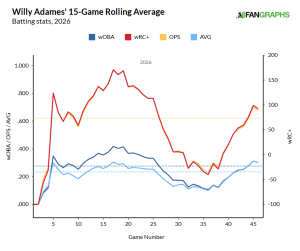
Adames, like Chapman, is going through it. Through 45 games, Adames is hitting .234/.265/.356 with a .621 OPS and a 77 wRC+. With three homers, 13 RBI, and an exasperating 56 strikeouts to seven walks. The 30-year-old seems a far cry from where he was just a year ago, when he hit 30 homers and touted a .739 OPS.
Let’s focus on those walks first. They serve as the foray into a larger field of discussion. Adames has, as of late, had strong plate discipline. An 11.7 BB% in 2025, a 10.8% in 2024, and an 11.1% in 2023, Adames knew the zone. He knew what he could dispense with and what he could do damage with, letting himself generate production with his bat and his eye.
This season, Adames is blind. His seven walks are tied for 11th-fewest by a hitter this season. His 3.7 BB% is tied for the sixth-worst in all of baseball. And where Adames takes the cake is his walk-to-strikeout ratio. At 0.13 BB/K, it’s second-worst in the sport. The only player with a lower BB/K is Baltimore’s Jeremiah Jackson, and he has 49 fewer plate appearances. There is a fair argument that Adames is the least disciplined player in baseball this season. It’s an astounding decline. To take what was an absolute strength and turn it into an abysmal liability.
What’s fascinating, though, is that Adames hasn’t replaced his walks with strikeouts. He isn’t swinging away. His 29.3 K% is up compared to last year, yes. That said, he has a career 27.1 K%, so it’s not a demonstrable rise. His Chase% is also up, but just by 5.8%. More notable is his ChaseContact%. That number is up 8.2%. In layman’s terms, Adames is successfully hitting more balls out of the zone than he did a year ago. So he is expanding the zone somewhat, just not at the cost of striking out.
Keeping the complexities going, it’s not as if pitchers are attacking Adames any differently. Nor is he whiffing through something he connected with a year ago. His Whiff% on fastballs and offspeed pitches is down; Way down in the case of the latter. It’s gone from 51% in 2025 to 31.7% in 2026. He’s whiffing through more breakers, sure, but only exactly 1% more. It’s, well, weird.
As is the fact that Adames isn’t drastically putting the ball elsewhere. His GB% and LD% are similar, and he’s not pulling the ball all that differently. Really, the only notable changes in his batted-ball data are a decrease in fly balls and an increase in pop-ups.
The good news is that things seem to be leveling out for Adames. He’s hitting .302 over his last 15 games and .367 over his last seven. He’s not walking more than he was, recording just two walks over the last two weeks, but contact and power are re-entering his arsenal.
The Verdict: See if this is for real. Without notable changes in Adames’s game, it’s fair to be skeptical. It’s also fair to admit that baseball, like life and the continuity of major film franchises, makes no sense.
Evan Carter, OF, Texas Rangers
Think back to 2023. It was September. The Texas Rangers needed help. So they called up then-20-year-old outfielder Evan Carter. Carter, a top prospect, immediately paid dividends. He was excellent in September with a 1.058 OPS. He was just as good in October en route to Texas’s first-ever World Series Championship. Carter seemed poised to be the face of the Texas Rangers. He, Corey Seager, Jacob deGrom, and Josh Jung would steer the team through more triumphs in the 2020s.
Now we’re more than halfway through the decade. The Rangers have yet to make the playoffs, and Carter is a shell of his former self. Through 46 games, Carter is hitting .167/.293/.312 with a .605 OPS and a 77 wRC+. He’s not even over the Mendoza line a quarter of the way through the season. He’s also not a run producer, posting just five home runs and 13 RBIs. The great hope has soured.
Why? To answer, let’s look at the Carter of old. Though he didn’t qualify for Baseball’s Savant percentile rankings in 2023, Carter left behind substantial data: A 46.2 HardHit%, a 43.6 Launch Angle Sweet-Spot%, a 10.3 Barrel%, and an elite ability to avoid balls and take ball four. He was about as well-rounded as a 20-year-old could be, making contact, walking, and slugging. He was the total package.
Fast forward. What do we find? We find all those skills, all those strong starts are gone. Carter’s saving grace and only translatable skill through the years is his eye. He’s in the 93rd percentile in Chase% and the 89th percentile in BB%. He knows what he’s looking for and how not to overextend himself. What he doesn’t know, or hasn’t retained, is how to revive the bat that once helped win a World Series.
He isn’t excelling against any one pitch. He’s not getting cheated by good defense. He’s striking out more than he did a year ago. His 21.4 launch angle is a little less than double that of a year ago and 12.4 degrees higher than it was in 2023. It sounds negative. But it’s not dire. He’s mediocre in nearly every major percentile ranking; his Baseball Savant page is all grays and baby blues. And maybe that’s worse. It’d be one thing if Carter were overmatched. He isn’t. His advance numbers are simply caught between.
For instance, there are signs of growth. His HardHit% and average exit velocity are the highest they’ve been since 2023. His Barrel% is up 2.8%, and he’s already barreled as many pitches as he did last year, despite seeing 156 fewer. As a result, his 5.6 Barrel/PA isn’t just good, it’s the best of his career. Even better than 2023. Likewise, he’s putting the ball into the air more than ever, with a 67 AIR%. These are all good signs.
But to some extent, they’re baby steps. Small improvements that don’t alter things in the grand scheme. One example of this is his 67 AIR%. It’s a nice step. But it corresponds to a 37.9 FB%. Most of these balls he hits into the air are lazy, lifeless flyouts. His 19.4 LD% is a career-worst. There’s no oomph here. He isn’t mashing the ball and getting out by happenstance. He isn’t generating high velocities that go into gloves. He’s just there.
For Carter, maybe that’s enough. Back injuries have plagued the outfielder, ending his 2024 season prematurely and causing two IL stints last August. Incremental gains might be okay in that context. He’s on the field. He’s making some strides. Perhaps that’s enough.
The Verdict: Let Carter sink or swim on his own time. There’s a chance he reclaims his 2023 form. If it comes, or if signs of its return fall on the horizon, seek him out. Until then, let the Ranger ride by his lonesome.
