





Welcome to Week 22 of our Patience or Panic series!
Otto Lopez, SS, Miami Marlins
Here’s a stat for you: Chicago Cubs outfielder Pete Crow-Armstrong leads the National League with 9.1 fWAR. Alright, pick your jaw up off the floor. That’s not why we’re here. We’re here to talk about who trails PCA. Spoiler alert: It’s not Cincinnati’s Elly De La Cruz, nor is it a Dodger. It’s Miami shortstop Otto Lopez. Yes, in terms of sheer fWAR, Lopez is the second-most valuable player in the National League and the fifth-most valuable in all of baseball.
So, why exactly are we having this discussion? Being second only to PCA in 2026 is like being stamped by excellence. You’re doing something right. For Lopez to be second in fWAR, then what’s there to be scared of? Why should we panic? He’s clearly doing enough. More than, in all honesty. That’s certainly true offensively. Lopez’s .306 batting average is third-best in the NL. Despite a lack of power, he’s tied for the 29th-best OPS in the NL. With him is someone no one would ever dare question: Luis Arraez. Again, why are we here?
The truth is Lopez isn’t the same hitter he was. The same hitter he had been. He hasn’t been since the All-Star break. In the last 37 games, Lopez is hitting .234/.272/.292 with a .564 OPS and a 54 wRC+. In that time, he’s generated just 0.2 fWAR. And if we’re putting his previous numbers in context with the NL, it’s only fair to do the same here. Among the 177 qualified hitters post-All-Star, Lopez ranks 118th in batting average, 170th in slugging, 171st in wRC+, and 140th in fWAR. The second-most valuable player in the NL is the 140th-most valuable player in baseball over the last 37 games. That’s why we’re here. It’s that simple.
But what’s ailing Lopez? That’s probably the bigger question. With hitters like him, contact, average-first players, instinct is to check expected numbers. And yes, there are differences. For instance, Lopez’s xBA in the second half of the season is .263, compared to his BA of .234. Likewise, his xSLG is .358, compared to his actual slugging percentage of .292. There’s even a .040 difference between his wOBA and xWOBA. There’s some bad luck in play. Yet even if we put Lopez somewhere in the middle of these ranges, he’s still a pale imitation of his previous self.
All this talk of expectations brings up a salient point. No one expected Lopez’s first-half success. From 2024 through 2025, Lopez hit .257/.308/.372 with a .680 OPS and 89 wRC+. He was fine, far from one of the most valuable players in baseball. Lopez struggling is natural. Considering his .268 xBA in the first half, it makes sense. Additionally, Lopez’s 2025 was worse than his 2024. Then, he hit .246 in 146 games with a .672 OPS. It’s a Cinderella story. But, to borrow another phrase from fairy tales, has he turned into a pumpkin for good?
Probably not. Beyond pure success, there aren’t many differences between the Lopez of the past and present. His hard-hit rate isn’t drastically better or worse than it was. Nor is his barrel rate. His batted ball data is similar, save for slight differences. For instance, he’s hitting 45.7% of all balls toward the middle of the field in the second half. In the first half, he hit them 39.9% of the time. That increase has come at the cost of Lopez’s ability to hit to the opposite field. He’s gone from a 27.7% opposite rate to a 22.5% opposite rate more recently. But in the grand scheme, these are symptoms of what’s wrong, not the root cause.
One root cause is that Lopez has lost his aggression. In May, his chase rate peaked at 36.9% for the season. Ever since, it’s been in steady decline. June saw a chase rate of 32.2%; July, 27.7%. August is the first uptick, with Lopez’s chase rate at 29.8%. On the one hand, this should be applauded. Lopez should be selective. On the other, Lopez can gamble on pitches out of the zone. His skill, his knack, is his ability to square up balls and put them in play. It’s okay to take chances. To return to Arraez, another high-average, no-power hitter, he ranks in the 24th percentile in Chase%. Lopez can learn a thing from that.
Other potential causes come with Lopez’s bat. No, literally. Since June, his bat speed has declined. And ever since August, his Average Attack Angle has nosedived. In June and July, Lopez had an Average Attack Angle of 10 degrees. In August, it’s 8 degrees. A slight decline, but it’s the first time Lopez has dipped under 9 degrees since April of this season. Both of these could be due to sheer exhaustion and the rhythms of baseball. It could also be due to a finger injury Lopez sustained on his dominant hand on July 19, AKA just after the All-Star break.
The Verdict: This is the first slump of Lopez’s season. Wait a while longer to see if he can get out of it. If anything, it seems he might be. Over the last week, he’s hitting .286.
Xavier Edwards, 2B, Miami Marlins
To the laymen, Xavier Edwards is something of an afterthought. To players of MLB The Show, he is nothing short of a god. With high contact numbers, switch-hitting capabilities, and sturdy defense, he is Rod Carew reborn with better speed.
Stepping out of the virtual world, we find Edwards has begun to earn a reputation in reality. After hitting .298 the last three seasons, Edwards seemed to reach a higher gear in 2026’s first half. Through 97 games, Edwards hit .303/.385/.425 with a .810 OPS and a 124 wRC+. He was fourth in the NL in batting average and 25th in wRC+. Combined with Otto Lopez and Liam Hicks, they formed something akin to the three-headed hydra Kratos fought in 2005’s God of War.
Now, the times have changed. Both for the PlayStation franchise and in South Beach, but the former’s beside the point. Lopez has, as detailed, cooled off. Miami traded Hicks up north to Tampa Bay for a boatload of prospects. And Edwards? Edwards has followed Lopez’s path. Since the All-Star break, the second baseman is hitting a paltry .233/.298/.260, good enough for a .558 OPS and a 59 wRC+. So much for the elite contact and the above-average slugging for his slight frame. Edwards went from 25th in the NL in wRC+ in the first half to 87th in the second half. There are only 91 qualified players. He hasn’t resembled a worthwhile hitter.
There are a few possible explanations at work. Some feel like a glitch. For instance, Edwards is hitting more ground balls. He is hitting fewer fly balls. But there are graphical and mechanical hiccups. The game-breaking viruses are elsewhere.
Most worrisome, Edwards has lost his superpower. He can no longer put his bat on balls, chiefly because he can’t connect. Since May, Edwards has been swinging and missing more and more. In June, he posted a whiff rate of 15.7%. In July, he climbed to 21.8%. That number is the second-highest whiff rate Edwards has ever had in a single month. The only month worse was June 2024, when the infielder had a whiff rate of 31.6%. That month, Edwards played just three games. Call that 21.8% second-place with an asterisk.
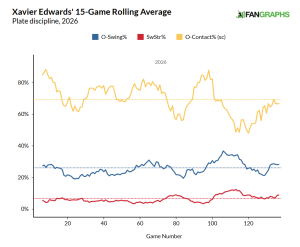
To some degree, this sounds a touch hypocritical. Why rail against Edwards for his lack of aggression and then punish Edwards for his? The key distinction is that Lopez doesn’t chase and then miss. He isn’t stepping on C4 like some clueless game in a first-person shooter. Compounding matters, Edwards’ chase-miss rate was 23.8% in May and 25.5% in June, both in line with his career average. In July, Edwards posted a chase-miss rate of 42.6%. The only month with a higher mark? June 2024. Get where this is going? It’s okay to chase. Sometimes, it’s encouraged. But to chase and miss, like Edwards, no less, is unsustainable.
Another issue is Edwards’ barrel rate in the second half. It is 0%. Yes, 0%. Edwards has not barreled a single ball in over a month. Only two other players can say that in all of baseball. They are San Diego’s Jake Cronenworth and Washington’s Nasim Nuñez. Remember those 91 qualified hitters from earlier? Of them, Cronenworth is ranked 60th. Nuñez is ranked 91st. It’s not the company one wants to keep.
One might rebut this. Edwards, after all, has never been a barrel machine. That’s true. Even in the first half of 2025, he only barreled 4.5% of all balls. And that’s a lot for him. In 2023, Edwards had a 1.3% barrel rate. In 2024, he had a 1.8 barrel rate. In 2025, he had a 0.8 barrel rate. Despite all that, he had great success. Fair enough. But it’s better to barrel a few balls than barrel none. It’s that cut-and-dry. Likewise, considering this is a trait Edwards had just improved upon — see his 4.5 Barrel% in the first half — it’s deeply troubling to see it disappear entirely.
The Verdict: For all the bluster, Edwards has one of the best batting averages in baseball these last few seasons. He’ll be fine. There’s a reason why he’s the second coming in The Show.
A.J. Ewing, OF, New York Mets
It’s been a banner year for the Mets. Yes, the team is among the most disappointing in the sport — even with a recent surge. And sure, rookie reliever Nate Lavender has more fWAR in nine games than free-agent signee Jorge Polanco and trade acquisition Marcus Semien, but they might have one of the best rookie classes in the sport. Anchored by outfielder Carson Benge and pitcher Nolan McLean, these former Oklahoma State Cowboys have corralled the sport.
Yet it wasn’t always just Benge and McLean. Every bit their equal was outfielder A.J. Ewing. Unlike his teammates, Ewing wasn’t a highly regarded prospect. The 2023 fourth-rounder only reached top-100 prospect status coming into this season. And barely at all. MLB.com had Ewing ranked 97th. Baseball America had him 83rd. As far as top prospects go, Ewing was a blip on the radar and a potential long shot to make the majors in ‘26 given his initial placement in AA.
None of this mattered to Ewing. He tore through AA and played less than two weeks in AAA en route to his MLB debut on May 12, 2026. From that date through the All-Star break, Ewing offered a balm amidst the “banner” year. In his first 57 games, Ewing hit .276/.350/.439 with a .789 OPS and a 121 wRC+. All while hitting seven homers and notching 57 RBI. And for all that talk of fWAR earlier, ranked third among all position players on the team with 1.5 fWAR, trailing just Benge and Soto. He ranked fourth among the entire roster.
Ewing went from a virtual no-namer among casual fans to one of the most beloved men in Queens. Soto called him and Benge psychopaths; he’d make the impossible possible in the outfield. To call him a surprise would be kind to the word. He was a revelation in every sense.
These last 38 games, however, have revealed something else: A different shade of Ewing. A different color beneath unfurled fabric. Since the All-Star Break, Ewing is hitting .184/.250/.230 with a .480 OPS and 37 wRC+. He’s gone from generating 1.5 fWAR in 57 games to -0.2 in his last 36. Ewing is now hitting .236 with a .659 OPS and an 85 wRC+. This silver lining is now behind a darkening cloud. Why?
The good news, well, the best news considering the circumstances, is that Ewing isn’t raining on his own parade. In other words, he isn’t getting himself out. Not much more than he already has. His strikeout rate went from 25.7% in the first half to 27.6% so far in the second half, a marginal increase. Nothing to ride home about. The same goes for other under-the-hood numbers. His hard-hit rate is down just 3%; his barrel rate is only 0.8% worse. There aren’t absurd differences here. He hasn’t lost his ability to hit heat or barrel balls, not that he was or needed to be elite at it to begin with.
What is concerning is Ewing’s in-zone whiff rate. Ewing made his bones as a pesky and patient hitter. He was selective and a real thorn in the side. Proof of the former is his 15% in-zone whiff rate in May and his 13.3% mark in June. If swung, it was for good reason. And though he might strike out, he didn’t put himself in disadvantageous positions. He hadn’t yet.
These last two months, Ewing’s become more, let’s say, aggressive. He posted an in-zone whiff rate of 16.9% in July. So far in August, he has an in-zone whiff rate of 19%, even higher. Before these last two months, he had an in-zone whiff rate of 13.3% in June. This all corresponds to an in-zone swing rate that, like its predecessor, has only increased over time. Ewing has an in-zone swing rate of 72.8% this month. In June, his best month, it was 67.5%. He’s getting swing-happy.
Interestingly, Ewing’s woes only extend to the strike zone. Unlike other swing-happy hitters who may be chasing power, Ewing isn’t expanding his strike zone. He isn’t making life harder than it has to be. Ewing’s chase-miss rate in August is a career-low 36.4%; His chase rate is another career-low at 22.1%. And while he peaked in both categories in July, it’s clear he’s already made adjustments to get back to the hitter he was. At least when it comes to discipline.
One adjustment Ewing hasn’t made is with his swing. More specifically, his intercept points. On the X-axis, Ewing started his career with an intercept point of 33.6’ in May and 32.5’ in June and July. In August, it’s down to 31.8’. This is nothing compared to the Y-axis. Ewing’s seen his point of contact go from the low 30s to 34.3’. In layman’s terms, this August, Ewing is intercepting balls at a career-low on the X-axis and a career-high on the Y-axis. Things are out of whack.
But, to some extent, they shouldn’t be. Ewing’s .227 xBA over the second half is far different from his actual .184 average. This is true to a greater degree in the power department, with Ewing touting a .335 xSLG versus his .220 slugging percentage. He should be seeing more success than he has.
That statement applies doubly to the specifics. For instance, Ewing hasn’t hit fastballs well. He’s hitting just .191 against them with a .348 slugging percentage and a -2 run value. Yet Ewing’s xBA on the pitch is .268, and his xSLG is .506. This isn’t entirely conjecture, either. Ewing’s hard-hit rate on fastballs is 50.7%. For all his struggles, there’s evidence it shouldn’t be so.
The Verdict: Ewing is 22. He hasn’t played 100 MLB games. Give him time, because Lord knows the Mets will give him an opportunity.
