





Welcome to Week Five of our Patience or Panic series! Here, we look at underperforming players, examine the causes, and consider what, if any, future worth can yet be extracted from them. Should you be patient, or, well, panic? This week, we’re sticking in the AL Central.
Vinnie Pasquantino, 1B, Kansas City Royals
Amidst a 11-17 start, the Kansas City Royals have one question to answer: Can they turn this around? Can they restore their postseason dreams? With a roster like this, the answer should be yes. But for the roster to execute upon those aspirations, they’ll need one player to get going: First baseman Vinnie Pasquantino.
If Bobby Witt Jr. is the do-it-all superstar, Pasquantino has historically been his superb second fiddle. A power bat that can score Witt and others, his success is a necessity. And it’s partly due to his struggles that Kansas City finds itself where they do. In 26 games, Pasquantino is hitting .160/.267/.310 with a .577 OPS and a 58 wRC+. He has three home runs, 14 RBIs, two doubles, and two triples.
So, what’s keeping the Pasquatch from leaving his imprint on the game? The simple answer is that his only truly elite skill at the moment is that he’s not whiffing. Pasquantino grades out as either mediocre or bad in every other major Baseball Savant metric. He’s not getting hits. His bat speed is slow. He’s somewhat hitting the ball hard. Outside of a BB% in the 73rd percentile, it’s all blues and greys.
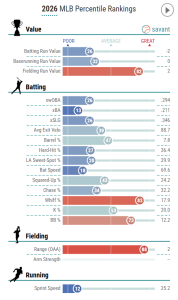
Perhaps the most notable difference is Pasquantino’s power, or lack thereof. He’s not driving the ball with any strength. As such, his max exit velocity is down, and closer to his 2023 numbers than 2025’s excellent 114.4 MPH. His HardHit is down 8.3%, K% is up. His .150 ISO is 89th-best in baseball and puts him among Mauricio Dubón, TJ Rumfield, and José Caballero. It’s not the company Pasquantino should be keeping.
As for how pitchers are attacking him, Pasquantino can’t touch fastballs. He’s hitting .172 against them. And while his .328 slug and .363 expected slug are positive indicators, his .211 expected batting average asks if either of these two stats matters. It’s great he can hit a fastball hard. But if he can’t do it with regularity, so what? All these numbers pale in comparison to Pasquantino’s failures against offspeed pitches. He’s hitting just .071 against them with an 86.9 average velocity. It’s these that are responsible for his rising K%, given his 22.2% PutAway% and 38.9% Whiff% against them.
That said, Pasquantino and the Royals are coming off their best stretch so far. Over the weekend, Pasquantino went 3-9 with five walks and scored four times. It’s no coincidence the Royals swept the Los Angeles Angels and won their first series in a little over two weeks.
Verdict: To find any cryptid, patience is key. The same goes for the Pasquatch. He’s proven himself worthy of some additional time. And if it’s any consolation, Pasquantino has historically been a slow starter, posting a .550, .569, and .697 OPS in his last three Aprils and March.
Steven Kwan, OF, Cleveland Guardians
Ask anyone who’s defined the last five years of Cleveland Guardians baseball. You’ll get the usual answers: Third baseman José Ramírez, longtime skipper Terry Francona, his replacement, Stephen Vogt, ex-Guardian Shane Bieber, and soon-to-be ex-Guardian Emmanuel Clase. Take your pick. But there’s one other name: Outfielder Steven Kwan.
From 2021 to 2025, Kwas was easily the second-best position player in Cleveland. He touted a .281/.351/.390 slashline, a .741 OPS, a 112 wRC+, and was second in fWAR, only trailing Ramirez. He was a two-time All-Star and an even more staggering four-time Gold Glove winner. He’s been Robin, and a fine one at that.
Sadly, Kwan hasn’t been a sidekick in 2026. He’s been a cinderblock. Through 27 games this season, Kwan is hitting .225/.310/.284 with a .594 OPS and a 73 wRC+. He’s homered just once, knocked in eight runs. It’s been a paltry start to say the least. His only extra-base hits include that aforementioned home run and three doubles. Otherwise, it’s been all singles.
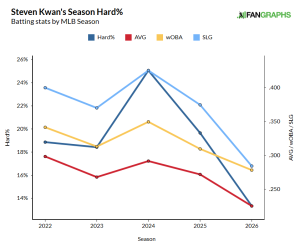
Last season, a relatively worse-than-average one offensively, Kwan was more unlucky than bad. His .273 expected batting average finished in the 86th percentile. And amidst a sea of blue on Baseball Savant, it was one of six offensive red lines.
Fast forward to now, and Kwan can’t even say he’s unlucky. His expected batting average is only .013 points higher than his actual batting average. And though power matters little in his game, almost all of these numbers are lower than before. His max exit velocity is down 4.2 MPH, and his HardHit% is 10% worse. In other words, Kwan isn’t making contact as he should, and he’s hitting it with less force than ever.
Then, what’s changed? Simply, Kwan isn’t hitting breaking balls. He’s still torching fastballs, still struggling against offspeed — and to a greater extent than before — but he’s not connecting with breakers at all. It’s odd. Kwan hit breakers in 2025 better than any other pitch, boasting a .293 average against. This season, he’s hitting .158 against them with a 77.6 exit velocity.
And yet there is some cause for optimism. All that aforementioned red on Kwan’s Savant page is still present. Kwan is in the 99th percentile in Squared-Up%, which would be impressive if he didn’t already have a pair of 100th percentile finishes and another in the 99th. His Chase% is the same, while his Whiff% and K% remain stupid elite. Seriously. He’s in the 100th percentile in the former, and the 97th percentile in the latter.
The Verdict: Believe. It’s a hard thing to do in Cleveland. Here’s why you must. All the things that made Kwan elite are still there. He hasn’t changed drastically. He’s not suddenly chasing pitches and trying to be someone he’s not. He’s the same player with worse results. That should change with time.
Luke Keaschall, 2B, Minnesota Twins
To borrow a phrase from Charles Dickens, the last 12 months have been the best of times and the worst of times for Minnesota Twins second baseman Luke Keaschall.
In 2025, Keaschall made his Major League debut and soared. A .302/.382/.445 slashline, a .827 OPS, a 134 wRC+. Keaschall also had four home runs, 28 RBIs, and 14 doubles, while stealing 14 bags and collecting 81 total bases. He finished ninth in AL Rookie of the Year voting despite playing just 49 games. It was as promising a stint as he or the Twins could’ve hoped for.
2026 has yet to repay that optimism, however. In 26 games, Keaschall’s hitting .208/.254/.264 with a .518 OPS and a 44 wRC+. For the most part, Keaschall’s gone backwards in every way. The bright spots in his stats include one home run, 12 RBIs, three doubles, and six steals. That said, the contact he prided himself on is gone, his excellent BB% has halved, and his OPS is down .307 points.
One of the biggest causes for this decline is that Keaschall isn’t hitting the ball hard. At all. His 26.4% HardHit% stands in Baseball Savant’s seventh percentile, his average exit velocity is in the sixth percentile, and his Barrel% is in the 17th percentile. He has no oomph. Further evidence of this can be found in the launch angle of Keaschall’s bat. It’s up by 7.6 degrees. Due to his abbreviated playing time in 2025, Keaschall doesn’t qualify in most year-to-year leaderboards. But had he, that +7.6 increase would be for the 11th-highest year-to-year rise in baseball.
Perhaps most concerning is that Keachall has played about half as many games this year as he did last. To return to Dickens, it’s becoming a tale of two Keaschalls. One was great, one is a well-below-average ballplayer. One inspired hope, the other invites concern. It was a time of contact and slug a season ago; It’s a time of doing neither now.
Can that change? Yes. And some numbers indicate it might soon. To his credit, Keaschall isn’t getting himself out. He’s made incredible swing decisions for a 23-year-old in his second season. He touts a Chase% in the 79th percentile, a Whiff% in the 97th percentile, and a K% in the 87th percentile. He is not getting impulsive amidst his failures. He is not his own worst enemy. That is an extreme credit to him. Likewise, some of those negatives aren’t signs of regression. Keaschall’s never had elite bad speed, high exit velocities, or high Barrel% or HardHit%’s. And though he outperformed expectations in 2025 due to those, his expected batting average was .263, hardly a paltry figure.
The Verdict: Let Keaschall find himself, because the Twins sure as heck will. This is a team going nowhere. Candidly, they stink. Keaschall has unlimited rope. Due to his previous success in college and in the minors, there’s reason to believe he won’t hang himself with it.
All stats accurate as of 4/28/26
