






Having crossed the midpoint of August, we’ve now reached the point where temperatures will decline across most of North America. In honor of the hottest months of the season, when the ball flies the furthest, let’s dive into the hitters with the most prodigious power in the game. I won’t cover all of the game’s premier power hitters in this one; I’m obsessed with Munetaka Murakami’s plate approach, but I’ve written about him recently. We’ll take our look through the lens of the hitters’ swing decisions.
Here at Pitcher List, we have a suite of PLV metrics to analyze every pitch in a baseball game. Decision Value (DV) is our hitter swing decision metric. It takes inputs like pitch velocity, location, and movement, and tells us whether the hitter made a good decision to swing or take a particular pitch. This isn’t quite as simple as plate discipline; swinging at a Logan Webb sinker and pounding it into the ground is a bad outcome even if the pitch was a strike.
Instead, Decision Value rewards hitters for swinging at pitches they should be able to hit hard, and for taking pitches they’re unlikely to do much with. The flip side is that Decision Value punishes hitters if they don’t swing at pitches they should be doing damage on or swing at pitches that are unlikely to generate quality contact. You can find a much more thorough introduction to PLV metrics and Decision Value here.
Kyle Schwarber – 103 DV (91 zDV, 105 oDV)
As has been tradition for at least the past five years, any discussion of the league’s premier power hitters will include Schwarber near the start of the list. Schwarber stands out on this list as one of two hitters with a better-than-average approach at the plate thanks to his 76th percentile chase rate. As opposed to Schwarber, the league’s best power hitters tend to rank well in zDV. The median zDV at this point in the season is 96; Schwarber and Yordan Alvarez are the only hitters on this list who rank below that number. I’ll spill a little more (virtual) ink on Schwarber because he’s a good example to contextualize the
To unpack Schwarber’s below-average zDV a bit, it’s worth considering how DV is calculated. Without doing all the math, let’s consider a simplified version of DV that doesn’t adjust for every possible edge case. Suppose we’re looking at a pitch in the zone, and therefore one that’s going to be called a strike if Schwarber lets it go. If Schwarber swings at it, the computation underlying his zDV will compare the average outcomes of a swing at that pitch against the value of a strike for the pitcher. Among pitchers who have thrown at least 25 innings this season, Jacob Waguespack leads MLB with a .247 xwOBACON allowed. Let’s assume that .247 is his xwOBACON for both strikes and balls; I’ll do the same with other stats since I don’t have a convenient source of ball/strike splits for every metric. Waguespack has a 25% whiff rate; swings and misses on strikes are neutral to zDV, though, since a swing and miss at a strike yields the same outcome as letting the pitch go. So, when Schwarber decides to swing, zDV will essentially compare the .247 xwOBAcon if he makes contact vs the expected run value of a called strike. A hitter with a .247 xwOBA would be the worst qualified hitter in the majors this season, so it’s often a bad idea to swing at Waguespack’s strikes. The counterpoint is that the value of a called strike varies with the count; a called strike doesn’t make much difference in a 3-0 count, but with two strikes, it’s really bad to give up a strike.
So, with that all in mind, why does Schwarber have a below-average zDV despite swinging at exactly the league average amount of strikes? I’ve got a couple of possible reasons here. First, Schwarber becomes dramatically less aggressive in the zone in the best hitters’ counts. Despite swinging at precisely two-thirds of strikes overall, he swings at 46.9% of 3-0 strikes and 54.9% of 3-1 strikes. Those are probably the best pitches he’s going to get to hit. Schwarber only gets about a quarter of his 3-0 pitches in the zone, so he appears to have decided they’re not worth gearing up for. He won’t get dinged too much by zDV for the cost of the extra strike, but if he’s watching get-me-over fastballs in hitters’ counts, zDV will argue he should swing more. On the other side of the equation, Schwarber doesn’t become much more aggressive in the zone on x-2 counts, either. When the cost of a strike is at its highest, hitters should be less selective. Schwarber swings at between 63.5% and 67.9% of strikes in all counts other than 3-0 or 3-1, though. Differentiating his approach a bit based on the count and looking to swing at 3-0 strikes could both nudge his excellent performance further upwards, though.
Matt Olson – 105 DV (98 zDV, 103 oDV)
Olson is the other hitter on our list with an above-average DV. Olson chases a tiny bit more than Schwarber, but still ranks in the 66th percentile for chase rate. The more peculiar feature when comparing the two is that Olson has a better zDV despite swinging at about 2 percentage points fewer strikes. Olson is better than Schwarber at being aggressive on the best pitches to hit. MLB averages an OPS of .778 on fastballs, while breaking balls sit at .653 and changeups/splitters at .607. Olson swings at 75.9% of fastballs in the heart of the zone, the 79th-highest rate of the 278 hitters who have seen at least 500 pitches this season. Schwarber, on the other hand, swings at only 69.7% of these pitches, 180th in the league by the same metric.
Otherwise, the two sluggers’ approaches are fairly similar. Olson also shares Schwarber’s extremely passive approach with 3-0 and 3-1 counts. Olson swings at just 11.4% of 3-0 pitches, courtesy of a 40% zSwing and pitchers throwing him strikes just 20.3% of the time. Olson also chases a bit more than Schwarber, but not enough to move the needle much on his oDV.
Yordan Alvarez – 89 DV (90 zDV, 98 oDV)
The third of our more selective mashers, Alvarez is having an otherworldly season. He’s sitting atop leaderboards as clearly the best pure hitter in the game this year, sitting at a 183 wRC+ that’s nearly 30 points ahead of second. Alvarez gets dinged a bit by our plate approach metrics because he only swings at 61% of strikes. That’s a career low for the Astros’ slugger, although it’s hard to argue with the results.
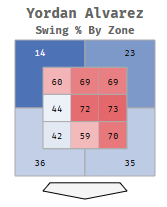
In Alvarez’s case, a lot of where zDV is dinging him comes from being relatively passive in the middle of the plate. He’s leaned into pulled fly balls even harder this year, reaching a career high of 24.8%, which explains why he rarely swings on the outer half of the plate. Olson and Schwarber both swing more than Alvarez on middle-middle pitches, though, which zDV ranks as the most hittable pitches. Alvarez is also excellent at avoiding chase above the zone, although he chases below the zone a bit more than you’d prefer to see. That’s not a given for this profile of hitter; Olson and Schwarber share Alvarez’s aversion to chasing up-and-away outside the zone, but they both chase more up-and-in than below the zone. Alvarez whiffs on pitches below the zone more than nearly any other spot, but when he connects on a pitch low-and-in, he still gets exceptional results.
Junior Caminero – 91 DV (98 zDV, 96 oDV)
Caminero is our archetype of the more chase-prone style of masher. He’s actually toned it down a bit this season, cutting his zSwing from a career-high 69.5% in 2025 to 62.7% this season. His 91 DV is a career high, though, as he’s managed to trim a few percentage points off his chase rate every season. Contact gains have come with his newfound selectivity. Caminero has never been particularly whiff-prone, but he’s cut his swinging strike rate from 14% in 50 games in 2023-24 to 11.7% last year and 9.3% thus far in 2026. In addition to swinging less, which gives him fewer opportunities to swing and miss, he’s ratcheted up his zone contact rate to 87.5% after sitting at 83.3% last year.
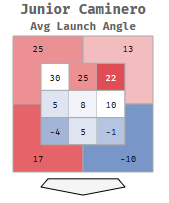
Caminero mashes despite having suboptimal launch angles for a hitter with his power. He has nearly as many homers in the middle-up zone, where he gets better lift, as he does in the middle-middle zone despite swinging at nearly 40% more middle-middle pitches. When Caminero manages to elevate, he does incredible damage. On those middle-up pitches, Caminero has a 1.021 xSLG compared to a .724 xSLG on middle-middle pitches. Caminero is very similar to Vladimir Guerrero Jr.. in many ways, but with a bigger margin for error based on 3 mph more bat speed.
Brandon Lowe – 90 DV (100 zDV, 94 oDV)
It may surprise you to learn that Lowe has averaged 34.5 homers per 162 games for his career, even though he’s only surpassed 30 in a season twice (so far). The culprit is extensive time missed with injuries and the Rays choosing to platoon him extensively. Lowe has more above-average than exceptional bat speed, but he has a very short swing for a power hitter (7.1 feet as opposed to Caminero’s 8.7, for example). Bat speed tends to increase with Statcast-measured swing length, so you should mentally adjust Lowe’s 73.6 mph bat speed upwards when comparing to Caminero’s 79.8 mph.
Lowe has the second-highest strikeout rate in this group, trailing only Schwarber. He’s much more aggressive in the zone than the preceding hitters, swinging at 70.5% of the strikes he sees. That’s actually a huge decrease from previous seasons; Lowe averaged a 77.4% zSwing entering this season. With a zone contact rate that’s about 5 percentage points worse than league average, Lowe’s aggression generates a lot of swinging strikes (16.4%). Lowe is also hurt by a chase rate that has crept up to a career-high 32.6% this year. He’s still managing a nearly 40% zSwing-oSwing, though, which is a hallmark of a good plate approach. Part of the issue is that Lowe has trimmed his zSwing on both clear strikes and marginal strikes, while also swinging substantially more at clear balls. He’s an excellent power source, especially at second base, but there’s a reason he’s never going to reach Olson levels of batting average, much less Caminero or Alvarez.
Casey Schmitt – 88 DV (102 zDV, 93 oDV)
Schmitt makes the list on a plate-appearance-adjusted basis, hitting 21 homers in 409 trips to the plate. Schmitt has adopted the lift-and-pull approach characterized by hitters like Isaac Paredes and Alex Bregman. He hasn’t reached Paredes-ian levels yet – no one has – but he puts 26.2% of his batted balls in the air to the pull side. This is essential for hitters like Schmitt and Paredes to generate their power output. Schmitt has 54th percentile bat speed and 62nd percentile average exit velocity. Those are both fine, but hardly representative of the rest of this list.
Schmitt swings a ton, ranking 14th among qualified hitters in overall swing rate. He gets there by being indiscriminate, ranking above the 80th percentile in both oSwing and zSwing. Schmitt makes a ton of contact in the zone (90.7%), so I’m a little unclear on why he feels the need to swing at everything. There’s a bit of an early-career Bo Bichette vibe in his plate discipline, with the principal difference in outcomes being that Bichette has always been allergic to pulling fly balls. Schmitt’s combination of aggression and contact means that he’s putting nearly everything in play. Schmitt’s approach drags down his overall value to his team, leading to a 1st percentile walk rate of 2.7% and a .301 OBP despite a .272 average. That’s less relevant for traditional fantasy scoring categories, but I’d revise my expectations for Schmitt’s runs scored downward in future seasons.
