






Here at Pitcher List, we have a suite of PLV metrics to analyze every pitch in a baseball game. Decision Value (DV) is our hitter swing decision metric. It takes inputs like pitch velocity, location, and movement, and tells us whether the hitter made a good decision to swing or take a particular pitch. This isn’t quite as simple as plate discipline; swinging at a Logan Webb sinker and pounding it into the ground is a bad outcome even if the pitch was a strike.
Instead, Decision Value rewards hitters for swinging at pitches they should be able to hit hard, and for taking pitches they’re unlikely to do much with. The flipside is that Decision Value punishes hitters if they don’t swing at pitches they should be doing damage on or do swing at pitches that are unlikely to generate quality contact. You can find a much more thorough introduction to PLV metrics and Decision Value here.
In today’s edition of PLV DV Weekly, we’ll be checking in on some of June’s hottest hitters. A batter heating up at the plate is sometimes just statistical noise. On other occasions, though, we may be able to identify concrete changes a player has made that are leading to the improved outcomes. Today, we’ll be taking a look through the lens of swing decisions to see whether changes in approach have led to improvement at the plate.
Shohei Ohtani – Last 30 days: .374/.479/.697, 220 wRC+
Despite his otherworldly talent, I believe this still qualifies as a heater for Ohtani. His overall season line sits at .296/.418/.545 – still elite, but actually a step down relative to his prior three years’ production at the plate. Ohtani has gained his elite OBP by adding a 16.0% walk rate on top of his strong average. He’s also avoiding strikeouts at close to a career-best rate (23%).
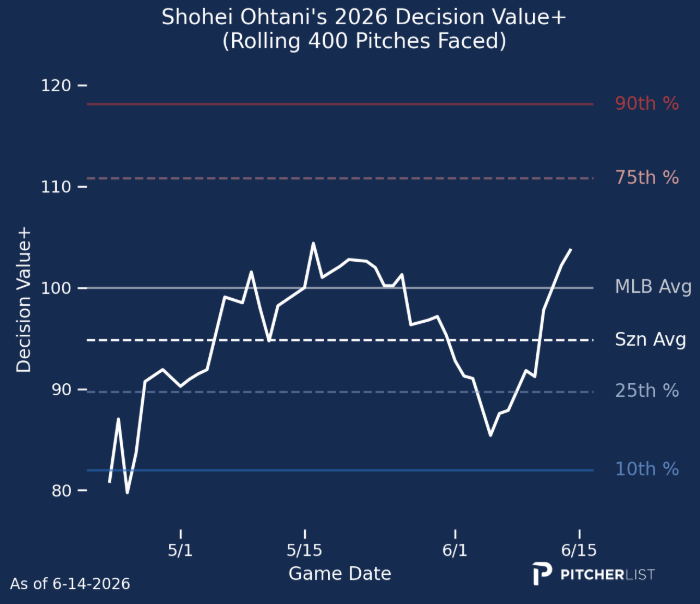
Perhaps surprisingly for someone with such elite walk and strikeout outcomes, Ohtani’s swing decisions might be the only below-average part of his game. This isn’t that unusual for the game’s brightest stars. Yordan Alvarez is also below average by DV, in part because he can crush anything he wants. In Ohtani’s case, he’s taken a small step back in his decision-making from 2025, when he had a 102 DV. The main issue, such as there is, is that Ohtani has gotten less aggressive in the zone. He’s only swinging at 62.8% of strikes this year, as opposed to 66.1% last year, and rates around 70% the preceding four years.
Over the past month, Ohtani’s DV has ticked up to average at 101. All of the movement is coming from an increase in his oDV, however. The changes he’s made are minute, chasing 2 percentage points less often and swinging in the zone 3 percentage points more often. There’s not much difference in his contact quality, either. He’s barreling the ball 1 percentage point less often during his hot streak, although his average exit velocity is up 0.9 MPH. Instead, this appears to be a sustained run of fortunate batted ball outcomes. Ohtani has a .446 BABIP over the past month and has outperformed his Statcast xBA by 19 points. His seasonal BABIP is .355, a cut above any season he’s posted since 2019. If there’s some regression in his batted ball luck, you’d expect his batting average to tick down. On the other hand, if his 20.8% HR/FB moves closer to his 27.5% career rate, he’ll gain some non-BABIP dependent batting average back. What a stud.
Dominic Canzone – Last 30 days: .347/.420/.736, 222 wRC+
The only hitter in baseball hotter than Shohei over the past month, Canzone has demolished major league pitching. Canzone’s Seattle breakout appears complete. A year after posting a .300/.358/.481 line in 268 plate appearances, Canzone has replicated it with a .293/.365/.575 line in 2026. Unlike his 2025 success, this season has some more markers of sustainability, with his BABIP dropping from .354 to .311. Canzone has also improved his plate discipline, taking more walks and striking out less than in past seasons.
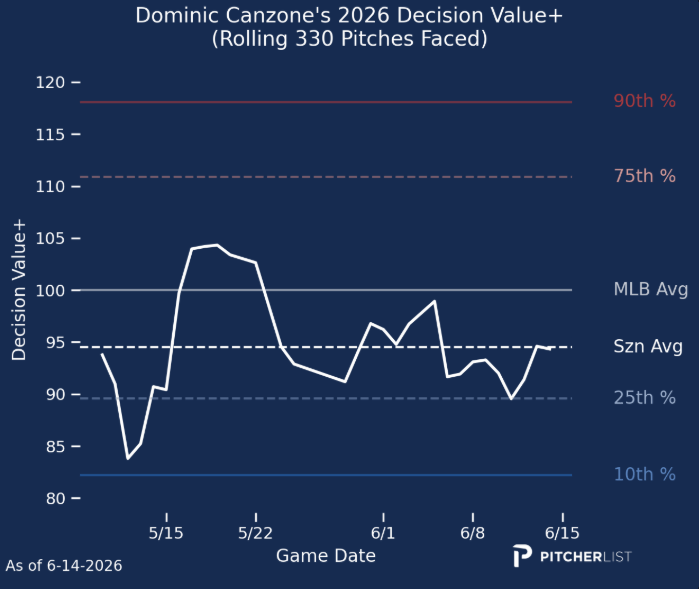
Canzone is also not an elite swing decision-maker. He swings at strikes 64.2% of the time and chases 32.7% of the time. Over the course of his extended hot streak, Canzone has maintained a DV that’s basically the same as his season number, 93 vs. 94. The unchanged DV is masking a little action in his swing decisions, though. Canzone’s zDV is up from a 96 on the season to a 102 during his hot streak. His oDV is down from 98 to 95. Over the same timeframe, Canzone has chased 2 percentage points more often and swung in the zone 3 percentage points more often. The whole season is a massive improvement on his 2025, though. Canzone had just an 80 DV in 2025, driven largely by a 36.8% chase rate.
Like Ohtani, Canzone has had some modest improvement in batted ball quality during his hot streak. He’s hitting the ball about half a mile per hour harder and barreling 1 percentage point more balls. Unlike Ohtani, he’s not running an extreme BABIP. Canzone’s BABIP is just .346 during his streak; high, but not outrageous. Sure, Canzone’s outperforming his expected stats over the past month – you have to get a little lucky to run a 222 wRC+ – but his xBA is .317, and his xSLG is .610. His .427 xwOBA would rank 2nd in MLB for the season, just ahead of Nick Kurtz, trailing only Yordan Alvarez.
Jung Hoo Lee – Last 30 days: .468/.475/.597, 204 wRC+
I kind of love Lee. He’s probably not the hitter Canzone is, and he’s definitely not the player Ohtani is, but he’s one of the most extreme players on nearly every metric. Lee’s hot streak has raised his season line to .325/.357/.448. That’s a 60-point improvement in his batting average, but only an additional 30 points in his OBP, and 41 points in his slugging. Essentially, Lee has traded a good number of walks and a bit of his power to slap singles all over the diamond. Lee has walked in just 4.1% of his plate appearances this year, with a 9.8% strikeout rate. During his hot streak, he’s walking just 1.3% of the time and has cut his strikeout rate to an Arraez-ian 3.8%.
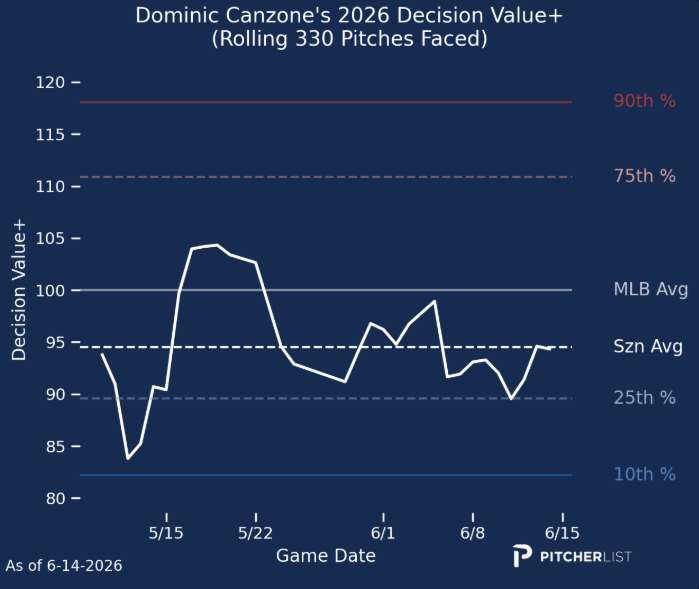
Okay, maybe I lied – he’s not extreme on our swing decision metrics, but I promise there’s more coming. Lee is in the Luis Arraez, Nico Hoerner class of hitters who can get the bat on anything they want. Sometimes that leads to poor swing decisions, although Lee has shown pretty solid decision-making during his time in the majors (112 DV in 2025). This season, Lee has been chasing 29.7% of the time, up from 22.4% last year. During the past month, his chase rate has increased by another 1.5 percentage points. His oDV for the past month is an even 100 during his streak, up a bit from his 98 for the year. His zDV during the past month is 104, an improvement of 4 points on his season value. Lee’s been swinging in the zone less than 1 percentage point more often during the past month, so his improvement is coming from changes in the selection of what he’s swinging at.
Lee’s exceptional contact ability has also manifested in solid contact quality for a guy with little to no power. While Lee is in the 8th percentile in barrels and bat speed, he’s in the 98th percentile in squared-up rate. His 5th percentile walk rate is offset by a 97th percentile whiff rate and 99th percentile strikeout rate. Ultimately, he’s a guy who gets everything possible out of his swing and swings often. He’s not hitting the ball any harder during his hot streak, nor is he barreling it more. He’s just consistently getting the barrel of his fairly slow-moving bat to the ball and placing singles everywhere. He’s running way hotter than anyone can imagine him sustaining (.473 BABIP), but even regression to his expected stats would leave him with a .378 average and .490 slugging for the past month.
Matt Chapman – Last 30 days: .313/.408/.576, 170 wRC+
Chapman is only running a 170 wRC+, good for 16th in MLB among qualified hitters over the past month. I wanted to highlight him, though, because unlike the other hitters mentioned, this is a season-saving hot streak for Chapman. Through May 16th, Chapman was hitting .216/.291/.298, a line even his excellent glove can’t redeem. His season line now stands at .252/.337/.400. Chapman’s missing some power relative to his career averages, but his line is 9 percent better than league average by wRC+.
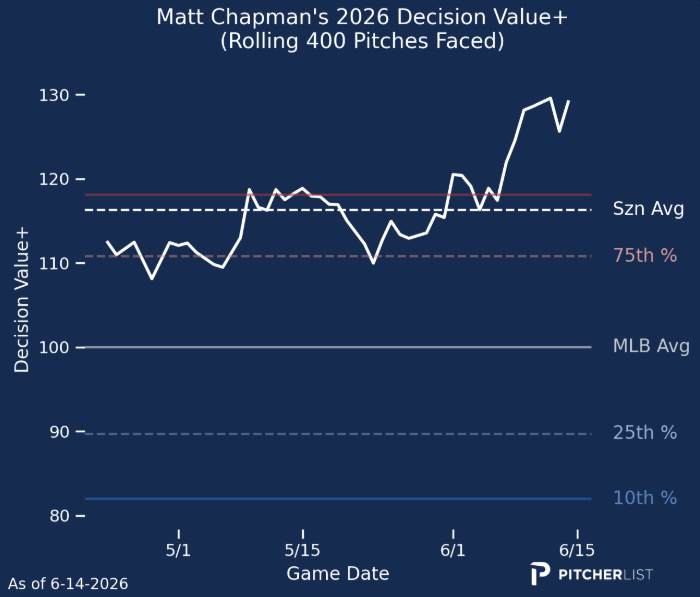
Chapman’s also the best decision-maker on this list, and his hot streak is supported by an upswing in the quality of those swing decisions. On the season, Chapman is chasing 26.6% of the time and swinging in the zone 63.1% of the time. The chase rate is a career high for Chapman, but the zone swing rate is right in line with his career norms. Over the past month, Chapman has chased a smidge more, but also increased his zone swing rate to 65.9%. The combination has led to a 130 DV since May 17th, tied for 5th in baseball. It’s a balanced skill set, with only Miguel Vargas posting both a better zDV and oDV over that time span. Chapman’s seasonal DV is up to 117, close to where he finished 2025 (120).
The changes in Chapman’s swing decisions are fairly small, but very positive. His increased zone swing rate is coming predominantly on pitches Statcast classifies as in the heart of the zone. While his “shadow” swing rate is up 0.7 percentage points over the last month, he’s swinging 4 percentage points more often on pitches in the heart of the zone. As a result, his zone contact is up 5 percentage points vs his season average. His average exit velocity is up 2 MPH over the last month as well, leading to a 9.3% barrel rate, up from 6.6% on the season. The barrel rate is still well below his career average, in part because Chapman’s average launch angle is 10.2 degrees on the season (12.3 degrees over the past month). Of these four hitters, Chapman appears to be the one making the most concrete changes to improve his outcomes at the plate. A little additional refinement to get some of his lift back, and we could see the return of 120 wRC+ Chapman over the rest of the season.
