





As we look at risers and fallers in points leagues, the focus should not just be on how players are performing, but what their role is.
Are your hitters suddenly leading off or batting lower in the order than expected? Have they gotten an off-day, and is it because the manager put them in a platoon? Or did they get subbed out at the end of a game for defensive reasons?
As for pitchers, did they get pulled after just 70-80 pitches, or were they allowed to work deep into the game? And could anyone on the IL or in the minors threaten their rotation spot?
As volume is everything in points leagues, these are the questions you want to answer beyond just whether a player gets hot. So, given their role and their performance, who should you buy in on, and who should you leave alone?
Risers
Could the Marlins have a new leadoff hitter? Heriberto has landed the role in three of the last four games, mainly thanks to a 16% Walk rate in August. Pounding 20 homers since June 1 also doesn’t hurt, and while his average is a not-great .229, he gets enough free passes to make a decent trade-off. With the volume that comes with a leadoff role, Hernandez looks like a solid investment down the stretch.
Think of him as a young Kyle Schwarber, whose extreme walk rate and tendency to mash balls over the fence also netted a three-outcome player an unconventional leadoff role. While Heriberto’s hard-hit metrics aren’t quite on the level of Schwarbs, they’re not far off. Hernández is barreling the ball 13.4% of the time with an Average EV over 91 mph, and his xwOBA is over 35%. He also crushes lefties, with 10 homers in just 120 at-bats, and maintains a better-than-2:1 K-to-BB ratio against them. If he can just make a little more contact against RHPs, the sky’s the limit.
As the Phillies have Schwar-bombs, now the Marlins have H-bombs.
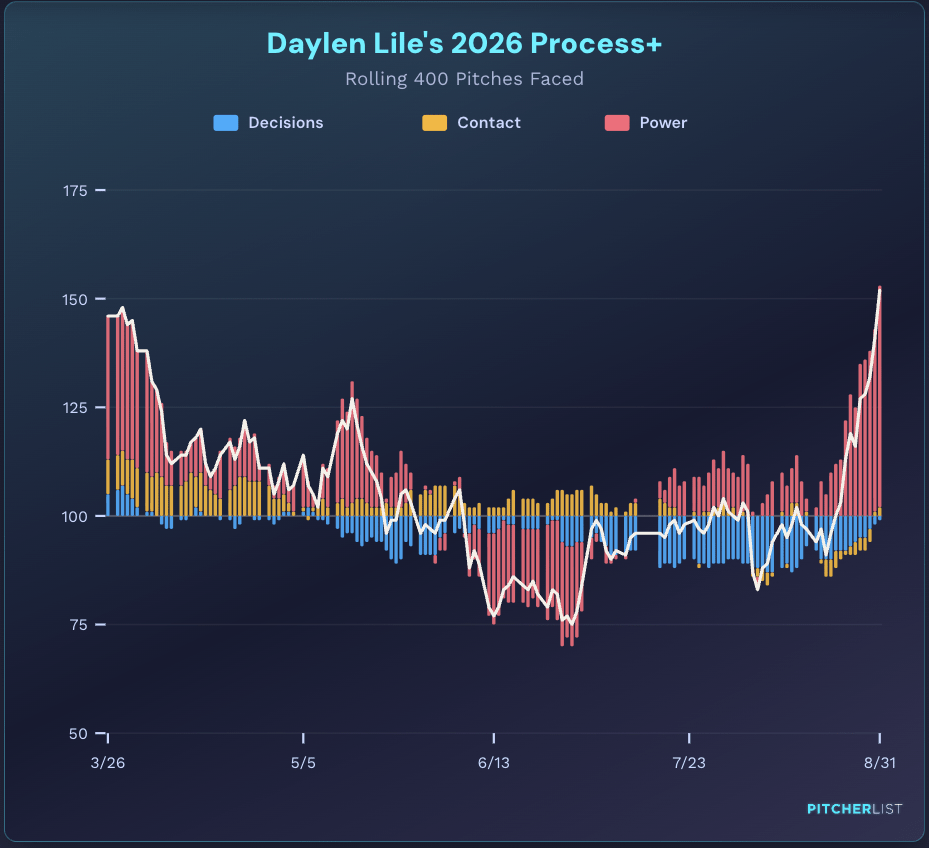
Lile was a talked-about sleeper after hitting .299 with nine homers and eight steals (and eleven triples!) in just 91 games last season. But there was a lot of skepticism in these numbers as he had just a 5% Barrel rate and Average Exit Velo’s under 89 mph. So who was right?
Well, while the average is a bit down from last season, everything else is coming up roses. In the middle of his already-a-breakout season, Lile just had a breakout month. In 117 PA’s in August, he hit .292 with an .897 OPS with seven homers and 26 RBIs. And he’s even taken that to another level in the last week, blasting three of those seven homers and hitting .429.
The power surge is a bit unexpected—given his Minor League career high in homers was NINE—but Lile’s been working with hitting coaches all season to maximize his swing mechanics for more power. And while his overall EVs are about the same, his Barrel rate has nearly doubled to 9.2%. Now, he’s a 20-homer hitter in the Major Leagues.
And he seems to like his new role in Arizona, where he’s leading off most of the time and succeeding at his main job, which is to get on base. But he’s also adding a little power with that, with an OPS as a D-back that’s 80 points higher than it was with the Cardinals. His hard-hit metrics suggest he should be slugging the ball even better, with an xSLG 70 points higher than his actual.
But one caveat here is Nootbaar doesn’t hit lefties well, with a .460 OPS against them this season. And he’s not getting many chances against them, either, as he’s scratched out only 42 plate appearances. That’s a curious development given his .800 OPS versus southpaws in 2024, but the long and the short of it is he’s in a platoon. So if, like many points leaguers, you need a guy in the lineup every day, Nootbaar might not be your guy. But I’m watching him closely to see if the Diamondbacks give him the chance.
Mayo might’ve been brought up to the Majors a little too soon back in 2024, where he was a September call-up and hit just .098 in 41 AB’s. But while he continued to struggle at points last season at the age of 23, he took some genuine steps forward (and it’s hard not to improve on a .294 OPS). He ended finishing the season on a high note, batting .301 with five homers and a .548 SLG in September.
That led a lot of fantasy owners to take a chance on him this year, and while the first half of his season was rough, he appears to have turned a corner—at a point in the season that very closely mirrors 2025. In Mayo’s case, aggressiveness leads to success, and he’s made the adjustment to swing at pitches earlier in the count; basically, letting his 13% Barrel rate do the talking. That’s led to a terrific run over the last seven games, where he’s slugged .667, hit two dingers, and driven in seven runs.
That said, I’d much rather have Mayo in a format where the K’s don’t punish you quite so much. Though he’s hitting .270 after the All-Star Break with this new “swing first, ask questions later” approach, it’s inflated an already high level of strikeouts. And like with Nootbaar, there’s the question of a platoon—though with Mayo it’s reversed, as he crushes lefties with a 1.143 OPS. But he’s starting to get more appearances against righties and his recent performance should net more starts. The O’s also have a favorable schedule as they’re currently playing in Colorado with seven games this week—Mayo’s worth keeping an eye on at least.
Those starts went seven and eight innings, respectively, which is a lot of outs.
But along with the elite volume, Wacha’s elite control is what keeps his points value so high. In those starts in August, as he accrued all those outs, he only walked four batters in over 32 innings. I’m not sure how he’s found this new level at age 35, but let’s just sit back and enjoy the ride.
