





As we look at risers and fallers in points leagues, the focus should not just be on how players are performing, but what their role is.
Are your hitters suddenly leading off or batting lower in the order than expected? Have they gotten an off-day, and is it because the manager put them in a platoon? Or did they get subbed out at the end of a game for defensive reasons?
As for pitchers, did they get pulled after just 70-80 pitches, or were they allowed to work deep into the game? And could anyone on the IL or in the minors threaten their rotation spot?
As volume is everything in points leagues, these are the questions you want to answer beyond just whether a player gets hot. So, given their role and their performance, who should you buy in on, and who should you leave alone?
Risers
A look at Bazzana’s .211 average might have you shaking your head, until you see that he has a 23.1% walk rate. Which is INSANE. Sure, he’s only got 52 total plate appearances since his call-up, but a 7:12 K:BB ratio is something every points league owner should salivate over.
Bazzana’s early metrics are interesting. He doesn’t swing the bat hard (68.7 mph) and he’s only got a single barrel (which resulted in his only homer), but his exit velo’s are solid (90.8 mph average, 108.1 mph max). He’s showing tremendous plate discipline already with a Chase rate in the 95th percentile, and he whiffs less than 20% of the time. And while that Batting Average still looks paltry, his xBA is closer to .270. Long story short, this is points league gold.
The Guardians are taking notice, as a .423 OBP should warrant attention. Batting seventh or eighth in his first several games, he hit fifth on May 12 and was slotted in at sixth in three of his last five. With Steven Kwan struggling this season to a .300 OBP, there’s a decent chance Bazzana gets to lead off by the end of the season.
Vargas doesn’t have a shade of blue in his Statcast metrics, and his only below-average stat is his Exit Velocity, which is still 47th-percentile. Last season, it took 569 Plate Appearances to get to 16 homers—this season he’s got 9 dingers in 172 PAs. And he’s also swiped six bags, which already ties his career high.
The White Sox are the AL’s Fun Team To Watch, as a bunch of young guys and castoffs try to make something special. Vargas is at the heart of that, and he should be rostered everywhere.
Brandon Marsh against lefties in 2025: a .197 average with a 42% strikeout rate. Against lefties in 2026: a .286 average with a 35% strikeout rate. Yes, that’s still too many K’s—but the important thing is he’s getting more chances to play every day. Aside from his rookie season, Marsh has never hit better than .222 against southpaws, so this is a significant early improvement.
As for his success against righties? Well, his overall numbers this season are a .353 average with an .888 OPS.
Marsh has been hitting fifth in the Phillies lineup most of the time, and seems comfortable in that spot with a .406 average and 9:5 K:BB ratio. For a career strikeout artist with a K-rate over 30%, the 19.4% mark he’s putting up so far is huge. An improved Zone Contact rate (over 90%) appears to be the driver here—when the pitch is a strike, he’s not missing.
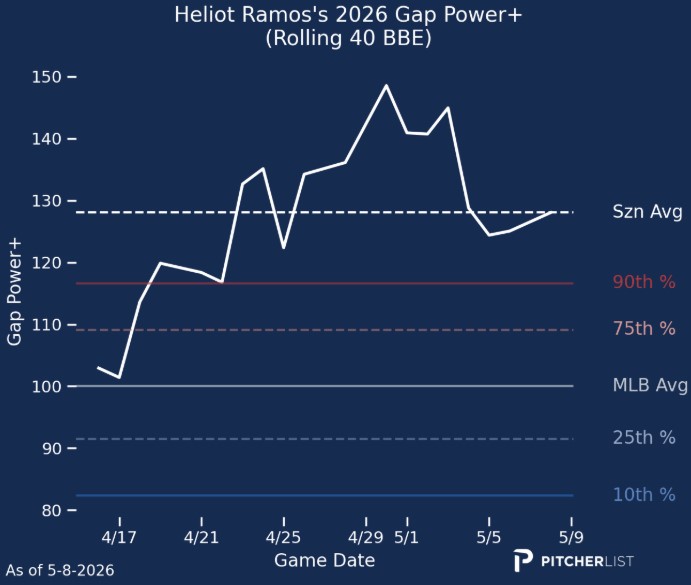
Ramos doesn’t have the points league profile of the first two names on this list, but he’s cut his K-rate down to below 20% in May and is driving the ball again with six XBH’s in his last ten games. His Hard-Hit rate is in the 91st percentile and he’s now up to a 13.5% Barrel, using the spacious gaps in San Fran to his advantage.
Heliot’s already hit in seven different spots in the Giants’ batting order, so it’s tough to predict where he’ll slot in on any given night. But lately he’s been getting a few chances to lead off, and in other games he’s hitting either fourth or fifth, so additional volume has come with his turnaround. Some guys are successful in points as purely doubles hitters, and Ramos is one of them as his gap power illustrates.
Ed-Rod’s been a pretty decent starter in Categories leagues, but in points he’s something else altogether. Getting wins in three of his last four starts, Rodriguez has become a volume king, with 15.1 IP over his last two outings. And he did all that with a combined .78 WHIP. While he hardly racks up the K’s (33 in 48 IP this season), he’s pitching to just 6.8 hits per nine innings and has almost cut his homer rate in half.
While all of this is tremendous, there may be some regression incoming. His Walk rate is currently a career-high 11% and his K-rate a career-low 16.5%. Also, his Swinging Strike rate sits at just 7.8%. Still, results are results, so ride the wave while it’s there.
Bouncing in and out of the Majors in Colorado, Lambert never made much of an impression—but pitching in Coors can do that. Now with Houston, Lambert’s had a strong run in his first five starts, showing some sold swing-and-miss capability with a 28.2% Whiff rate. He’s only getting barreled 5.2% of the time and netting a lot of ground balls. The former second-round pick out of San Dimas High School (cue the Bill and Ted air guitar) might be coming into his own, and points league players should find his 5.2 innings per start and 1.13 WHIP with a nearly 9K/9 intriguing. He makes for a solid streamer in almost any matchup, as his scoreless seven-inning outing against the Dodgers last week should show.
Fallers
This is not a knock on Ballesteros’ capability as a player (the future is SO bright), but he’s really slumping of late and it can’t be ignored—and sadly, that’s meant some adjustments to his volume.
Ballesteros was on everyone’s grab-him-now list given he was moved to second in the batting order and he was getting more time at Catcher, which would give him additional eligibility (in many leagues, he’s just a DH or UTIL, like Ohtani and Schwarber). Oh, and as of April 24th he had a .400 batting average and a 1.098 OPS.
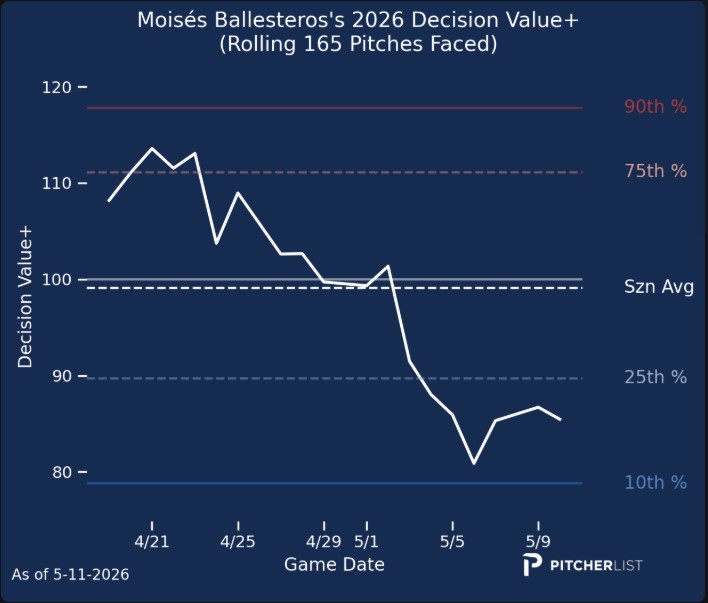
In May, however, that’s come crashing down to earth—he has just a .067 average on the month with one homer, and his OPS has dropped nearly 300 points. Looking at his advanced stats, it looks like two factors are to blame.
First, his Decision Value appears to have dropped precipitously over the last month or so, from a very good 75th percentile down the 20th percentile:
Second, his quality of contact has also fallen, meaning more grounders and pop-ups and fewer line drives.
Can he turn it around? Sure, as it looks like even with these recent issues he’s not striking out a ton (still in the low 20’s). But as he was potentially looking like an everyday player who was going to hit near the top of a very impressive Cubs lineup, that’s not going to happen for a while. And he still needs to show he can hit against lefties to truly become a points-league powerhouse.
Aside from Lambert, it is not a good time to be a Houston Astros pitcher. After a long hiatus, McCullers came back to the league with a bang in his first start, striking out nine in seven innings, mostly powered by his sinker. Since then, he’s gotten pummelled, and a sparkling 1.29 ERA has ballooned to 7.41. He was pummeled by the Dodgers in his last outing on May 6, yielding six earned runs in 2.2 IP and ending the night with a 2.63 WHIP.
McCullers has decent Whiff and Strikeout rates and is (for now) netting more than a K per inning, but that becomes less impressive if you’re facing an average of six hitters in each frame. His Hard-Hit rate is in the tenth percentile, and his 13.5% Walk rate highlights his lack of command. The results are unsightly: despite missing a couple of starts in the early season, he’s given up the second-most runs in the American League. There might be a silver lining in that his xERA is around 4.5, but he should be a drop until he shows better form.
