





The Milwaukee Brewers are smarter than your favorite baseball team.
The proof is in the pudding, from getting this version of Jacob Misiorowski to Brice Turang’s never-ending ascent. Kyle Harrison is a new man, Shane Drohan came out of nowhere, and Gary Sánchez and Andrew Vaughn are excelling on the short end of their respective platoons. When they make a trade, we assume they’ve won it; when they do something surprising, we surrender our skepticism in an appeal to authority.
The Brewers must know better than us. At the very least, they always seem to.
Part of this calculus lives in the roster spots not home to 105-mph fastballs. It is of little surprise that Milwaukee, despite losing five pitchers since the start of June, will enter the second half with the league’s most valuable pitching staff. Misiorowski isn’t alone, either; the Brewers’ bullpen ranks fourth in fWAR and fifth in ERA. Milwaukee is nearly as deep as it is potent, thanks to an unrelenting churn of player development victories.
One such win is lefty reliever DL Hall. Armed with a new sinker, Hall is navigating a declining four-seamer and dealing with the most complete arsenal of his career.
Super Supinator
Hall entered the league in the golden age of high-carry fastballs meant to dominate above the letters. For a brief moment, he joined them, tossing a four-seamer with 15.8 inches of iVB and just 6.5 inches of arm-side run, all while sitting at 96 mph.
It didn’t last. Hall has struggled with injuries since his 2022 debut, and they’ve taken their toll. By Stuff+, Hall’s four-seamer declined year-over-year for three seasons, bottoming out at 82 before gaining back some ground in 2025. His velocity fluctuated, and the shape fluttered with it. He has gained 1.4 inches of run while losing 1.9 inches of ride, flirting with the dead zone as he lost over a tick on the radar gun.
Hall was always walking a tightrope as a supinator with an elite heater. Without the pure backspin of his pronating peers, the pitch had a fragile profile. That came to fruition in 2024 and 2025, when it started to miss fewer bats and hit more barrels. As his most frequent offering, Hall was getting into trouble more often, reflected in his xFIP rising from 3.11 to 4.48 and 4.85. There’s some small sample size noise here—he’s yet to throw 45 innings in a season—but Hall’s pivot is an acknowledgment that something was amiss.
Milwaukee sought to address Hall’s diminished fastball by adding a different one.
Rather than embracing a cutter, the more natural pivot for his supination bias, Hall doubled down on the sinker he threw on 6.5% of pitches a season ago.
Hall’s sinker is sporting above-average horizontal break with much of the velocity and extension that once made his four-seamer dangerous. He has achieved this through seam-shifted wake, which allows pitchers to access movement profiles that their observed spin axis would not suggest. This happens by changing the orientation of the seams, which then forces an asymmetric airflow around the ball and creates movement separate from the typical Magnus effect.
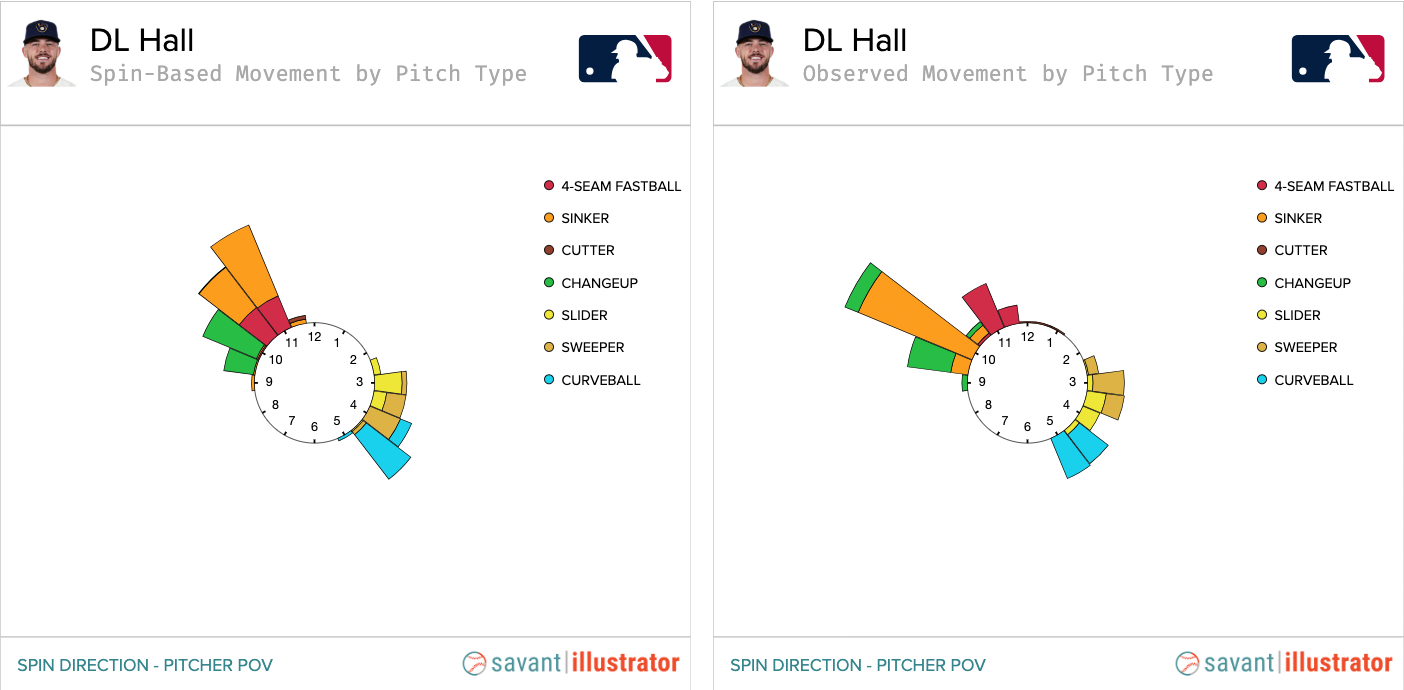
In all likelihood, Hall would struggle to throw ordinary sinkers, pronating his way to left-hand turns. Here, he can work with his natural biases—the same ones that allow him to throw three distinct breaking balls.
Hall still doesn’t top any leaderboards. By Baseball Savant’s count, his 45 “minutes” of deviation is 53rd among 83 (qualified) left-handed sinkers. However, it’s the same as the aforementioned Drohan and Tarik Skubal, each of whom has benefited from quality sinkers. Present-day pitching development is more about arsenal diversification than outlier movement, and Hall is checking the box with a two-seamer that has quickly become his primary pitch.
The Impact of an Ordinary Pitch
It’s important to note that Hall’s new sinker is… fine. Its 107 Stuff+ says it’s good, not great (albeit an improvement from 95 last season). By PLV (4.80), it’s a 37th-percentile offering, and a startling 40% of them are labeled as “bad” by that same metric.
Hall’s new toy isn’t taking over the sport. But in a game of pie charts, bell curves, and heatmaps, his sinker is making life a little easier.
For one, he’s not throwing his worst pitch nearly as often. Hall’s four-seamer has been uncompetitive in 2026, with an abysmal 26.9% zone rate and poor metrics on contact. I’d argue that throwing it an eighth of the time is still too much, at least while command issues persist. It’s acting as a chase pitch above the zone, but not returning the O-Swing% necessary to be productive.
Hall has had some difficulty locating everything, but zoning the sinker just 48% of the time has been enough to generate a 30.7% CSW%, almost all of which has come inside the zone. There might also be downstream effects with his secondaries. Introducing a sinker with 16.2 inches of arm-side run mirrors another new pitch, his sweeper. Interestingly enough, that, too, has a strong deviation from its spin-based movement. In turn, each of his preceding secondaries—a changeup, curveball, and slider—has improved greatly by CSW%. The first 22 swings on his slider have found 11 whiffs; 36 off-speed swings have a contact rate of 58.3%.
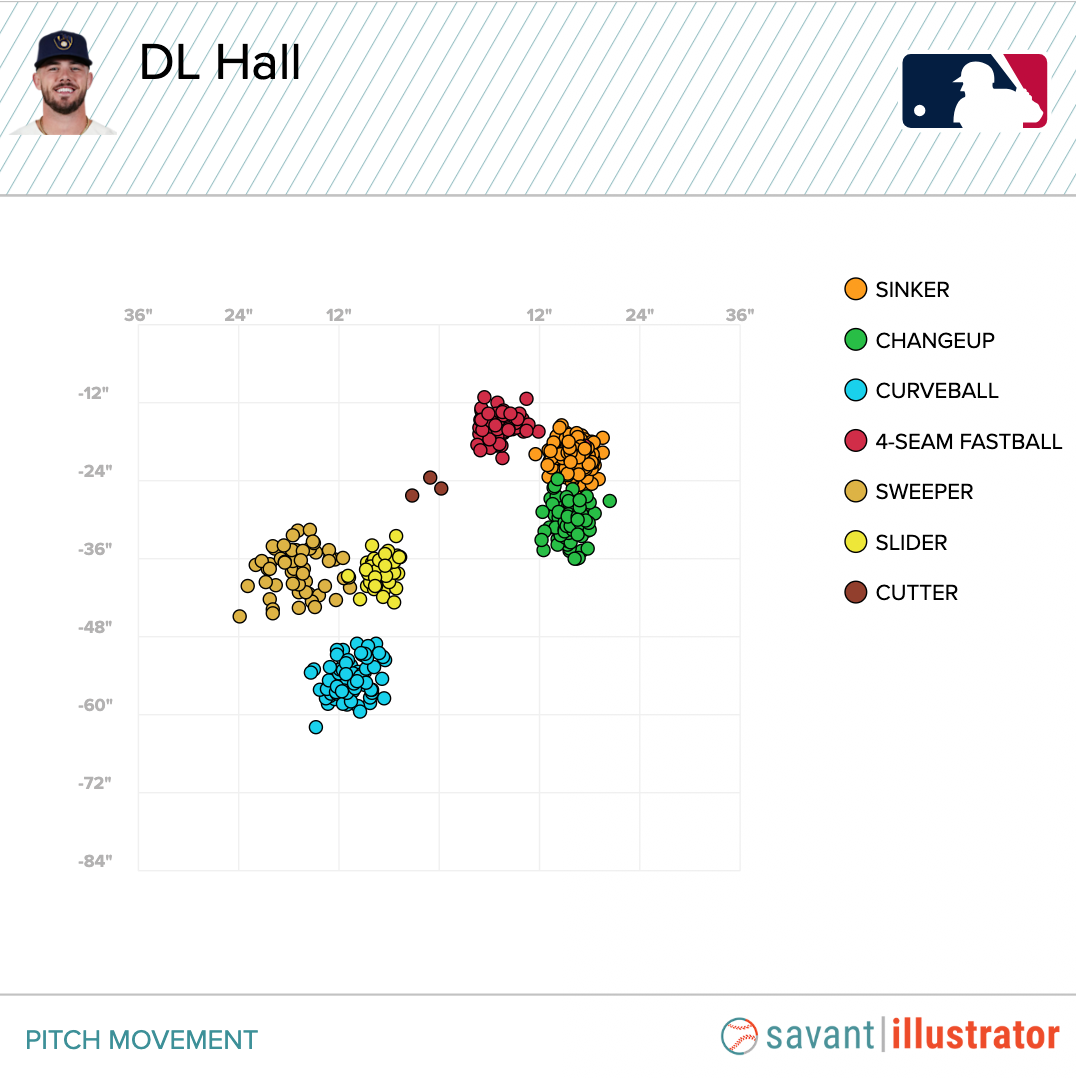
Hall has added arm-side and glove-side run to his arsenal and is reaping the benefits of a more complete arsenal. He can limit his fastballs to a selective out pitch without getting punished, and the secondaries are playing up. We can see this in the contact he’s allowing. Over the last two years, Hall fell from the best 10% of pitchers in pull air rate to the bottom 10%. In 2026, he’s back in that top decile, while seeing a significant uptick in groundballs, specifically to the two non-pull parts of the field.
With his spray and launch angles in a better place, the home run rate that saved his FIP last year feels more sustainable. The extra insulation in his arsenal also suppresses damage by keeping hitters off balance and unlikely to ambush. His True F-Strike and Early Called Strike rate are up 7.0 and 6.0 percent, respectively. He’s losing far too many guys later in counts but has yet to suffer the consequences of challenging the zone from behind. Having extra offerings helps that cause, and he now has distinct four-pitch approaches to batters of each handedness.
Stuck in the Middle (Relief)
As things stand, Hall is working his way back from a pectoral strain that has threatened the middle third of his season. He figures to be the second lefty in Milwaukee’s bullpen, a far cry from the lofty projections set for him at the time of the Corbin Burnes trade.
And while I am bullish that Hall’s new arsenal can help reintroduce himself as a stable arm, his path to late-inning work is laden with obstacles. Chief among them is an untenable 19% walk rate. Perhaps the injury played into his struggles, but his newfound potency hasn’t saved him from his control. A 2.7% uptick in O-Swing% is futile when compared to a 6.8% drop in Zone%. Likewise, it’s fair to chalk some of his called-strike successes up to justified passivity. With a BB/9 approaching 7.o, guys are going to anticipate the free pass.
It makes sense that a more significant movement profile would make for fewer strikes. But Hall hasn’t been able to locate his four-seamer, much less a full assortment of secondaries. Despite zoning more of the breakers than one would expect, neither fastball has offered much reprieve in three-ball counts.
Even with the walk rate, Hall’s WHIP remained above-average due to strong batted ball luck. As believable as the HR/FB% looks, outperforming his xBABIP by 94 points isn’t sustainable. There’s a world in which the hits come back before the command and things get messy. The Brewers are incredibly deep and chasing down home-field advantage in October; they could simply run out of room if things go badly.
However, Hall’s improvements in early counts could trickle down, and the shape of his contact allowed may be more meaningful than 31 innings’ worth of results. The sinker is outperforming last year’s fastball on barrel rate and ideal contact rate, and his strikeout rate has jumped by 8.0 percent.
This is the most well-rounded version of Hall Milwaukee has seen. Stardom may no longer be in the cards, but getting the best out of everybody means turning around certain trajectories. Hall’s new-look arsenal, headlined by the seam-shifted wake on his sinker, is a step in that direction and an underrated example of why the Brewers are sustainable contenders.
Photo courtesy of Icon Sportswire | Adapted by Aaron Polcare (@abeardoesart on Bluesky and X)
