





The Minnesota Twins have plunged themselves into a rebuild, surrendering a perpetually weak American League Central on the whims of waning championship odds and turbulence at the upper levels of management.
To its credit, Minnesota’s trades last summer were good business. Dealing Jhoan Duran and Griffin Jax with team control allowed the Twins to maximize their return, recouping young starters Taj Bradley and Mick Abel, along with catcher Eduardo Tait. Before they find out whether those starters will be insulating their next playoff rotation, Minnesota must first figure out what it’s working with.
Subsequently, Bradley and Abel are pitching big-league innings in 2026, with varying results. Abel has struck out less than a batter per frame across 7.1 innings with a WHIP over 2.50. He looks like a mid-to-high-4 ERA pitcher who is waiting out his peripherals. Bradley, meanwhile, has a career 4.70 ERA, but is running hot to start the year. After out-dueling Kyle Bradish, Cole Ragans, and Tarik Skubal to start the year, he’s become the bright spot of Minnesota’s early going.
A 1.08 ERA through three starts isn’t particularly meaningful. The changes Bradley made to get there might be.
Bradley’s Stuff Looks Different This Year
Bradley has always relied heavily on his four-seam fastball. While we can’t draw a through line between his best stretches and his top fastball — there simply hasn’t been enough success to do so — it fueled his prospect pedigree and remains his most frequent offering. Its upside is tantalizing, and aside from below-average extension, the ingredients are present for an elite pitch.
Last year, though, Bradley’s fastball shape wavered. He threw it 0.2 mph slower than the year prior and added arm-side run at the cost of induced vertical break. It generated the fewest swings and whiffs of his career, without the contact suppression to compensate.
Through three starts, Bradley is back where he belongs: the top of the Stuff+ leaderboard. He fell from first to third for fastballs after his most recent outing, but the gains are notable. With premium velocity and induced vertical break, Bradley’s heater has a truer four-seam shape than 2025. The results have been encouraging, posting the best PLV of his career, albeit without the kind of whiff numbers that one would expect.
The fastball’s swings and misses (or lack thereof) remain an issue. However, Bradley tinkered with his arsenal over the offseason, and his fastball is playing an important part in an approach more conducive to success.
Bradley’s heater lost arm-side run, and in gaining iVB, it approached the prototypical 12 o’clock on a movement plot. His splitter and curveball followed suit, inching toward that vertical axis. This makes sense given his change in arm angle. Getting more over the top, from 54° to 59°, makes vertical movement easier to come by. It also may have made his fastball less deceptive. A high-iVB fastball from a lower arm slot is bound to defy expectations more than one from a higher angle, where ride is considered typical.
The trade Bradley’s making is twofold: his arsenal is more cohesive as he attempts to change eye levels, and it seems easier to command. He’s sacrificing horizontal movement for added depth and better tunnels, and thus far, batters are proving him right.
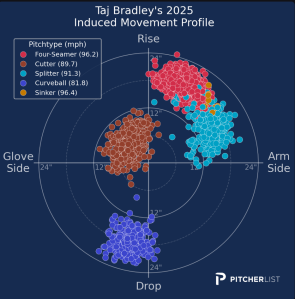
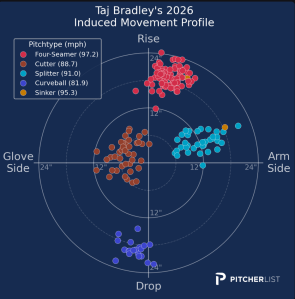
Bradley’s strikeouts are surging (31.4%), and his walk rate through three starts is a personal best (5.7%). If that’s a sign of things to come, the Bradley breakout will have arrived. I’m not entirely convinced that’s the case, but it’s good news and likely a result of his adjustments. His splitter lost 2.6 inches of iHB and is generating the best whiff%, CSW%, and PLV of his career. The cutter, now his only true glove-side offering, is getting more chases and whiffs than ever before. Even as a work in progress, Bradley’s curve is getting ground balls and swings and misses.
While not a perfect match, it’s a blueprint closer to someone like Tyler Glasnow. The stuff is good enough to compete in the zone, and the uptick of strikes has generated more favorable counts. Bradley’s secondaries are getting the whiffs necessary to elicit upside, and the shape of his fastball suggests there’s room for even more.
Is Bradley’s Success Sustainable?
Bradley’s first few starts look like a different pitcher than in years past. In the pitching lab era, it’s more important than ever to be open-minded to these kinds of improvements. Yet, not every hot streak is emblematic of future success.
There are reasons to approach Bradley’s stretch with caution, and it starts with his fastball. It’s a good pitch, maybe even a great one based on its characteristics. But through three starts, it has generated seven whiffs on 72 swings. That’s a 13th-percentile mark, exacerbated by an inability to miss bats outside the zone. Bradley can’t pummel batters at their eyes because he needs to tease hitters with enough mid-to-low-zone fastballs to keep the splitter in play. The cutter and splitter don’t tunnel well, taking that option off the board. This isn’t entirely a location issue, either, as fastballs up in the zone have found two whiffs on 19 swings.
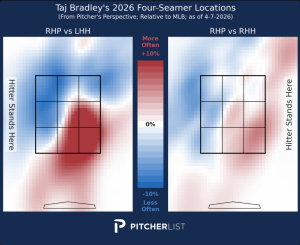
If there’s a next level to Bradley’s game, it’ll come from his fastball returning the whiff rates we’ve come to expect. Perhaps that comes with an increase in high fastballs to right-handed hitters. He’s less likely to use the splitter against them and, to this point, has emphasized establishing the inside part of the plate than the upper third of the strike zone. Neither his cutter nor curve should suffer from this adjustment.
Doing so would bank on his fastball landing the right side of the high-risk, high-reward spectrum. Historically, his fastball has been hit hard, and there’s reason to believe the cold weather is suppressing contact for him. If that fortune turns, he won’t outperform his peripherals for long.
This time around, Bradley has new tools at his disposal. There’s no immediate reason why the cutter and splitter should stop missing bats, and zoning more curveballs could give the heater some breathing room. I won’t plead with pitchers for command gains, but I’m hopeful the over-the-top release and limited horizontal movement make that easier.
It’s too early to tell whether Bradley’s gains will stick. As he looks to solidify his spot in Minnesota’s long-term plans, his new-look arsenal has given us a glimpse into his upside. Stuff+ and PLV like him more than ever before. So do the ERA estimators. It’s a small sample, but this is the best version of Bradley we’ve seen, and that should give Twins fans hope in an otherwise forgettable early-season run.
