







Welcome to the PLV Power Report! Here, we examine hitter performance by utilizing Power+, a PLV+ metric that indexes a player’s power based on the characteristics of the pitch, i.e., count, location, velocity, induced vertical break, height-adjusted vertical approach angle, and other factors. Essentially, we’re searching for players with upside who are adding power based on the expectation of the individual pitches they see.
For example, say a hitter hits a well-located fastball on the outside corner that might typically coax a weak line drive, but instead, they belt a home run the opposite way; they’ll get a much better power grade for that outcome. Conversely, if that hitter sees a hanging changeup over the heart of the plate, or another pitch that would normally be crushed, and instead pops up to short, they’ll get a much lower score for the outcome. The power metric is unique because it provides a more intuitive way to assess player performance by accounting for the quality of each pitch they see. In other words, it’s a good way to check if a player is over- or underperforming by adding context. Note that Power+, like PLV+ metrics, is normalized to 100 and generally becomes more meaningful after around 75 BBE (batted ball events).
If you’re new to the PLV metrics, you can find Nick’s primer here.
Last week, we surveyed a few potential buy-low candidates; this week, we will scout some ascending young hitters.
Note: Stats and PLV metrics are current through Sunday, June 1.
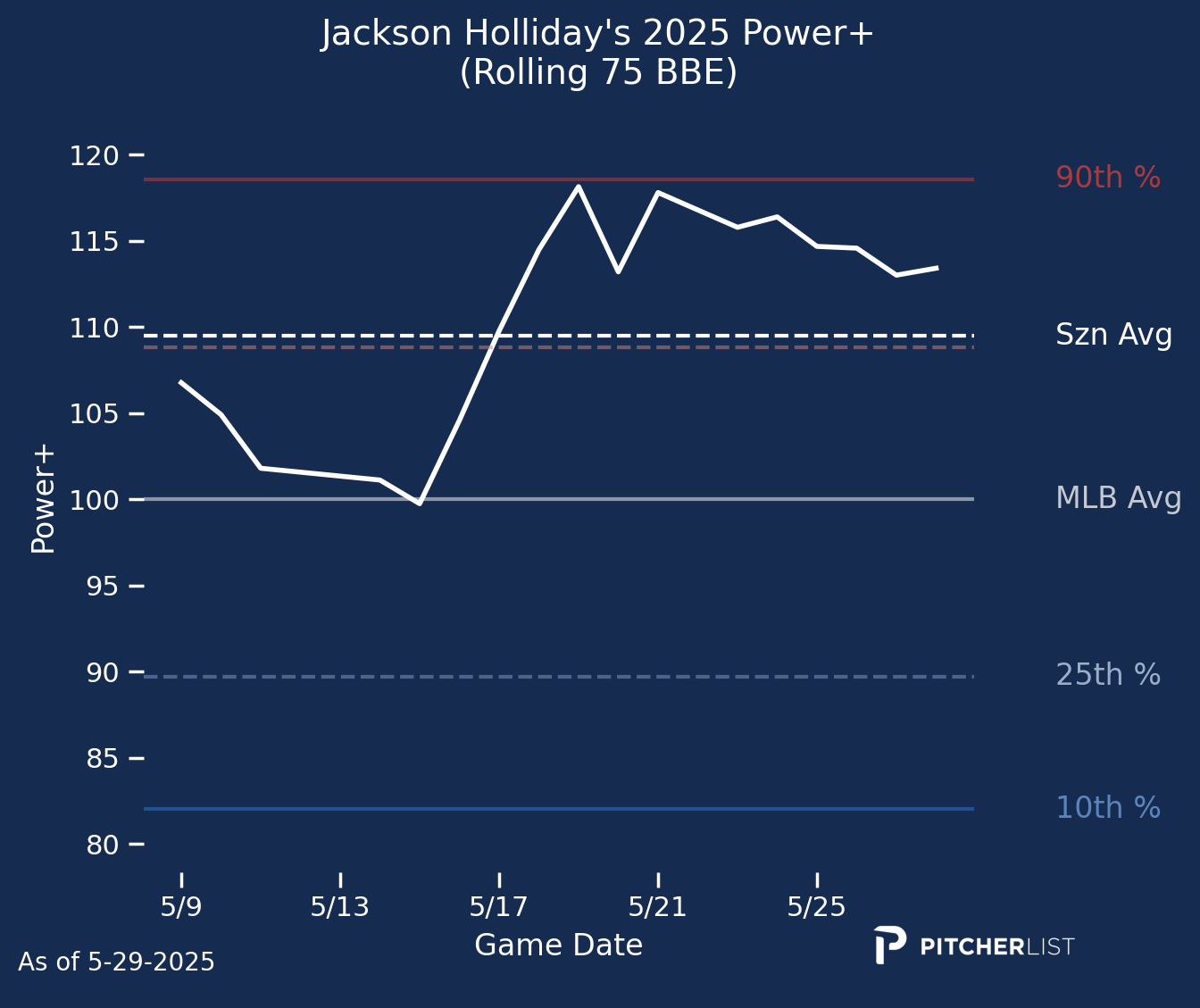
Last year, the Stillwater Stinger’s eldest son proved the latest example of the tenet dictating it’s usually best to fade rookies. Jackson Holliday hit five home runs with a .251 wOBA across 208 PAs. However, the 21-year-old has already surpassed last year’s total by two in a nearly identical span of 207 PAs with a .333 wOBA. Holliday’s Power+ was 94 last season in 113 BBE; this year, he’s indeed leveled up to 106 through 136 BBE. The Orioles are having a down season, but they can perhaps find solace in the former first overall pick’s recent ascension.
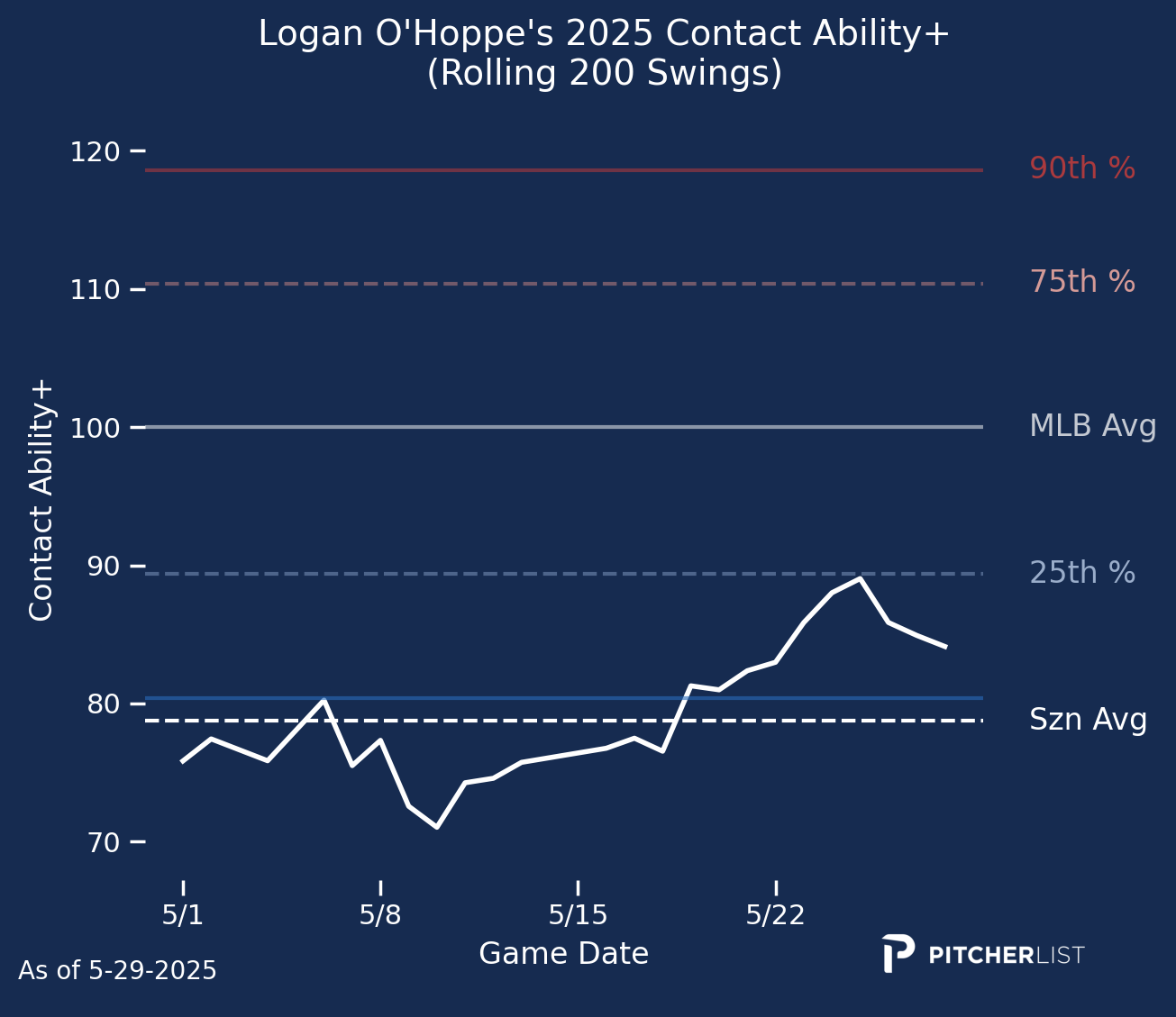
As far as catchers and taters go, it’s Cal Raleigh and everyone else. Still, O’Hoppe has made a name for himself leading the rest of the backstops with 14 home runs through 188 PAs; that’s only six fewer than he hit all of last season in 488 PAs. The 25-year-old’s Power+ this season sits at 123 through 109 BBE, on par with last year’s 126 in 311 BBE. The power’s legit. However, you might have noticed the strikeouts. Sure enough, his Contact Ability+ has dipped from 83 to 76, well below the 25th percentile. Still, it might be creeping up slowly. Let’s keep an eye on it.
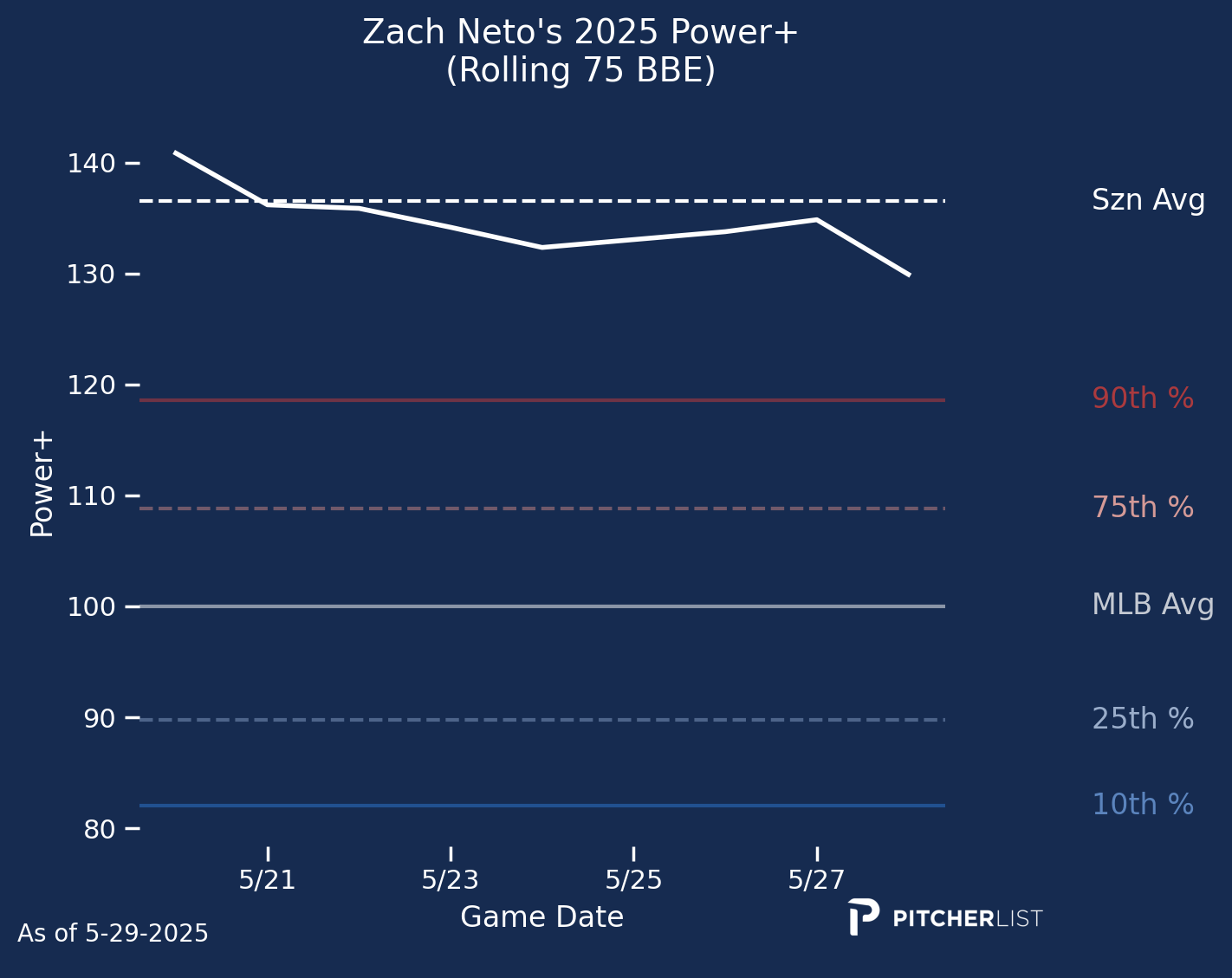
Shohei Ohtani’s 151 Power+ leads all batters with at least 70 BBE. What you might find surprising is that the next batter isn’t Aaron Judge (135 Power+; 153 BBE), Pete Alonso (135 Power+; 155 BBE), or Oneil Cruz (137 Power+; 107 BBE). That’s right, it’s Mr. Neto with a whopping 140 Power+ through 99 BBE, nine of which have left the yard. I have a hunch that it will probably regress some. Still, he’s swinging with serious thunder right now, and sure enough, he just hit his 10th against Richard Fitts. Great timing. Neto had a terrific rookie year, swatting 20 home runs with a .330 wOBA, and the early returns (99 BBE; 170 PAs) indicate him having an even louder sophomore season.
However, like his teammate O’Hoppe, Neto is striking out more often than last year. He might be selling out for a power just a touch, his Contact Ability+ having dipped from 104 to 94.
Did you take a chance on Addison Barger last season with Matt Chapman having packed his bags for San Francisco? If you did, you were rewarded with seven home runs and a measly .262 wOBA across 225 PA. But hopefully, you kept his name on speed dial. After going yard three times this weekend against the A’s, the 25-year-old lefty is just two away from matching last year’s home run total while flourishing to the tune of a .35o wOBA through 132 PA.
If you enjoy the color red, you’ll find Barger’s Statcast profile appealing, his xBA, xwOBA, hard-hit rate, and barrel rate all being in the 83rd percentile or better. His bat speed is way up there, too. Through 81 BBE, Barger’s Power+ is coming in at 110, ten points above average. It’s still a little early with 75 BBE being our loose barometer, so-to-speak, but Barger is looking pretty decent. What’s more, his K rate is down just over six ticks from last year to 20.5%.
The Dodgers weren’t exactly wanting for offense, but they’re getting more than expected from their centerfielder. The 24-year-old Cuban swatted two home runs this past weekend against the Yankees, giving him 11 for the year, two fewer than he hit last season in roughly twice as many at-bats. His wOBA of .352 represents a big improvement from last year’s .310. Nonetheless, the improved results aren’t reflected by his batted-ball data. Through 155 BBE, Pages’ Power+ is 105, above average but also nearly identical to the 104 he posted last year in 288 BBE.
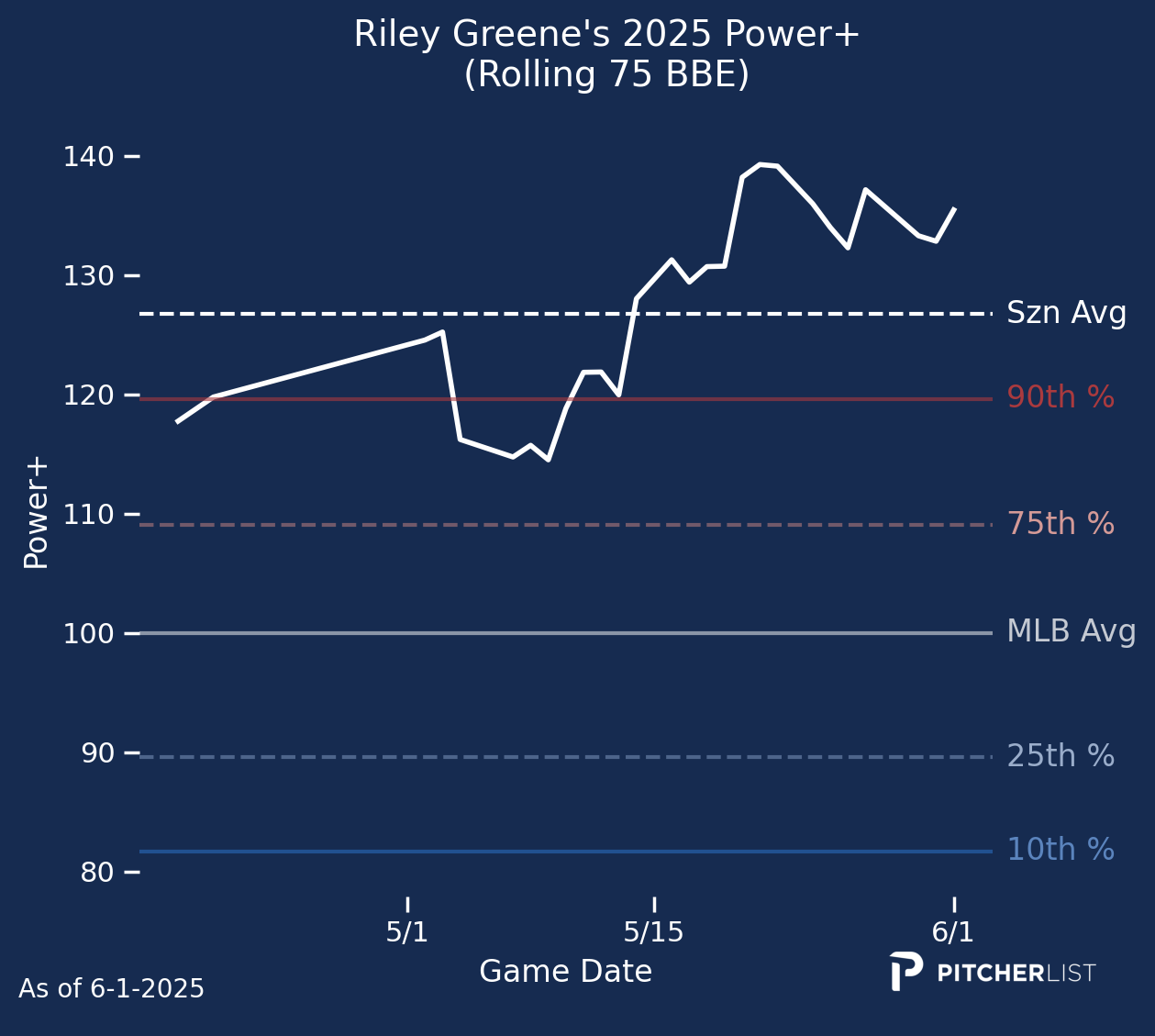
All told, Greene had a terrific 2024, establishing career-highs across the board, including 24 home runs, a .355 wOBA, and, most importantly, 137 games played. However, I think many thought he had another gear, and there could be something to that. Through 144 BBE, Greene’s Power+ is 126, up six points from last year, and, yeah, he seems just about ready for liftoff.
Who? Don’t look now, but the Guardians might, I said might, have something cooking in Daniel Schneeman’s bat. The 28-year-old super utility man has hit seven dingers in 147 PAs, two more than he had last year in 221 PAs. Through 89 BBE, his Power+ sits at 117. Hey, that’s pretty good! Sure, maybe this is a mirage, but the 2B, 3B, SS, OF eligibility plays in deep leagues.
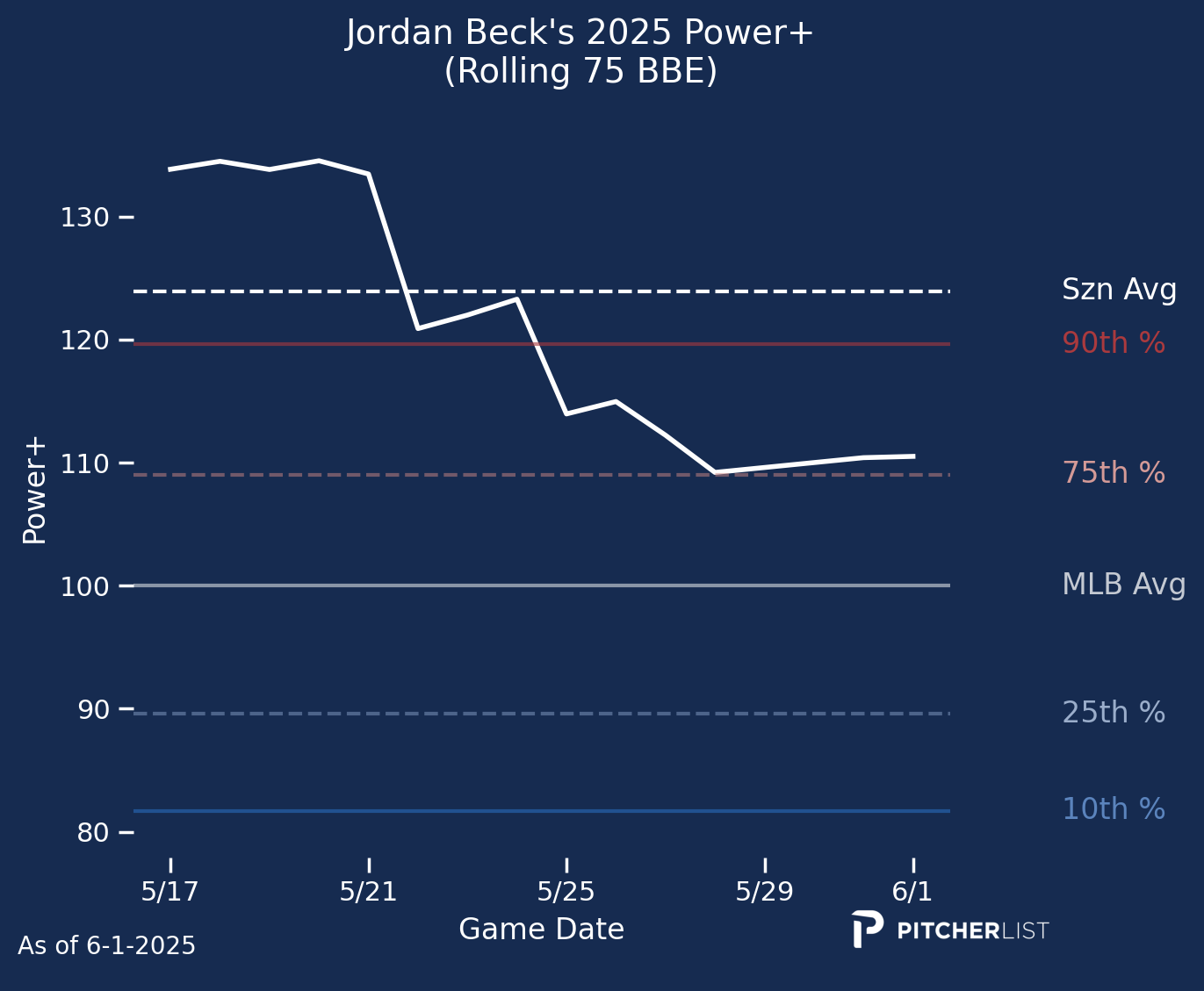
Beck’s hot start seems like a distant memory, with him hitting .224 with a .555 OPS over his last 14 games. Not surprisingly, Beck’s Power+ has waned. Still, it remains well above average at 119 through 109 BBE. Beck’s power is legit.
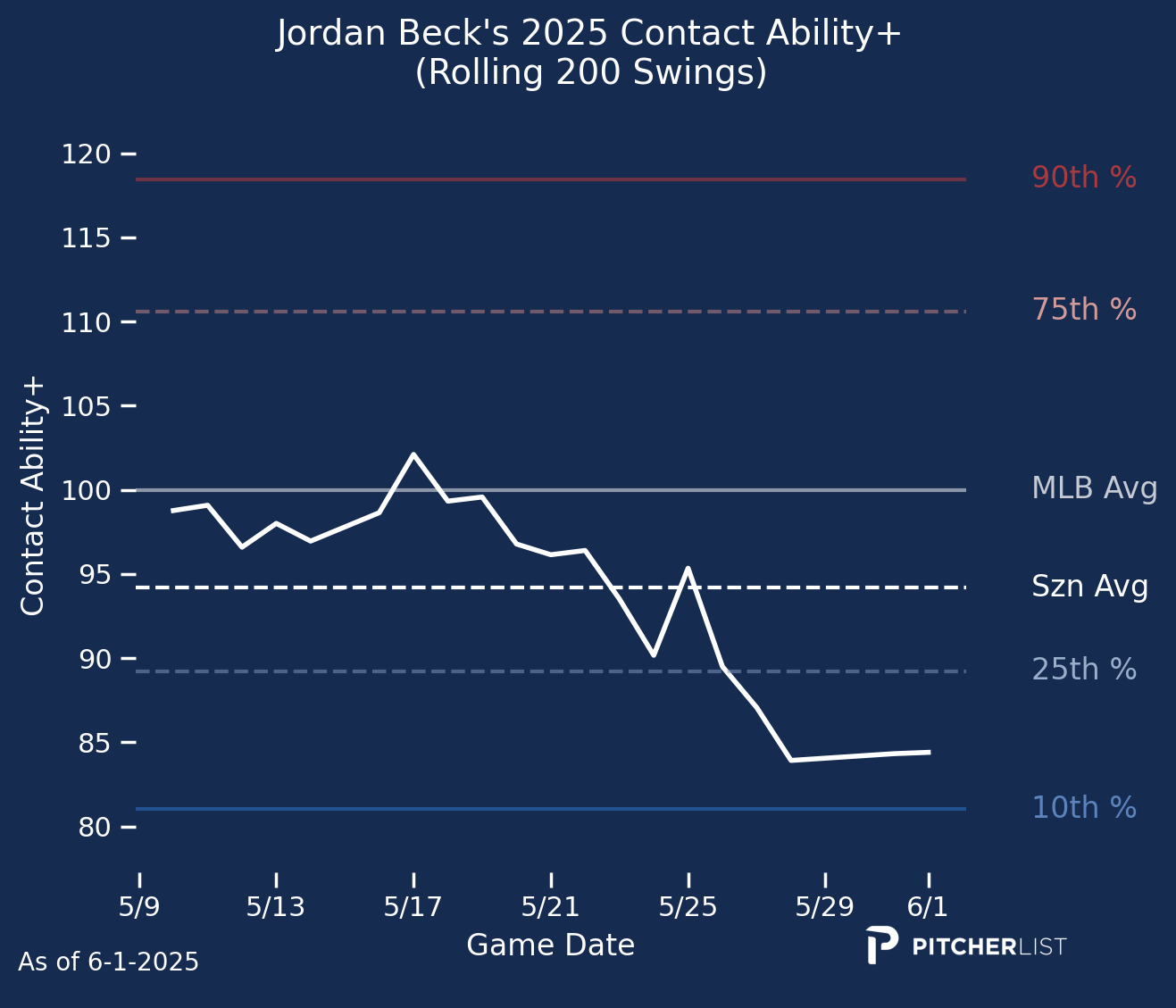
However, his contact ability is the bigger question, with strikeouts being a prominent part of his prospect profile. It initially hovered around league-average, which was perfectly manageable, considering the power he brings. But he’s trending in the wrong direction, with his Contact+ currently at 90. For reference, the recently demoted Michael Toglia had 73 Contact Ability+. Beck has at least maintained average-ish swing decisions (96 DV), which could help him stay afloat, but things could get dicey if his ability to make contact slips further.
The 21-year-old Dominican had a big weekend in Houston, slugging three longballs with 11 RBIs. Through 227 PAs, he’s hitting .262 with a .340 wOBA. His Power+ sits at 104 through 169 BBE, just about where he was last year (107 Power+; 102 BBE). A few points above average sounds pedestrian if you’ve ever watched Caminero smash an opposite-field home run. Simply put, he swings the bat just about as hard as anyone, and with a sub-20 % K rate no less. So what gives?
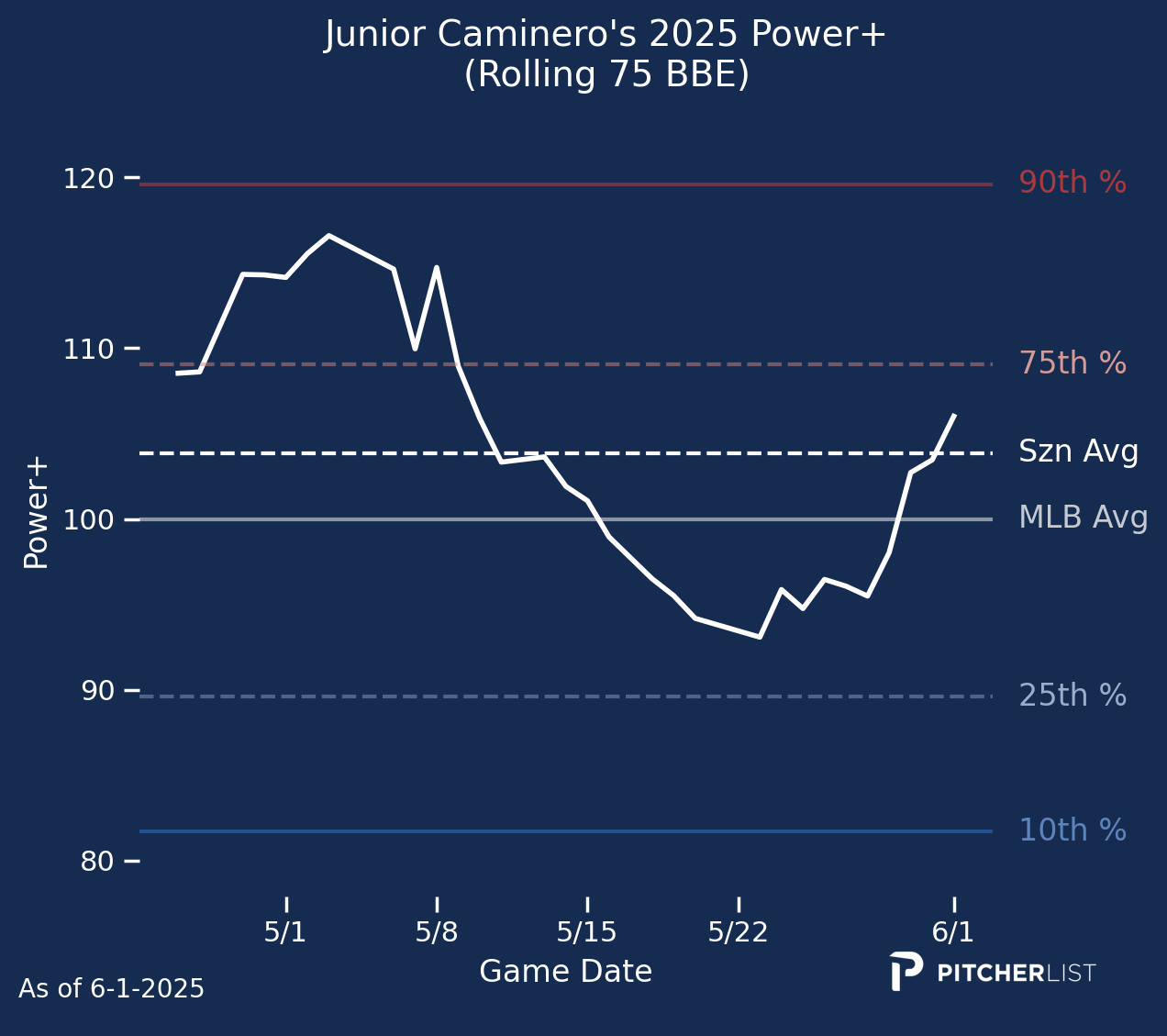
For one, his bat path might be holding him back, indicated by a groundball rate in the 94th percentile. And he tends to stub himself in the foot with questionable swing decisions (85 DV+; 4.4% walk rate). In short, his approach has yielded a surplus of subpar batted balls, belying his preternatural bat speed. Caminero is, of course, nowhere near his peak, but for now, at least, he might be prone to running hot and cold, depending on which direction the BABIP winds are blowing.
