





It’s November 1, 2023. The Texas Rangers have finally claimed their first World Series in franchise history, defeating the Arizona Diamondbacks on the road with a shutout victory in game 5. Relatively speaking, this fall classic didn’t generate much nationwide fanfare – not even close to the one that would happen a year later between the Dodgers and Yankees, and in retrospect, 2021 and 2022 at least had pennant winners on the east coast. Despite that, this was about as cathartic of a championship victory as can be in sports. Sure, it came when many expected the Rangers were merely at the early dawn of their competitive window, so they were ahead of their perceived timeline, but they were tantalizingly close in 2011 and 2012 and were non-competitive for most years after that while their state-side rivals ascended to the top of the baseball world. This was a fanbase that had been dealt more playoff heartbreak than any other in the 21st century, and they unquestionably deserved to bask in the glory of their first-ever title.
Looking at the roster, it was no wonder that they won it all. They may have survived the postseason with a patchwork bullpen, but their lineup struck fear into opposing pitchers. Texas’ offense scored 881 runs in 2023, which remains the highest single-season mark by an AL team of the 2020s. Only 1 guy in their starting lineup for that championship-clinching game 5 had an OPS+ under 100 during the regular season, and it would’ve been 0 if not for an injury to Adolis García, who still holds the all-time record for RBI in a single playoff game. Corey Seager and Marcus Semien rightfully finished 2 and 3, respectively, in MVP voting. Evan Carter recorded an OPS+ of 187 after making his MLB debut in September and was regularly batting in the middle of the order by the World Series. The length of the lineup was a sight to behold, also featuring Mitch Garver (138 OPS+), Nathaniel Lowe (114), Josh Jung (113), and Jonah Heim (106).
There wasn’t an easy out to be found anywhere. In fact, this team’s collective approach at the plate was so good that Robert Orr (not the hockey player), a writer for Baseball Prospectus, created a new statistic to quantify it, literally named it after Corey Seager, and ended up winning awards for it. They pushed the boundaries of what was measurable about the process of hitting. Remember, Seager and Semien were each coming off just the second year of their respective free-agent megadeals they signed before 2022. Carter hadn’t yet graduated from rookie status and Wyatt Langford was on the way. Jung received rookie-of-the-year votes for the season he had. This was just supposed to be the start.
Since that long-awaited celebration, the Rangers are 117-125, the 8th-worst record in baseball. This season, despite retaining most of the core from that 2023 lineup, they now have a bottom-5 offense in the game, placing 5th-last in runs scored and wRC+ at the moment. They’ve fired their hitting coach, things have only gotten marginally better since, and they’ve completely abandoned the hitting philosophy that got them to the top of the mountain. Just as quickly as they burst onto the scene, they vanished, and we’re still waiting on the world-beaters that they were in 2023 to reappear. They poured money into the roster to get where they were and had the young talent to supplement it. It’s time for a post-mortem. Why couldn’t Texas build off their first championship when it seemed like more were to come?
At the team level, the Rangers did all the right things in 2023. They were among MLB’s top 6 teams in key indicators such as barrel rate and hard hit rate while suppressing weak hits, and not only did they hit balls hard, they hit them in the air, finishing 2nd in team flyball rate and 3rd in line drive rate – all a perfect recipe for damage. It went beyond the batted balls too. They were top-5 in both zone swing and zone contact rate and chased less than everybody else. They ambushed often, swinging at the first pitch at the 4th-highest rate in the league, and were also aggressive on middle-middle pitches (8th in meatball swing rate). Teams that are this locked in at the plate from the top to the bottom of the lineup are a rarity, but they flipped the script on pitchers with incredible consistency. In 2024, they took a step back, scoring nearly 200 fewer runs with the team finishing 78-84. In terms of output, the offense went from being the best in the AL to slightly below-average, and while they made less menacing contact with the ball, there were still positive signs within their swing strategy. They placed 4th in MLB in zone swing rate and were still in the upper third in terms of zone contact and chase.
Over the winter, they made moves to shore up the complementary pieces of their roster. Nathaniel Lowe was traded to Washington for Robert Garcia due to key departures from the bullpen; the latter has been one of the team’s best relievers this year. Jake Burger and Joc Pederson were signed to inject some pop back into the lineup. Seager, Semien, Garcia, Heim, and 2024’s breakout utilityman Josh Smith were all returning. Evan Carter was healthy again after a pesky back injury held him out for most of 2024, and Wyatt Langford was gearing up for his second season after going on an absolute tear in September. While unrelated to the team’s run-scoring efforts, let’s not forget about Jacob deGrom, by the way, who was set to return following another Tommy John surgery. Considering the landscape in the AL West, they shaped up well. Going into opening day, they were MLB.com’s consensus pick to win the AL West, and The Athletic’s consensus pick to win the AL pennant for the second time in 3 years. Barely a month later, they had already fired their hitting coach.
In 2025, the Texas Rangers, with most of the same core that became famous for their plate approach and discipline, are chasing pitches at the 4th-highest rate in MLB. They’re still awfully aggressive in the zone but making less contact, and the hard hits that went missing last year are still nowhere to be found. They’re also still hitting balls in the air, but it doesn’t mean as much now that they have the 3rd-highest popup rate in baseball. Corey Seager’s OPS is down about 300 points from the World Series year. Semien’s is down by about 200, while Garcia and Heim have become decidedly below-average at the plate. What happened here?
The sacrificial lamb for this org-wide offensive drought was offensive coordinator Donnie Ecker, who was previously an assistant hitting coach with the Giants from 2020-21 before effectively being handed the keys to the Rangers’ offense in 2022. He was the one who oversaw the fireworks show that was 2023, and was let go when they couldn’t replicate it. Texas currently has two assistant hitting coaches, Seth Conner and Justin Viele, the former of whom has been there since 2022 alongside Ecker while the latter joined this season. Viele worked with Ecker in 2021 as part of a Giants team that also had one of the most productive offenses in the league. There was one departure from last year’s staff, though, and that was Tim Hyers, a more tenured guy who was the primary hitting coach under Ecker’s watch from 2021-24. Hyers was the lead hitting coach for the Boston Red Sox from 2018-21, a stretch where they scored more runs than anyone in baseball. This included a year on Alex Cora’s staff when they won 108 games and the World Series. He was also an assistant hitting coach with the Dodgers from 2016-17. Hyers left the Rangers to become the hitting coach of his hometown Braves, who are a below-average offense themselves as of now. We obviously don’t know what’s going on behind closed doors, but was Hyers instrumental to this team’s lineup-wide approach even though he wasn’t first in command on the hitting side? It’s pure speculation, but the timing of these results is uncanny.
Of course, none of that fully excuses what’s happening on the field. Looking at the sudden drop-off from a big-picture standpoint is quite fascinating:
To me, the common theme across the board is they’re swinging too much. Yes, mishaps related to timing and swing path are undoubtedly behind the decrease in batted ball quality, but the biggest year-to-year changes in this table have to do with them being more aggressive on pitches that are worse to hit (thank you to Robert Orr for the SEAGER data; this is a metric that models a hitter’s decision to swing or take based on pitch location and the count. I’m sure he didn’t anticipate this negative trend from the stat’s namesake or his team). As far as this overarching trend goes, there are a couple guys who stand out. Let’s use PLV or pitch-level value, which includes a swing decision model of our own here at Pitcher List thanks to Kyle Bland, to identify which ones.
It feels fitting to begin with Garcia, who simply could not be stopped in his quest to bring a title to Texas. The 2023 ALCS MVP ran astronomical chase rates in the first couple years of his career. He managed to push that figure down under 30% the year they won, but it has since climbed back to the high-30s. As you’ll see below, he’s been making better swing decisions of late, but if the Rangers have been too aggressive as a team, he has been downright reckless. The connectedness of the different aspects of being a good hitter are on display here: if you swing at bad pitches, your contact-ability and power will decrease in tandem.
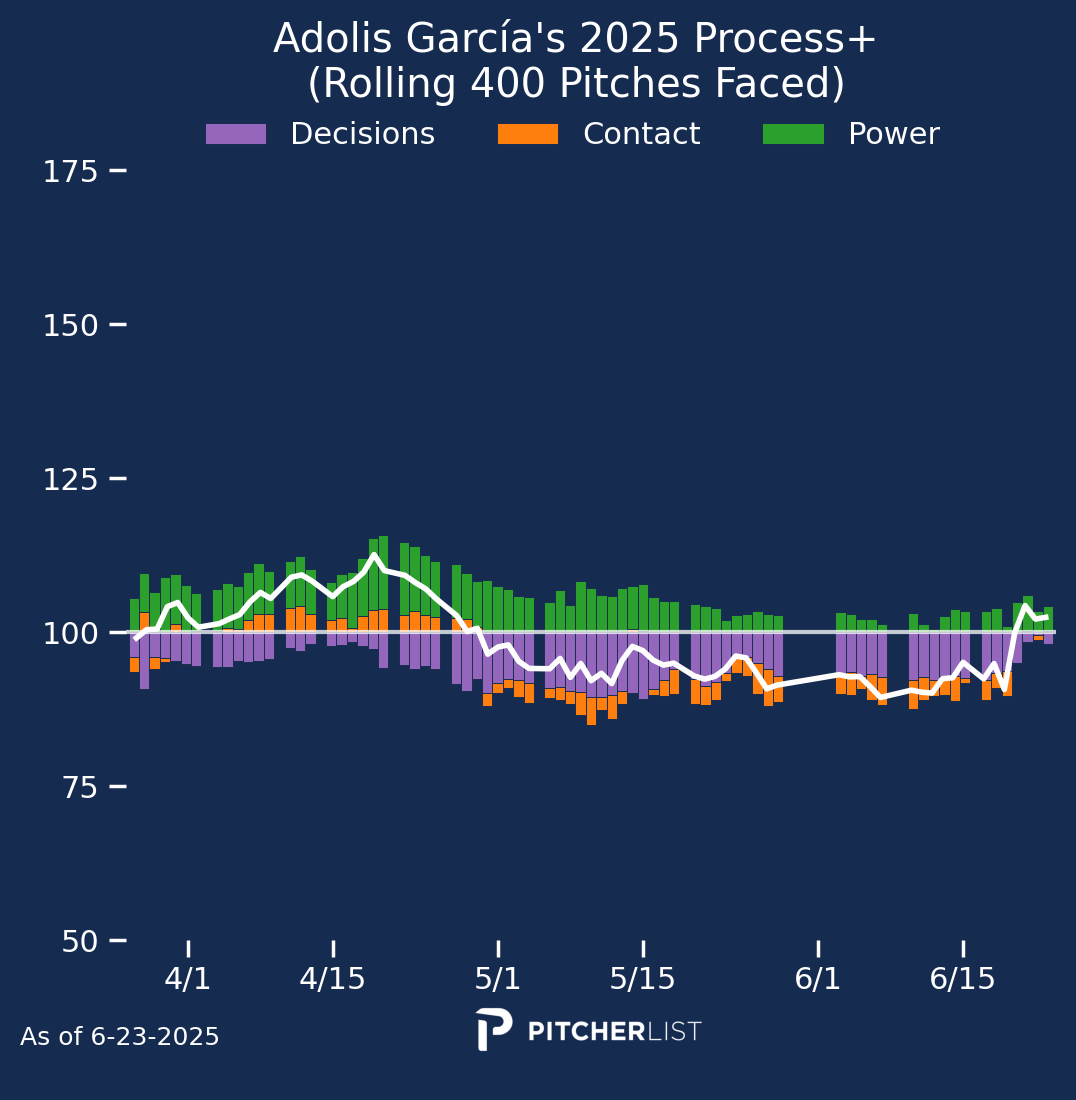
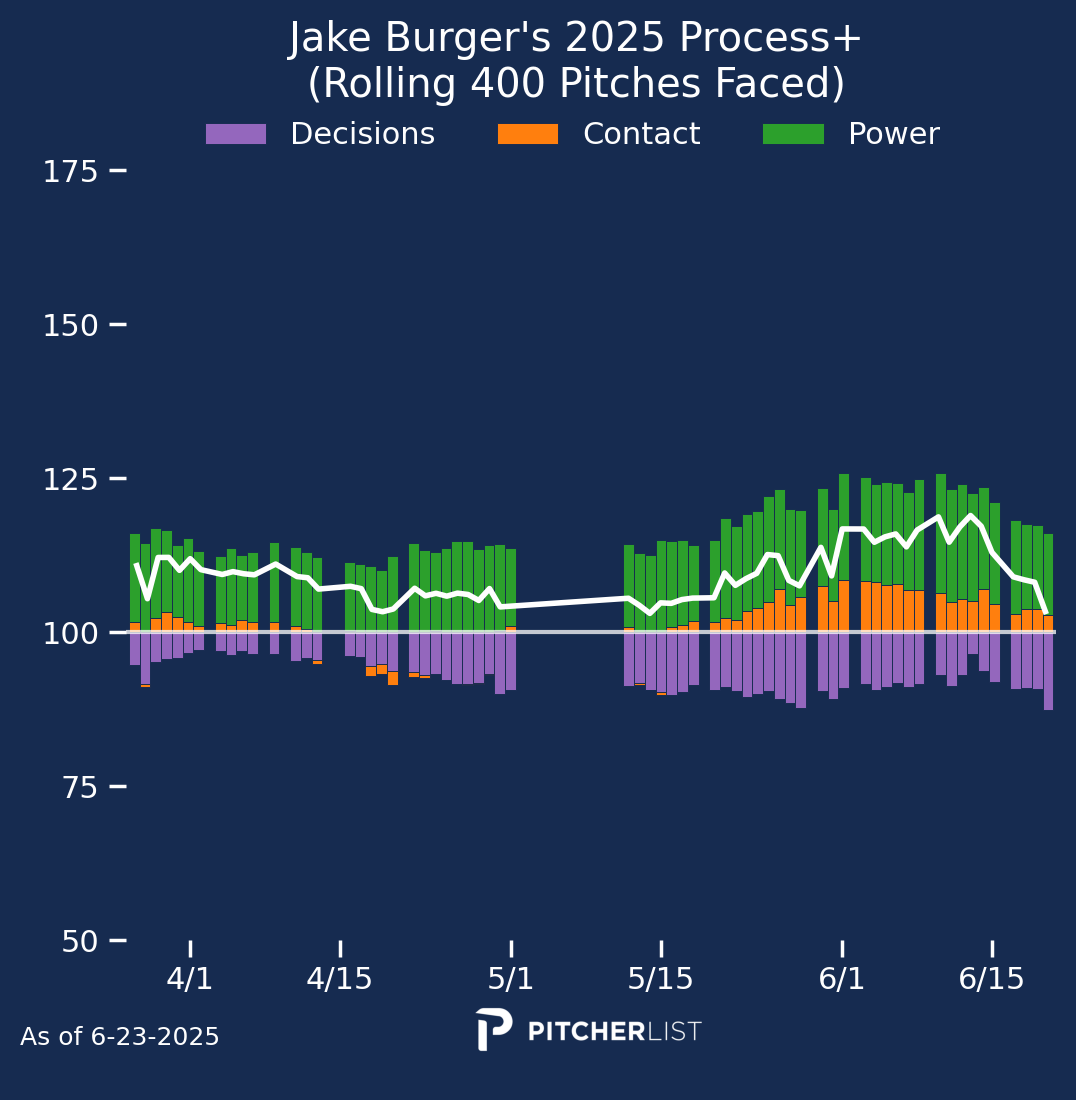
Another hitter who grades out poorly in PLV’s swing decisions model is Jake Burger, whose choices to swing or take are nearly 2 full standard deviations below the mean entering today. Burger was never a disciplined hitter even in the best of times, but his walk rate has been compressed to around 3%. What’s crazy is he’s swinging and missing, as well as chasing, less than last year, and may be due for some positive regression on account of career-low BABIP and HR/FB%. The barrels are still there too, and PLV still likes his process overall. However, the high-30s chase rate is just too hard to stomach and it’s easily the biggest thing holding him back. In hindsight, the Rangers could have stood to learn more from the cautious case of Garcia. Guys who chase that much and make contact under an 80% clip are bound to go through some fairly tough stretches. Burger has been no stranger to that this year.
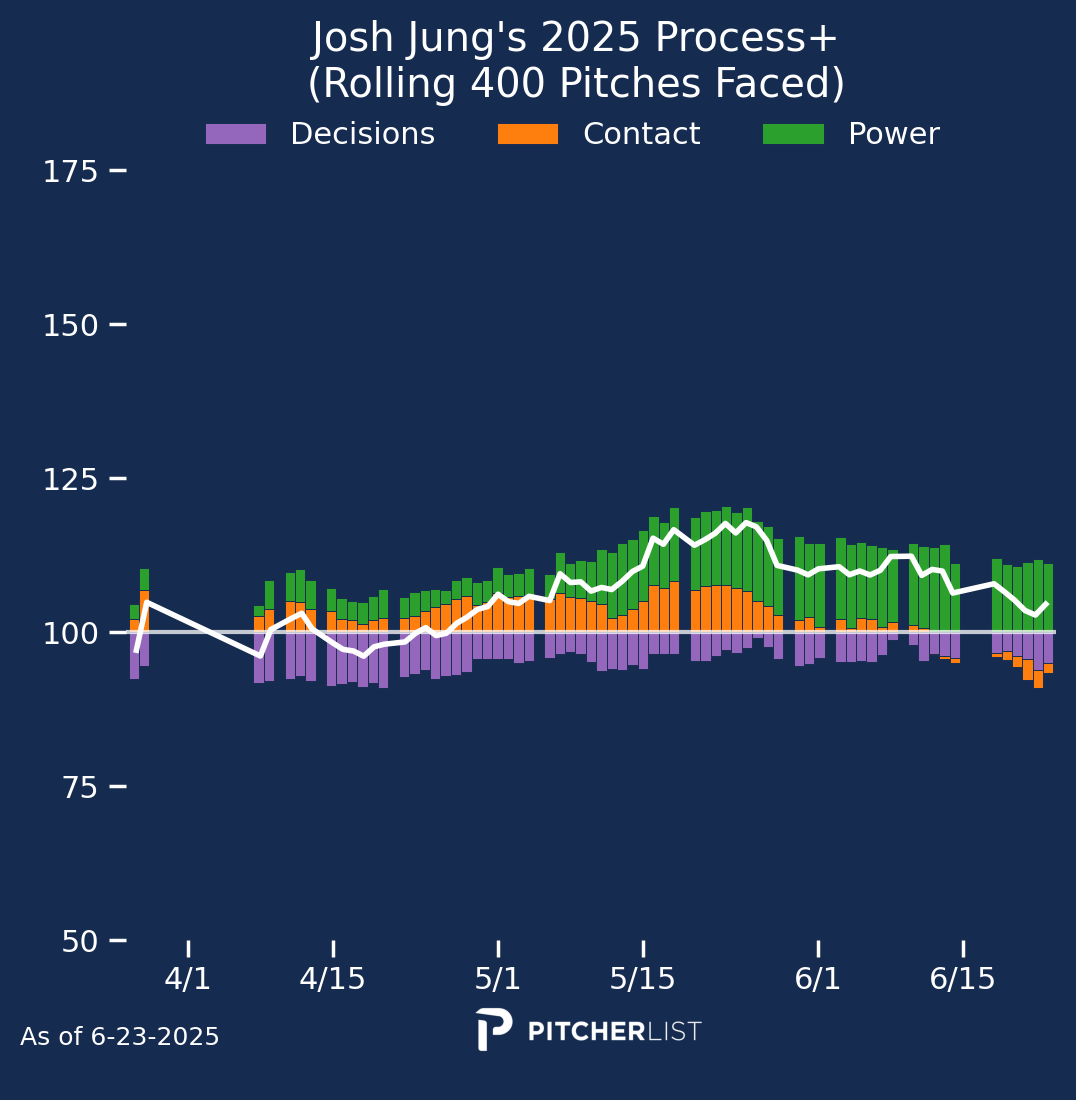
There have been some losses on the hitting development side as well. Since that 2023 season where he established himself as a quality bat and defensive player, Josh Jung has been limited by injury and inconsistency. He started the season off hot, but a forgettable month of June headlined by a .402 OPS has sent his year into a downward spiral. Jung swings at ~10% of the pitches he sees in what Statcast defines as the “waste zone” – 10+ inches off the plate width-wise or 18+ inches off the plate height-wise. This is the zone that defines the last competitive pitches in baseball, so ideally, hitters are keeping that waste swing rate well under 10%. He has cost the Rangers 2 runs of value from these swings, good for the 5th-most of any hitter in baseball. He’s still a plus in the field and has shown flashes of being able to hit the ball hard, but strikeouts, walks, and swing-and-miss have all been consistent issues throughout his career. He grades out similar to Garcia in Pitcher List’s swing decisions model.
As high as the peaks were for this iteration of the Texas Rangers, the rest of baseball can learn a lesson from the valleys. Picking the battles at the plate and choosing when to be most aggressive is a staple of a good offense, and while combining that with an ideal distribution of batted balls makes a team virtually unbeatable, ditching discipline in the name of trying to hit the ball harder is almost certain to backfire completely. Nothing about hitting is one-size-fits-all; there are certainly some players around the league who could benefit from being more aggressive in the aggregate, but this must be done with care and only certain types of pitches. At a team level, swinging more at pitches outside the zone will put a firm ceiling on what the offense can do.
The Rangers made that mistake this year, and now find themselves at a crossroads because of it. They have shown a repeated willingness to add and they have money tied up long-term in their middle infield, yet their coaching staff on the hitting side is likely going to be in a state of flux until the start of next year. A good chunk of their lineup has also become fairly one-dimensional with an imprecise approach at the plate hampering their power upside. The silver lining of this whole situation is their pitching staff has kept them afloat and they have a positive run differential despite entering the day two games under .500. The American League is also a complete logjam, as it looks like finishing a couple games above .500 is all it’ll take to get into a playoff spot. Punting on this year, despite how badly the offense has regressed, is too premature at this point. They are still, however, 7.5 games back in the division of an Astros team that has been scorching of late. If they get in, they’ll most likely have to squeak in and overtake some teams to do it. Beyond this year, a retooling of their offensive personnel is a top priority regardless.
All figures entering June 25, 2025.
