





The Washington Nationals have been in the proverbial wilderness for more than half a decade. Since Daniel Hudson got Michael Brantley swinging to end Game 7 of the 2019 World Series, they haven’t made the postseason. They haven’t even had a winning season. People have grown accustomed to them being the least competitive team in their division, even though they were a model franchise for most of the 2010s. Their ownership group finally accepted that those days were over last July when they fired longtime GM Mike Rizzo and field manager Dave Martinez. Eleven months later, there are still some signs of the quintessential 2020s Nationals in plain sight. At the start of play on Monday, they were 9.5 games out of first place. No team in baseball besides the Rockies had allowed more runs per game.
Yet, they were also 2 games over .500 and just 1 game out of a playoff spot. That’s mostly because, on a per-game basis, no team in baseball has scored more runs in 2026. Not the Dodgers. Not the Yankees. No one.
How does an offense go from 26th in runs per game one year to 1st the next? Such a jump implies personnel changes on the field, but for the most part, that isn’t the case. Nine different Nationals have recorded at least 150 plate appearances this year, and seven of them were on the team last year. Mind, there were a couple of notable departures. Josh Bell and Nathaniel Lowe aren’t around anymore, and they combined for over 1,000 plate appearances in 2025, but this is a strikingly similar cast of characters to last year’s team that lost 96 games.
The same cannot be said for the personnel off the field. The new baseball ops head honcho, 36-year-old Paul Toboni, is a UC Berkeley baseball alum who worked for the Boston Red Sox for nearly a decade, overhauling their farm system and amateur scouting processes. Their GM, 32-year-old Anirudh Kilambi, has experience leading the Rays’ R&D department, contributing to the success they particularly experienced from 2019-21. He then became the assistant GM of the Philadelphia Phillies, overseeing statistical practices for a team that won an NL pennant and 2 division titles during his tenure. His former colleague in Tampa Bay, 33-year-old Blake Butera, was named the field manager. 35-year-old Matt Borgschulte, who came up as a hitting coach for the explosive early 2020s Orioles teams, took the reins of Washington’s offense.
Even though the position player group contains most of the same names as it did last year, these are not the same old Nationals. It starts at the top with 23-year-old James Wood, who has made the leap from a very good outfielder to an MVP candidate. He has maintained thunderous bat speed and begun to catch the ball a little farther out front, which has cut his groundball% by over 10 points and allowed him to slug like never before. His plate discipline, which was already good before, has also gotten a smidge better. The result so far is a 40-point jump in wRC+.
Also enjoying a career year is CJ Abrams, whose slash line is right up there with Wood’s. It might be coming together a little too perfectly for Abrams, as his .326 BABIP would be the best of his career by a long shot, and his HR/FB ratio is up to a career-high 16.7% even though the quality and quantity of flyballs he’s hitting haven’t changed much. Still, his barrel rate has soared to the right side of league-average, and he’s doubling down on his lift-pull approach, which has helped him outperform his exit velocities. Abrams has also seen his walk rate nearly double, even though he’s chasing a bit more (welcome to the Harper Paradox Club, CJ!). The reason for this is a sudden passivity in 3-0 and 3-1 counts. He’s identifying pitches he knows he can slug earlier in counts, but he’s also showing a heightened awareness that he doesn’t have the raw power to swing for the fences every time he gets ahead.
Green Light% measures swing rate in 3-0 and 3-1 counts, a metric I first used in the Harper Paradox article linked above.
The unnamed newcomer I alluded to earlier is Curtis Mead, the Australian journeyman and former Rays top prospect who was acquired from the White Sox via trade in March. He took on an everyday role not long after the deal and is hitting for a 127 wRC+ with strong peripherals. Pulling the ball more shouldn’t be a goal for every hitter, but Mead has tapped into more power by doing so. His pull air% is up nearly 8 percentage points and his overall pull rate is up more than 12% compared to last year. Sometimes it’s simply a matter of a change in batting stance, and the changes he has made in that regard have paid off. He’s way more upright and slightly more open in the box compared to last year with his hands closer to his body. He always had a better-than-average combination of bat speed and contact skill, but along with the stance change has come better selectivity, and in turn, more hard-hit balls.
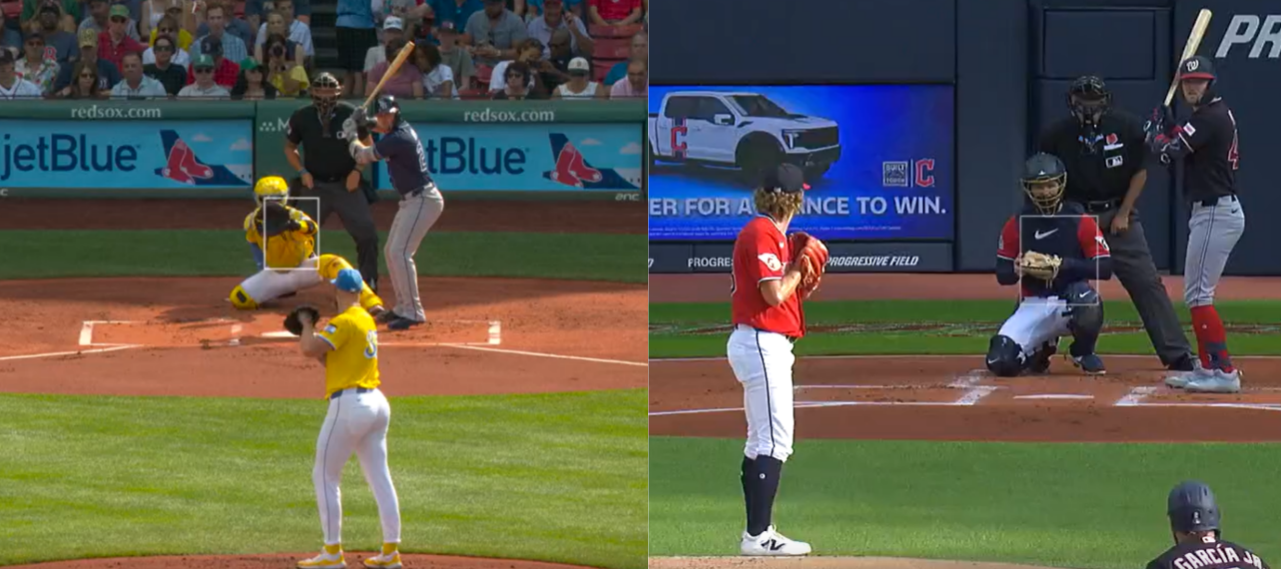
Curtis Mead Batting Stance Comparison, July 2025 (left) and May 2026 (right)
Not to be discounted in any of this are the secondary players who have improved enough around the edges to become positive contributors and lengthen the lineup. For instance, after 3 consecutive years of being one of the worst catchers in baseball, Keibert Ruiz has a 120 wRC+ and is also figuring out the defensive side of the ball. One of the first big trades by the Toboni & Kilambi regime was to send lefty reliever José A. Ferrer to Seattle for catching prospect Harry Ford, which many took as a sign that Ruiz was finally on the hot seat, but the latter has responded by having what’s on pace to easily be his best big league season.
Ruiz hasn’t won back every day playing time yet. His stance hasn’t changed much, he’s still making a boatload of non-threatening contact, and his discipline is still egregious. He has, however, added 3.5 MPH of bat speed from the right side, which has greatly improved his batted ball quality against left-handed pitching. He is also pulling everything and hitting the ball in the air way more, much like he did at the start of his career, except the difference between now and then is that a lot of those elevated hits are flyballs instead of popups. While he remains one of the freest swingers in the game with 2 strikes, he has been more patient early in counts, which has allowed him to see better pitches to hit. He’s also becoming more aggressive against those hittable pitches, as his bat speed on pitches over the heart of the plate is more outsized compared to his overall average than it was before.
That last column is what says the most about the philosophical changes the Nationals have made. On pitches over the heart of the plate and in hitters’ counts, you want to see your hitters swinging harder than usual because situations like that often represent the best chances you have to do damage. Last season, only the White Sox were worse than the Nationals at increasing bat speed in hitter’s counts. This year, they’ve completely flipped the script.
I’d also be remiss not to mention Jacob Young, a center fielder who is gifted with world-class speed and range but was a sub-replacement-level hitter from 2023-25. He’s still below average with the bat, but a 90 wRC+ is more than serviceable with his skills in other areas of the game. His quest to unlock more swing speed at Driveline this winter looks like a success, as it’s up a tick and a half this year. He has also joined the Abrams, Mead, and Ruiz school of pulling the ball in the air, which has helped him hit 8 home runs, surpassing his previous high of 3 in 2024. He’s far from the most dangerous hitter in this lineup, but if he can stay this close to being a run-of-the-mill hitter, he’ll automatically become one of the elite center fielders in the game.
It wasn’t difficult to foresee the Washington Nationals shedding their old ways with so many new faces filling baseball operations roles this year. That said, I have a hard time buying that even their most optimistic stakeholders could have expected they would have the league’s most productive offense through the first 2 months of the first full season of this new era. This remarkable turnaround is also a reminder for fans of any rebuilding team that a huge front office overhaul isn’t always followed by a roster blowup. The current lineup, as well as the new coaching and development staff, deserve credit for realizing the potential of what was already there and that a bottom-5 offense could become elite without a significant roster shakeup. We’re still waiting for the run prevention aspect to catch up, but for now, don’t let this team’s standing in recent years fool you. Their offense is a joy to watch, and it might be just getting started.
All stats entering June 15, 2026.
