





Hello and welcome to week three of using PLA to evaluate pitchers! This series uses PLA, along with other run expectancy metrics, to break down results and better understand the process behind them.
This week, I will be taking a look at three starters flashing their potential for a breakout thus far in 2026. For some more details on PLA and what goes into PLV scores, be sure to check out Nick Pollack and Kyle Bland’s breakdown here.
Will Warren has gotten off to a strong start in 2026, firing five starts across 25.1 innings and 31 strikeouts to just six walks. After making 33 starts in 2025, Warren has cut his ERA nearly in half and is showing real signs of breaking out so far this season.
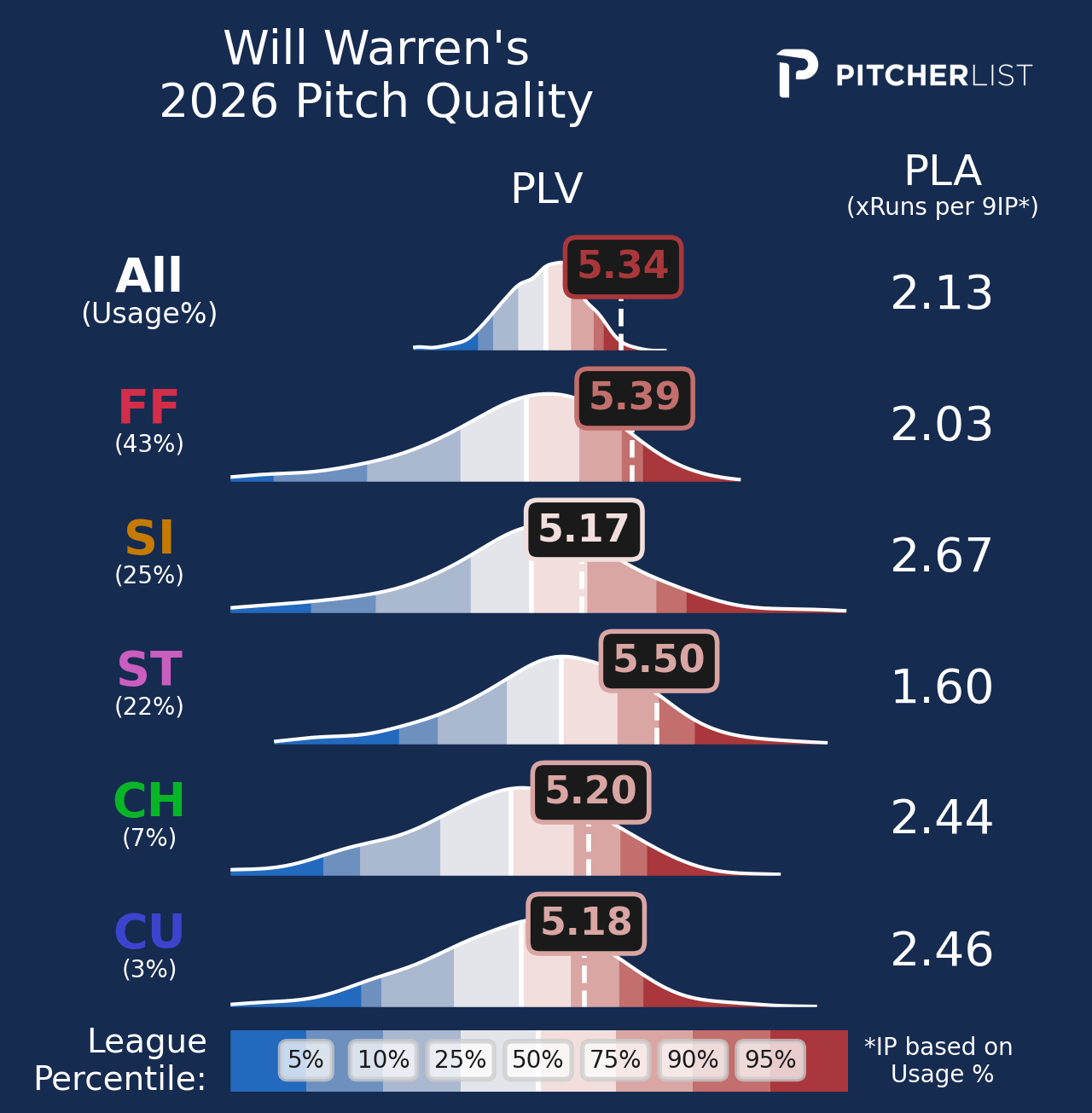
Warren’s big stuff has taken a huge step forward in 2026, with some of the following changes reflected in his consistently high PLV scores:
- Velocity – FF/SI up ~1 mph, ST/CB up nearly 2 mph
- Movement – SI running another inch, CH running another 2 inches
- Changed setup to the third-base side of the rubber – adds lateral deception to SI/ST, have been big pitches so far
These changes have been helpful in general, but particularly target his problems vs LHB in 2025. Warren’s elite stuff gives him tons of ways to put batters away, and his execution thus far has reflected this ability. Righties have continued to struggle against Warren and, while lefties have had some loud contact, a .222 AVG/.407 SLG is still fairly manageable.
Warren’s elite 2.14 PLA is sixth among all starters, and his 5.34 PLV overall ranks third. While his stuff has always been a strength, this level of execution without elite command is very intriguing. Warren has yet to face a truly elite lineup, but his most recent start (7.0 IP, 11 K/0 BB vs. Royals) was his best in the majors to date. Look for Warren to keep working deep into games while limiting hard contact in his next start, currently projected to be in Houston this Friday.
Since his promotion to the majors in August 2025, Parker Messick has been one of MLB’s best starters on a run-prevention basis, with the third-lowest ERA among qualified starters behind Tarik Skubal and Yoshinobu Yamamoto. Messick has also averaged nearly 6 IP/start, utilizing his deep six-pitch arsenal despite low fastball velocity.
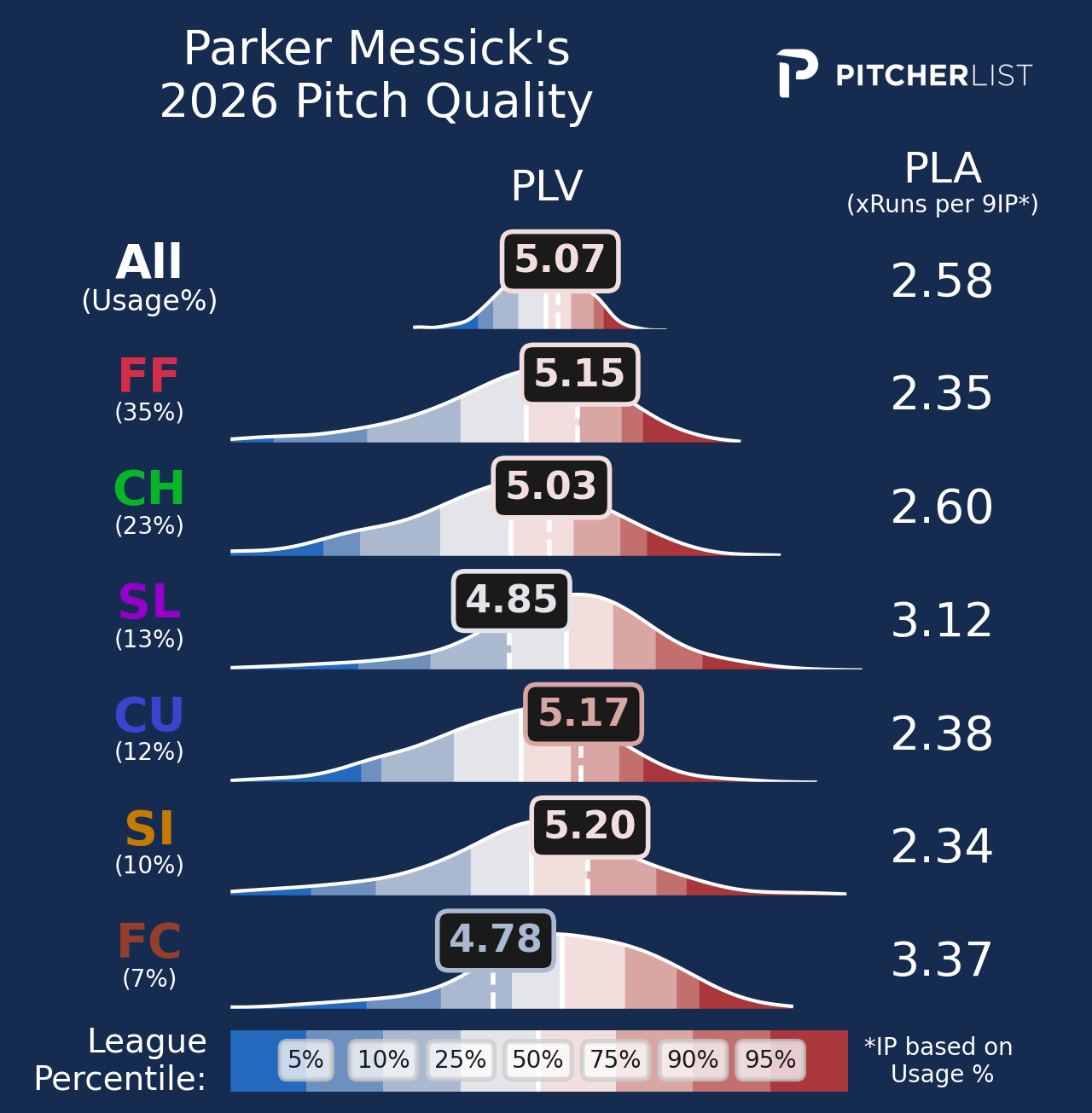
Messick’s plus changeup, multiple breaking-ball shapes, and cut/carry four-seam reminds me of 2025 Kris Bubic – a tough lefty consistently working deep into games by limiting hard contact, generating ground balls, and running elite chase rates. This makeup is sustainable as long as the stuff remains, and Bubic’s recovery from shoulder surgery this season has led to some more hard contact and weaker command.
Obviously, this is not an applicable concern for Messick, whose stuff in 2026 looks even better than in his strong cup of coffee in 2025. Messick has implemented a cutter against righties, added an inch of drop to his changeup, and is throwing a bit harder across the board.
This strong arsenal is reflected in his elite 2.55 PLA, which is consistent with other run estimators. Messick’s .200 BABIP and 5.0% home-run-per-fly-ball rate are both warning signs of regression, but his 1.05 ERA clearly has some room to step back. Look for Messick to continue generating chases and weak contact through his first full major league season in 2026.
Braxton Ashcraft is also following up a strong debut in 2025 with an elite start in 2026, pitching 22.2 innings over four starts without allowing a single home run.
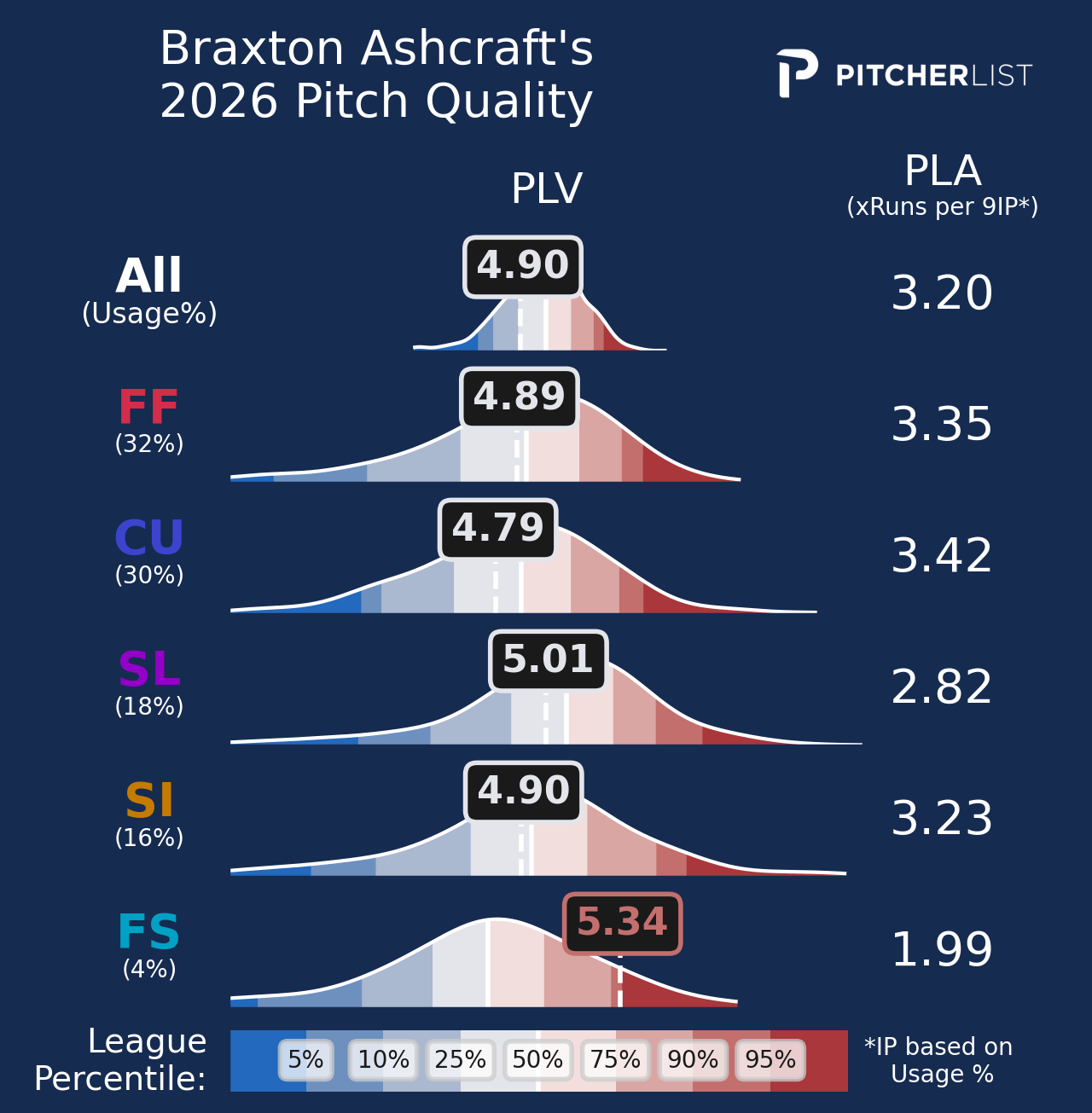
Despite solid velocity and a five-pitch mix, Ashcraft’s stuff never jumped off the charts. This is reflected in his 3.10 PLA; above average, but not at the same elite level as Warren and Messick.
Ashcraft has managed this by mixing his pitches well. He throws four pitches 25% of the time against righties, and mixes three pitches ~30% of the time while going majority fastball/curveball against lefties. This has kept Ashcraft’s platoon splits fairly neutral, striking out an elite 29.7% of batters while limiting walks (7.7% walk rate), generating ground balls (53.6% ground-ball rate), and avoiding too much hard contact (33.9% hard-hit rate).
Overall, I would expect most of these numbers to regress, but Ashcraft has flexed a mature arsenal and impressive command so far in 2026, keeping both his xERA and FIP below two. Look for Ashcraft to continue his strong start to the season in a tough road start this week against the Rangers.
