Hello and welcome to Pitcher List’s latest series: Using PLA to Evaluate Pitchers! Every week, I will examine various pitchers and break them down using PLA. There will be various themes and topics each week, which will range from topics such as waiver wire picks, to buy or sell, to awards races, to lefties/righties only, etc. I hope to mix it up as much as possible to keep you all on your toes.
Now, you might be asking, what is PLA?
PLA is an ERA estimator that was created in tandem with Pitch Level Value, which we refer to as PLV. PLV is essentially an all-encompassing stat that measures individual pitches and rates them on a 0-10 scale. The elements that factor into PLV include velocity, movement, release point, location, count, and handedness of the batter. We have an excellent primer on this by the one and only Nick Pollack that you can find right here! PLA takes this 0-10 score and translates it to an estimated ERA, which makes it easier to understand and more useful for those looking for help with their fantasy teams.
It’s important to note that PLA isn’t necessarily a catch-all estimator, just as xERA, FIP, SIERA, and pCRA aren’t either. These stats ultimately still measure outcomes, which are largely dependent on how a player is executing that day. ERA estimators are not crystal balls; however, they can provide some insight if taken with a grain of salt. For the purpose of this series, we are going to use PLA as the main factor to evaluate pitchers (hence the series title), but again, no stat is perfect, especially in the complex world of pitching.
Also, stay tuned for other PLV evaluation article series, such as one that will look at individual pitches and another that will use Process+ to evaluate hitters!
Today, we will be looking at some of the top rookie pitchers from this season.
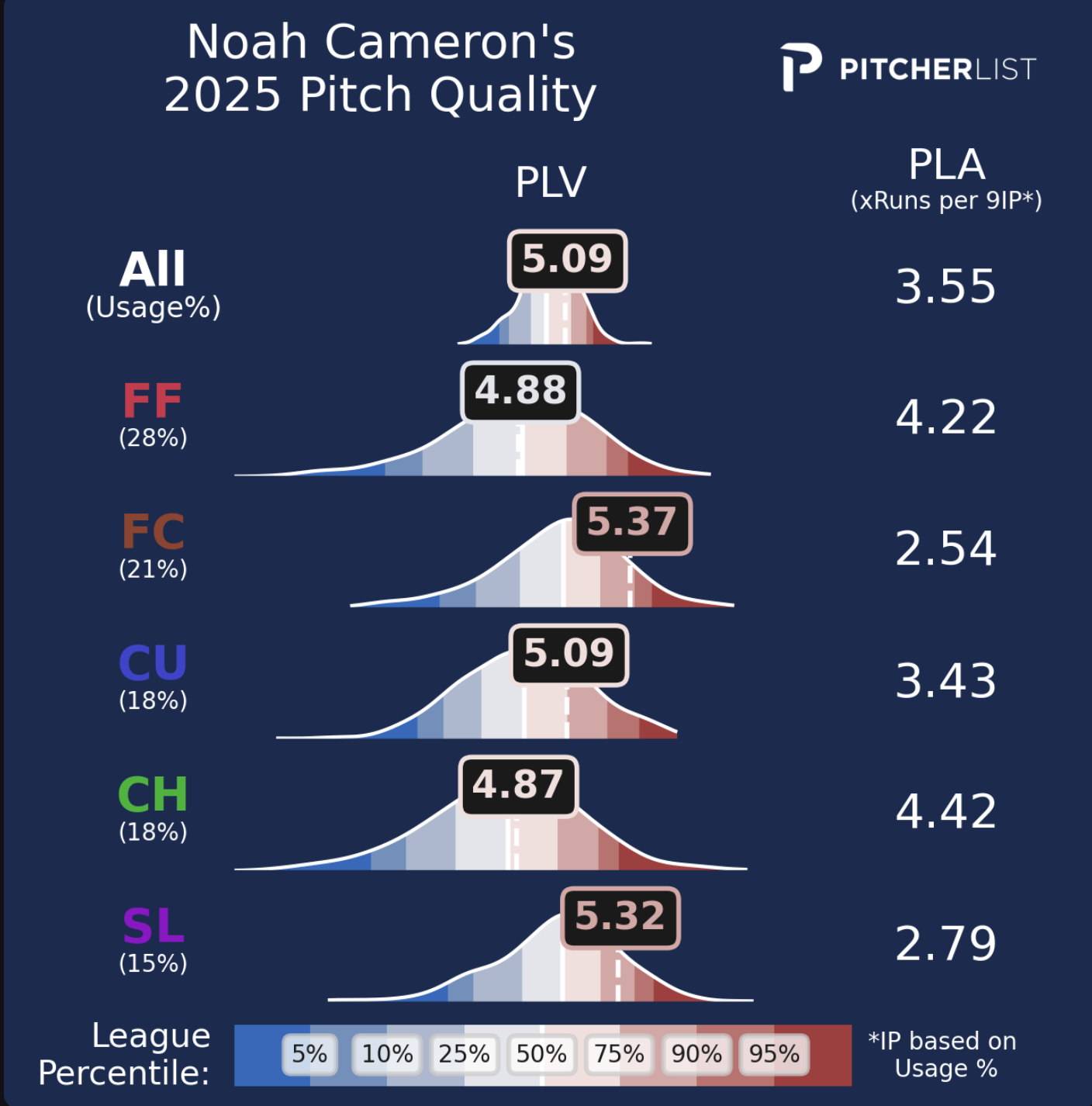
Noah Cameron – 3.55 PLA
You really can argue that Noah Cameron has been the most successful rookie pitcher this season. After ace Cole Ragans went down, and Kris Bubic followed behind, Cameron became sort of the de facto ace of the staff as a rookie, and in terms of basic stats, he hasn’t disappointed. He’s helped ratios tremendously and has kept his team in games. However, despite this, PLA isn’t the biggest fan. Why is this?
The low grade starts with his four-seam fastball. It isn’t that great stuff-wise. Mediocre velocity, below-average extension, decent vertical movement, and a very steep attack angle. He’s able to locate it high in the zone consistently, which makes up for this, but still, it isn’t the best fastball by any means. His cutter, however, grades out exceptionally well. He’s located the pitch with plenty of precision this year, dotting the right edge of the strike zone.
Cameron rounds out his arsenal with a curveball, changeup, and slider. The curve is a solid pitch, mainly thrown for strikes, though it has a solid swing-and-miss rate. The changeup is a hallmark of a good lefty pitcher, though his grades out somewhat mediocre. It gets decent whiff numbers, but it doesn’t get strikes at a particularly great rate. Last, but certainly not least, is his awesome slider. This pitch grades out really well and gets tons of strikes and swings and misses, though of course, it’s thrown significantly more to lefties than righties.
Cameron is a solid pitcher who isn’t beloved by PLA due to not having electrifying stuff. His command is solid though and he’s proven that he is more than capable of pitching in the big leagues.
Cam Schlittler – 4.31 PLA
Do the Yankees have their Gerrit Cole replacement for the postseason?
Well, not quite. But Cam Schlittler forms a formidable 1-2-3 with Fried and Rodon.
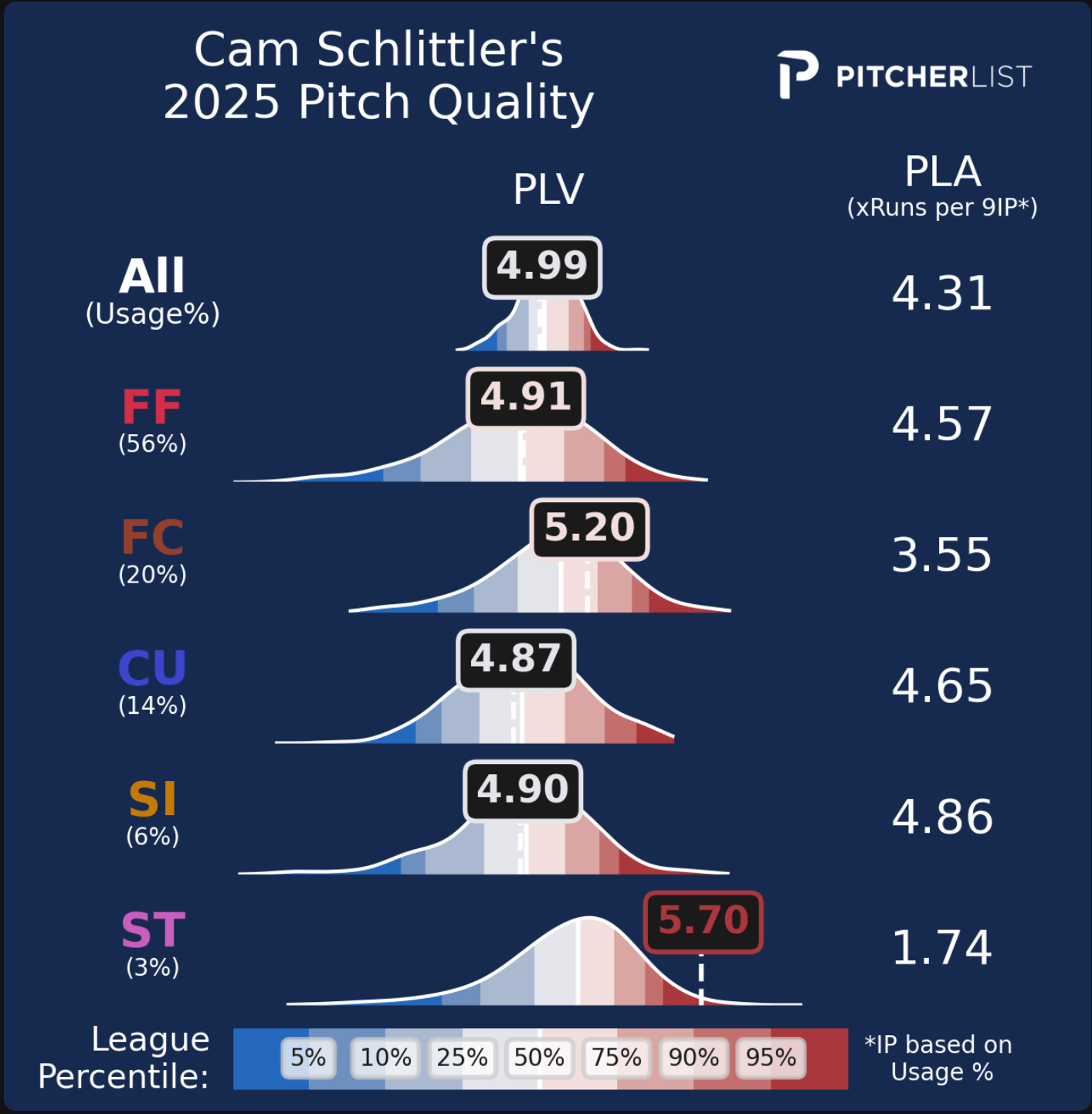
By now, everybody is familiar with Schlittler’s fastball. It hits triple digits on the gun at times, making it one of the fastest four-seamers of any starter. Unfortunately, PLV doesn’t grade it out particularly well, and you might be asking why? Well, it’s kind of deadzoney. It doesn’t have great vertical movement and comes in at a steep attack angle with little extension. Though again, it’s hard to call a heater this high-speed “empty velocity”, especially considering the fact that Schlittler is a master of getting it up in the zone.
In a similar vain to Noah Cameron, Schlittler also has a cutter that grades out really well. The scatterplots of the thing are kind of all over the place, but it’s a higher velocity offering with good drop and horizontal cut. He also uses a curveball to get strikes, and it’s a pretty high-velocity one, too. He also throws a high-velocity sinker that grades out similarly poorly, largely because it is also a bit deadzoney, featuring not much more drop than the four-seamer.
I’d like to see Schlittler utilize the sweeper more in the future. He rarely throws it, but it’s a 97th percentile pitch in terms of velocity, and it gets tons of strikes. PLV shows that the more it is used, the better Schlittler can be.
Schlittler is a great young pitcher, and there is a solid foundation for success for him in the big leagues.
Jacob Misiorowski – 3.37 PLA
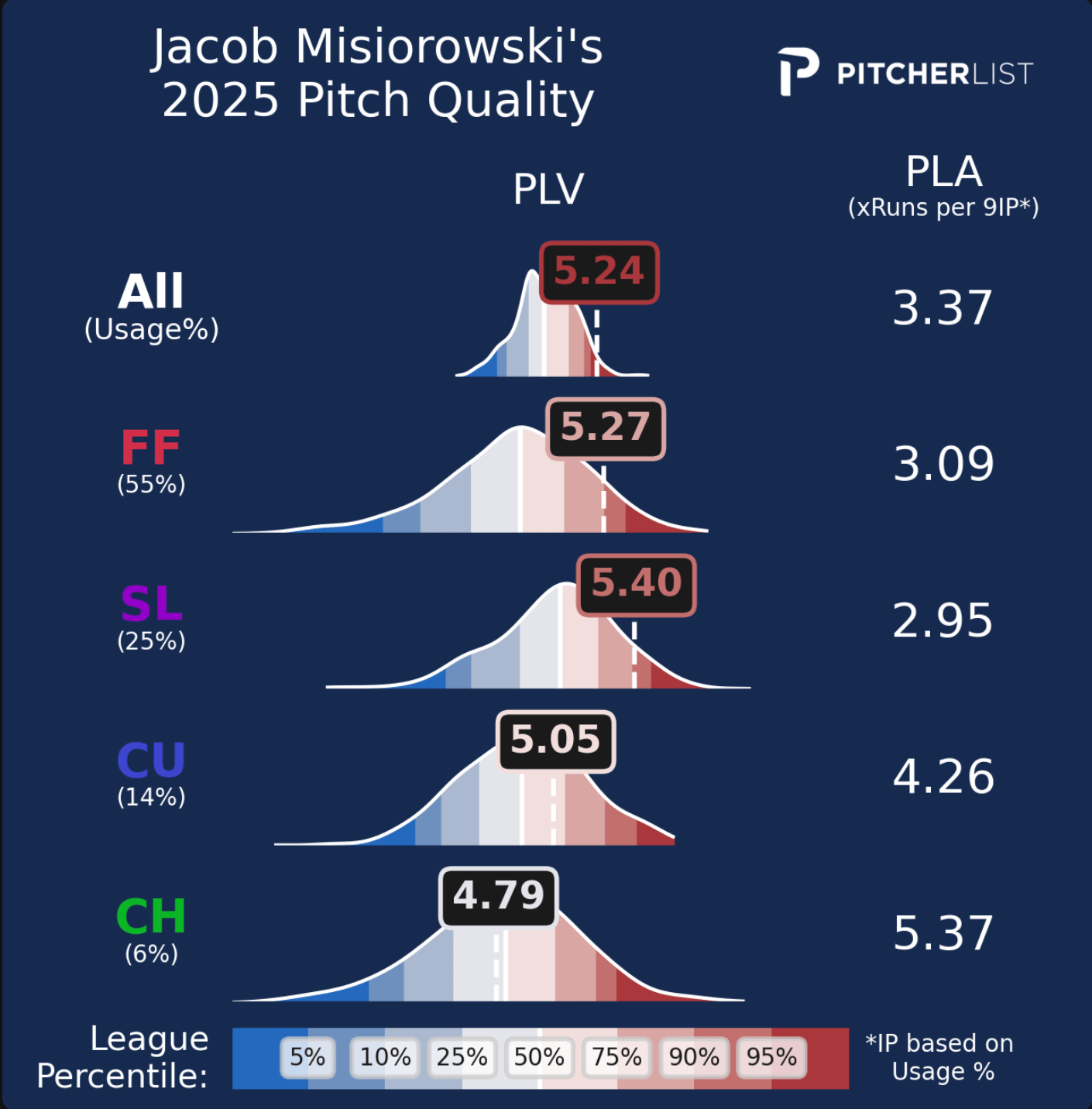
Injuries and some up-and-down performances made this season perhaps not what Jacob Misiorowski envisioned when he first got called up, but overall there are lots of positives to be taken away from his 2025. Mainly, the fact that pitch-modeling stats are absolutely in love with his arsenal.
Misiorowski is electric. His fastball is one of the best we’ve seen. You combine elite velocity, the best extension in the Majors and an incredibly flat attack angle and you get something that is beyond unhittable. His location may need some work, though he’s getting the pitch high in the zone at a pretty good rate, especially for a pitch that is so nasty.
His slider is perhaps even better, though. Per PLV, it is, though he hasn’t quite gotten the results on it that he may have hoped, at least for now. The slider is one of the fastest breakers in the Majors, if not the fastest. If you thought that a slider hitting 97 was crazy enough, wait until you see his curve that can hit 90. It’s an insane combination, and both pitches still grade out well. Misiorowski also has a changeup that he rarely uses, which is as you could predict, one of the fastest changeups in MLB. The main concern with Misiorowski is location, though we’ve seen in the past guys with electric fastball/slider combinations still become aces despite not throwing with the best precision.
Misiorowski is perhaps the best rookie pitcher this year, a take which PLV would definitely vouch for.
Nolan McLean – 3.83 PLA
Talk about a successful start to a career!
With the Mets’ rotation in complete turmoil, McLean has stepped in and has become the ace they’ve desperately needed. We still haven’t gotten one bad outing out of him, the worst one you would still probably consider a quality start. He’s going deep into games and has excellent ratios. The basic stats and the under-the-hood estimators all love him, yet PLA isn’t giving him the best grade?
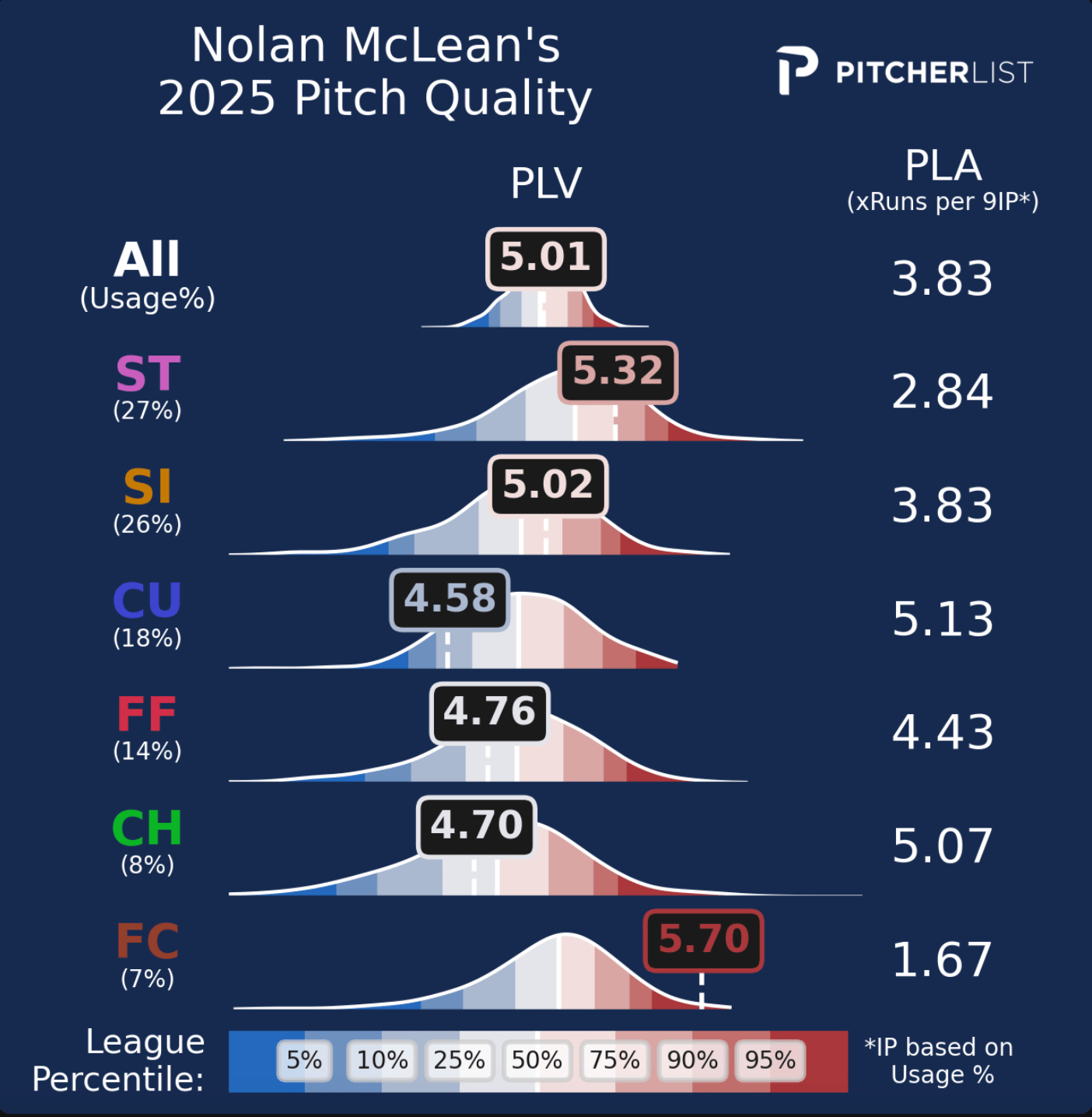
It mainly has to do with his secondaries outside his main two pitches. McLean is a sweeper thrower who uses it 27% of the time, a decision that is clearly a good one with a 5.32 PLA backing that up. His main heater is a sinker, which has done well for him, registering a 31% CSW and a near-70% strike rate. It grades out pretty much exactly average. Where it goes south are with the curveball, four-seamer and changeup. None of these pitches really jump off the page stuff-wise, though he hasn’t thrown too many so perhaps it’s still a bit early to judge them too critically. His cutter is elite though, though he rarely ever throws it. It’s cool to see an 81% strike rate on a pitch, though, even with the small sample size.
McLean has a weaker PLV largely due to his mediocre secondaries, though he’s found a formula that works, one that will make him potentially go high in next year’s drafts.
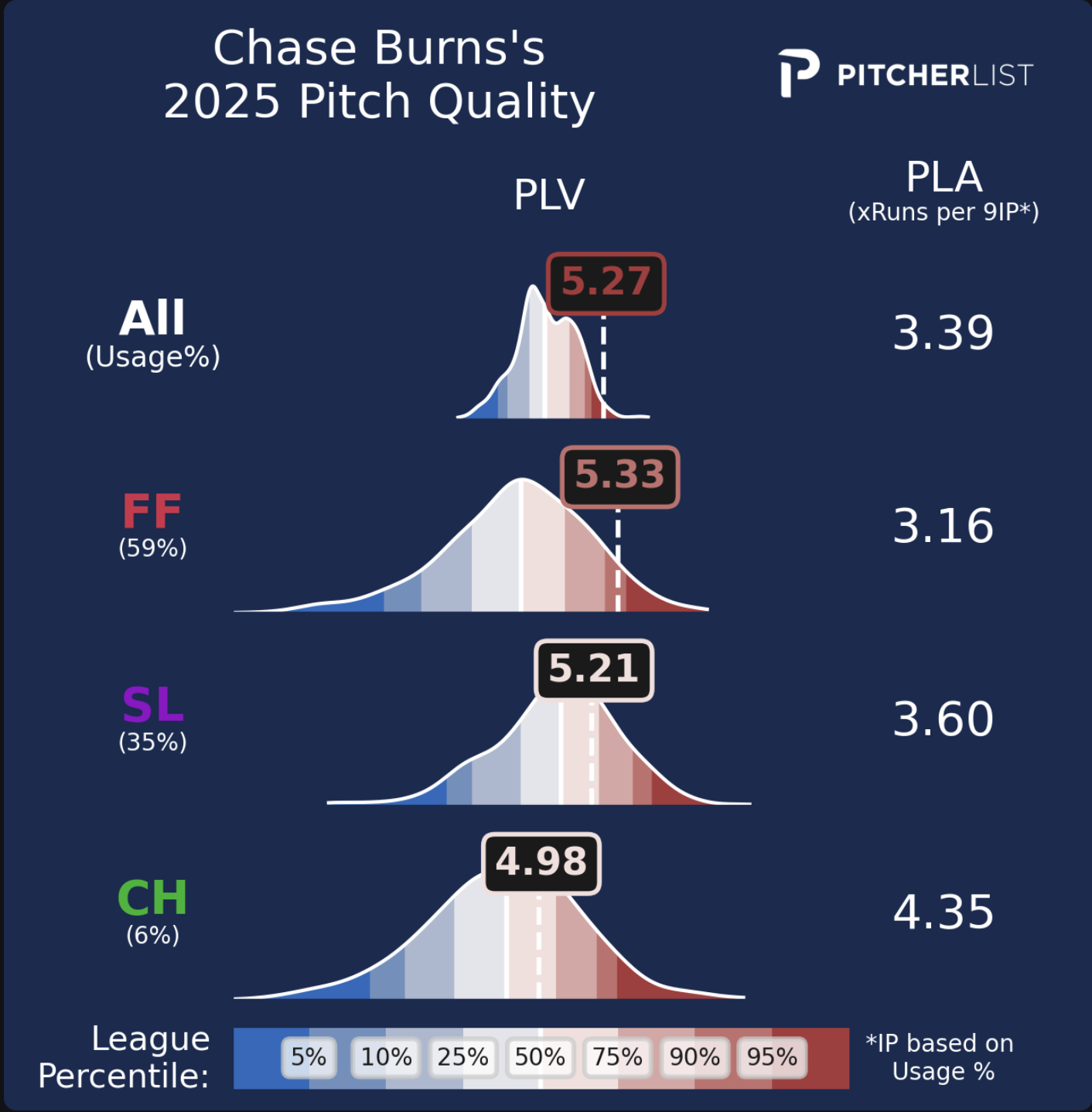
Chase Burns – 3.39 PLA
While he’s finishing out the Reds’ season in the bullpen, Chase Burns will almost certainly be the team’s ace moving forward.
Burns is a pretty simple pitcher arsenal-wise. He throws an elite four-seam fastball nearly 60% of the time, and throws an elite slider 35% of the time. The rest of his pitches are a changeup, which is solid, but isn’t at the level of the other pitches.
Burns’ four-seamer is an impressive pitch due largely to velocity. It is one of the fastest four-seamers in the Majors, hitting similar numbers to those of Misiorowski. Burns is also really good at getting the pitch upstairs, something some of his contemporaries will fail to do. The four-seamer has an extra layer of effectiveness to it, as it has elite vertical movement, making it even more unhittable.
The slider is an impressive offering as it is a true bullet slider. It has a near-zero induced vertical break, which allows it to have its sharp downward movement. It also is an incredibly high velocity slider, sitting in the 97th percentile. Both his slider and four-seamer are pretty similar to those of the elite relievers, but this is a guy who’s likely to be a starter.
Burns didn’t have the best standard numbers this year, but with his elite stuff, PLV projects him to be one of the best young pitchers moving forward.