





As the fantasy season reaches its conclusion, it seems like a great time to dive into some of the players with the biggest disparity between their preseason rankings and their actual 2025 production. Can we blame these players’ unexpectedly poor performance on their swing choices, or is there something else at play?
To analyze these players, we’ll be using PLV’s Decision Value. If you’re unfamiliar, PLV considers every single pitch’s placement, movement, and other metrics, and assigns it an overall grade. We can then use those grades to determine whether a hitter is making good swing choices and attacking pitches that he can turn into offensive production. We can also break this down further by looking at pitches both in (zDV) and out (oDV) of the strike zone. For a more in-depth explainer, check out the intro to this piece.
Like many metrics, Decision Value is graded on a scale where 100 represents the league average. Every 15 points above or below 100 is one standard deviation.
You can support Pitcher List and get access to full leaderboards for Decision Value and other PLV statistics by joining PL Pro.
Jackson Merrill, San Diego Padres – 78 Decision Value
It’s been a sophomore season to forget for Merrill. After an All-Star rookie campaign ended with a second-place finish in the NL Rookie of the Year race, he’s seen his numbers drop from 24 HR, 16 SB, and a 130 wRC+ to 14 HR, 1 SB, and a 114 wRC+. That’s a disappointing season, sure, but while it wasn’t bad enough to sink your fantasy season, Merrill was nowhere near returning value since he was typically one of the first 25 or 30 players coming off draft boards.
On the swing decision front, Merrill’s also taken a step back. In his stellar rookie season, Merrill managed to put up just an 85 Decision Value, but this year it’s slipped even further to a paltry 78. A large part of that downward shift can be attributed to Merrill upping his aggression.
Merrill has increased his swing rate over a full percentage point to 58.3% this year, a clip that falls in the 98th percentile of hitters. He’s attacking more often no matter if a pitch finds the strike zone or not, so he has a massive disparity between his 121 zDV and 71 oDV.
Merrill’s second-year struggles have been more than just his production at the plate; it’s been tough for him to even stay on the field. He just recently eclipsed the 100-game threshold, but his season’s been punctuated by three separate trips to the IL, making it hard for him to not only find a groove but to stay in it for more than a few weeks at a time.
You can see his struggle to find consistency in his Decision Value rolling results.
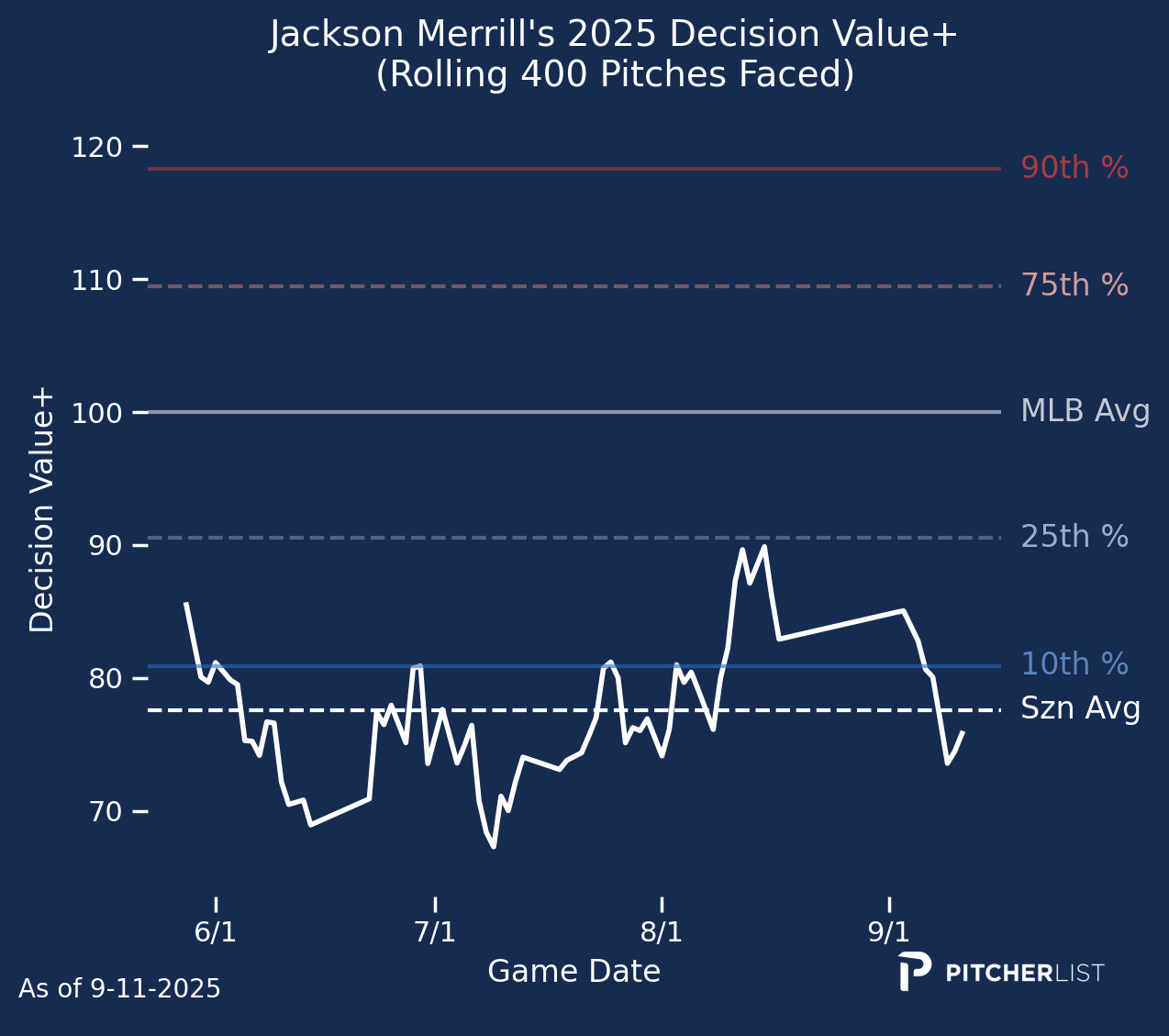
We certainly can’t blame Merrill’s swing decisions for the entirety of his decline in fantasy value, but they did likely play a part. Let’s hope we get to see a fully healthy 2026 from the Padres’ centerfielder to see just how much he bounces back in his third year in the show.
Michael Harris II, Atlanta Braves – 65 Decision Value
If all you care about is counting stats, Harris’s season doesn’t look too bad. He’s popped 17 home runs, swiped 16 bags, and driven in 79 runners, but that’s where the good times end. Harris’s respectable counting stats are more a factor of quantity of playing time than quality of production
Looking at overall offensive output, Harris has seen a huge decline in the batter’s box for a third straight season.
Looking at his swing decisions, we see a similar story. The decline hasn’t been quite as steep, but he’s gotten continually worse in every big league season, starting with an 83 Decision Value as a rookie to this year’s near league-worst 65 Decision Value. Only nine hitters have made worse swing decisions than Harris.
Harris has always been aggressive at the plate, and that’s only increased as his career has progressed. He began with swing rates near 52% in his first two seasons, but has upped that number to 55.1% and 56.8% in 2024 and 2025, respectively. PLV sees Harris’s frequency of swings as a positive in the zone (113 zDV) and a major negative out of it (61 oDV).
Like nearly everything else in Harris’s profile, his chase rate has also worsened this year as his swing rate has continued to increase. You have to wonder if the increased aggression is a reflection of him pressing at the plate, trying to get back to his high-production ways of 2022 and 2023.
Adley Rutschman, Baltimore Orioles – 109 Decision Value
Like Harris, 2025 marks the third straight year we’ve seen a decline in performance from Rutschman, although the drop off has been nowhere near as severe. After posting back-to-back 5 fWAR seasons to begin his MLB career, Rutschman has looked more like a serviceable starting catcher rather than a franchise-altering talent behind the plate.
While Rutschman’s production has dipped, his swing choices have stayed nearly identical, save for an outlier 2024 season. Beginning in 2022, he’s posted numbers of 110, 108, 93, and 109.
Rutschman’s consistently solid Decision Value grades across both good and bad seasons point away from swing choices being the cause of his offensive struggles. Additionally, nearly all of his standard plate discipline metrics have remained in the ranks of baseball’s top tier of hitters.
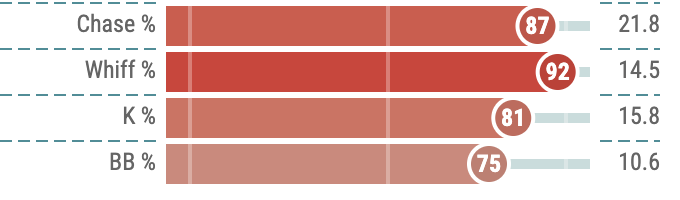
Over the first three seasons of his big league career, no catcher had as many plate appearances as Rutschman. With catching being such a physically demanding season, perhaps the wear and tear he accumulated began hampering his performance at the plate. I’m excited to see if Rutschman’s numbers bounce back at all in 2026 since he should be splitting time between catcher and DH with the arrival of the Orioles’ latest premier backstop prospect, Samuel Basallo.
Marcell Ozuna, Atlanta Braves – 120 Decision Value
Ozuna crushed 40 and 39 homers in 2023 and 2024, so if you drafted him with an early pick hoping he’d anchor your fantasy squad’s power output, you’ve been sorely disappointed with his uncharacteristic 20 bombs and .400 SLG. Unexpectedly, despite the downward shift in his power numbers, PLV thinks he’s made the best swing decisions of his career.
After having so much success the last two seasons, you wouldn’t necessarily expect Ozuna to change his approach at the plate, but that’s exactly what he did. Ozuna had swung at just over 46% of the pitches he’s seen during his long career, but he cut that rate dramatically this year to just 38.9%. Only three percent of hitters have swung less often than he has.
Ozuna’s new patient approach has significantly increased his Decision Value. His 120 mark this year is easily his highest score ever. Watching so many pitches go by creates a very disparate Decision Value profile. Because he sees so many called strikes (12th percentile), PLV gives him a measly 75 zDV. On the flip side, Ozuna works deep counts since he doesn’t often swing out of the zone, so he’s thriving with a 125 oDV.
Ozzie Albies, Atlanta Braves – 92 Decision Value
The fact that there are two Braves on this list is pretty telling of how this season has gone in Atlanta. Like some of the others on this list, Albies’ declining production is more than a one-year anomaly – 2025 will be the third out of the last four seasons in which Albies has produced at a rate below league average. His 85 wRC+ this season is not just a new career low, but represents his worst mark by nearly 10 full points.
Albies’ struggles don’t coincide with a swing profile change. All of his zone, strike, swing, and chase rates have remained stable over recent seasons, and there’s no notable changes in those statistical categories from Albies’ 2018-2021 prime production years.
Although Albies’ swing profile has remained consistent, his Decision Value has been a bit more of a roller coaster ride. Beginning in 2021, his Decision Value has jumped from 102 to 80, 83, 101, to this year’s 92 mark. Albies’ in-zone decisions carry the weight of his 92 overall grade. His swing rate falls in the 91st percentile of batters, so it’s rare for him to watch a hittable pitch go by. His 139 zDV is the top mark in baseball, while his 80 oDV falls well below average.
Adapted by Kurt Wasemiller (@kurt_player02 on Instagram & Threads, @kuwasemiller.bksy.social on BlueSky)
