





Objectively, the 2025 trade deadline was full of action. A new record was set for the number of deals made, and breaking news kept coming until well after the clock struck 6 PM in the eastern time zone. The Padres pillaged their farm system, the Orioles restocked theirs, the Yankees and Mets acquired a ton of relievers, the Mariners boosted their offense, and the Twins executed perhaps the most drastic sell-off in recent memory.
Somehow, that all happened a month ago. In the ensuing weeks, the Brewers and Phillies would go on to create lots of daylight between themselves and 2nd place in their respective divisions, while the Padres and Mariners would creep tantalizingly close to 1st place in theirs. Some of the biggest names on the trade market have been exactly what they were supposed to (Jhoan Duran, Carlos Correa), while others have slumped (Ryan Helsley, Eugenio Suárez). An intriguing topic, though, is those who have been fundamentally different players since changing uniforms. After all, teams trade for players for what they perceive those players will be, not what they have been – and with the expansive nature of current pro scouting departments, some clubs already have preconceived ideas for how they will help new additions adjust their skillset before the trade is officially complete.
Now that everyone who was dealt at the deadline has had some time to acclimate to their new environment, I wanted to highlight these types of players – the ones who were clearly valued differently by their acquiring club than the one they were on to start the season. These guys have made concrete changes to their process since getting traded, and in all of the cases below, it has led to increased success and effectively changed their outlook.
Dustin May, SP (BOS)
Of all the players that switched teams in the days leading up to July 31, May was probably the most obvious candidate to make some adjustments. Why? Because he’s a pitcher with unremarkable shape on his four-seam and was traded to the Red Sox. May throws hard, but his four-seam gets little carry and too much tail. Boston is notorious for simply doing away with below-average four-seam shapes and getting their guys to throw more cutters and sinkers instead. In his first stretch of MLB action since 2023, May had a 4.85 ERA, 4.72 FIP, 1.4 HR/9, and a 12.0% K-BB with the Dodgers. Since the trade, the results are similar through four starts (4.50 ERA, 5.21 FIP, 1.8 HR/9, 14.1% K-BB), but his first three went very well – and it was largely driven by the same thing the Red Sox seem to do with everybody else.
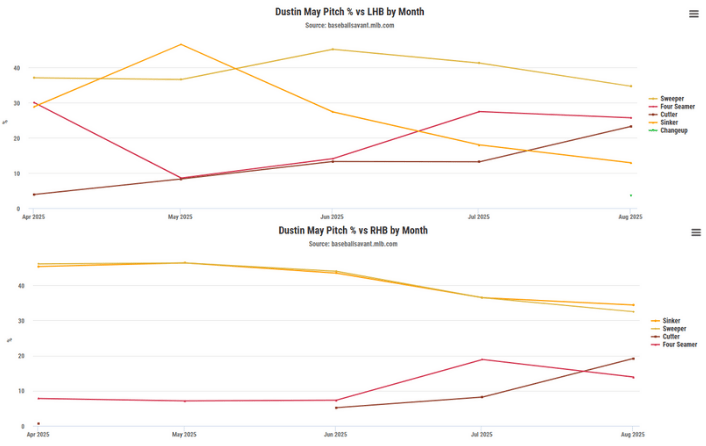
Dustin May pitch usage by handedness and month, 2025 (Statcast)
Unlike some of Boston’s previous reclamation projects, May hasn’t drastically altered his four-seam usage, but he’s throwing way fewer sweepers and sinkers to allow for more cutters. The results have been undeniable since the trade: Opponents are just 2-for-15 against it with an average exit velocity of 86.5 MPH (easily the lowest of his arsenal), and a groundball rate of 46.2% (behind his rarely-used new changeup for the highest in his arsenal). Cutters are mostly used to generate weak contact, which May’s definitely does, but it has also returned a 25% miss rate (2nd-highest in his arsenal). It’s not likely to ever profile as a put-away pitch given that it’s only used <10% in 2-strike counts, but it has worked brilliantly as an inducer of harmless batted balls and a weapon for him to gain count leverage.
Pitch models are quite mixed in terms of their grade on May’s cutter. It has universally poor location grades despite being in the zone over 60% of the time, which indicates that, on the season, he has been leaving it in spots that are easy for hitters to damage. However, by using it more, he’s becoming less predictable – a firmly necessary trait needed to outperform raw stuff. (Reminder when reading the table below: Average is 96 for Fangraphs Stuff+ on cutters, 49 for PitchingBot Stuff on cutters, 5.09 for PLV on cutters, and 0 on StuffPro, where negative is better.)
There is a lack of unanimity as to the strength of May’s cutter at a pitch level, and in a small sample with his new club, he has had two really good outings and been knocked around in the other two. Still, he has 7 starts this season of at least 6 IP and at most 2 runs allowed, and 2 of them have already come in a Red Sox uniform. Look for him to continue to try to push that ceiling going into September.
Mick Abel, SP (MIN)
Abel came the other way in the Jhoan Duran trade with a certain amount of pedigree as a former 1st-round pick out of high school with mid-high 90s velocity. He had been a consensus top-100 prospect for most of the decade, and is now a non-consensus top-100 prospect at 24 with an uninspiring 6-start big-league stint under his belt from earlier this year. With the Phillies at AAA, he recorded a 3.57 FIP, 4.04 xFIP, 16.1% K-BB, and .280 xwOBA in 2025. Not necessarily bad, but not as much progress as he likely hoped, given his age and how much time he had already spent in the minors. In 3 starts at AAA in the Twins system, he has been lights-out (2.54 FIP, 2.94 xFIP, 30.4% K-BB, .260 xwOBA). In particular, his K% has jumped from the mid-20s to the low 40s, yet his BB and in-zone rates are virtually identical.
This isn’t simply a case of a prospect rediscovering his spark with a new team. While Abel has certainly done that, he has made wholesale changes to his delivery, shapes, and mix since the deal. He began by dropping his arm slot, and while we don’t have exact arm angle data for the minor leagues yet, his release height is down from ~5’9″ to ~5’5″ while his horizontal release has moved slightly toward third base. He has also changed the deployment of his secondary pitches:
To me, the most interesting trend here is the increased changeup usage. I think we could see it even more in the near future because it has come with a shape tweak. Besides throwing it essentially double, Abel has removed ~4″ of arm-side run from the offering while maintaining 88-MPH velocity. I’m not sure who came up with this idea first, but either way, the straighter change is working (31% SwStr, 51.7% Zone). It’s missing more bats despite being in the zone 20% more often than the version with ~12″ of arm-side was in the Phillies’ system.
Beyond that, he has also added a sweeper to that already-redesigned arsenal. He’s still clearly in the early stages of getting comfortable throwing it in-game (6.4% usage), but Robert Orr’s pitch quality model (same scale as Fangraphs Stuff+) gives it a positive 107 grade. It sits 84-85 MPH with around 3″ of induced drop (~3″ more drop than his slider) and ~14″ of glove-side action (~13″ more than his slider). He isn’t zoning it much at all, and it hasn’t generated much chase either, but opponents are making weak contact either way.
This all comes with the important caveat that Abel has only made three starts with his new club, but he has taken all these adjustments in stride and immediately seen massive gains as a result. He isn’t the same pitcher he was a month ago, and because of that, he’s once again on the doorstep of the majors for a Twins team that desperately needs good news about their future.
Ramón Laureano, OF (SD)
Laureano was a good addition for a Padres lineup that needed to add power. The 30-year-old is in the midst of a career year, which gave Baltimore a good opportunity to sell high on his 15 home runs (he has hit 4 more since the trade). He’s not the kind of hitter that San Diego usually goes for, in that he swings and misses quite a bit, and added both speed and length to his swing last year. He’s harnessing it this year with better swing decisions and a retained ability to pull the ball in the air, but there still aren’t many hitters like him in his new lineup. Indeed, he has undergone a slight transformation after being dealt to the west coast, but he’s making it work all the same, with a .402 wOBA/.379 xwOBA this month.
That opposite-field% is not only Laureano’s highest in a single month this year, but the highest monthly rate of his career by nearly 10%. It’s such a strange difference for someone who has consistently pulled flyballs for years now. Meanwhile, his swing length, tilt, and attack angle are the lowest they’ve been in a single month this year (lowest single-month tilt of his career too), while his bat speed is at its lowest since April. It’s all so quintessentially Padres, who favor shorter, compact swings and have the highest opposite-field rate of any MLB team this season. Regardless, Laureano continues to hit the ball hard and get his barrel to it, a testament to his raw strength and the fact that he continues to catch the ball out front. I don’t know how sustainable that part of it is, given that his batted ball profile closely resembles that of a low line drive, gap-to-gap hitter instead of a pull-happy home run hitter, but another thing he has done is push his in-zone miss to its lowest since May 2022 – again, that has Padres written all over it. The point is that they’re happy with him as he has continued to produce. Definitely a guy to monitor for the stretch run.
David Bednar, RP (NYY)
Not all of the Yankees’ new relievers have pitched according to plan. Jake Bird was optioned to AAA a couple of weeks ago and hasn’t been back, while Camilo Doval has lost all control of the strike zone. You could even make the same argument about David Bednar, whose ERA with New York sits in the mid 3s after running a 2.37 with Pittsburgh. However, his FIP continues to stand out at 2.53 (1.98 with PIT), and his K-rate has jumped from 33.1% to 38.6% – more than enough to offset a relatively minuscule ~5% jump in BB-rate. He leads the Yankees with 3 saves in 6 opportunities since the deadline, and while it may seem like there’s no need for any pitcher to get more strikeouts when their K-rate is already at 33%, it hasn’t happened by accident. To put it simply, Bednar is throwing way more splitters.
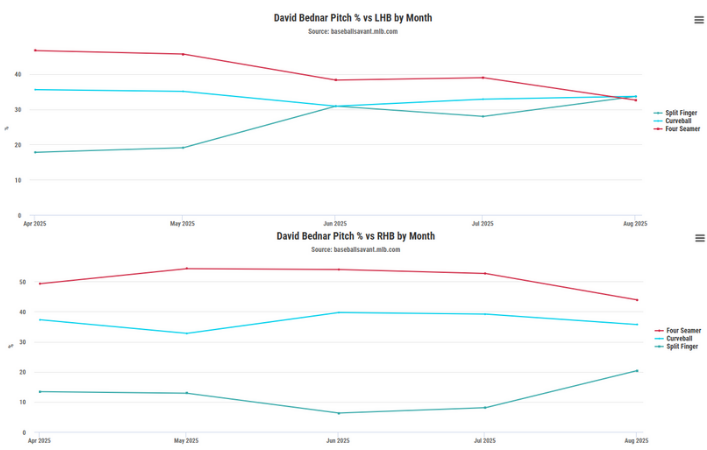
David Bednar pitch usage by handedness and month, 2025 (Statcast)
This offering is beautiful to watch. It sits at 92 MPH with only ~1700 RPM and ~5″ iVB with ~7″ of arm-side. Its PLV grade of 5.41 sits in the 96th percentile among MLB relievers, and it’s now his primary pitch to lefties and in 2-strike counts to both sides. He has been using it ~45% of the time in 2-strike counts with the Yankees when it used to be his tertiary put-away pitch, and it’s also in the zone more often than any other pitch type in that situation. Opponents know it’s coming, and it has a higher chance of being a strike than either of his other options, and they still can’t hit it – it’s running a 41% K-rate this month. Hitters are 2-for-16 against it, and they’ve only put it in play 9 times since he donned the pinstripes for the first time. Those 6 batted balls have an average launch angle of -11°. They’re either swinging and missing or pounding it into the dirt. As a closer with three “plus” pitch types, Bednar has places to go if the league starts to catch up to his splitter, but right now, it’s just too nasty to hit. The Yankees have had him lean into it at the perfect time.
Ty France, 1B (TOR)
France was the piece that arguably carried the least amount of trade value in the four-player swap that sent him north of the border along with reliever Louis Varland, but he has had to play a slightly bigger role than expected with Vladimir Guerrero Jr. missing a week with a hamstring injury, and it’s going well – he’s hitting .296 as a member of the Blue Jays; his previous monthly high for batting average this year was .276 in June. He’s still slugging under .400, but his miss rate is under 20% for the first time all season and he’s going the other way a lot more. There’s a clear focus on hitting a lot of base hits here, and he’s succeeding despite his exit velocities and plate discipline staying about the same. Only, I wouldn’t be so quick to write France off as a depth contact hitter.
Remember, this was a 20-homer guy at the start of the decade, and he’s back to swinging like it. Since coming to the Blue Jays, he has added more than 1 MPH of bat speed than what we were seeing with Minnesota. He also started the season with a 36° tilt in March/April and then flattened it out with each subsequent month, but now he’s back to that same level of uppercut – and remember, that tilt is one of the hardest things for a hitter to suddenly change about their swing. For the couple of seasons preceding this one, Toronto preached an offensive philosophy that prioritized contact and going the other way, but they’re going back to doing damage on top of that high-contact approach and pulling the ball more. France is effectively straddling the line between both of those right now, and while he’s reaping the benefit of the highest batting average he has had all year, he’s showing some early signs of a raised potential for power. If that comes to fruition, the Blue Jays lineup, which is noticeably better this year than it was in recent memory, will get even longer.
All figures entering August 25, 2025.
