





Three years ago, Alex Fast and Eno Sarris did a show on the Pitcher List Podcast Network about Bobby Miller’s arsenal. They discussed his lucrative upside and troubling inconsistencies, which revolved around throwing two fastballs: a four-seamer and a sinker. After some analogies about supination and pronation, the two deduced that Miller favored the latter, given his high spin efficiency.
Miller’s career has continued to go sideways since that episode went live. However, the crux of his ceiling case lives on. If a pitcher can effectively throw a four-seam and two-seam fastball, they can become two different pitchers to mitigate platoon advantages. As they oscillate between whiffs and weak contact, they shape-shift into the optimal pitcher for a given count.
Few players embody this skill set like Seattle Mariners starter Bryan Woo. And if the success of the game’s best pitchers provides any signal, Woo is in store for a monster 2026 season.
Bryan Woo Gets the Best of Both Worlds
One distinction between Woo and Miller is that Seattle’s star is a supinator, sporting two distinct glove-side breakers. Thus, Woo relies on seam-shifted wake with his sinker and is unlikely to have an elite four-seam movement.
Woo gets away with below-average vertical break on his four-seamer due to his arm angle and command. By consistently locating atop the zone, Woo’s 25-degree arm angle lends itself to an incredible height-adjusted VAA (1.7, 98th percentile).
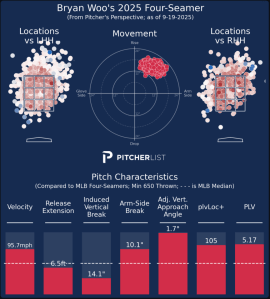
Unsurprisingly, this translates to a consistent ability to miss bats. His fastball generated a 34.8% chase rate in 2025, with a 28.8% whiff rate and a 75.2% contact rate inside the zone. Results-based pitch metrics can be messy, but plate appearances ending with his four-seamer earned a .241 wOBA. He’s turning guys into Nick Allen!
Woo also relies on his fastballs a ton. Both his four-seamer (47.3%) and sinker (25.6%) are used at above-average rates. That usage isn’t sustainable for a starter without diversification. Fortunately, Woo’s sinker separates itself well from the four-seamer. It also has nearly identical movement to his changeup, making for a strong tunnel.
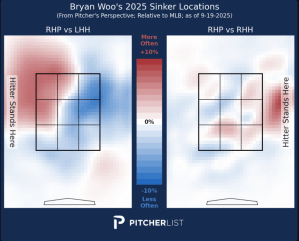
Even without elite movement, Woo’s fastball execution approaches the Platonic ideal. It’s thrown hard and up in the zone, gets swings and misses, and is platoon neutral. His sinker is similarly prototypical. Its arm-side movement demands a turn signal, and it’s located exceptionally well.
Woo uses this more often against right-handed hitters to generate weak contact and ground balls. He does so effectively, forcing ground balls, chases, and weak contact at above-average rates. He is also happy to locate it to the glove-side part of the plate against lefties. Throwing God’s favorite pitch, the front-door fastball, it generally exceeds expectations.
Simply put, throwing two strong fastballs is a skill. Woo has it in spades, and it’s the biggest part of what makes him an ace.
Woo Is in Excellent Company
Woo’s profile isn’t perfect. The sweeper isn’t located particularly well, and the slider can do a better job of mitigating damage. Yet, the potency of these fastballs put him in rare air.
While different pitches carry slightly different PLA means, 3.39 is a helpful proxy for the average fastball. Four-seamers and sinkers carry a standard deviation of 0.789 by this metric, so we can estimate that 2.60 is a decent threshold for a 60-grade pitch. Last season, three starters threw at least 250 fastballs and sinkers while posting a PLA below 2.60 on each offering.
Tarik Skubal. Zack Wheeler. Bryan Woo.
The two relievers who hit those marks, Gabe Speier and Aroldis Chapman, also had excellent seasons.
Bryan Woo’s 4Ks in 2.1 Innings. pic.twitter.com/SfuWGYQS4K
— Rob Friedman (@PitchingNinja) March 3, 2026
Wheeler is a better match for Woo than Skubal, whose sinker had an abnormally high zone rate and produced plenty of in-zone whiffs. The Philadelphia Phillies ace, perhaps the game’s best pitcher without a Cy Young, boasts similar shapes and locations with his fastballs. Subsequently, it’s no surprise that those pitches get nearly identical results. It’s Wheeler’s assortment of secondaries and elite command that sets him apart, but Woo has flashed enough to elicit the same kind of upside.
This skill set is repeatable, too. Both Woo’s fastball and sinker ranked in the 90th percentile of their respective pitch types by PLV in 2024. With a playoff-hopeful roster, a favorable home stadium, and last season’s 186-inning workload, the recipe for a Cy Young season resides in Seattle. Woo will be my pick for the award, and I expect him to outperform his current 3.62-ERA Pitcher List projection.
Who Could Join Woo in 2026?
You probably didn’t need 700 words to figure out that Woo has excellent stuff. Still, it’s worth considering who might make them jump into this double-barrelled fastball territory. Moving the threshold from 2.60 PLA to 3.39 (250+ pitches) gives us a new crop of pitchers to work with. That group can be broken into two categories: established stars and names to watch.
Paul Skenes, Garrett Crochet, Joe Ryan, Max Fried, and Michael King need no introduction. In Skenes’ case, his command and secondaries are so good that he can be the National League’s best pitcher without tipping the scales with a heater. Crochet can go toe-to-toe with Skubal for the top southpaw in the sport, and his cutter more than compensates for an average fastball. The same can be said for Fried. Ryan’s four-seamer is a HAVAA monster that defines his profile — there might not be a better one in the bigs. King, sans health concerns, has used this versatility to transition from the bullpen successfully.
These guys can’t break out. They’re too good! But if Ryan or King is a Cy Young finalist in November, I’d wager their second fastball’s development probably has something to do with it.
The next tier is far less fun, largely including names who are in desperate need of a skill jump. One or both of these pitches becoming elite could pave a path to production, and with both a fastball and sinker posting average-to-above-average marks, there’s reason to believe they are benefitting from the pairing, too.
Casey Mize improved in 2025, partly because his sinker usage allowed for fewer bad breaking balls. Jack Leiter’s fastball got him drafted second overall in 2021, but neither his four-seamer nor sinker has shown enough command to get the whiffs and ground balls we’re looking for. Aaron Nola was perhaps baseball’s unluckiest pitcher in 2025 after years of eating innings with this combination. Entering his age-33 season, he might not have enough bite to get back to normal. Dean Kremer would benefit from throwing his sinker inside to right-handed hitters more often, and Bailey Falter lacks separation between his sinker and four-seamer, capping his upside.
In the stuff-chasing arms race that has taken over baseball, throwing as many elite pitches as possible is paramount. Some guys just don’t have the raw talent to do so. Others haven’t been able to access it, whether it be because of command or cohesion with the rest of one’s arsenal. Woo’s talent is rare. He’s a Cy Young candidate for a reason and has a unique feel for arm-side movement as a supinator. But the principles that make him great – finding whiffs with the fastball and weak contact with the sinker – are applicable throughout the sport, especially for pronators like Miller who are predisposed to ride and arm-side movement.
Photos by Icon Sports Wire and MLB.com | Graphic by Carlos Leano
