






Hello, deep leaguers! I have terrible news. The NL Central continues to struggle. My Pirates have been unable to weather injuries to Oneil Cruz and Konnor Griffin. They’ve lost 8 of their last 10 games and have joined the Reds (who are without Elly De La Cruz and Hunter Greene) in sub .500 territory. Oh well, I had been enjoying the run of Central Supremacy. Also, I want to say “Happy Father’s Day” to all the dads out there. Now without further ado…
Fallers
Mitch Keller, Starting Pitcher, Pittsburgh Pirates – 35% Rostered
The book has been out on Keller for a while. He’s an innings-eater type of pitcher who typically pitches much better over the first half of the season than he does after the break. In fact, his ERA is nearly a full run better during the spring than it is during the summer. Maybe it’s the consistent mid-80s heat we’ve seen in the burgh lately that’s causing 2nd half Keller to show up early. Mitch gave us a 3.18 ERA in April, a 5.50 ERA in May, and an 11.42 ERA so far in June.
I’ll start with the positive: Keller has a .400 BABIP this month, so he has been a tad unlucky. He also has the worst strikeout and walk rates we’ve seen him post since the completely crazy 2020 Covid season. Back in 2020, Keller made just 5 starts where he covered just 21.2 innings with a 16:18 K:BB ratio. He had an FIP of 6.74 and yet, somehow, with all those awful numbers, he had an actual ERA of 2.91. That’s why we don’t talk about 2020 stats.
Anyway, current Keller has lost a little bit on his four seamer over the last few years, and it’s now sitting at just 93 MPH. Despite the drop in velocity, it’s also been his most used and most effective offering. His slider has also been useful this season, but opposing hitters are batting over .280 against his cutter, change, and sinker. But the real issue lately for Keller has been his elevated walk rate and depressed K rate.
Two of his recent clunkers came against Atlanta and Los Angeles, and you probably would have avoided those starts anyway. This article will be finished before his start in Sacramento, but I’m obviously avoiding just about every start in that stadium. I think Kurtz could bunt the ball into the stands. After that, though, he gets Seattle at home. I’m not suggesting using Keller for that one, but if he can stop issuing so many free passes, I’ll consider him a streaming option in QS leagues again. That looks like his ceiling right now.
Gavin Sheets, First Base and Outfield, San Diego Padres – 14% Rostered
I may have foreshadowed featuring Pirates and Padres with the intro about Pirates and Dads. I covered Sheets on 5/20, back in week 9. He had just finished laying waste to Mariners pitching, and I was impressed with his power output and pleasantly surprised he had chipped in a couple of stolen bases. I also thought his chase rate would prevent him from maintaining his batting average, but I overall thought he could be a legitimate power threat.
Well, Sheets didn’t launch any more dingers in May after that, and has slashed just .163/.250/.372 with 2 homers through the first half of June. He has suffered through a .167 BABIP during that time, and his K rate has held at an acceptable rate just over 20%. He walked a ton in May, and that’s tailed off some, but he’s around 10% for both the season in general and June in particular.
It would be easy to just chalk his recent performance up to bad luck with that awful BABIP, but Sheet’s quality of contact has dropped off significantly.
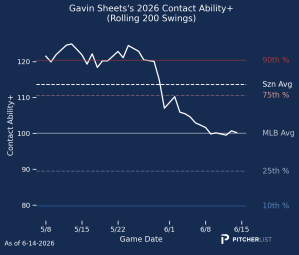
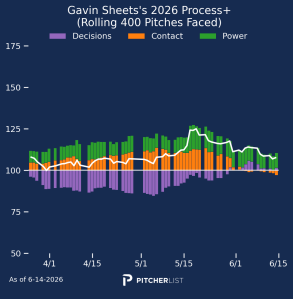
As I noted earlier, his K and BB walks have held up alright, and we can see his decision value holding strong near the mean in the process chart. But his contact ability has dipped well below his own season average, although it’s still not fallen below the MLB mean. I don’t love what I’m seeing, but I also don’t think it’s a glaring problem.
Sheets is still walking at a good clip; he isn’t striking out at a rate where we expect prolonged slumps, and with 11 dingers in 203 at bats, he’s still on pace to eclipse 20 for the first time in his career. Maybe I’ll revise my expected batting average down from .250 to .240, but I didn’t believe he’d keep his average up back in week 9 anyway. I say hold if you have him, or buy the dip if you need some pop in your outfield.
Edwin Arroyo, Second Base and Short Stop, Cincinnati Reds – 4% Rostered
Arroyo got his first taste of MLB action with Elly De La Cruz out with a hamstring injury. He’s gotten a good share of time at the keystone since his promotion, starting 9 out of 13 possible games. He’s racked up 36 plate appearances, a very small sample, but he is a highly touted middle infield prospect, so we, as deep leaguers, are interested.
It hasn’t been a tremendous debut. Arroyo is slashing just .219/.278/.219 with no homers or steals. He has a 26% hard hit rate, an exit velocity under 90 MPH, and has not recorded a barreled ball. His chase rate is over 40%, and he’s drawn 2 walks while striking out 10 times. So there isn’t really anything to hang your hat on here. Spencer Steer gaining 2b eligibility in some formats is probably the most notable part of Elly’s absence.
Elly is also likely to return next week, according to recent reports, and when that happens, Arroyo likely heads back to AAA, where he was slashing .323/.383/.562 with 11 homers, 9 steals, and a strikeout rate under 20%. The Reds are last in their division right now, and while that could change quickly once their injured starters return, if they don’t climb the standings, Arroyo could get an extended opportunity later this season. If you have minor league spots in your league, Arroyo could be an excellent stash.
Risers
Cole Carrigg, Outfield, Colorado Rockies – 13% Rostered
Carrigg earned his MLB debut after slashing .333/.414/.529 with 6 homers and 30 stolen bases over 225 at-bats in the admittedly hitter-friendly PCL. He’s stayed scorching hot through his first 7 MLB games, slashing .259/.333/.667 with 3 homers already in 27 at-bats. As with Arroyo above, we have very little MLB data so far, but I think it’s worth looking at Carrigg right now.
The early returns have been great, and he’s shown great bat speed while posting a 14% barrel rate, a 43% hard hit rate, a 20% K rate, and a 6:3 K:BB ratio so far. All of those are great underlying rates that could change wildly as Carrigg accrues more playing time. On the other hand, he’s chasing almost 50% of pitches out of the zone and has an average exit velocity of just 86 MPH.
He had very similar walk and strikeout rates in AAA to what he’s done so far in the Majors, so I do think he can keep up the walk rate, but that chase rate is something to be wary of if we start to see his strikeout rate jump. But Carrigg is a clear power and speed threat with an acceptable strikeout rate (at least so far), who also gets Coors for half his games. He racked up 43 dingers and 142 steals in 334 MiLB games. Jump on this if you can.
Henry Bolte, Outfield, Athletics – 7% Rostered
We have another rookie who mashed in the PCL and carried that production with him to the Majors. With 50 homers and 139 stolen bases in 397 MiLB games, Bolte has a strikingly similar profile to Carrigg. They’re evenly matched in height and weight, too, but Bolte has just eclipsed the 100 at bat mark, so we have more data and can trust his walk and K rates a bit more.
On the surface, Bolte has been pretty good. He’s slashing .326/.400/.413 with 5 steals, but he’s homered just once and has a modest 10 runs and 7 RBI. So he’s given us great ratios and steals, but has lagged behind in the power department. He’s actually got huge bat speed and sports a robust 49% hard hit rate and 91.5 MPH average exit velocity, but he also has a barrel rate just over 3%, which accounts for the lack of dingers. He’s also mostly batted in the bottom third, and that’s unlikely to change given the talent in the A’s lineup.
The biggest caveat with Bolte, though, is his contact ability. His walk rate is under 7%, and he’s chasing nearly a third of pitches out of the zone and whiffing almost as often as he chases. All of that adds up to a K rate over 27%, and he’s sporting a .460 BABIP and an xBA of .219. He does have elite sprint speed, so an elevated BABIP is to be expected, but .460 isn’t sustainable. His contact chart also looks like this:
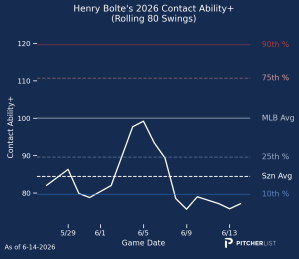
That’s bad. But also, Bolte is currently riding that downward slope while on a 7-game hitting streak. I’m getting whiplash trying to determine if I care more about his incredible speed and moderate power potential or his underwhelming on-base skills and contact rates. In the end, I’m choosing to be optimistic. It’s hard to teach bat speed or sprint speed, but players often improve their approach with experience. I prefer Carrigg between these two outfielders, but I like Bolte a lot too.
Samad Taylor, Second Base and Outfield, San Diego Padres – 7% Rostered
According to BSR, Taylor lost his rookie status as a Royal back in 2023, but he has less than 130 MLB plate appearances, so he’s a rookie in my heart. Also, it lets me continue this week’s risers’ theme: PCL graduates. Taylor earned his promotion by slashing .319/.406/.500 with 7 homers, 9 steals, and a 26:39 walk-to-strikeout ratio over 222 plate appearances for El Paso. So we have our third outfielder with great wheels and enough pop to matter, and Taylor even offers some extra eligibility for your troubles.
Samad has just 32 MLB plate appearances this season, so we have about the same amount of data we had with Carrigg. He’s had no trouble with MLB pitching so far, and has slashed .357/.419/.500 with a homer and two steals already. He’s drawn 3 walks, but has also struck out 9 times in 8 games.
Checking under the hood, Taylor’s 93rd percentile sprint speed jumps off the page, even if it means he’s actually the slowest of our three risers this week. Taylor has posted a walk rate over 9% so far, but also a K rate over 28%. However, his chase rate is under 24%, and his whiff rate is barely over 20%, so I would expect that K rate to drop a bit if he can maintain the first two.
Unlike Carrigg and Bolte, though, Taylor has unimpressive bat speed, clocking in at just 68.7 MPH. When you compare that to Carrigg, just under 76 MPH, and Bolte over 77 MPH, the differences in power potential become more apparent. It should be unsurprising that Taylor has posted poor power metrics. His 25% hard hit rate, 5% barrel rate, and 83 MPH average exit velocity all suggest that Taylor will provide little, if any power, and should be considered a batting average and speed play if anything. He’s also benefitted from a .500 BABIP so far, the highest and least sustainable of all the high and unsustainable BABIPs we’ve seen today.
So Taylor is the eldest of our three “rookie” outfielders and plays for the worst offense of the group as well. In fact, he plays for the lowest-scoring team in the Majors. (Maybe stop batting Machado third?) To recap: I like Carrigg the best of the group, but Bolte also looks like a worthwhile add in anything larger than 12-team mixers. Taylor looks more like a hot bat than a legitimate late-career breakout.
That’s it for week 13. I tried to keep the roster percentages extra low and hopefully actionable this week. Thanks for reading, and good luck out there, Deep Leaguers!
