






Hello Deep Leaguers! I can’t believe it’s week 8 already. It’s the middle of May, and all five NL Central teams have winning records. In fact, the NL Central has more winning teams than the entire American League. The Yankees, Rays, Guardians, and Athletics are the only AL teams above .500, and we have a quarter of the season in the books. The Marlins, Mets, and Giants are the only NL teams with losing records against AL teams right now. Honestly, this was bound to happen once interleague play became the norm, and both leagues had designated hitters. Maybe the AL should get 2 designated hitters in interleague matchups to even things out? The National League is simply too good.
Fallers
Daylen Lile, Outfield, Washington Nationals – 50% Rostered
Lile came into the season with a lot of buzz around him. He deserved it after slashing .299/.347/.498 with 9 dingers and 8 steals in 321 at-bats as a rookie last year. A 20/20 season in 2026 looked like a real possibility. Alas, Lile has struggled in the early going. He’s batting just .253 with 3 dingers and 2 steals.
His barrel rate has held steady from his 2025 mark, but his hard rate has dropped, and his exit velocity is down a couple of ticks and currently resides near the very bottom of the league. He’s not striking out a lot, and he’s walking more than he did last year, but his chase, whiff, and K rates are all worse than his 2025 levels.
Lile has been particularly cold over the last couple of weeks (outside of last night), slashing just .186/.265/.279. His process chart doesn’t offer much hope either.
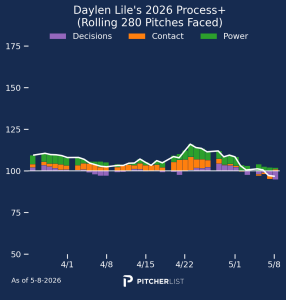
We can see a few signs of life show up back in the third week of April, but since then, Lile’s contact and overall production have been trending the wrong way. I’m not optimistic, but I’m holding Lile in leagues with 14 or more teams. Anything smaller than that and I’m eyeing up guys like Bolte, Bleday, or Ewing as potential replacements.
Moisés Ballesteros, Catcher, Chicago Cubs – 33% Rostered
Every year since I’ve been doing this, there seems to be one guy who ends up in this article several times. Of course, I strive to include a variety of players. I love late career breakouts and crafty lefty veterans as much as buzzy prospects. But some guys just have wild enough swings in performance and pique my interest enough that I have to check in on them over and over. This year, Ballesteros seems like that guy.
It’s strange that it’s him, because it’s usually big power/big strikeout guys, who are naturally more prone to streaks. Michael Toglia stands out as the perfect example. Ballesteros is more of a low K rate, strong on base percentage type of player, so when I saw that he was batting just .056 with a .146 OBP over the last two weeks, I had to include him. It didn’t take long to see the issue. Here are two charts:
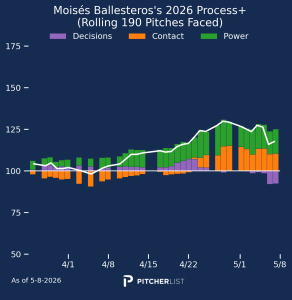
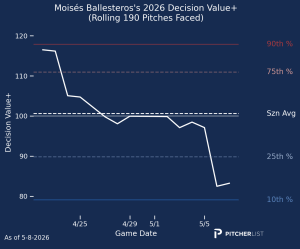
First, we have his overall Process where we can see his contact and power rates dipping, but remaining well above league average. That little purple bar is his decision value, which I’ve included on its own for dramatic purposes.
This is a real concerning problem. Last we checked in on Ballesteros (April 22nd), he had an 8% walk rate, which has actually ticked up a bit. His chase rate, though, has ballooned to over 36%, which is much worse than his 27% rate last season. He is 0 for his last 16 at-bats and has walked just once while striking out 5 times over that span. He is up to 3 catcher appearances on the season, but has caught just once over the last three weeks. I am holding in leagues where he already has C eligibility, but I’m starting to waiver in leagues where he is utility only. I’m also speculating on Jimmy Crooks.
Spencer Torkelson, First Base, Detroit Tigers – 53% Rostered
Torkelson gave us a pretty typical Tork month in April. Not much batting average, but nice power with 5 homers over 101 at bats, and he got on base at a .350 clip, which is a big help in OBP leagues. But since the calendar flipped to May, he is slashing just .156/.270/.313 with just one homer over 32 at-bats. He has drawn 5 walks over that time, so no issue there, but his contact rate and power output have cratered. His May BABIP is .267 compared to .290 in April, so it isn’t just bad batted ball luck either.
Tork’s 18% chase rate is elite, his 14.6% walk rate is outstanding, his whiff rate is just a hair below average, and all of the above rates are better than they were last season. Yet, Tork’s K rate has spiked to almost 32% and ranks in the bottom 10% of the league. I crammed all of that data together into my patented “What’s the Matter” machine and figured Tork might be too patient at the plate lately.
Sure enough, Tork has been behind in the count for nearly 16% of the pitches he’s seen this season. His career rate is 12.7%, and the MLB average is 12.3% this season. He’s also been put away with a two-strike count almost 25% of the time, which is much higher than his career 20.4%, or the current MLB average of just 19.1%.
He’s both falling behind in the count more often and striking out more when faced with two-strike counts. His rate of putting balls in play early in the count has also plummeted from nearly 13% for his career to under 10% on the season. The walks are great, but both the Tigers and fantasy managers need Tork to hit home runs, and it appears that he needs to be more aggressive earlier in his at bats. I think he can make the correction, and I recommend holding or even taking a shot at acquiring Tork before he starts hitting bombs again.
Risers
Connor Prielipp, Starting Pitcher, Minnesota Twins – 11% Rostered
Prielipp has now made 4 Major League starts and enters the day with a 3.32 ERA, a 1.00 WHIP, and a 21:7 strikeout-to-walk ratio. It’s worth mentioning that three of the four offenses he’s faced rank in the bottom third of the league in runs scored, but Prielipp has looked good so far. He carried a 22:8 K:BB ratio over 15 AAA innings before his promotion, which is perfectly in line with what he’s done in the Majors, which is a good sign that he’s not afraid of MLB hitters and is trusting his stuff.
That stuff is primarily an 87 MPH slider with 34 inches of and a four-seamer averaging 95+ MPH with a 33% usage rate. Both come in harder than what the average lefty tosses. His slider and heater have returned 31% and 28.5% CSW rates so far. He also throws a curve and changeup enough to matter, and those pitches have produced his best put-away percentages.
Prielipp was the Twins’ second-round pick back in 2022, and now he has a minor league track record and some MLB success to go along with that pedigree. The AL Central is the weakest-hitting division in the league, with Prielipp’s Twins the only team sporting a top-10 offense. He gets the Marlins today, and I’m in on that one wherever possible with the intention of holding Prielipp.
JJ Bleday, Outfield, Cincinnati Reds – 14% Rostered
Bleday was barely left out of this article last week, but Lowe and McLain were already included, and I’m not here just to cover the Reds, no matter how magnetic Sal Stewart’s mustache might be. But Bleday could be denied no longer as he’s slashed .244/.367/.561 over the last two weeks.
He is 28 years old with a .217 career average and .712 OPS over more than 400 MLB games, so it’s more than reasonable to be skeptical about the .262 average and 1.035 OPS that Bleday has posted this season. However, he looks like a completely different player than the guy who hit .212 with the Athletics last year.
The 2025 version of Bleday had above-average walk and chase rates. That’s it. He whiffed nearly 30% of the time, struck out over 25% of the time, and made weak contact. All of his expected rates were in the bottom 10% of the league. The 2026 model features elite, top-of-the-chart barrel rates, hard hit rates, and exit velocity. And that’s not it. He’s cut his whiff rate to 25%, his chase rate to 23%, and his K rate all the way under 14%! The only thing he isn’t doing is hitting lefties. This is your Lile replacement right here.
Zack Gelof, Second Base, Third Base, and Outfield. The Athletics – 11% Rostered
Gelof teased us by slashing .267/.337/.504 with 14 dingers and 14 steals in just 69 games as a rookie back in 2023. He did manage 17 dingers and 25 steals in 2024, but batted just .211 with 188 strikeouts in 139 games. He struggled even more last season, batting just .174 and appearing in only 24 MLB games. This season, Gelof torched the PCL with a 1.250 OPS in 11 games before rejoining the big club.
He’s carried a lot of that production to the Majors, where he’s slashed .274/.328/.484 with 3 homers, 2 steals, and a 5:18 BB:K ratio in 24 games. His whiff and chase rates are much better than last season, but he’s still striking out in more than 26% of his at-bats and whiffing on almost 30% of his swings. Both would be in the bottom third if he qualified.
Gelof has elite sprint speed and plus bat speed. But while his 91 MPH exit velocity would rank in the top third, his 41% hard hit rate is middling, and his 6.5% barrel rate is rather poor. His process chart is more uninspiring than it is disappointing, but we know Gelof has some pop and speed. What needs improving is his contact ability.
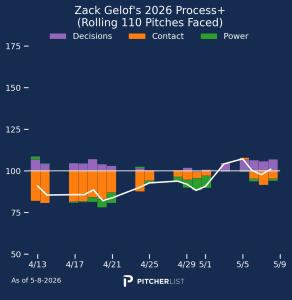
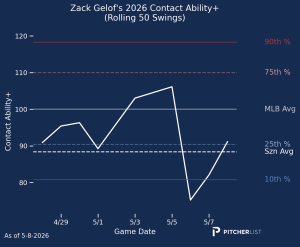
We can see his decision-making quality lining up with his excellent chase rate on the process chart. However, his contact ability hangs out below the mean most of the time. When we focus on his contact ability in the second chart, that peak in early May really stands out as a very brief moment in time before a sharp plunge.
I do think Gelof has shown legitimate progress. There is still too much swing and miss in his game, but it’s considerably less of an issue right now than it has been for the last couple of seasons. He has great eligibility, a great home park for offense, and should have a long leash right now as the A’s are dealing with a slew of injuries. There could very well be a 20/20 season here, even if Gelof is still more likely a .240 hitter than a .270 one.
That’s it for week 8 of DLRF. Good luck to all the managers with Prielipp in their lineups today, and thanks as always for reading. See you next week Deep Leaguers!
