








Honestly, draft season is my favorite season. Everyone is looking for the next 2023 Matt Olson or 2021 Vladimir Guerrero Jr. at first base. When I think of first base, I think of power and RBIs, and some of these guys have the potential to be fantasy game changers. In this offseason, the market was very active, with many players changing scenery and some solidifying starting roles. So, it will be interesting to evaluate the situation the team sees at first base.
When it comes to the definition of a true sleeper, you’re looking for a player who is being drafted later than his projected production suggests he should be. Meaning, you want to find the guys that have a strong chance to outperform their draft cost to have a successful fantasy squad. While Vladimir Guerrero Jr. and Bryce Harper are my set-and-forget tier of first basemen, I wanted to mention some honorable mentions for sleepers and busts for 12-team fantasy formats for 2026. I see value in “Swiss Army Knife” sleepers like Kazuma Okamoto, Ben Rice, and Cody Bellinger because of their versatility across positions. And I keep a wary eye on reaching too high on names like Pete Alonso while he adjusts to his new home, Freddie Freeman due to his age and injury history, and high-variance guys like Tyler Soderstrom and Jake Burger. The key here is to evaluate draft value vs. expected return on your investment, and I’m here to identify some potential sleepers to give you draft profit to spend elsewhere.
Sleepers
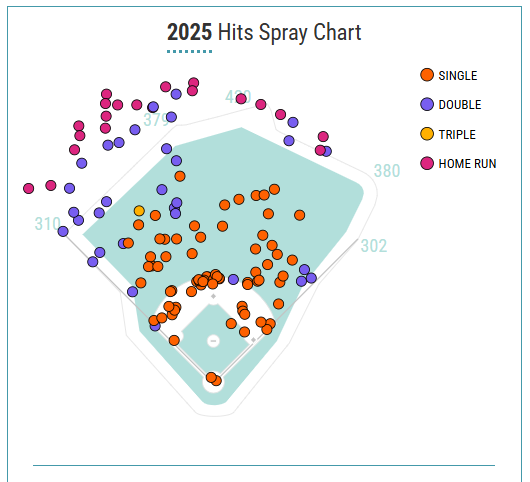
One of the best parts of fantasy baseball is being right about a player the rest of your league lets slide because of preseason questions. Willson Contreras is shaping up to be one of those forgotten draft-day values at first base in 2026. Long viewed primarily as a catcher, Contreras has quietly graded out as an above-average defender at first in recent seasons, boasting an Outs Above Average in the 90th percentile in 2025. That defensive versatility becomes a relevant topic when discussing how playing time is divided between him and the injury-riddled Triston Casas. If Casas struggles to stay on the field, Contreras could lock in every day at-bats, and even if Casas stays healthy, there’s a legitimate case that Contreras just outright outperforms him both defensively and offensively. A. 358 xwOBA (86th percentile) in 2025 supports the production, and his spray chart plays perfectly at Fenway Park.
When it comes to the definition of a true sleeper, you’re looking for a player who is being drafted later than his projected production suggests he should be, and Contreras fits that mold. Most managers will overlook him, but he has top 10 power potential. His Statcast looks shockingly similar to a 2025 Matt Olson page, which most managers were paying a second-round pick for, making him a great sleeper. He doesn’t have the greatest stats in Fenway Park. Here is his last home run there back in 2023, to remind you of that sweet power swing. His draft costs are around the 12th round, which isn’t too costly for a power hitter that may lean off of the Green Monster all year.
Alec Burleson has spent much of his career bouncing between the corner outfield spots and dabbling in some starts at first base, but with the departure of Willson Contreras, he now has a clear path to settle in at first and cement his bat in the lineup. As a lifelong St. Louis Cardinals fan, this script has worked before. We’ve seen it with names like Allen Craig, Chris Duncan, and Matt Adams. Power bats shuffled around the corner outfield to keep them in the lineup, only to land at first base, where the offensive value outweighs the glove. Burleson also made tremendous strides against left-handed pitching, turning what once was a clear platoon concern into a legitimate strength and further solidifying his case for everyday at-bats. If he can clean up the routine fly balls and succeed against lefties, then he has the profile to be a staple power bat at a position that carries a rich history in St. Louis.
In a 12-team format, Burleson is a late-round flier with an ADP around 180. You’re likely getting even better draft value than Contreas, and that’s the type of players that we call league winners. Being able to find an everyday first baseman in the latter parts of the draft allows you to spend higher draft picks on guys you know have a solid floor at another position. To give some perspective, I’ll bring up another Cardinals first baseman, Matt Adams, who boasted a 32.1% Pull AIR in 2019, which is typically correlated with a stronger flight path for flyballs, leading to more success. Which is why we see Matt Adams hitting one of his highest totals for home runs that same year. We see Burleson’s Pull AIR% consistently dropping, but still producing 18 home runs. That’s two fewer home runs than Adams at his BEST Pull AIR%. A slight change in that category could produce serious value from Burleson.
Andrew Vaughn enters the 2026 season as a premier sleeper candidate, largely because his mid-2025 trade to the Milwaukee Brewers finally unlocked the plate discipline scouts raved about when he was the third overall pick. During his stint in Milwaukee last year, Vaughn most importantly slashed his chase rate from 36% to 24.6%. By escaping the CrySox lineup and moving to a hitter-friendly environment at American Family Field, where his Expected Home Runs by Park shows he would’ve hit 21 in Milwaukee instead of the 13 he hit in Chicago. Despite his late-season breakout, his draft-day price remains wide open until that White Sox stink wears off.
With an ADP lingering outside the top 250, Vaughn provides a rare high-floor, high-upside profile at first base. I know he’s a deep sleeper in a 12-team league, but he’s the kind of player where ADP is so low you don’t even have to burn a pick on him. The moment he flashes, you’d better move fast on the wire because that’ll be the last chance you get to grab him for free. I could see Vaughn knocking 20-25 home runs, so take your chance before everyone catches. Burn the last pick in your draft with his power potential, why not?
Busts
Josh Naylor is a prime Bust candidate for 2026, and I feel bad because it’s almost too obvious! His move to T-Mobile Park creates a statistical storm for regression. The heavy Marine Layer in Seattle historically suffocates the pull-side power he relies on. With a park factor that suppresses left-handed home runs by nearly 17%, and managers are still paying a premium price. According to Statcast, he may be a “speed fraud”, swiping a career-high 30 bases in 2025, yet he still ranks in the bottom 7th percentile for sprint speed and a nearly impossible 94% success rate for a player with his wheels. So, I’m going to bank on that 20/20 floor not being so certain in T-Mobile Park. His late-season surge with his new team was impressive, but the price you’ll have to pay for him is staggering.
Home runs dipped, meaning power decreased, while batting average rose, meaning contact improved. The stolen bases took an unrealistic jump, adding 24 more than the year before. Don’t get me wrong, I would love for my first basemen to steal 30 bags a year, but I’m taking the chance that he won’t be able to do this again and that, from a base running standpoint, he’s being drafted at his absolute ceiling. And I’m not trying to be picky, but his groundball rate rose to a 39%, confirming a now three-year increase trend. With the park that he plays in, it worries me for his 2026 outlook. I see there being better value in the middle of the 6th, where he’s being drafted.
It’s truly wild what Nick Kurtz displayed on the diamond in 2025. It’s no surprise that the public is already drafting Nick Kurtz as a premium top-20 ADP, which is a hefty price to pay, and we can’t ignore the massive red flags. I have nothing but respect for Kurtz. The Stacast is bright red; I believe regression is certain. The real question is: will the regression be a fall-off-the-cliff bust or live up to second-round draft value? I’m going to take the chance that he doesn’t, and I feel confident in other options high in the draft. While his 36-homer rookie campaign was historic, he is a primary candidate for a sophomore slump because he significantly overperformed his underlying metrics. Statcast data reveals a staggering 42-point gap between his actual .290 average and his .249 Expected Batting Average (xBA), driven by a 31% strikeout rate.
Kurtz is going in the second round in a 12-team league, so you’ll need to decide whether you want to take that risk early on. It’s one of these situations where I have no cold, hard evidence to prove he will have a sophomore slump. As a matter of fact, most experts think he’ll power through and be a consistent threat to the league. The xOBA Kurtz produced in his rookie season hadn’t been done since 1871…I don’t believe it can be replicated.
