






Braves-Nats: 2 Harris, 2 HR
Michael Harris (ATL): 2-4, 2 HR, 2 R, 3 RBI.
The Braves and Nationals faced off in a high-scoring, and particularly homer-friendly, game yesterday. Michael Harris II showed off his power against Zack Littell, contributing two of the four home runs the Braves posted against the starter. In the top of the 2nd, Harris got a 1-1 splitter that started inside and tailed over the plate and absolutely crushed it down the line to right at 107.6 MPH. The next inning, Littell tried to flip the script, throwing a 92 MPH four-seamer up and away to Harris. Harris extended and got all of that one, too, sending the ball to the left field bleachers at 104.2 MPH. Harris finished his day with a soft pop-up to short and smoked his hardest-hit ball of the night 110.3 MPH for a lineout to right.
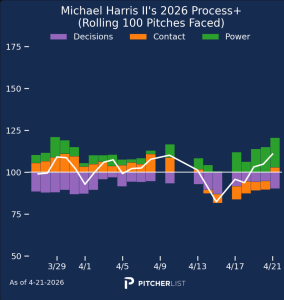
Harris has never been a particularly good decision-maker at the plate; his 5.8% walk rate and 17.4% K rate this year would both be career highs. His power is showing up early this year, though, and he has historically had strong contact ability. Through yesterday’s games, Harris is swinging half a mile per hour harder than he did in 2025, equal to his 2024 bat speed, and swinging hard on nearly half of his swings, about 9 percentage points more than last year and also similar to 2024. The main change has been he’s squaring up the ball more frequently than he has in the past. Despite running a 6.8-degree average launch angle, which is nearly a degree flatter than his previous three years, Harris is actually barreling the ball more often thanks to the quality of his contact. He’s already posted the hardest-hit ball of his career at 114.9 MPH this season, and has increased his average exit velocity to a Stantonian 94.8 MPH. It’s hard to believe that Harris will maintain this level of power throughout the year, but he’s certainly earned everything he’s gotten so far, with his .296 AVG and .543 SLG underperforming their expected counterparts by 32 and 59 points, respectively.
Let’s see how the rest of the hitters did Wednesday.
Ildemaro Vargas (ARI): 2-5, 2 HR, 2 R, 5 RBI.
Vargas continued his unlikely hero turn for a Diamondbacks team that needs every warm body that can field a position. He had two no-doubt homers off Anthony Kay in this one. The first was a three-run shot off a middle-in four-seamer that the lefty Kay elevated to him. He turned it right around and sent it out to left field at 107 MPH. An inning later, Kay tried to get him on a changeup at the bottom of the zone, and Vargas reached down to pull it to left for his second homer of the night. Vargas has been torching pitchers so far this season with a .364/.382/.697 line and hits in each of his first 17 games. The contact ability has always been there for the journeyman middle infielder, but both his career numbers and batted-ball characteristics say he’s way out over his skis on the power front. Enjoy the production if you, like the Diamondbacks, need any infielder with a bat in your lineup, but this isn’t one to count on for the long term.
Nolan Arenado (ARI): 4-4, HR, 3 R, 3 RBI, BB.
Arenado also enjoyed his time vs the White Sox yesterday. Arenado singled in the 2nd, 4th, and 8th innings, with a walk in the 3rd inning and his 4th home run of the year in the 6th inning. Arenado increased his bat speed a bit from 2024 to 2025, in part by lengthening his swing, but his bat has slowed back down while the long swing remains in 2026. He’s still aging fairly gracefully thanks to his superlative defensive ability, but he’s swinging at missing at a near career-high level thanks mostly to a near career-low zone contact rate. His chase rate is right around his career average, while he’s dramatically cut his swing rate in the zone; his 57.6% z-swing would be a career low by over 6 percentage points. This combination has led to what would be a career-high 20.2% K-rate for Arenado. While games like last night’s are a fun reminder of the player he was 5-8 years ago, my expectations are pretty firmly in line with a repeat of 2025.
Corbin Carroll (ARI): 3-4, 3B, 2 R, RBI, BB, 2 SB.
The speed was on full display for Carroll last night. He popped out in the first, then followed up with 4 straight times on base. He had a single over the second baseman in the Diamondbacks’ four-run 2nd inning and beat out a chopper to Chase Meidroth in the fourth before stealing second and third and scoring on a balk. His triple in the 7th was off the top of the wall in straightaway center; I think it’s the furthest you can hit a ball in that park without it being a homer, supported by Statcast saying it would have been gone in 29/30 MLB parks. Carroll’s plate discipline has been significantly worse than usual to start the season. He’s chasing a career-high 34.8% of the time and swinging in the zone a career-low 58.5% of the time. At the same time, he’s running the worst contact rates of his career, regardless of whether the ball is in or out of the zone. I’d be surprised if this is just the new Carroll – he’s still a star – but there’s not exactly a bunch of green flags in his profile supporting the jump to a .312 average. Expect something closer to his .260 career line and you shouldn’t be disappointed.
Miguel Vargas (CHW): 2-4, HR, 3 R, RBI, BB, SB.
It wasn’t only the Diamondbacks wh0 feasted in this game. While Eduardo Rodriguez has had a strong start to the season in his surface-level numbers, Vargas and the White Sox got to him for 4 runs in 5. Vargas smoked a 107 MPH single in the first, then stole second before being stranded. He then led off the third with a long home run to left-center which Rodriguez didn’t bother watching after he heard the loud contact. The pair of Vargas and Munetaka Murakami had 7 batted balls of 97 MPH or harder, 6 of which were in the air. This was the third straight game with a homer for Vargas who has had a rough start to the season. He’s cut his already-low chase rate to just 16.8% of pitches outside the zone while maintaining a 69.1% zone swing rate. His bat speed is up 2 MPH vs 2025, and he’s still elevating the ball regularly while maintaining an 86.1% contact rate. He’s not pulling the ball quite as regularly as he has in past seasons, but I’m optimistic that the batting average will improve.
Nolan Schanuel (LAA): 2-4, 2B, HR, 2 R, 4 RBI.
Two extra-base hits for Schanuel in one game? I guess it was a big night for offense across the league yesterday. Schanuel lined out in the first before turning on an 89 MPH fastball from Eric Lauer and depositing it just over the right field wall for his third homer of the year. He later cleared the bases on a curve which was out of the zone high and away. He hit the ball 85 MPH at a 29 degree launch angle, a type of batted ball that is a hit only 6 percent of the time, but he placed it perfectly down the left-field line and a long run away from Nathan Lukes. Honestly, I don’t think there’s anything to like in Schanuel’s profile other than the Angels commitment to him. It’s hard enough to fit guys like Luis Arraez at your corner infield spots. Why would you want a version of Arraez who strikes out 15 percent of the time instead of 5 percent of the time and has no potential for getting MI eligibility? This is a deepest-of-leagues option best turned to when injuries give you no other choices at the corner.
Vinnie Pasquantino (KCR): 2-3, 2B, HR, 2 R, RBI, BB.
Italian Breakfast got started early, crushing a sinker that caught too much of the plate from Chris Bassitt out to right field at 108 MPH. He also doubled in the 4th and walked in the 5th vs Bassitt before popping out to first against Tyler Wells. It’s been a rough start to the season for Pasquantino, with yesterday’s home run being his first hit since April 17th. He’s never had particularly elite bat speed, but this year he’s swinging slower than ever (69.5 MPH) while shortening his swing a bit from 7.4 to 7.2 feet. It’s not that this swing can’t work – José Ramírez and Randy Arozarena have similar slow, short swings – but so do players like Andrew Benintendi and Brayan Rocchio. Maybe a bigger issue has been that his contact is coming on the wrong pitches. Pasquantino’s zone contact rate is down a few points from his previous elite rates above 90%, while his contact rate outside the zone is up at 76%. If you’re going to hit most of what you swing at, you have to be better at choosing when to swing. Pasquantino’s 92 PLV DV is actually up from last year, but he’s gone from making slightly above average decisions on what to swing at in the zone to being well below average to start the season.
Carter Jensen (KCR): 2-3, HR, 2 R, 2 RBI, BB.
Jensen has officially heated up, with this last game raising his season line to .275/.354/.565 with 6 HR. He walked to lead off the second inning, then singled up the middle in the 4th at 103 MPH. He led off the 6th inning with a long blast, 106 MPH to center for his 6th home run of the season. Jensen has settled into the 5th spot in the Royals lineup, alternating games between catcher and DH. He swings hard and hits the ball hard; the main wart on his profile is the nearly 28% strikeout rate at this point in the season. His contact rates are pretty decent, though, and he doesn’t chase much (25.6% chase rate). He’s being much less aggressive in the zone than he was in his short 2025 debut, though, and this less aggressive profile lines up with his AAA numbers. If he’s going to swing at strikes around 63% of the time, I’ll take the under on his average going forward, although he’s still an elite catcher option due to the power and volume.
Mike Trout (LAA): 1-3, HR, 2 R, RBI, 2 BB, SB.
A combo meal for Mike Trout in an Angels win! Trout has been great to start the season. Despite a .239 average due almost entirely to a .228 BABIP, he’s still running a .417 OBP and a .557 SLG with 8 homers and 4 steals off the back of a 21.7% walk rate and a dramatic cut in his strikeout rate to 20%, much closer to his career average. He’s swinging harder than he did last year and barreling the ball at a career high 23% rate so far this season. He’s exhibited remarkable plate discipline with a an 18% chase rate and added back some of his in-zone aggression, swinging 61% of the time. This has led to a 2018 vintage 6.6% swinging strike rate and a 25.5% CSW. Whether he can stay on the field for a full season is the omnipresent question, but you have to love seeing Mike Trout do Mike Trout things.
Juan Soto (NYM): 1-3, BB.
Finally, our long national nightmare is over! Childish Bambino returned to the lineup after missing three weeks with a calf strain. He announced his presence with authority, smoking two balls 104 MPH in the air in his first two at-bats, leading to a very 2026 Mets 2 outs. He walked in the 5th inning, then singled in the 8th on a soft liner past a diving Luke Keaschall. In a strange turn of events for the Mets, they ended up winning this one 3-2 over the Twins. Soto has had an odd start to the season, swinging way more often both in the zone (probably good) and outside the zone (definitely bad). I covered a bit of Soto’s change in decision-making here; the short version is I think it’s probably a small sample phenomenon, but there also weren’t any small samples like this in the recent past, so maybe there’s something going on here. In any case, the Mets need whatever version of Soto they can get, as they’ve struggled to a 29th-best 79 wRC+ as a team to start the season.
Photo by David J. Griffin/Icon Sportswire | Featured image by Ethan Kaplan (@djfreddie10.bsky.social on Blue Sky and @EthanMKaplanImages on Instagram)
