





It’s been said many times lately that the A’s should’ve been better than this by now. A shocking amount of injuries to their core position players have left the team with a bottom-3 winning percentage in baseball entering Thursday. It’s another lost season for a club that recently seemed like it was on an upward trajectory. For any fanbase of a rebuilding team, talk of encouraging pieces for the future amidst the backdrop of meaningless September baseball grows stale after a few years. Regardless, Henry Bolte deserves your attention.
The now-23-year-old center fielder was taken by the then-Oakland A’s in the 2nd round of the 2022 draft after growing up in the Bay Area. In hindsight, his path to the majors looks more linear than it probably felt in the moment. He played nearly 200 games in the lower levels of the minors, saw AA for the first time in 2024 and played 134 games there, and was promoted to AAA partway through 2025. The breakout came this year. After hitting for a 153 wRC+ for AAA-Las Vegas in the early part of the spring, he was summoned to the majors and debuted on May 13. If you check his stat line through his first 406 plate appearances without any context, it looks perfectly acceptable for a rookie who plays his home games in a launchpad: .278/.359/.404 (.763 OPS). However, those numbers are the result of a burgeoning toolset coming to fruition.
Bolte is what you’d call an elite athlete. In fact, Baseball America went so far as to call him an “exceptional” one in their 2022 draft report, tagging him with 60-grade speed in their final rankings. In his preseason scouting report this year, they upgraded that number to 70. He’s had no issues whatsoever with translating that to the big leagues, having swiped 19 bags so far. His sprint speed, at 30.5 feet per second, places in the 100th percentile among MLB position players this year. Nominative determinism at its finest!
He isn’t simply fleet of foot either. Bolte has a thunderous swing with an average bat speed of 77 MPH. His fast swing rate, or percentage of swings 75 MPH or faster, is top-10 among MLB hitters, ahead of fearsome power threats like James Wood, Yordan Alvarez, and Elly De La Cruz. That combination of sprint speed and bat speed is quite rare, and even harder to find are players who have both while also being valuable defenders. Bolte’s quickness makes him a natural fit in center field, where his range has been worth 3 outs above the average fielder at his position so far. Out of 597 qualified hitters this year, Milwaukee’s Garrett Mitchell is the only man besides Bolte with at least 95th percentile sprint speed, 95th-percentile bat speed, and 85th-percentile OAA.

That defense has been a sight for sore eyes in West Sacramento. Athletics outfielders have a collective fielding run value of -20 according to Statcast, last in the majors by a considerable margin. Of course, this is no fault of Bolte’s, whose +5 FRV is better than 84% of qualified center fielders. He’s 6’3″ and 195 lbs with a strong arm, and his speed allows him to track balls down standing up that most others would have to dive for. When he does have to leave his feet, though, it’s a sight to behold:
Someone who can make catches like that, while also boasting a 60-grade arm, 70-grade foot speed, and 75-grade bat speed, would theoretically have the potential to be a perennial superstar on both sides of the ball. Think about it: That description alone sounds a lot like Pete Crow-Armstrong, who’s separating himself in the NL MVP talks at the moment. What’s stopping Bolte from achieving results of that caliber?
Far be it from me to declare that a 23-year-old with this toolset wouldn’t be able to have an MVP-type season sometime in the future. For now, one thing is for certain. Bolte hits the ball on the ground far too much to be a true home run hitter, and he doesn’t simply hit a lot of them: No qualified hitter in baseball hits the ball on the ground as much as he does. 63.3% of his batted balls as a major leaguer to date have been grounders. That’s slightly higher than Chandler Simpson, higher than Justin Crawford, higher than Luisangel Acuña, all of whom are speed demons notorious for keeping infielders active – higher than anyone.
In fairness, this is a double-edged sword. Hitting balls on the ground isn’t necessarily a bad thing if you’re as fast as Bolte. The likelier you are to leg out an infield hit or stretch a worm-burner down the line from a single to a double, or from a double to a triple, the better your results will be on groundballs. This is why I’m hesitant to declare Bolte’s .379 BABIP unsustainable. It’s the 2nd-highest BABIP in baseball among players with at least 400 PA this year (ironically, Garrett Mitchell is the only player above him), but it makes sense when you think about his speed and his groundball rate (even more ironically, .379 would be Bolte’s lowest single-season BABIP at any level of professional baseball). All that said, sprint speed aside, this is not an ideal batted ball distribution for someone with the bat speed to be a 30-homer guy.
So, how should Bolte go about trying to lift the ball more? Surprisingly, his vertical bat angle is slightly steeper than average, and despite the lack of pulled flyballs, he has an open stance. On the flip side, his attack angle is flatter than average, his swing is consistently angled toward the opposite field, and he lets the ball travel.
The answers may seem obvious in the table above, but simply trying to catch the ball farther out front or doing his best to pull may not give him the results he’s looking for. See, Bolte tweaked his swing many times throughout his minor league journey with the goal of making more contact. When he was first drafted, there were serious questions about whether his fringy hit tool would allow him to reach the major leagues at all, so most of the adjustments he made as a prospect kept his contact-ability afloat.
You’ll notice from the earlier percentile comparison with Garrett Mitchell that Bolte’s strikeout and whiff rates aren’t good (12th percentile and 7th percentile respectively). Still, they’re above the floor that players like him, with other carrying tools such as elite raw power and speed, need to stay clear of in order to be serviceable major leaguers. He’s striking out less than 30% of the time, and he’s making contact on 80% of the in-zone pitches he swings at. That’s fine for someone with this style of play, but one big change in the name of more flyballs risks plunging his contact frequency into unsustainable lows.
I chose to include the average distance between Bolte’s feet, as well as his stance angle, in the table above. That was by design. With respect to these two data points, Bolte is not that different from the average major league hitter. To supplement them, here’s a look at his stance in a game earlier this week:
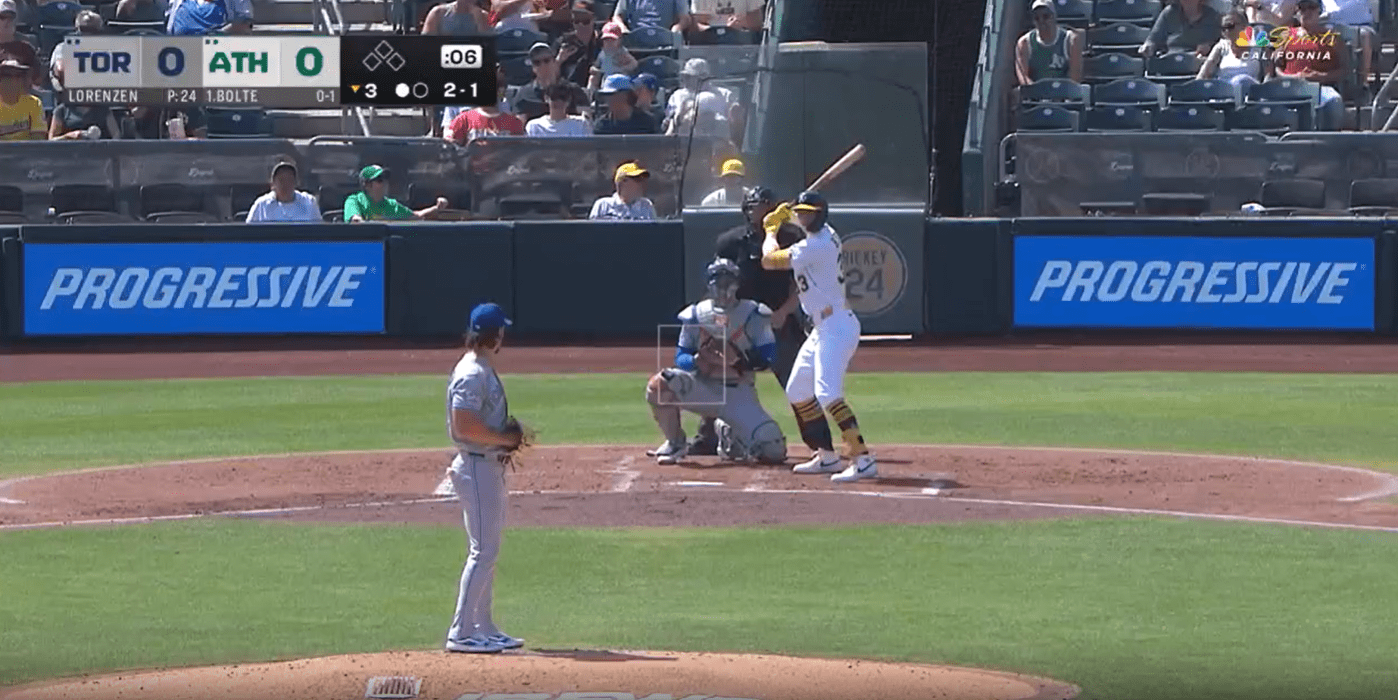
Henry Bolte Batting Stance, September 2026
He connected for a long home run in this very at-bat, capping off an outstanding series against the Blue Jays, but that’s not what I want to focus on. Observe the offset he has between his feet. A year ago, there was a tooled-up hitter of the same age Bolte is now that was gifted with raw power but, like Bolte, hit too many groundballs. He has since broken out this year, and while he hasn’t sustained the blistering pace he was on in April, he has a career-high 28 homers at the time of writing. Ring any bells?
The man in question is Jordan Walker. Last year, he had the exact same offset in his stance, but he’s more upright nowadays. The side-by-side comparison below is pulled directly from an article I wrote about Walker back in April. He’s lifting the ball, and pulling more flyballs, than he ever has. Now, I’m not a hitting coach or an expert on the kinetic chain. I never played high-level baseball growing up, and I’m less confident in my eye for swing mechanics than pitching mechanics. On the surface, though, the overlap between these two situations is uncanny: Physically gifted hitter with plus pop, plus speed, a fringy hit tool, and too many groundballs.
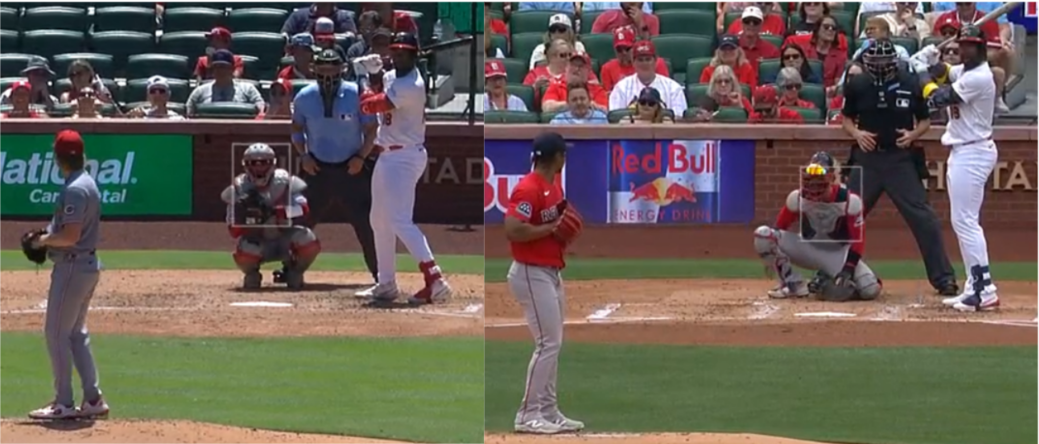
Jordan Walker batting stance comparison, June 2025 (left) vs April 2026 (right).
I can’t explain what it is about the offset that may or may not naturally predispose hitters like this to a disproportionately high rate of grounders. Yet, compared to last year, Walker’s swing tilt is flatter and his stance is more closed. His attack angle is unchanged. His average intercept point is more in front of his body, but only by an inch or so. Unlike Bolte, his attack direction was already leaning toward the pull side, but not extremely so, and he hasn’t changed that either. The most noticeable change is that the offset is gone and he’s more upright. I’d love to know what else there is to this story, but all I can say for now is that Bolte has a similar toolset with a similar groundball issue. Could a similar adjustment in the offseason pay similar dividends?
The point of going down this rabbit hole isn’t to declare that making this subtle change in his lower half will launch Bolte into another stratosphere. Digging into his batted ball distribution, however, reveals a clear conflict with his raw power, and the root cause isn’t an extremely flat swing or a glaring timing issue. If Bolte going to hit more balls in the air, a dramatic overhaul isn’t likely to do the job. Besides bat speed, he isn’t a clear outlier in any of the mechanical categories shown in the table above.
When a player has the raw talent that Henry Bolte does without the eye-popping results to match, the question is always going to be a matter of bridging the gap between the two. He’s at an early crossroads for the first time in his MLB career: Making the most of his talent without straying too far from the earlier changes he made to raise his floor and make it to the big leagues in the first place. This month has shown a glimpse of what could lie ahead, as he’s slashing .353/.488/.735 with 4 homers since September 1. That’s good for an OPS over 1.200, and for now, his home park is more than favorable for power hitters. He’s inside the top 20 qualified hitters in terms of fWAR since the all-star break, bouncing back in a big way from a rough July. The step forward many anticipated for the A’s this year has yet to occur, but it’s hard to dislike their chances if Bolte can truly become their center fielder of the future.
All stats entering September 10, 2026.
