





It feels like Jesús Luzardo should be better than this, doesn’t it? For a lefty with stuff as good as he has and no walk problems, everything else should pretty much take care of itself, right? Yet, here we are again. For the third season in a row now, Luzardo is falling short of the expectations we’ve placed upon him. There is good news and bad news. The good news is that he’s had some tough luck this season that should at least somewhat regress positively for him. The bad news is he’s got a process problem that’s holding him back.
Getting Burned
“He’s just unlucky”! Yeah, it sounds like an excuse when I type it out too. Let’s look at it a bit differently. A ball in play seems to be the Phillies’ worst nightmare. They have the league’s highest BABIP against, but more importantly, they have by far the biggest gap between their xBABIP (.315) and actual BABIP (.334). A difference of .019 may not seem like much, but it is a chasm compared to the rest of the league.
As a league, teams are out-fielding their expected BABIP. This has been happening for years. The Orioles are the only other team with a negative differential, and theirs is .001, landing them at .311 BABIP against. The Phillies are seeing more balls touch grass than any other team in the league, and it isn’t even remotely close. It’s even worse when Luzardo is on the mound.
Abysmal. You might have noticed that Luzardo’s xBABIP is above the league average, though. This problem is being exacerbated by Luzardo’s process on the mound. This seems to be a recurring thing for Phillies pitchers. Wheeler is the only starter they have whose BABIP is substantially lower than his xBABIP. BABIP itself isn’t as luck-based as people think it is; it has more to do with situational variables. That said, while organizational philosophy could be part of what’s leading them to the highest BABIP against, their xBABIP against ranks 9th in the league, suggesting some bad luck (or bad fielding) at play.
I’ve mentioned BABIP a lot thus far, and another thing I learned from reading Carson Picard’s 4-part series on it (that can be found here, here, here, and here) is that Under% is the most directly correlated metric with BABIP for hitters, in that a lower Under% increases BABIP by reducing easy popouts that rarely land. Assuming similar logic can be applied to pitchers, it’s probably worth noting that Luzardo’s Under% is down 8.3 percentage points from last season. This leaves him at 17.6%, the fifth-lowest mark among qualified pitchers. This could go some of the way toward explaining his BABIP spike this year.
Unsurprisingly, the pitchers with even lower rates (Skenes, Sánchez, Kochanowicz, and Soriano) are all groundball machines. Until this season, Luzardo couldn’t count himself among that group. His groundball rate has spiked this year from 42.7% to 51.5%. While groundballs aren’t generally dangerous contact, they can become problematic when your infielders are sitting at a combined -3 OAA and -10 DRS a month and a half into the season.
Heat Rises, Right?
The shift toward inducing ground balls seems to be a conscious change for Luzardo. Excluding his changeup, he’s throwing all his pitches lower in the zone more frequently. If he were on a team that fielded better, I might be more pleased to see it. As it stands, I do like how he’s using his sweeper and sinker compared to last season. He’s been less aggressive in the zone with them, and it’s helping him accrue more chases. What I do not like is this:
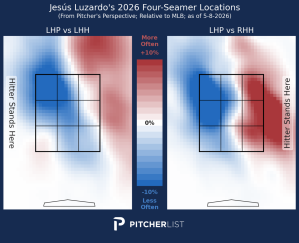
This can be explained, but I don’t love what I believe to be the reason behind it. Due to its shape, his 4-seam has never been much of a whiff-getter despite him being a lefty who has thrown 95-100 for his whole career. Going off of his other location frequency charts, I get the sense that he’s throwing the 4-seam there to try to tunnel with the rest of his arsenal against righties. You be the judge for a minute:
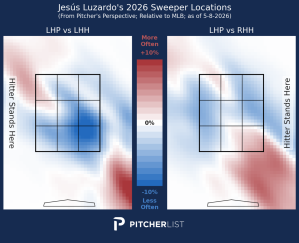
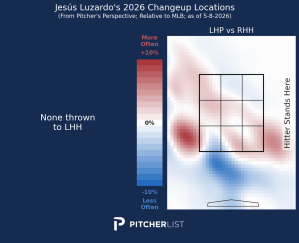
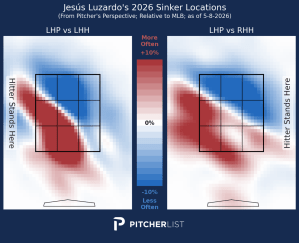
The sweepers down and to the right, the sinkers and changeups down and to the left, the tunneling strategy makes sense on paper. Regardless, I don’t like it for his fastball. Throw the 4-seam high, man. He’s upped his chase rates on all his pitches by doing this, but he’s leaving his 4-seamer exposed in the process. The expected numbers are acceptable, but the results have been catastrophic. +10 Hit Luck by mid-May. The better-than-average barrel and hard-hit rate are hard to keep in mind when the pitch is turning into a hit nearly half the time it’s put into fair territory. As much as I want to give him a pass for his 4-seam wOBAcon being nearly 200 points higher than its xwOBAcon, it’s difficult to ignore that this could potentially be mitigated by being less aggressive with it in the zone.
He’s executing his other stuff so well that I’m not convinced he needs to bother doing this with his 4-seam. I think he could be throwing it high to try to get some whiffs without significantly diminishing his chase rates across the board. They might drop a bit, sure, but it’s not like he’s ever had issues with walking hitters or an inability to get chases. Throwing your pitches in the best position possible is more important than getting them to tunnel. Leaving your weakest pitch that you throw 29% of the time in platoon matchups in hittable locations to set up everything else is robbing Peter to pay Paul.
Cooking With Gas
Let’s be clear, it’s not all bad. There’s a reason we’re all disappointed in Luzardo, and it’s because we expect him to do better than this. The reason we expect better is the same reason we can remain hopeful he’ll turn it around and get back to form. Put simply, Luzardo is nasty.
Luzardo’s primary pitch has become his sweeper. He picked this up after being traded to the Phillies during the 2024 offseason, and it immediately became a staple in his mix. It was labeled this to differentiate from his old gyro slider, which has apparently been absorbed by Statcast’s labeling as part of his sweeper. I don’t know what exactly is going on there, but more than 10% of the pitches labeled sweepers look a lot more like gyro breakers to me, having less than 5” of horizontal movement. They were kept separate last year. As they aren’t this season, we are using combined slider data in the table above. It looks odd on the chart.
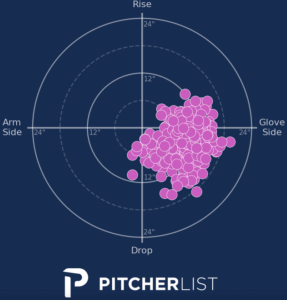
That’s a very, very wide spread of movement. The pocket of pitches directly below the zero-zero center is where I think the current form of his gyro slider is. For now, we’ll operate under the assumption that it’s just one pitch he’s tinkering with to go along with the data available to us, even if I’m not entirely convinced that’s what’s happening here.
Focusing back on the sweeper, since this pitch debuted, it has run above-average marks in nearly every category, from whiffs to chases to contact suppression. It’s an outstanding pitch to build an arsenal around, and he locates it remarkably well for such a new offering. The tighter form of his slider is also devastating, as it’s taken on more of a gyro curve shape rather than the pure bullet spin pitch it used to be. Slightly different than the old form, just as nasty though. He had 40+% whiff rates with it every season except for 2025 on that one.
As previously mentioned, his 4-seamer does not have a great shape. He throws it hard, but with just 5.7’ extension and pedestrian movement. Pedestrian might be generous, actually. This pitch is right in the dead zone vertically and only avoids the center of it thanks to higher-than-average horizontal movement. It plays mostly because he’s a lefty throwing 97. With that boon, it’s around league average in terms of stuff.
Luzardo modified his changeup this season, as shown here by Lance Brozdowski.
Jesus Luzardo altered the grip on his changeup.
It’s 1.5 mph slower w/ 7″ more drop. He killed ~300 rpm on the pitch by moving his middle finger over and rotating the ball’s orientation.
SwgStrk, chase & whiff on the pitch are all up vs righties compared to 2025. #Phillies pic.twitter.com/k8vPTGZWj0
— Lance Brozdowski (@LanceBroz) April 15, 2026
It now has exceptional movement and velocity disparity from his fastball while maintaining spin and release deception. Given the feel he’s shown for locating the new grip early on, I want to see more of this pitch. It’s a firm 70-grade to me. What a find for him.
Lastly, his sinker is also a bit better this season, having gained an additional inch of both depth and run. It’s a great pitch, best used against lefties but good enough to work against righties too if he can locate it more cleanly. Its movement separation from his other fastball while maintaining the same release, spin direction, and activity%, should make it difficult for hitters to tell which is which until it’s too late.
It could help him take some weight off of his 4-seam and otherwise force weak contact if he tried it against them more often. With that said, I’ll repeat myself on the drawback: he’d need to shore up the command of this one some. 10.9% mmLoc% is simply too high for the wrong type of fastball in a platoon matchup, regardless of stuff quality. Get this down and away from them and keep it there. Miss outside if you have to. Do not let this pitch seep into the inner half or land down the middle. He’s paid for that a few times already this season.
Nothing To Luz Sleep Over
At the end of the day, Luzardo’s problems aren’t anything that serious. He’s still the high-potential pitcher he’s always been, just with a new, fixable brand of frustration. The defense behind him is a bit worrisome, but odds are he’ll land back in line with the other Phillies pitchers rather than being singled out as the least supported of the bunch. Still, I’d love to see him aim for more punchouts rather than weak contact. He could always lean further into pitching backward and trust his two best pitches to get the job done for him.
The plan from here should be simple. Raise the sights on the fastball; there’s no need to put it in harm’s way by throwing inside to righties. Outside of that, he can largely stay the course and expect that positive regression should come at some point. As unlucky as he’s been and as questionable as his teammates’ gloves are, I find it hard to believe Luzardo will spend the whole season with 44 points between his BABIP and xBABIP, or with a not-so-fine .369 for his actual. That’s second-highest in the league right now and the highest of anyone who hasn’t suffered through six starts in Coors Field. Poor Michael Lorenzen.
Back on topic, there’s nothing to freak out about with Luzardo. He isn’t bad now, I promise. Even with the fastball issue I highlighted, all of his ERA predictors are looking good. 3.36 xERA, 2.91 FIP, 3.36 PLA, etc. He’ll get it turned around, and we can go back to enjoying his outings.
*Stats up to date through 5/18
