





If you were to watch a Kyle Harrison outing from his rookie season, as opposed to now, three years later, what would you see that’s different? He throws a little harder, though not by much. He sped up his delivery a bit, but it looks pretty similar. The little pause after he steps his plant leg back before raising it is still present, albeit slightly truncated. He still throws about 60% fastballs, 30% breakers, 10% changeups. Dear reader, you may at this point be wondering why we’re here if so little has changed on the surface.
While I tried to avoid burying the lede, I neglected to mention that Harrison has made changes each season of his career. Let’s dive a little deeper to take a look at the collection of tweaks Harrison has made under the hood.
Delivery
Arm angle plays an integral role in the spin direction of a fastball as it comes out of the hand. A lower arm angle will generally lead to less vertical and more horizontal movement, barring changes in other factors. As you might imagine, the changes he made had substantial consequences for his arsenal. Most notably, his fastball has changed each year in tandem with his mechanical adjustments.
Looking at it year by year, we see that in 2024 he leaned further into what made him unique, dropping his slot even lower. The advantage this provides is that it creates a flatter angle for his fastball to cross the plate. However, in this instance, lowering his arm angle caused him to lose more than 3” of Induced Vertical Break (IVB). This more than negated the benefit he would have otherwise gained, as you can see his height-adjusted vertical-attack angle (HAVAA) dropped from 2023 to 2024.
It also seems that he lost a bit of seam-shifted wake (SSW) on his fastball as well. Previously, his observed movement direction was higher than his spin direction. That’s why, despite having a spin direction that is below 10:30, the pitch was rising more than it was running. But that seems to have vanished after 2023. It only came back fully in 2026 as well.
To make matters worse, he also lost velocity in the process. This regression in fastball stuff quality had the exact consequences you would expect. The following is a not-entirely-comprehensive but still long enough to get the point across list of stats it did worse in in 2024: CSW%, whiff rate, xwOBAcon, ideal-contact rate, mistake rate, hard-hit rate, barrel rate, EV, fly-ball EV, call-strike rate, RV/100, etc. In summary, not ideal. Let’s leave this season behind; I’m sure Kyle would like to as well.
In 2025, we have to put a small asterisk next to his velocity, as he had some relief and short-start outings with the Giants before being sent to Boston in the Devers trade. Regardless, we see some course correction from the step backward he took the previous season. His arm slot rises slightly, while his release point remains about the same, improving his HAVAA to a level even better than his first stint. 1.7 puts him in the same realm as guys like Joe Ryan and Bryan Woo, with the bonus of being a lefty.
In 2026, we see him leaning further in this direction now. His arm angle is higher than it has ever been, and as expected, his fastball’s vertical movement has also reached a new peak. Following the trend from last season, if you compare this season to 2023, like we did 2024 to 2025, you’ll see that he’s looped back around to about the same release point but with a higher arm angle. This is the crux of his fastball growth. Of course, it also helps that he’s throwing as hard as a starter now as he did in relief appearances last season. However, this is not the whole reason his fastball is playing better than it ever has.
Location, Location, Location!
As league-wide stuff trends upward, hitters have become increasingly resistant to its effects. Keeping walk rates within reason is not a sign that a pitcher’s command is good enough to be a major leaguer, excluding the guys with truly exceptional stuff. You need to be able to throw good strikes, too. While Harrison is decidedly pretty nasty, his stuff does not meet that “too good to fail” qualification, even with the recent upgrades. The way he’s located his pitches over the years, as it goes for most pitchers who eventually figure it out, is a non-linear story of a player trying different things until he reaches flow state.
After his first season, he decided he wanted to be more aggressive with his fastball in the zone. If he’s going to throw the pitch 60% of the time, he better be willing to go right after hitters with it, right? Regrettably, as we covered earlier, this was the year in which his fastball stuff was at its worst. This likely exacerbated the problem with the worsening of that long list of stats from a few paragraphs ago.
However, coming into 2025 reenergized with improved stuff, he kicked the aggression into overdrive by his standards. Harrison’s 56.1% four-seam zone rate wasn’t particularly close to the league leader, but it was his first time clocking in with a rate that was well above the league average. Unfortunately, he wasn’t locating it as well within the zone, leading to too many pitches that were bad strikes. Then comes this season…
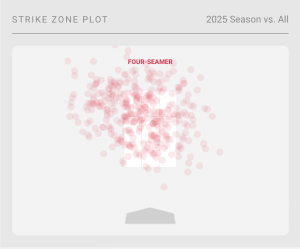
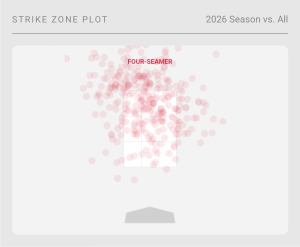
I love this. Pardon me for a moment while I gaze upon these and gush about how perfectly they indicate the adjustment he made. Just look at it! Acknowledgement of chart beauty aside, allow me to explain them; that’s what I’m here to do after all. All those fastballs clustered where the top third and middle third of the zone meet in 2025, right in most hitters’ wheelhouse, shifted up to the top and just above the zone.
You can hardly draw up adjustments that perfectly, but he’s going out there and executing it! Even better, he’s being rewarded for it. That 41.9% chase rate he’s rocking with this pitch right now is good for the 92nd percentile among starters thus far. Its swinging-strike rate is in the 95th percentile and higher than it’s ever been. Strike and swing rate both went up despite a five-percentage point drop in zone rate. His waste rate has cratered into near non-existence. That is phenomenal for Harrison, the kind of development you dream about in terms of execution.
He Does Throw Other Pitches, Right?
Now that we’re about a thousand words deep on his fastball development, the time has finally come to talk about the rest of his arsenal. The other two constants in Harrison’s repertoire have been a breaking ball that has been somewhat uniquely identified as a slurve and a changeup. The differences made to the slurve’s shape over the various delivery changes he’s made aren’t nearly as interesting or impactful as they were for the fastball, so we don’t need to cover them in depth.
The main things to know about his slurve are as follows: it is functionally a sweeper with some extra depth. I’d mark it around a 50 for stuff, but that’s aided by his funky delivery/release; the movement and velocity are not particularly intriguing. As a sweeper-adjacent pitch thrown by a lefty, it confounds same-handed hitters and tends to be acceptable if not outstanding in platoon matchups. His execution of this pitch, as you’d hope with a young pitcher, has improved over time. Both this season and last have seen him post chase rates above 32%, whereas the best mark from his first two partial seasons in the majors was a measly 25.3%.
Against lefties, he’s a two-pitch guy: four-seam and slurve. That’s really all he should need, even if he’s been stung by them a bit in a very small sample this season. Against righties, he needs another pitch; that slurve can’t carry the same 40% usage load against them. Enter his changeup.
Changeups, like fastballs, are usually very heavily influenced by arm angle. There’s a wrinkle to evaluating Harrison’s changeup over the years, however. As mentioned earlier, Harrison was traded to the Red Sox in 2025. And while they may have moved him just 8 months later, they did leave him with some advice. They wanted him to learn a kick change.
While Harrison’s changeup wasn’t bad from a stuff perspective, he wasn’t getting the whiffs he was looking for, with mostly uninspiring numbers. Then in 2025, we saw him tinkering with something new.
The Red Sox, like many teams, have become enamored with the kick change. Both of their top pitching prospects, Payton Tolle and Connelly Early, have learned one. According to Brewers beat reporter Curt Hogg, Harrison struggled with the grip and lacked feel for it initially. It wasn’t until this past offseason that he got a tip from former Giants teammate Hayden Birdsong that it clicked for him.
Now in 2026, it does still look like a new pitch for him, but the potential of the pitch is obvious. It isn’t getting the results yet, I know. But it’s really hard to bet against a funky lefty throwing what functionally are 86 mph screwballs. The movement separation between his four-seam and changeup is immense. If the command of this pitch develops, it’s going to be a serious problem for hitters.
Harrison has experimented with a cutter a bit, though it hasn’t made an appearance yet this season, suggesting it’s been shelved for the time being. In the past, it’s been mostly an afterthought gyro cutter that could theoretically be a bridge pitch for his four-seam and sweeper against lefties and a legitimate weapon against righties. The Red Sox had him throwing it a lot more in AAA last season. It made up 18.6% of his pitches there. It’s odd to see it gone entirely now; I hope we’ll get it back at some point.
He has also thrown sporadic sinkers that I’m not convinced he needs to bother with. It might be nice for him to have one, but as a low-slot pure pronator who gets a lot of horizontal movement on his four-seam, he’d probably have to throw a splinker or a one-seam to get the kind of movement separation from the four-seam he’d need to make it worthwhile. No telling whether or not he has the aptitude for those. It’d be interesting to see, though!
Bright Things Ahead
You want to know the funny thing about all of this? We have this much sample and data to analyze for a pitcher who’s only 24 years old. It’s easy to forget, given how much we’ve seen of him in the last few years, but he’s the same age as some of the up-and-comers we’d give more leeway for being balls of clay like Chase Dollander or Connor Prielipp. Don’t let Harrison’s 224 innings of MLB experience fool you; he’s still a work in progress with room to improve.
His present fastball is a carrying trait. As long as the stuff and locations hold, he should be a big league pitcher. How much more he is than that depends on the rest of what he’s doing. What I want to see more than anything is for one of his secondary pitches to progress to a point where he feels confident enough in it to take some of the burden off of his fastball. Even for one as good as his is right now, 60% usage is insane. I have to assume that hitters will eventually make him pay for that at least a little bit.
While he has legitimately improved from last year, I don’t think it’s quite to the extent of the results he’s seen so far. Even knowing that lefty sweepers can get the job done against righties, I think they will eventually start capitalizing on those better than they have been. It’s a solid pitch, but it’s not .184 xwOBA against solid.
I understand that ending this with a “keep your expectations in check” speech is deflating after all the talk of progress. That’s why I can’t help but reiterate: I think Harrison is actually good now! Maybe not great yet, but he’s made significant progress and is on the right track.
People have been waiting for Harrison to take the “next step” since he debuted. It’s kind of ironic that all the gradual progress he made from 2023 to now led to a sudden breakout after three consecutive seasons of “talk to me once you’ve got your stuff together”. I can’t help but wonder what the next “next step” will look like.
*MLB and AAA data are queried separately. So for a greater sample, I used his AAA changeup data for 2025, separated by his time with both organizations. Unfortunately, this means there is no arm angle, advanced spin, or HAVAA data, as that is not presently available for AAA.
