





After an exciting breakout season in 2024, Lawrence Butler picked up where he left off to start 2025.
Fresh off signing a seven-year, $65.5M extension with the Athletics in March, Butler had a 138 wRC+ through April 23rd, pacing ahead of his 2024 130 wRC+. He added four home runs and five stolen bases, putting him in the early running for a 30/30 season. It seemed Butler was well on his way to a potential All-Star game appearance and maybe more.
Since April 23rd, things have gone dramatically different for the Athletics slugger. In his 88 plate appearances in that time frame, Butler has just a 39 wRC+.
Butler has the 9th biggest dropoff around this date, but it’s arguably the most notable. He’s one of the few who went from producing as expected to not producing. Some hitters here went from otherworldly to just league average (Aranda & Langford), others were flash-in-the-pan callups (Misner & Paris), veterans (Mullins & Story), or exciting young players (Campbell & Lee). While Butler probably fits in the “exciting young players” grouping, his struggles are apparent around that date range.
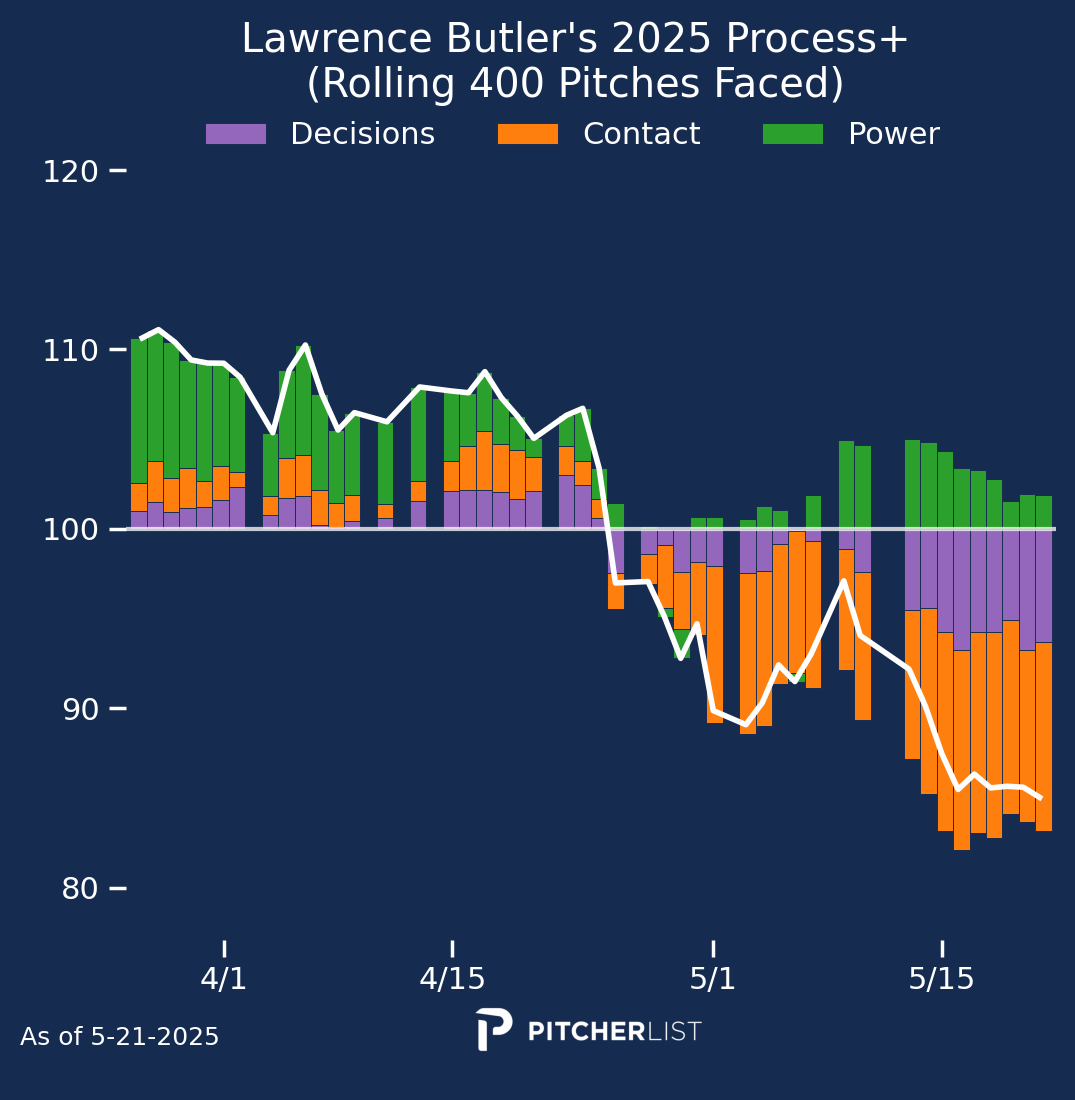
Just about everything disappeared for Butler, with his contact ability getting eviscerated and everything else hurting along with it.
When a hitter’s ability dramatically changes like this, it usually can be chalked up to one of two things: pitchers have a new approach, or there’s a mechanical change. Let’s take a look at what happened to Butler.
Is Butler Getting Pitched Differently?
Last year, Butler’s hot stretch was built on his success against fastballs and breaking pitches, without an apparent weakness. While it was an overperformance, he wasn’t necessarily beating up on one pitch type.
Butler saw nearly 60% fastballs and around 25% breaking pitches, which was nothing out of the norm. As the hot stretch went on, he saw more fastballs as one of the few holes in his approach is the high fastball.
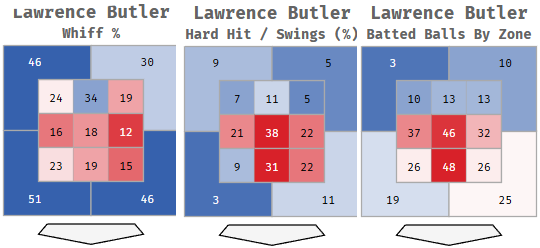
That didn’t stop Butler from mashing the right pitches. When he got anything center cut, it was getting clobbered. Otherwise, he was still susceptible to whiffs. Butler runs a zone-contact rate of around 80%, just around the bare minimum for acceptable. This year, Butler is seeing fewer fastballs and has to face more secondaries, to which he is whiffing more overall. He isn’t able to take advantage like he did last year.
After putting up a 17.9% barrel rate and 27.3% whiff rate against breaking pitches in the second half of 2024, Butler has found himself with a 30.0% barrel rate and a 53.8% whiff rate since April 23rd. Extremes in both directions are a classic case of the small sample size. Regardless, it still tells us Butler is mashing pitches he can get the bat on.
The pitch usage has changed, but I don’t think that is actually the story here (and neither do you reader, since there are hundreds more words to go).
Naturally, the location has changed, too. However, it’s in the opposite direction from what you think. Pitchers are giving Butler more hittable pitches, yet the results are getting worse.
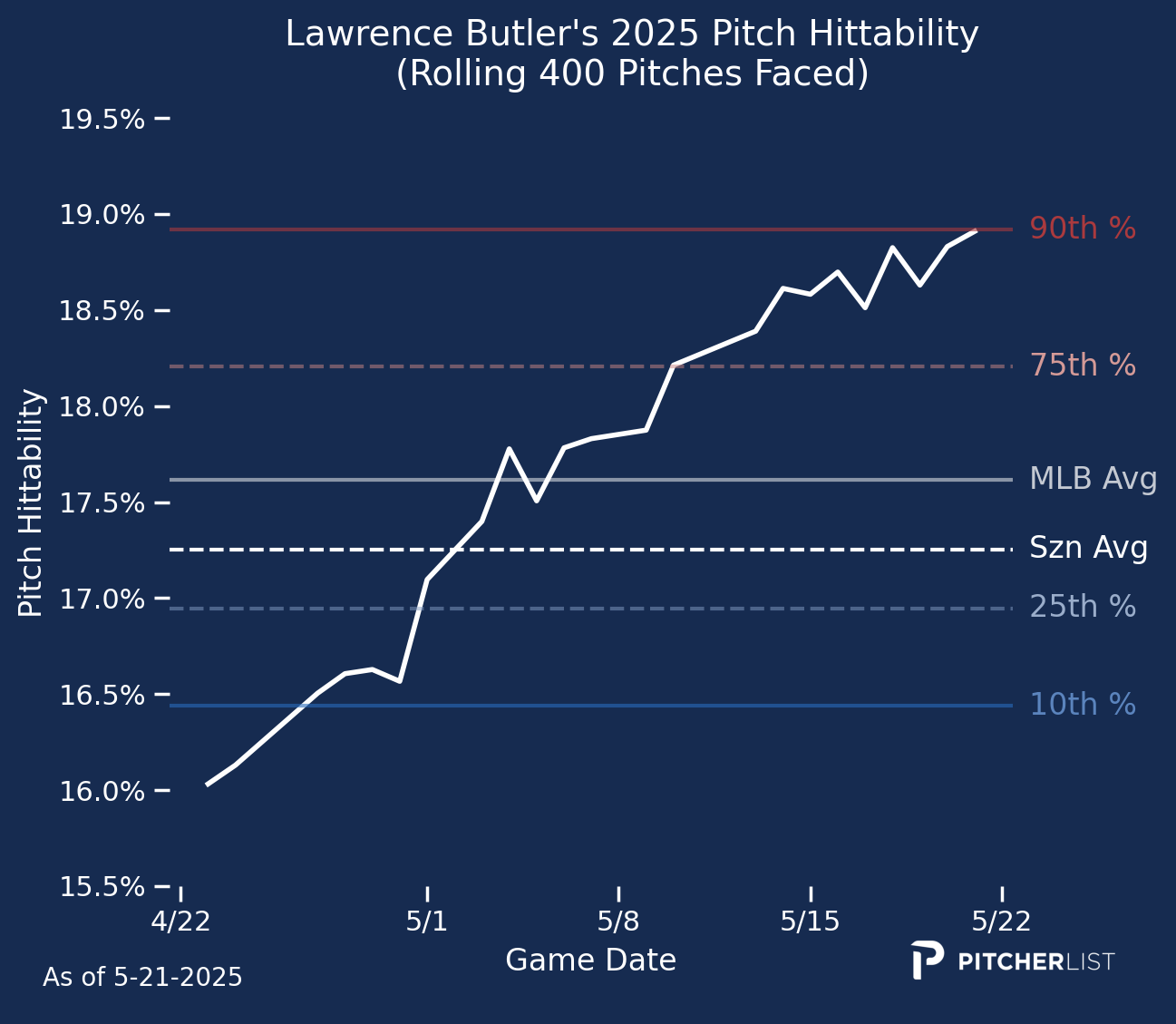
That’s… odd. The first rolling window of 400 pitches starts right at April 23rd, and pitch quality increased consistently from bottom to top. While he probably wasn’t going to get bottom 10th perce ile pitch hittability all season, seeing it skyrocket up into the 90th percentile is absurd. The pitch heatmaps show a similarly stark contrast. On fastballs, Butler is getting more in his wheelhouse (down-and-in).
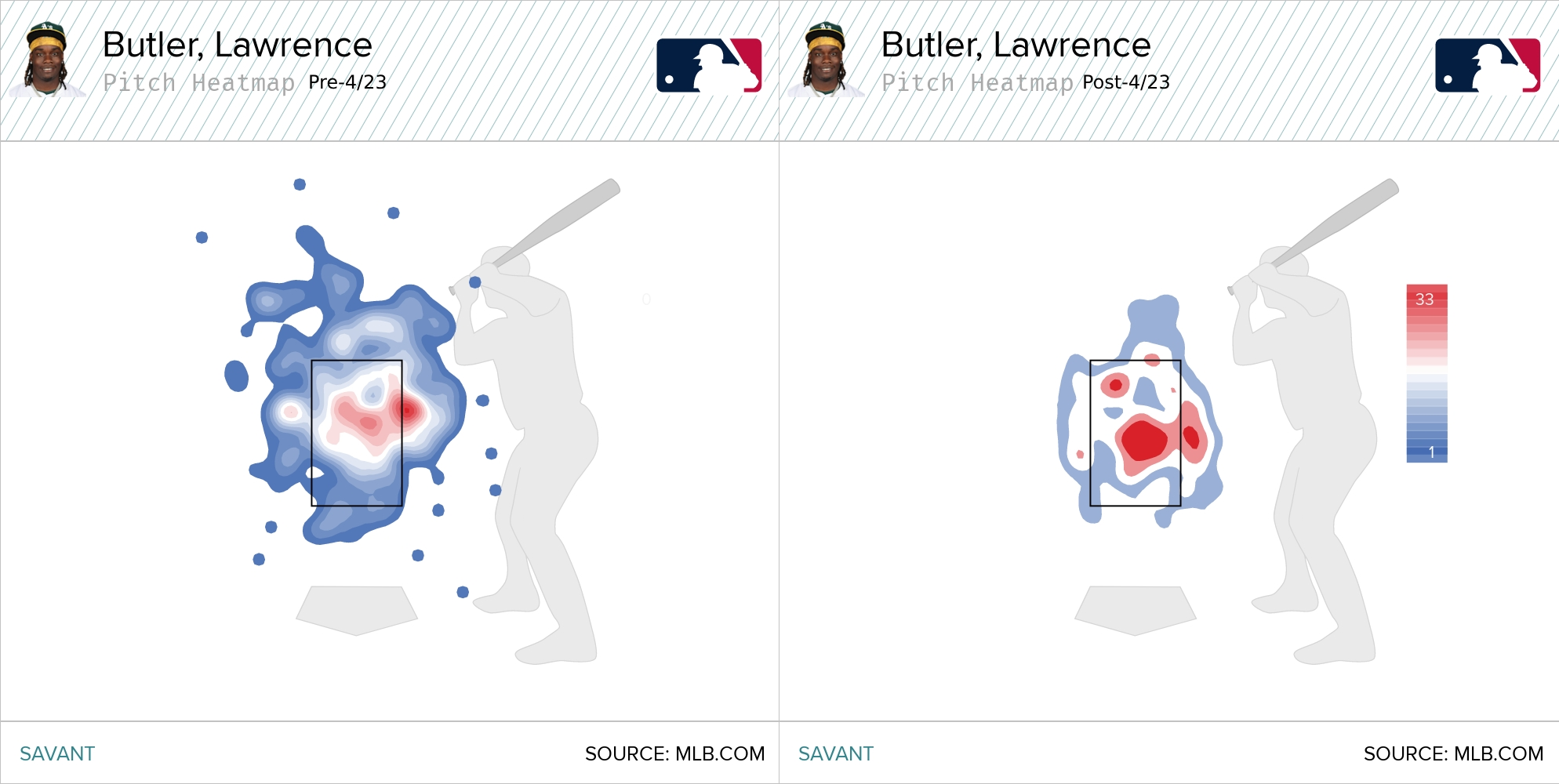
On breaking pitches, everything has drifted closer toward the center of the zone. While that means more pitches in the shadow zone, it’s also more over the heart of the plate.
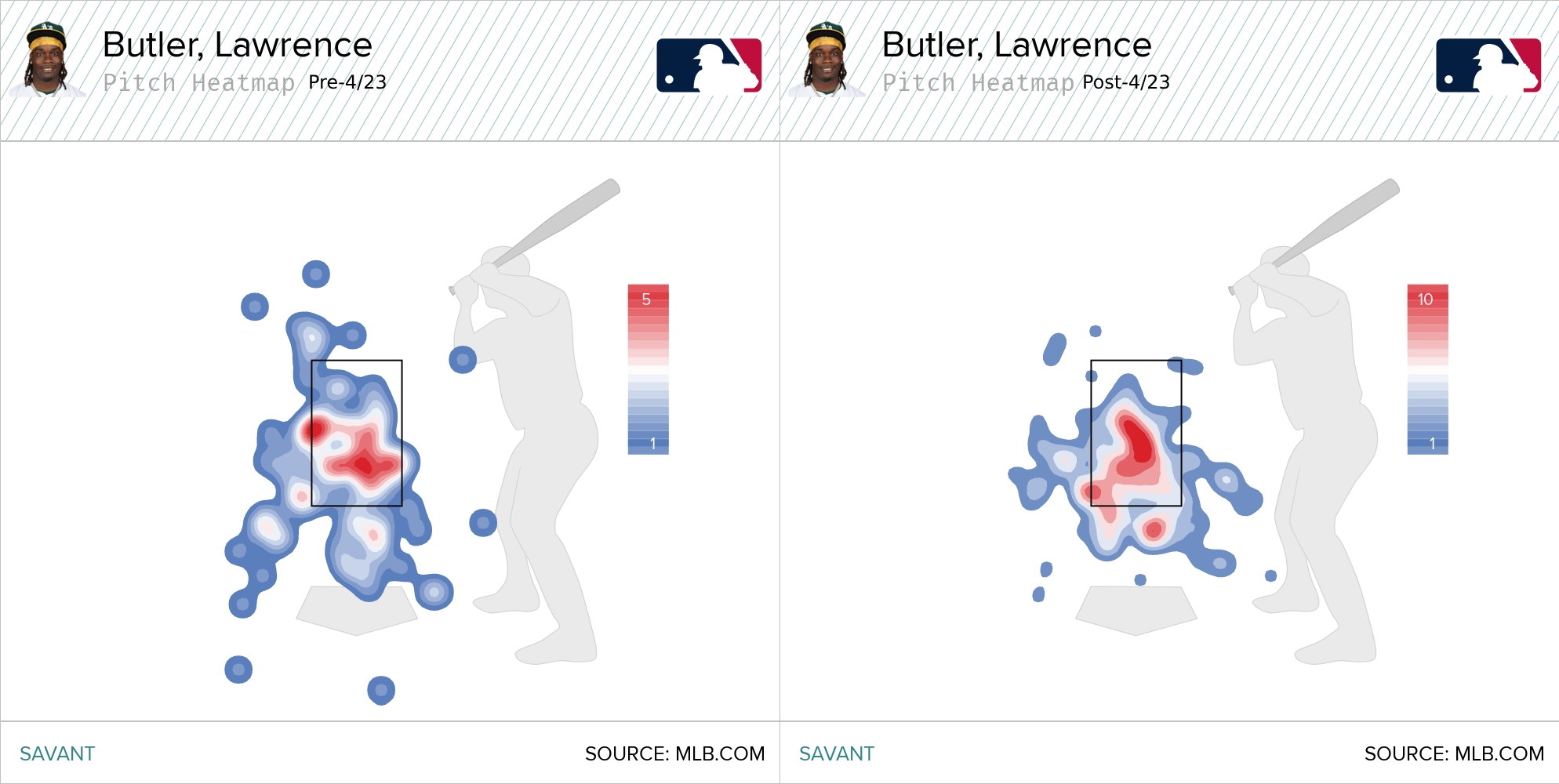
While he is getting pitched slightly differently, it’s not drastically different, but more hittable. That suggests there’s something else going on with Butler.
Is There Something Off Mechanically?
Looking back at the rolling Process+ chart from the top of this article, Butler’s contact ability falls first, followed by his decision value. The difference between 2024 and 2025 is pretty jarring within contact ability exclusively.
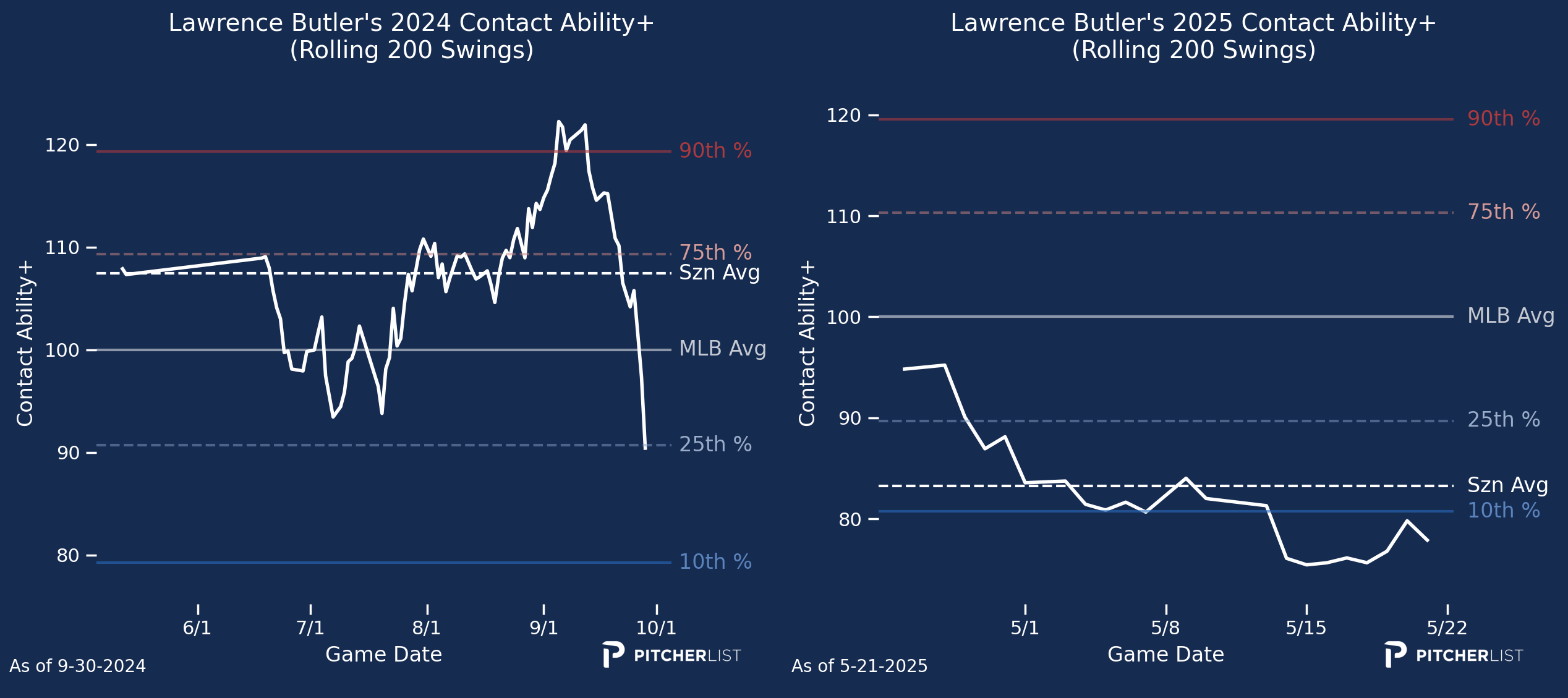
I see two things here. First, that stretch in the second half is clearly an aberration, and second, I don’t think this 2025 figure will remain this low. His 2024 contact ability was strong despite an 80% zone-contact rate, and a two percent decrease in zone-contact doesn’t often reflect a drop in contact ability like this.
His stance and swing speed have remained the same. However, with MLB releasing new swing path metrics just this week, one thing stood out for Butler. His swing tilt has remained the same as last year, but his attack direction is drastically different.
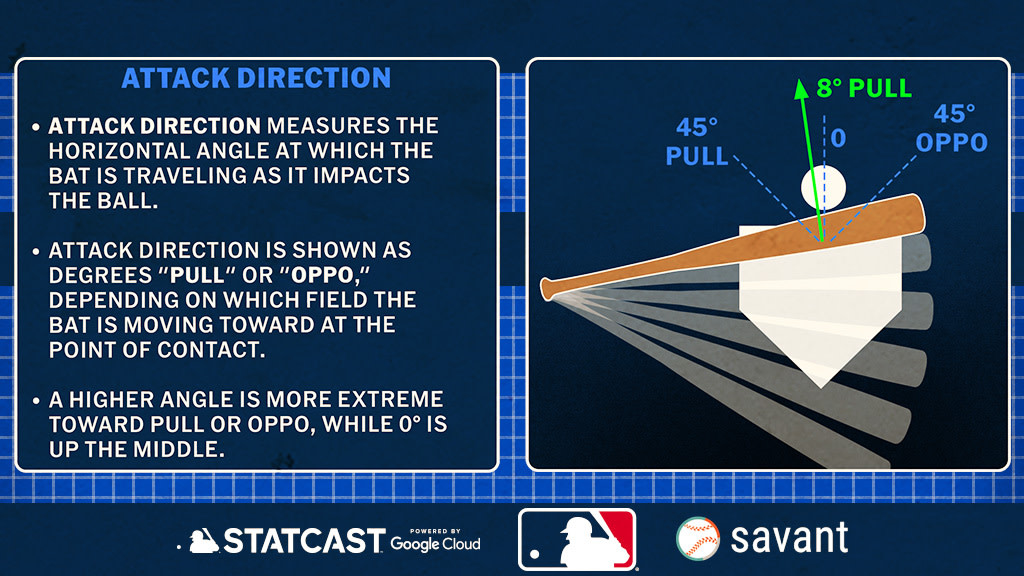
For attack direction, this is immensely helpful for determining a player’s batted ball tendencies. Butler has had some of the biggest variance between April and May among qualified hitters.
With a lot of the new bat tracking data, an early takeaway is that there isn’t necessarily a right or wrong way to do things. It’s the context of everything else that matters. That applies in the case of this leaderboard. Every hitter here has significantly increased their attack direction towards the opposite field, and they all have drastically different outputs in different directions. Only three hitters are relatively unphased in their results: Kyle Schwarber, Luis Arraez, and Steven Kwan. Arraez and Kwan are both extreme contact hitters, which is likely just based on pitch location, while Schwarber went from seven degrees of pull to two.
Butler went from two degrees oppo to five degrees oppo. Last year, Butler was at an even zero degrees. Even though he is an all-fields hitter, this is the furthest to the opposite field he’s been. Butler’s barrel rate is still above 10%, which leads me to believe he isn’t seeing the ball well. Most players who need to hit the ball to the opposite field more are those who pull the ball too much, not guys who already do it.
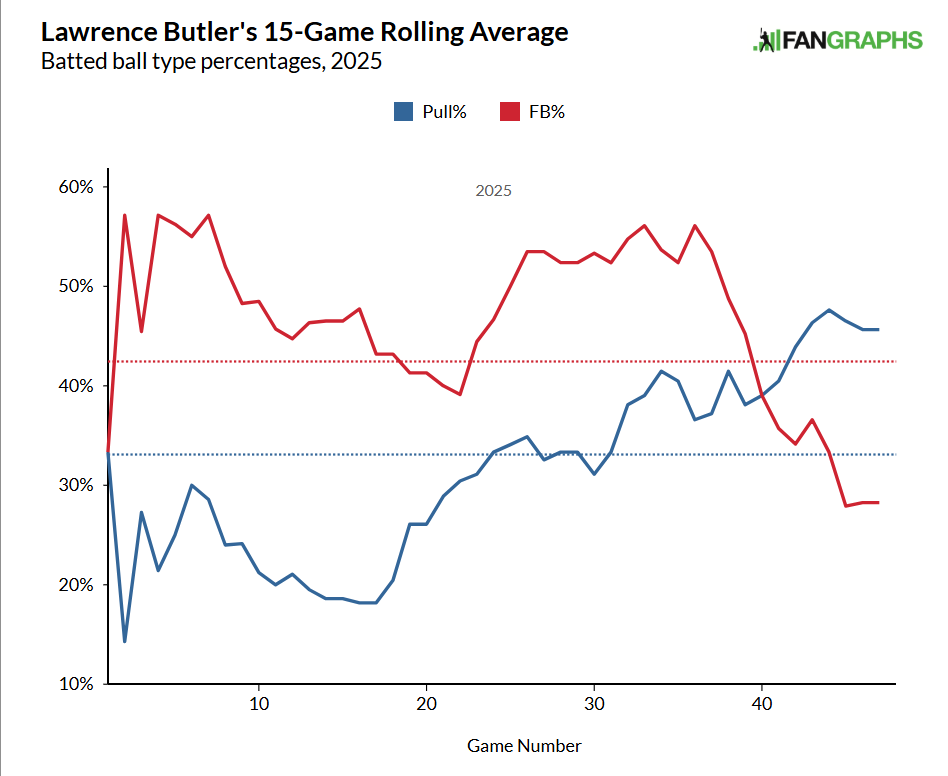
Surprisingly, this has not reflected more opposite field batted balls, but this emphasizes that his process is not where it needs to be. Add in that his flyball rate has dropped precipitously, and the blueprint for his return is there.
Where Does He Go From Here?
More hittable pitches and worse results can be a very scary combination, especially for a player whose credibility is built largely on one hot streak. Butler has lost his way for the time being, but his continued fall in decision value suggests he is pressing to snap out of it.
This might be a perfect explanation of a guy who “needs to start going the other way” in order to get back into a groove. Even though the underlying data says he’s hitting the ball directionally more to the opposite field, the results don’t reflect that. This won’t be the norm for Butler, especially with his newfound job security, but he has some significant adjustments to make in order to salvage 2025.
