





You don’t need me to tell you who Logan Webb is. The Giants’ ace has gone from rising star to premium workhorse, leading MLB in innings pitched since the start of 2021. During that timespan, his ERA is 3.21 and his FIP is 2.90. He doesn’t throw hard, with his trademark sinker sitting squarely in the low-90s, but he eats innings, locates, and gets outs as efficiently as anyone, thanks in large part to consistent 90th-percentile-or-better ground-ball rates.
While the Giants haven’t been back to the postseason since his first year atop their rotation, he has a near-spotless playoff track record with a 0.61 ERA in two October starts, both against a Dodgers team that won 106 games. He’s very good and very dependable – a true cornerstone starter.
In 2025, though, he has become a strikeout guy. Webb’s 26.2% strikeout rate is just a few ticks off his career-high 26.5%, set during that wonderful 2021 campaign. His swing-and-miss rate of 24.2% is also its highest since that year. That miss rate is only 42nd percentile, and his chase rate is only 61st, down below 30% for the first time since 2020. Yet, batters don’t strike out across the league as much as they did in 2021, so his strikeout rate is at a personal best 77th percentile this season.
His fastball velocity has not changed, his overall pitch mix isn’t dramatically different, and his release point remains the same. How does a workhorse pitcher, who’s constantly around the top of the league in ground-ball frequency but around the bottom in swing-and-miss, suddenly start racking up strikeouts too?
In previous years, Webb’s ground-ball rate hovered between the high 50s and low 60s, and it has dropped only slightly this year to ~54%. That’s not league-leader territory, but it’s still 90th-percentile. He’s continuing to rack up grounders, and the strikeouts are coming all the same.
Against righties, he’s still a sinker-sweeper guy with an occasional changeup, and against lefties, while his sweeper usage is up this year, he’s still throwing his fair share of changeups and sinkers.
However, a driving force behind the increase in punchouts: His four-seamer. Yes, the same pitch he opted to replace with the sinker as his primary fastball years ago, has been one of the keys to his success. Webb’s throwing it 7% of the time compared to 5% last year, and it’s the least-used pitch in his arsenal. The caveat is he’s relying on it more with two strikes. To righties, two-strike usage of the four-seamer is up ~12% from last year, and to lefties, it is now his main secondary offering when the batter is up against the wall.
His four-seamer has the highest strikeout rate of any pitch in his repertoire and an impressive 32% miss rate. In an interview with Marquee Sports Network’s Lance Brozdowski at the all-star break, Webb said he tries to get more strikeouts every year, but was candid about the fact that his pitching coaches don’t want him throwing his four-seamer very much. This makes sense, because it sits 93 from a low arm slot without much carry – biomechanically, the sinker is a much better offering. When he uses it for effect, just enough to throw hitters off but not nearly enough for them to sit on it, that’s when it gets results. Don’t bet on seeing this offering any more from Webb than we already do, especially with two strikes, but reintroducing it in certain spots has been worthwhile.
Aside from tinkering with his usage patterns in strikeout opportunities, Webb has also seen a large increase in two-strike swing-and-miss with his changeup. This is his put-away weapon to lefties, and he still uses it nearly 25% of the time in the same situation to righties. Against both sides, his two-strike miss rate on the changeup is usually around the mid-20s.
In 2025, it has skyrocketed to 43% because he’s locating it a little differently. On two strikes, pitchers don’t need to be as sharp with their command because most hitters expand their zone in those spots. Webb is leveraging this perfectly as you’ll see in the heatmaps below, expanding his changeup below the zone more often this year than he previously did. In turn, hitters aren’t making as much contact.
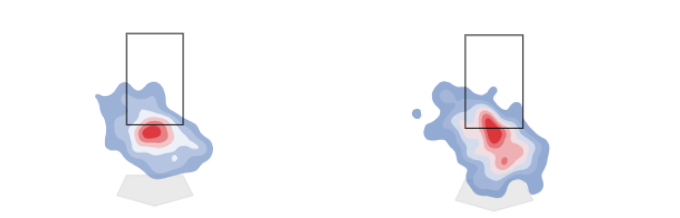
Logan Webb changeup location with 2 strikes, 2024 (left) vs 2025 (right)
What’s remarkable from a big-picture standpoint when considering Webb’s strikeout increase is the fact that the sweeper, his primary breaking ball, has lost effectiveness. Its run value has fallen from +3 last year to -5 this year. He’s throwing it about 10% more to lefties, but various pitch models are in agreement that it isn’t as dangerous as it was.
Velocity on the offering is up about 1 MPH to ~85, but it has lost nearly two inches of glove-side movement (16.4″ to 14.7″). This may sound subtle, but even PLV, which directly accounts for the fact that Webb’s locating the pitch better, isn’t as bought in.
At the pitch-by-pitch level, this offering is still well above-average thanks to Webb’s command. He’s versatile enough that he can use his location to compensate whenever the stuff is down (which isn’t often), and make his other four pitches more potent so the bottom-line doesn’t change.
Add this newfound affinity for strikeouts and Webb’s signature knack for getting hitters on top of the ball, and you get one of the game’s most difficult pitchers to do damage on. Going back to that sample of qualified starters since 2021, Webb’s 0.61 home-runs-per-nine-innings is the very best in baseball during that span.
If he can maintain this level of dual-threat strikeout/ground-ball guy, that only figures to continue, perhaps to an even stronger degree. Per Statcast, only 13 qualified starters have a ground-ball rate over 50% this year. Of those 13, only eight have a fly-ball rate under 20% on top of that. Finally, of those eight, only two have a strikeout rate over 25%. Logan Webb is one of them.
That’s pretty good! Sánchez is a stud in his own right, perhaps Webb’s lefty counterpart, who will certainly earn Cy Young votes this year as well. If we take away the fly-ball rate threshold, Yoshinobu Yamamoto and Nathan Eovaldi join the list; Yamamoto gets the most strikeouts of the bunch.
As the ground-ball rate leaderboard any given year will show you, some of the game’s very best often lag behind with their strikeouts (think José Soriano, Andre Pallante, Quinn Priester). Webb is one of the select few who has bridged the gap.
What modern pitching illuminates is the innate mutual exclusivity that lies between getting swing-and-miss, generating harmless contact, locating, and durability. To varying degrees, each of those skills is at odds with one another, and it’s increasingly difficult to be good at all of them.
Despite all that, here stands Webb, at the very center of the Venn diagram, controlling all these lanes in the bustling intersection that is being a good pitcher. When he’s striking out this many batters on top of everything else he’s already good at, there are very few things he cannot do on the mound. He’s a contrarian to the advents of velocity and pitch limits, with pinpoint command and enough raw stuff to keep up. As he has established himself as one of the elite starters in the game, it has become increasingly harder to improve his standing, but at age 28, in his 6th full season in the show, he has found a way.
All figures entering August 14, 2025.
