





Michael McGreevy’s first real time in a big league rotation has gone about as one might expect for a rookie. He’s posted a 4.17 ERA in ten starts, showing some exciting upside along with some classic rookie struggles. After getting a cup of coffee in St. Louis at the end of last year, he got a brief three-start stint in June before getting a full rotation spot in late July.
Unlike most pitching prospects that get recalled, McGreevy is a low-stuff/high-command pitcher. He doesn’t have the flash that many do, but that’s not to discredit who he is as a pitcher. FanGraphs grades his command as a current 60 and future 70, while his 110 Location+ ranks 11th among 159 starters with at least 50 innings.
When a pitcher has great location, even without excellent stuff, that usually results in some amount of strikeout potential. Whether it’s getting hitters to swing at pitches just out of the zone or freezing them with good sequencing, there are ways for command-first pitchers to get their whiffs. In the case of McGreevy, he desperately lacks in finding ways to make hitters miss.
This is not a great list to be on. Just two pitchers have a sub-5.00 ERA, being McGreevy and Randy Vásquez. Most have more issues than just striking out hitters, with variable walk rates and a lot of hard contact. McGreevy holds the only K-BB% above 10%, when the league average is 13.7%. His 3.9% walk rate is elite, but it isn’t good enough to match such a poor strikeout rate.
It’s clear he has the skills to be good, but it hasn’t all come together yet, for a variety of reasons.
One Pitch Can Only Carry So Far
McGreevy’s sinker is elite at doing sinker things against right-handed hitters. He throws it almost 40% of the time at an absurd 73% zone rate, which is in the 99th percentile. His sinker heatmap is as good as you’d expect.
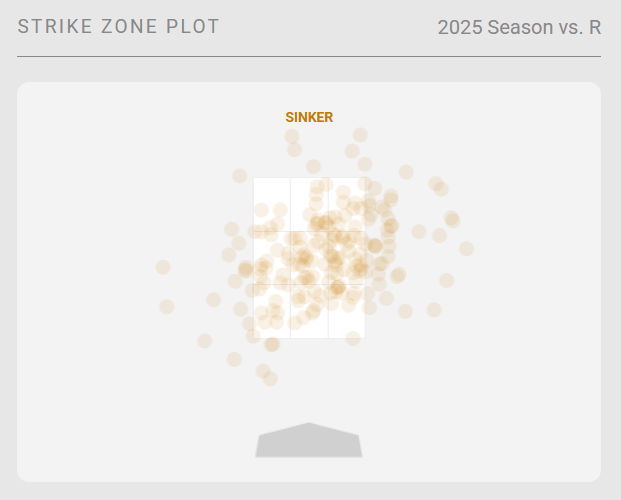
His ability to throw the pitch on the inner third of the plate is fantastic, and he’s rewarded for that ability. It has a 23.2% Ideal Contact Rate (ICR) and a 30.0% called strike rate, both of which are 90th percentile or above. McGreevy excels at getting weak contact when ahead in the count with the sinker. And while these are all exceptional marks, there’s one thing that McGreevy does better than anyone else in baseball: throw competitive sinkers.
Through our PLV model, we’ve developed Non-Competitive Rate (NC Rate), which considers pitch location, pitch characteristics, and count to determine if a pitch was not competitive. These waste pitches are extremely damaging to pitchers and correlate strongly with more pitches per inning and poor Location+.
McGreevy’s sinker has the best NC Rate among all sinkers thrown at least 200 times. With just 2.0% of his sinkers being non-competitive, his NC rate is less than half of number two on the list. The average sinker has a 10% NC rate.
With so many competitive pitches, he gives hitters two options: take for a strike or hit it poorly. The .242 average against is actually bad luck compared to the actual batted balls (such is life as a sinkerballer).
However, the sinker doesn’t earn whiffs in any capacity. The pitch gets a great amount of drop, but underwhelming velocity and a lack of horizontal run limit its ceiling. The pitch has a 7.3% whiff rate, which is in the 10th percentile.
While the sinker is just about all you can ask for, McGreevy needs something to get whiffs. It’s also a righties-only pitch; he uses it just 3.3% of the time against lefties.
So, What Else is There?
By Statcast pitch classifications, McGreevy has six other pitches in his arsenal: a four-seam fastball, sweeper, curveball, cutter, changeup, and slider.
He has two non-sinker offerings to righties, the four-seam and sweeper, while occasionally sprinkling in the rest of the arsenal. Against lefties, McGreevy relies heavily on the four-seam fastball and primarily turns to the cutter, curveball, and changeup beyond it.
The Righty Approach, Continued
With the immense amount of strikes from the sinker, McGreevy can afford to work outside the zone with everything else. His sweeper is the go-to secondary pitch, which he throws 32.6% of the time to right-handed batters. It doesn’t have a spectacular movement profile (13 inches of sweep, 2 inches of drop), but he throws it at a strong 83.6 mph. Without an overpowering profile, he needs to be able to execute effectively in location for it to succeed.
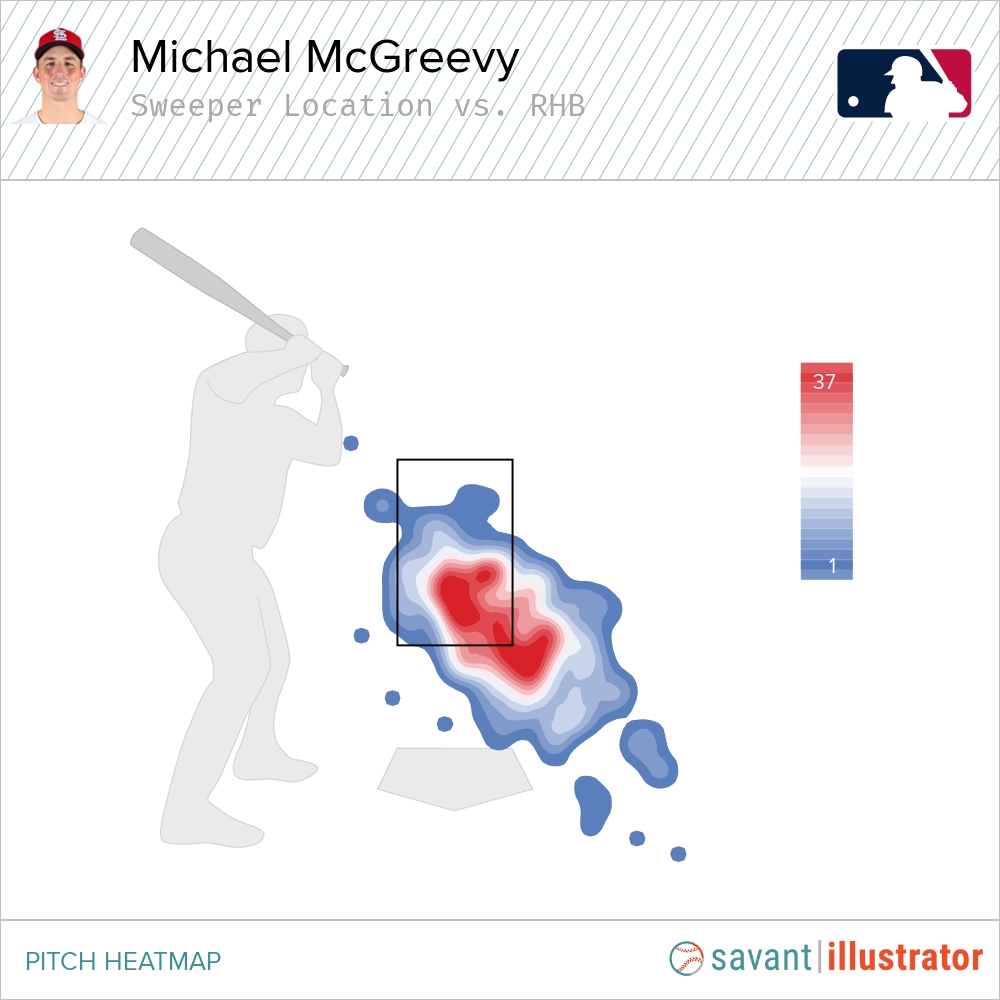
He throws the sinker early in the count for strikes or tries to get just outside the zone to get whiffs. The problem for McGreevy is that hitters don’t miss the sweeper, either in or out of the zone. The sweeper has an average 41.9% zone rate, but nearly forty percent of those strikes are put into play, one of the highest figures in baseball. Hitters also only chase the pitch out of the zone 26% of the time, which is in the 26th percentile. Overall, the sweeper has a 29% whiff rate, which is just below the league average. However, it doesn’t get strikeouts: he has just a 13.0% putaway rate with the pitch, comfortably below the 17.7% league average.
Beyond the sinker and sweeper, which equate to over 70% of his right-handed approach, McGreevy mostly turns to his fastball (13%) and curveball (7%) as his other options.
The fastball is used heavily in two-strike counts, where McGreevy elevates above the zone in hopes of getting a whiff. 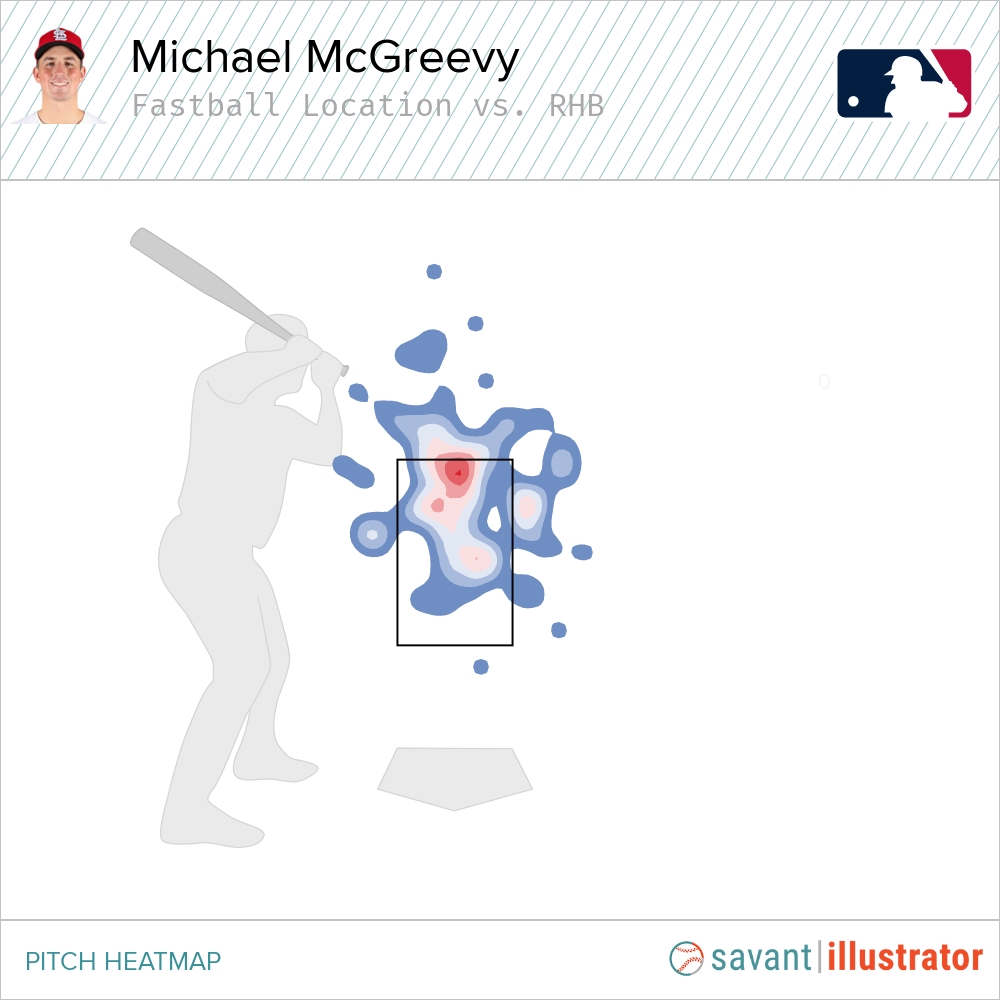
It gets more chases than the average fastball, but hitters are not missing the heater. It has a 16.2% whiff rate and 83.8% contact rate, both poor figures for a pitch that primarily seeks to miss bats.
The pitch isn’t exactly suited to miss bats: with just 11.9 inches of induced vertical break, the fastball ranks in the 17th percentile. He also has a 0.5-degree height-adjusted VAA, another low figure for the fastball. These suggest that the fastball isn’t built to get swings and misses, even if McGreevy is trying to do so. The fastball’s 6.5% putaway rate is horrid compared to the 16.7% league average.
Since the fastball gets more drop than expected, it still generates a decent amount of groundballs. Among starters with at least 100 same-handed fastballs, McGreevy ranks 10th in combined high location rate and groundball rate. It’s an odd combo, but it further shows that this is not a whiffable fastball. It has still suppressed contact (a 36.4% ICR is slightly below league average), but a .308 average shows the problems with allowing more batted balls.
Finally, the curveball exists for McGreevy as a rarely valuable offering. It has a paltry 9.5% zone rate, but fails to receive nearly enough chases to make that zone rate worthwhile.
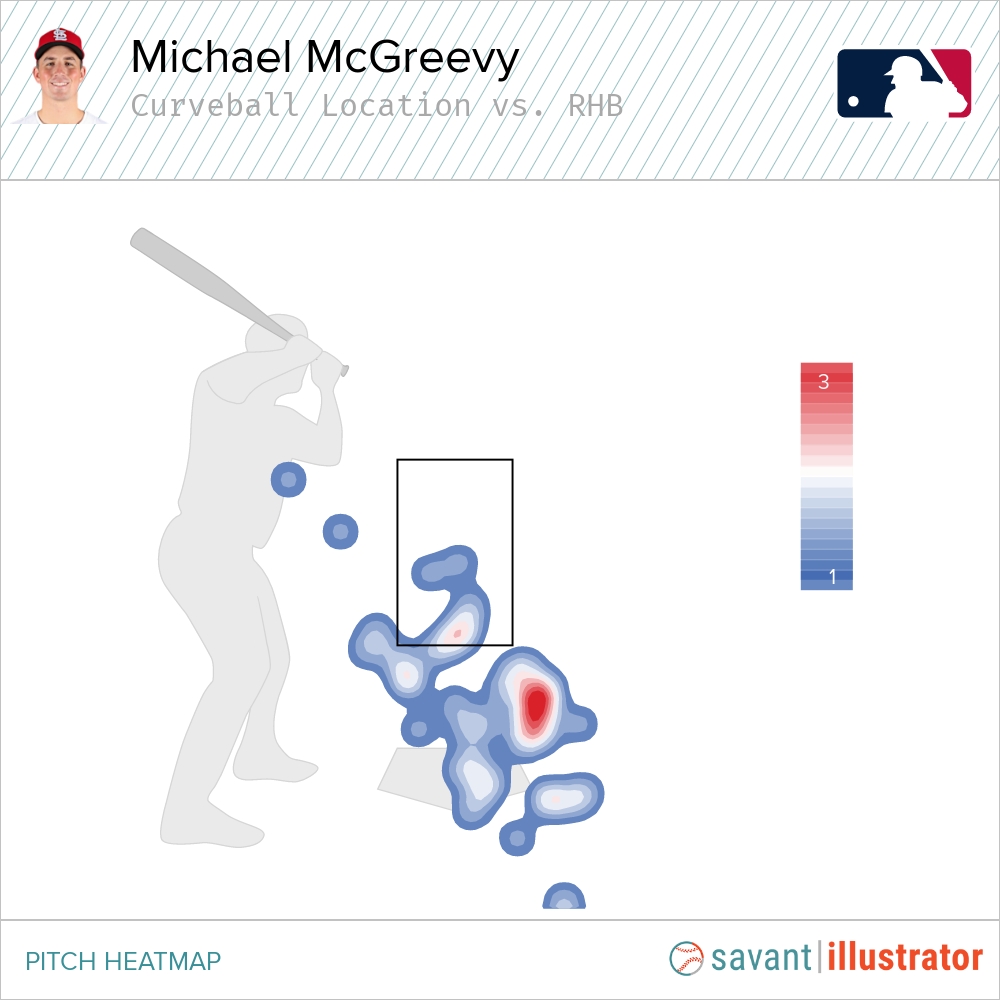
It’s a work-in-progress pitch that often does more harm than good.
He also sprinkles in the cutter (used in one start), changeup (used sporadically), and a slider (showed up recently). It’s enough to keep hitters off balance as he suppresses hard contact, with each of these pitches only appearing once or twice a game on average.
While he doesn’t get whiffs, McGreevy excels against righties: he has a .231 average and a .362 xSLG. It may not be perfect, but it works.
The Lefty Approach
However, lefties mash McGreevy. They’re hitting .303 with a .584 xSLG against him and five home runs. While he relies heavily on the sinker against righties, he uses the four-seam fastball as the primary pitch against lefties.
At 40.0% usage, McGreevy relies more on the fastball here than his elite sinker against righties. The problem for McGreevy is that the fastball is not anywhere close to as good as the sinker. He utilizes the fastball mostly early in the count, targeting up and away to the left-handed hitter.
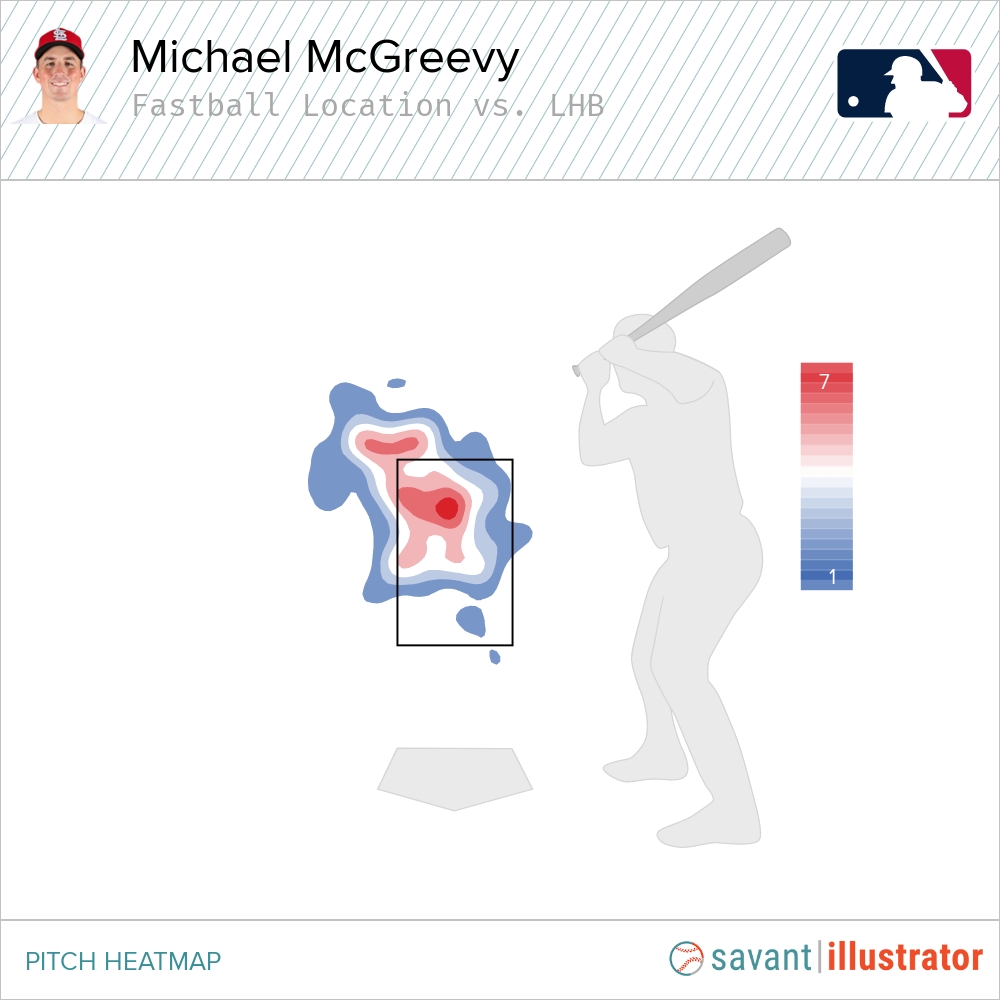
When executed well, the pitch is actually capable of getting some swings and misses. Its 26.4% whiff rate is the second-highest whiff rate for McGreevy, only behind the sweeper vs. RHB. However, it ends up leaking over the heart of the plate, unlike the impeccably consistent sinker. There are a lot of non-competitive misses, too, when McGreevy tries to ensure a pitch isn’t getting into the nitro zone. Combining the fastball’s NC rate and mistake rate, McGreevy’s fastball ranks in just the 12th percentile. This results in a significant amount of poor pitches, and there’s not enough pure stuff in the fastball to overcome it.
It gets hit hard, resulting in more power than contact: a .261 average and .585 xSLG is a tough combination for a 40% usage fastball to have.
Off of the fastball, McGreevy turns to three secondaries interchangeably: a cutter (19.5%), a changeup (14.9%), and a curveball (14.5%).
The cutter is located up in the zone, as it plays off the fastball in an attempt to induce weak contact. It gives up slightly more hard contact than the average cutter, yet it only has a .231 average against. This is, in part, because it gets a lot of swings as it dominates the upper third of the zone.
It has a 63.7% zone rate (98th percentile) and a 60.4% swing rate (90th percentile), living up to the contact-inducing profile of a cutter. Generally speaking, up-in-the-zone cutters often exhibit whiffability. McGreevy, like the rest of his arsenal, doesn’t get whiffs on it. Instead, he gets flyball contact, which frequently turns into pop-ups. Pitching in Busch Stadium helps too, with many flyballs not making it out of the ballpark.
The changeup is yet another secondary pitch that is not frequently in the zone. It has a 22.8% zone rate, but actually gets a decent amount of chases. The 47.5% chase rate is in the 93rd percentile, and it’s paired with a slightly below-average 25.6% whiff rate. He doesn’t have the confidence to throw it late in the count frequently, but it’s an intriguing option.
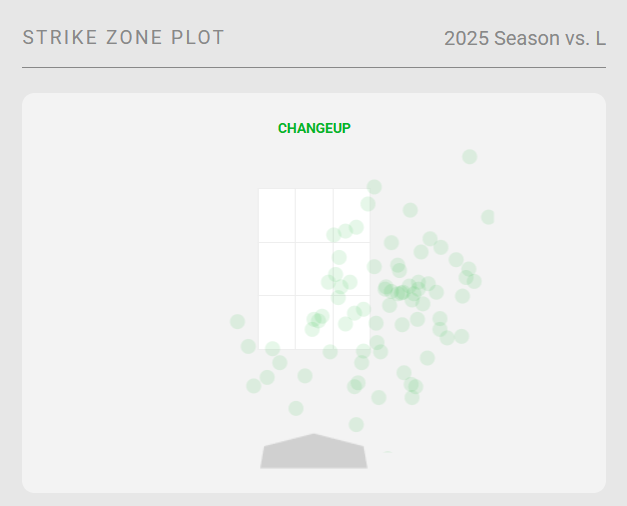
The overall problem is with command: too many pitches leak up and away rather than down, and he needs pitch separation. This has led to a few mistakes and a .375 average/.636 xSLG, but the in-zone damage is predictable. There have been only four base hits (two for extra bases) on changeups in the zone, all of which are in the up-and-away quadrant of the zone. Easier said than done, but burying the pitch is a straightforward path to success. Even the out-of-zone damage (including this preposterous home run by Ryan Noda) has been on pitches that are in the middle area off the plate where hitters can get the barrel to.
The changeup’s movement doesn’t stand out on its own, but it’s intriguing due to the seam-shifted wake (SSW) on the pitch. His release allows it to move differently compared to what the spin would suggest.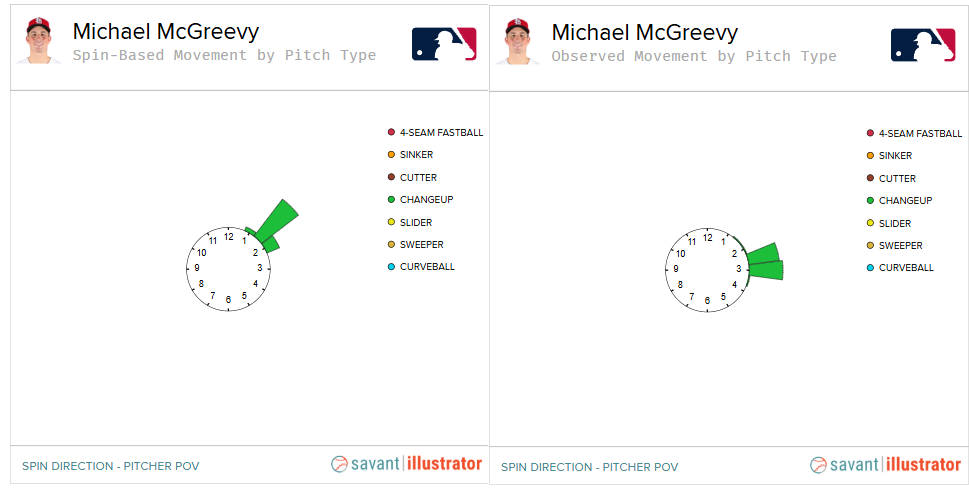
The result is more horizontal movement than expected, part of why it misses middle or up and away, rather than down. The changeup, when thrown well, actually earns McGreevy strikeouts: a 27.8% putaway rate is 98th percentile.
Finally, the curveball has a similar place against lefties as it does righties. McGreevy throws it more in the zone, but a 27.3% zone rate isn’t saying much. It struggles to get whiffs or strikes in any regard, and a .273 average/.461 xSLG isn’t great for a pitch that’s seldom near the plate.
McGreevy will also occasionally throw the sinker or sweeper to lefties, but it ends very poorly. They’ve combined to give up seven hits on 13 batted balls, effectively making sure he doesn’t throw them to opposite-handed hitters.
His approach works at the big league level, but it’s still unfinished. He’s trying to throw pitches that induce weak contact or get whiffs, but isn’t executing as much as he should. There’s a minimum threshold for how many whiffs you need to succeed, and McGreevy is currently below it.
Ideas for a New Tool
With seven pitches in the arsenal, there isn’t exactly a “new” tool that he can come out with (unless he becomes Seth Lugo). Instead, the pitches he currently throws could be used in different ways.
Against righties, this starts with more pitches on the outer third of the plate. He needs to create more confusion in both velocity and movement. McGreevy excels at throwing the sinker inside to righties, but gets a lot of called strikes middle and away early in the count. When hitters aren’t ready for it, he can get away with pitches there.
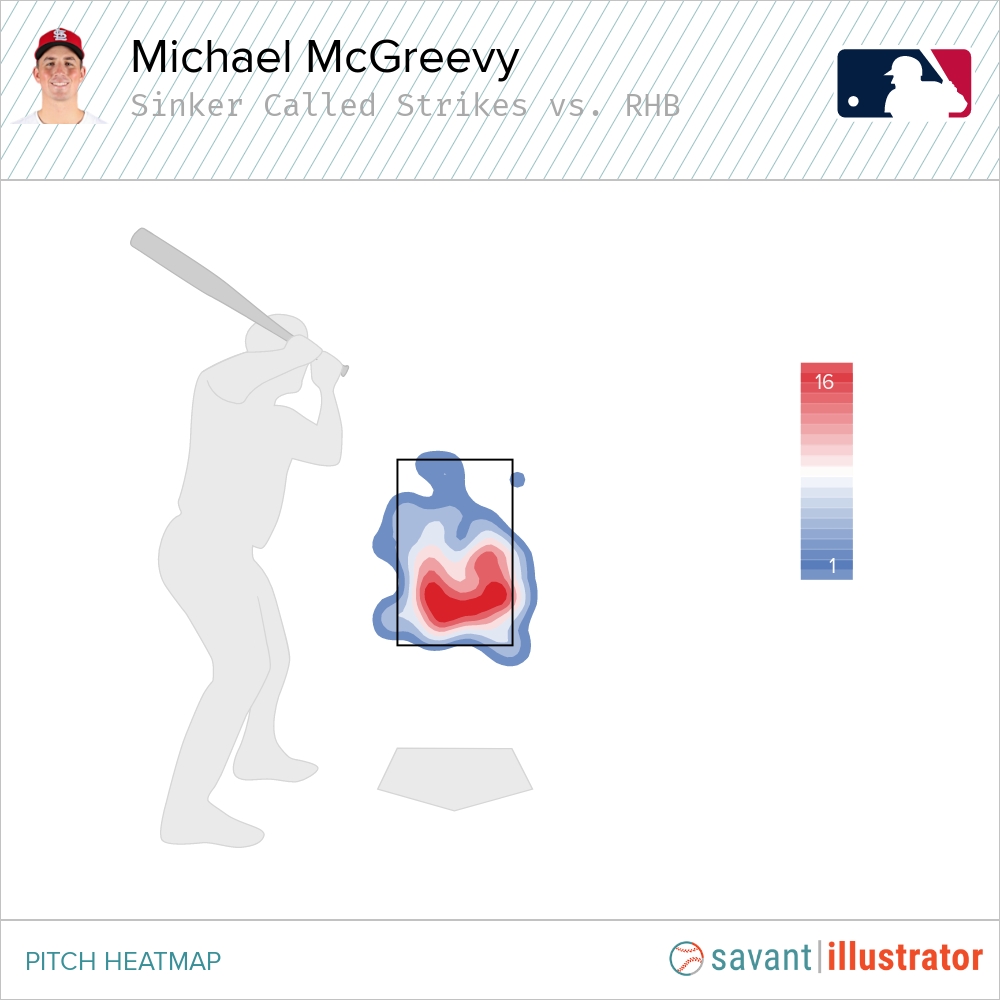
He’s only thrown six sinkers on the outer third in two-strike counts. Without much worry about the outer third sinkers, hitters only need to see spin to recognize if it’s a breaking ball going off the plate.
We’ve seen it attempted just three times, with two poorly hit batted balls and one strikeout. I would like to see more backdoor sliders to get looking strikeouts. He’s capable of throwing the sinker in great locations for poor contact, but he doesn’t need to do that when he gets to two strikes immediately.
Off the sinker, I would like to see McGreevy throw the cutter more to righties. He threw the cutter to RHB in just one game this year: his second start of the year against the Dodgers. The line from that game looks worse than the performance (6 IP/4 ER/8 H/5 K), with most of the damage unsurprisingly coming against left-handed hitters.
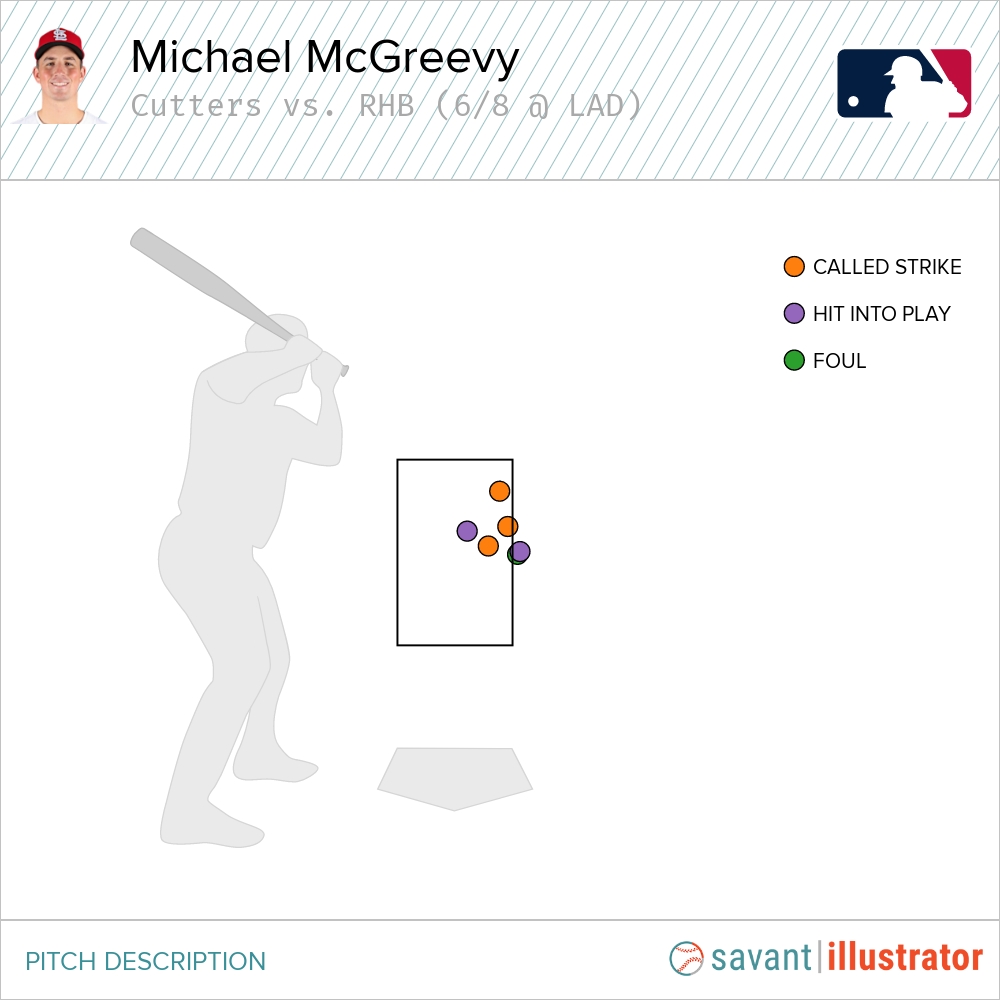
Hitters see a fastball coming in that starts up and assume it will start breaking towards them. Instead, they get tied up on a movement profile they weren’t expecting to see. Even the batted balls come from a swing that looks surprised.
While all but one cutter has been in a 0-0 or 0-1 count, deploying them to righties can help McGreevy work later into the game, with a different fastball type to keep hitters from keying into the sinker too much.
At the same time, the cutter can help create a bridge to his other offspeed pitches. He’s flashed a new slider over his last few starts, with a distinct shape that we hadn’t previously seen.
currently writing about him, but Michael McGreevy has a new slider over the past two starts (7 thrown). Differs significantly from the sweeper:
84.9 mph, 7 inches of break, 1 inch of vert
Two whiffs and only one in-zone so far. Worth monitoring. #STLCards pic.twitter.com/KjcgoYeiqN
— Nate Schwartz (@_nateschwartz) August 29, 2025
Command has been an issue, but as a weapon for next year, having three shapes of pitches that break gloveside (four, including the curveball) can help create whiffs if the shapes themselves aren’t built for it.
Additionally, these changes should drive McGreevy away from the fastball. It doesn’t work up and above the zone, despite his insistence on throwing it there.
For lefties, there are some similarities with how he could improve against righties. It begins with moving away from the fastball. The 40% usage is too high for a pitch that is not particularly effective, and the cutter can operate more than just as a secondary pitch.
With the cutter primarily being located up in the zone, McGreevy leaves open the opportunity to jam hitters inside consistently. Despite it working with his high strike rate sinker against righties, he is not attacking lefties with the cutter in a similar manner. In the few instances where he has, the results have been decently intriguing: it has a 14.3% HardHit% against, but poor surface-level results.
The other change McGreevy should consider is using the changeup as the dominant secondary pitch. The changeup is by far his most exciting offering against lefties. Its extremely high chase rate and SSW movement suggest that there’s a viable whiff pitch for McGreevy to use.
He just doesn’t use it in two-strike counts enough, and the handful of mistakes show that might be a confidence issue. On a broader scale, the changeup doesn’t end up as a non-competitive or mistake pitch frequently: it ranks in the 94th percentile for changeup NC+MTK rate.
With seven pitches and impeccable command of most of his harder velocity pitches, there are a lot of avenues for McGreevy to go down to find what clicks. The moderate success already with such a low strikeout rate keeps the floor high while he can tinker too. But for McGreevy to become a future staple in the Cardinals’ rotation, he needs to do something new.
