





As September begins, we’re now in crunch time for the remainder of the fantasy baseball season. Let’s take a look back at the hitters making the best decisions at the plate in August as we prepare for the stretch run. I’ll omit a couple of the best decision-makers like Miguel Vargas and Gleyber Torres because they’ve been elite at this skill all season, and there’s not much to learn from their continued performance.
Here at Pitcher List, we have a suite of PLV metrics to analyze every pitch in a baseball game. Decision Value (DV) is our hitter swing decision metric. It takes inputs like pitch velocity, location, and movement, and tells us whether the hitter made a good decision to swing or take a particular pitch. This isn’t quite as simple as plate discipline; swinging at a Logan Webb sinker and pounding it into the ground is a bad outcome even if the pitch was a strike.
Instead, Decision Value rewards hitters for swinging at pitches they should be able to hit hard, and for taking pitches they’re unlikely to do much with. The flip side is that Decision Value punishes hitters if they don’t swing at pitches they should be doing damage on or swing at pitches that are unlikely to generate quality contact. You can find a much more thorough introduction to PLV metrics and Decision Value here.
JJ Bleday, Cincinnati Reds – 138 Decision Value
August was a down month for Bleday despite leading the majors in Decision Value. He had a minuscule .219 BABIP, driving his OPS down to just .587 for the month. Bleday also had poor BABIPs in June and July (.169 and .218, respectively), although he managed a .745 OPS in July due to a .209 ISO. One thing that has stayed pretty consistent for Bleday, however, is his excellent approach at the plate.
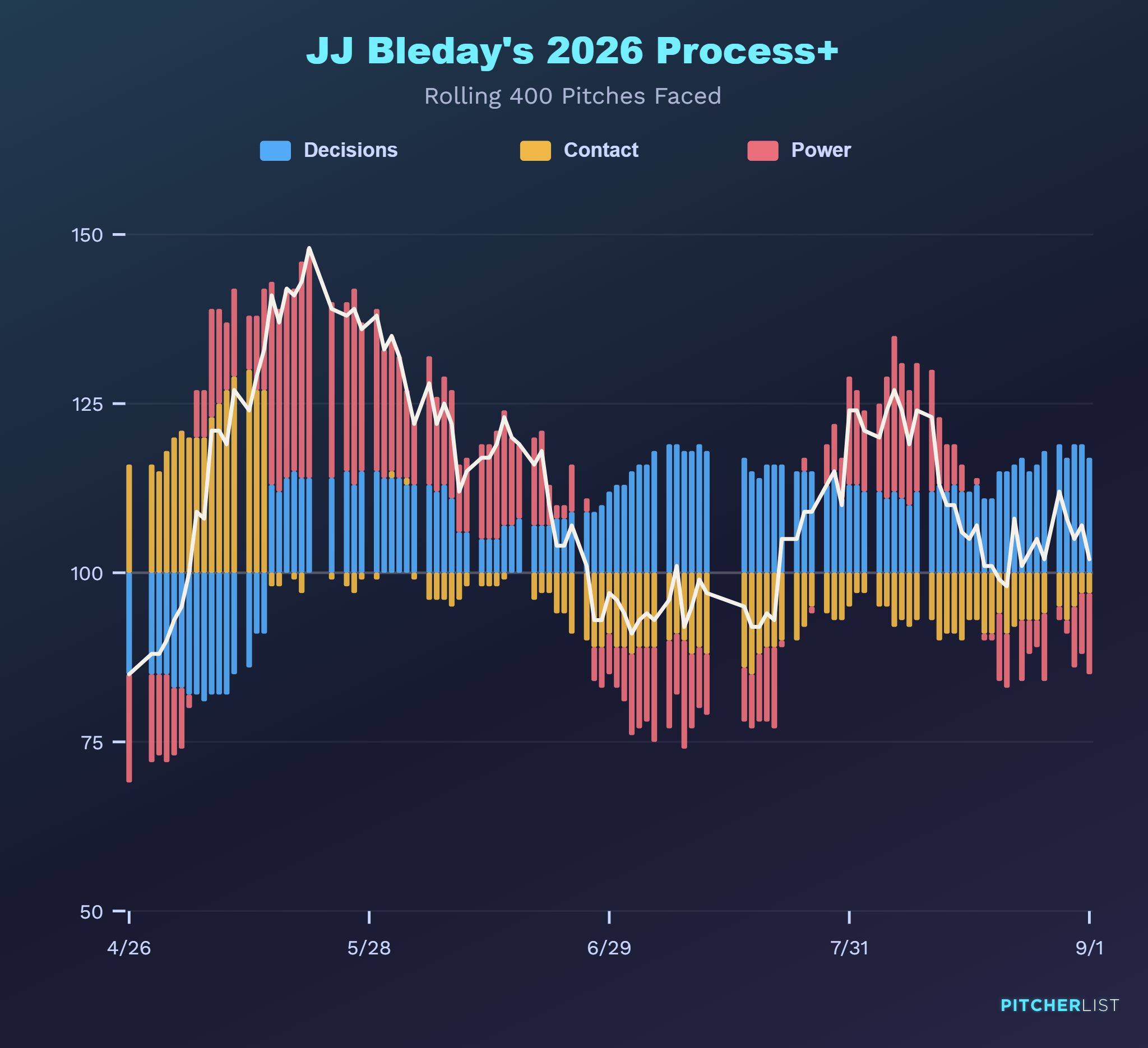
The story of Bleday’s season is pretty vividly apparent from his Process+ chart. He started the year on a tear, hitting .308/.398/.642 from his Reds debut on April 26th through the end of May. Bleday crossed the 400-pitch threshold on May 23rd; at that point, he had about average contact ability. His power was outrageous at the time, with Process+ ranking him 26% better than average, and his Decision Value was an excellent 131. Since then, the contact rate has deteriorated a bit, the power has come and gone, but the decisions have remained excellent. Bleday has been 10% better than average for the season despite a .237 BABIP. Still, he’s an extreme fly ball hitter with 38th percentile exit velos, so a low BABIP is to be expected. Not bad for a hitter that the Reds picked up for free after he was DFAed by an Athletics team with the 23rd-best (park-adjusted) offense in baseball.
Carter Jensen, Kansas City Royals – 130 Decision Value
It’s been a rollercoaster of a first full season for the Royals’ now-and-future backstop. He alternated good months with poor months at the plate until he posted a second consecutive sub-.700 OPS in August. He has two home runs in three at-bats vs Eury Pérez to start September, though, so he could be back on the upswing. One thing that Jensen had going for him in August, however, is a significant improvement in his decision-making at the plate.
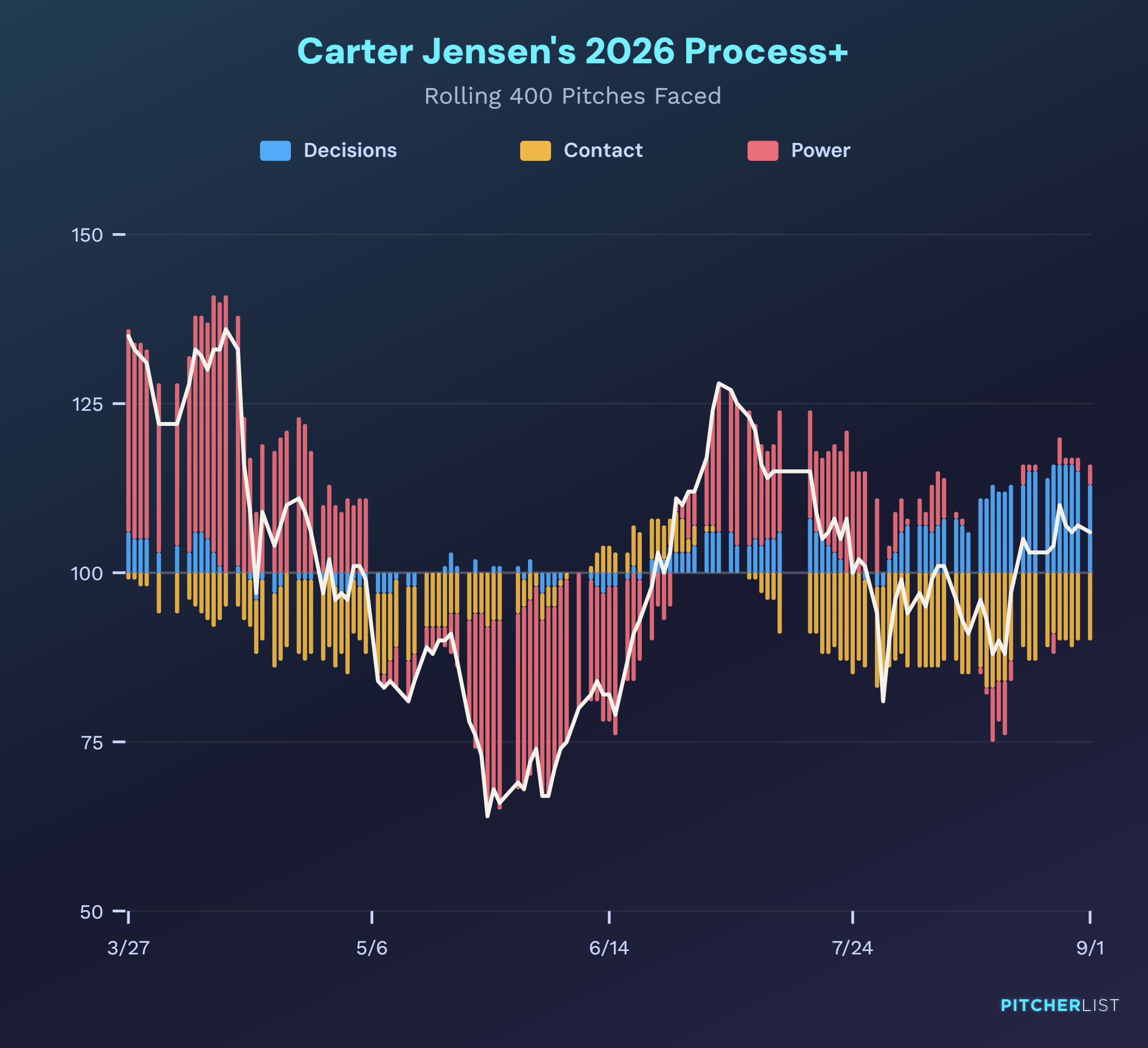
Jensen has spent most of the season as a roughly average decision-maker at the plate. Combined with his relatively poor contact skills (Jensen ranks 95th of 128 major leaguers with 450+ at-bats in contact percentage), his average decision-making led to an elevated strikeout rate of 29.6% through the end of July. In August, however, Jensen was much more disciplined on pitches out of the zone. He cut his chase rate to just 16.7% while still swinging at over 68% of strikes. That’s not sustainable for a full season; only Kevin McGonigle crosses the 49% mark in zSwing – oSwing, while the rest of the world’s most elite swing decision-makers (Miguel Vargas, Kyle Tucker, Freddie Freeman) sit in the high-40% range of the same metric. It paid off for Jensen, as he cut his strikeout rate by 5.1 percentage points for the month while nearly doubling his walk rate to 17.3%. Despite a .203 BABIP leading to a .180 average for the month, Jensen still managed a 96 wRC+.
William Contreras, Milwaukee Brewers – 128 Decision Value
Contreras’s power has waned over the course of his time with the Brewers, but he’s still one of the best in the game at choosing what to swing at. This season, Contreras has taken his strikeout avoidance to a new level. He’s striking out in only 13.7% of his plate appearances this season after setting a career low of an 18.2% strikeout rate last season. Contreras’s new approach is not without costs, though, as he’s also trimmed 3.3 percentage points off his career-high 12.7% walk rate from 2025. Altogether, 76.9% of his plate appearances end with a batted ball, up from a career high of 69.1% last year.
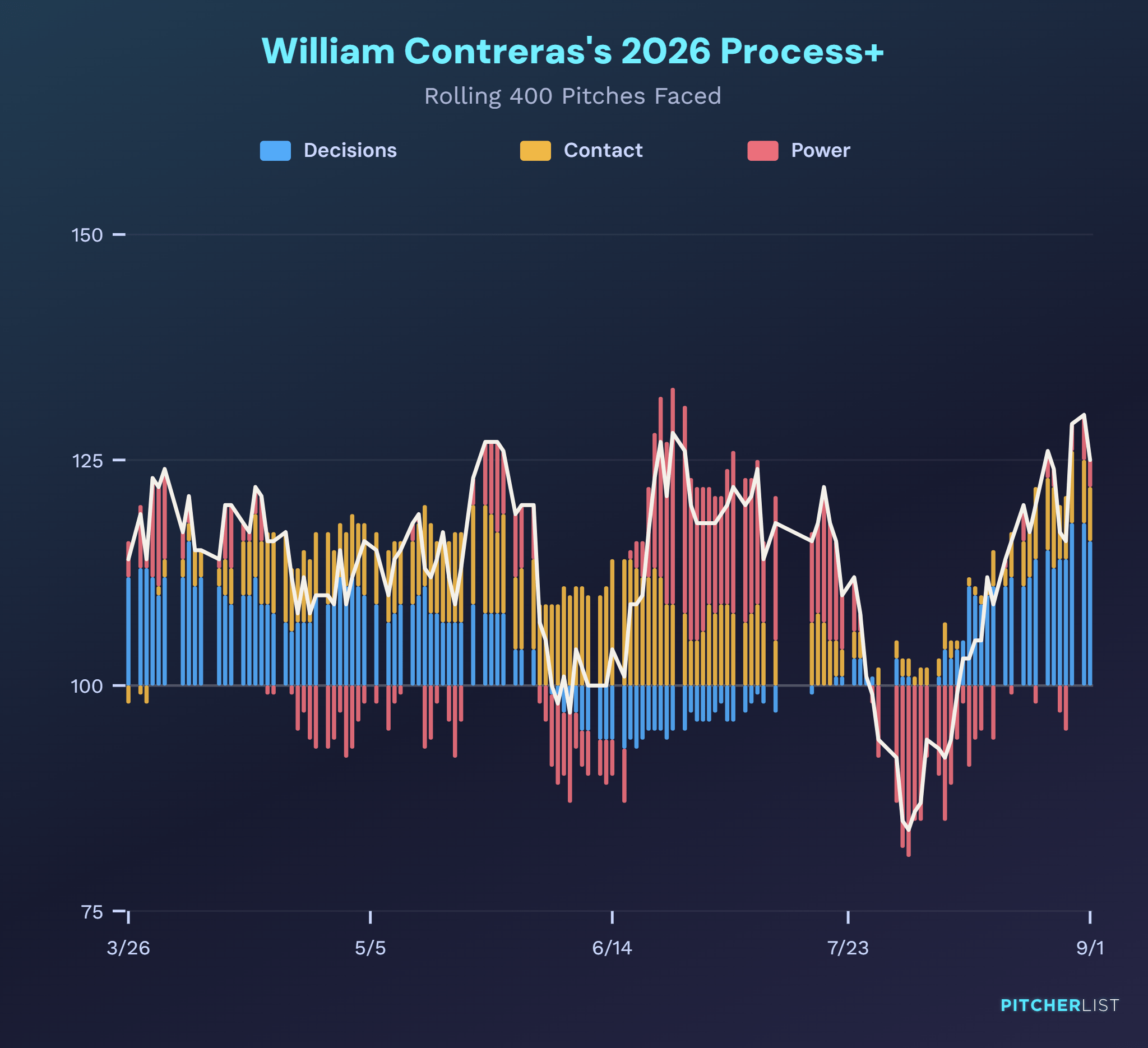
Except for a May and June resurgence, Contreras’s power has also disappeared with his new approach. He’s swinging the bat at the same speed as last year, but nearly 1.5 mph slower than in 2024. The contemporaneous decline in bat speed and improvement in contact rates over the past couple of years lead me to believe this is an intentional choice by Contreras. I’m not sure it’s a good one, though. Sure, Contreras is still an excellent hitter, especially for a catcher, but the decline in batted-ball quality has more than offset his gains in contact. He’s now put up nearly 2 full seasons of roughly 10% better-than-league-average offense after three years of hitting 30% better than the average player.
Wyatt Langford, Texas Rangers – 127 Decision Value
Langford is another young player who has made incremental improvements over his first couple of seasons in the majors. Langford debuted in 2024 with a .253/.325/.415 line that resulted in a 111 wRC+. In his sophomore season, he added a bit of OBP and slugging, pushing his wRC+ up to 119. His approach at the plate was basically the same in his first two seasons. He had about a 23% chase rate and swung at about 64% of strikes. Nevertheless, he hit the ball a bit harder in his second season despite a decline in his batting average. This season, though, his approach at the plate has had notable changes.
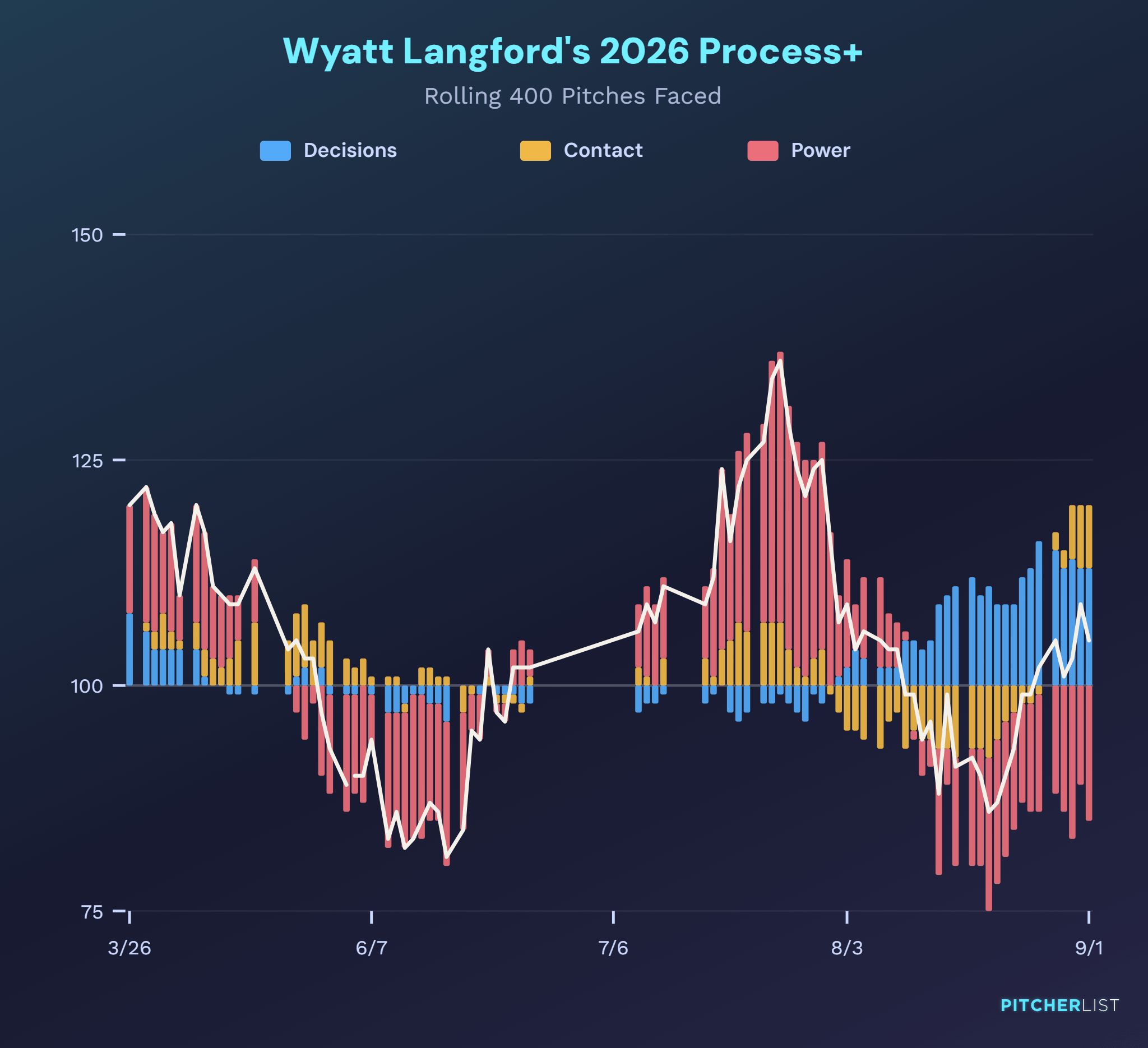
Langford started the season cold (recall that 400 pitches seen is a bit less than a month of full-time plate appearances). He went on the IL with a right flexor strain in April, having been less disciplined than his normal self. He started the season by chasing nearly 30% of the time without really changing his zone swing percentage. After returning from the IL in June, Langford was aggressive at the plate. He managed to keep his chase to 28.4%, but swung at 72.5% of strikes through the end of July, well above his career norms. Since August 1st, he’s shown even better decision-making at the plate. He’s trimmed his chase back another two percentage points to 26.6% while still attacking 69.4% of strikes he sees. Unfortunately for Langford, his contact quality has been poor of late. He’s swinging the bat 72.3 mph in the last month, a bit under his season average and over 2 mph less than in his debut season. His average exit velocity is down 1 mph in that span, and the barrels have disappeared as well. Langford’s improvements in selectivity outside the zone and aggression inside the zone are promising, but you’d love to see him swing the bat like he means it down the stretch.
Steven Kwan, Cleveland Guardians – 127 Decision Value
What is happening with Steven Kwan? He’s lost 40 points on his already-low .100 career ISO, but is walking 3.5 percentage points more than his previous career high of 9.8%. He’s hitting .275 on the season, which is typical for him, but he hasn’t gotten there in anywhere close to a typical manner. Kwan started the season by hitting .212/.318/.257 through the end of June, a shocking line for someone whose lowest seasonal contact rate is 90.3%. Since the calendar turned over to July, though, he’s hitting .362/.454/.443.
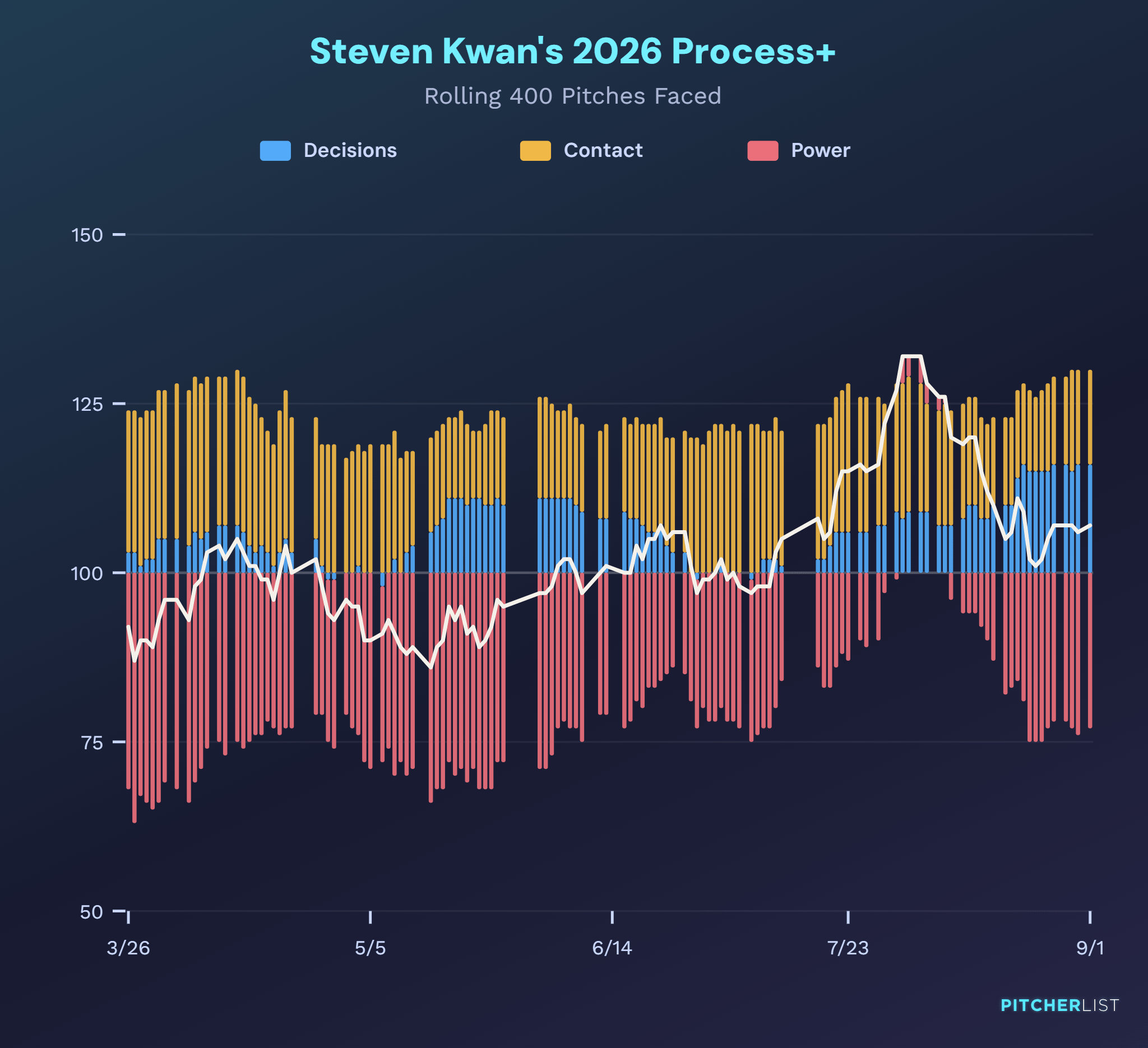
Kwan’s contact ability has remained consistently excellent despite the highly varied nature of the results he’s been getting. As expected for the light-hitting Guardians outfielder, the power has been mostly absent, except for a short span in July where he reached average. Instead, the big variation from month to month has been in Kwan’s approach at the plate. Kwan doesn’t swing much; his 35.6% swing rate is above only Taylor Ward’s exercise in passivity among qualified hitters this season. Kwan has been consistent in his refusal to take the bat off his shoulders, with a July-onwards swing rate of 35.5% and a pre-July swing rate of 35.8%. Instead, what’s driving Kwan’s improvement in Decision Value is a change in what he swings at. In the first half of the season, Kwan chased 21.4% of pitches outside the zone – a very good rate, but one that would be the second-highest of his career. In the July-onwards sample, Kwan is chasing only 16.7% of the time. Since his overall swing rate has been constant, that means he’s swinging more in the zone (a slight increase from 50.7% to 52%). The small changes are obviously working for him, but I’m mostly left impressed that two of the premier contact bats in the game (Kwan and Luis Arraez) practically could not be more different in how they approach hitting.
Corey Seager, Texas Rangers – 126 Decision Value
Seager is a patron saint of swing decision metrics, the namesake of the SEAGER metric at Baseball Prospectus which has a lot in common with Decision Value. Seager hasn’t been good at the plate this season, but he has maintained his consistently excellent approach. Despite that, Seager’s strikeout rate has ticked up to 23.8% this season, the highest of his career. Nevertheless, Seager is also maintaining an excellent 12.4% walk rate, the second-best of his career.
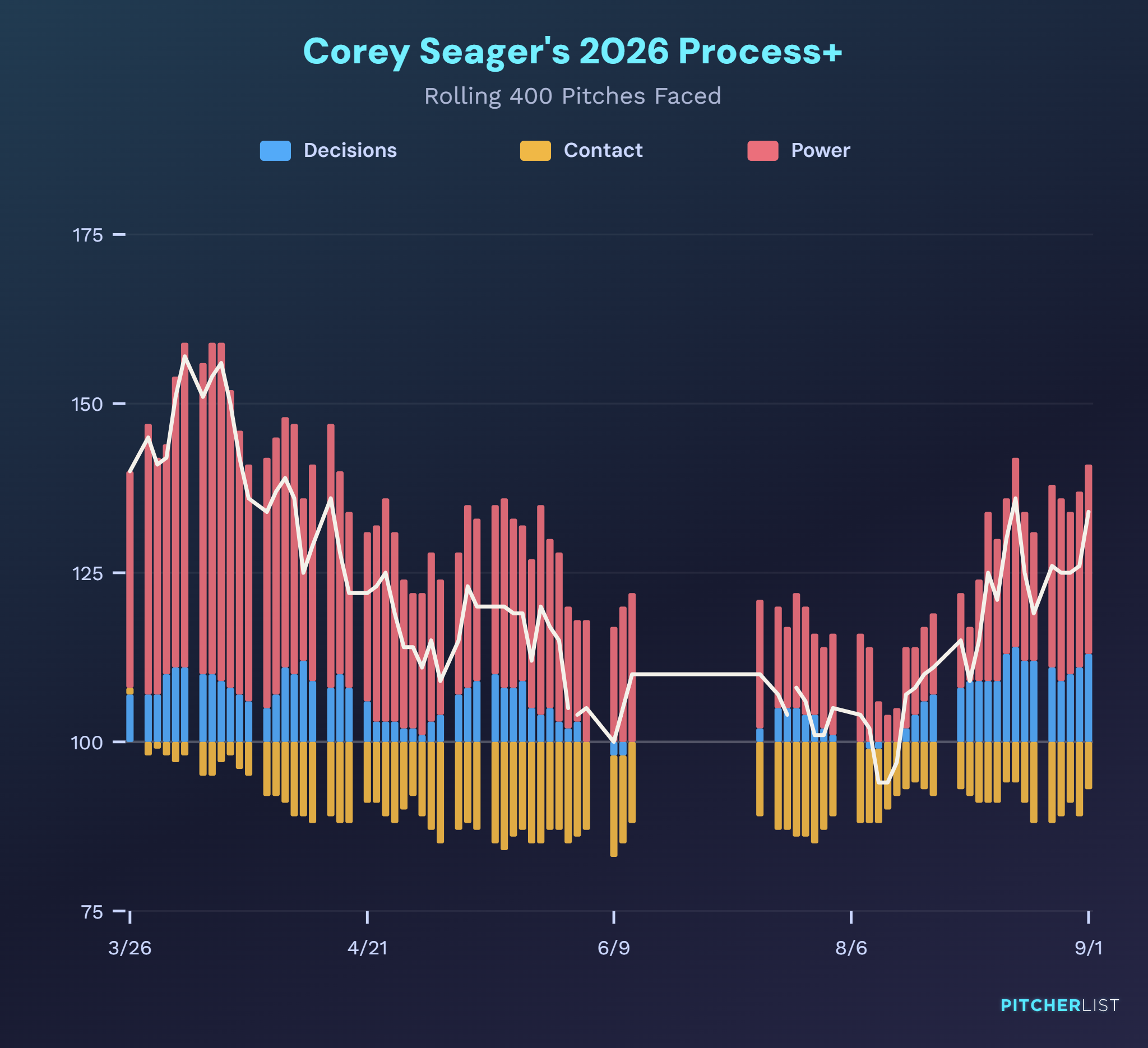
Seager has performed excellently by our Power metric, but he’s struggled with contact this season. It’s the lack of contact this season that has eroded Seager’s value at the plate. Peak Seager had zone contact rates of around 87% while also being incredibly aggressive in the zone with zone swing rates of around 80%. Current Seager is only making contact on 82% of pitches he swings at in the zone, while his chase contact rate is 40.7%, nearly 9 points below his career rate. Small changes in zone contact rate can show up as relatively large changes in swinging strike rates when you swing as often in the zone as Seager does. Indeed, with an 82.9% zone swing rate, Seager’s decline in contact has contributed to a 15.3% swinging strike rate. If you’d asked me at the beginning of the season to predict the two players who would rank just above and below Seager in swinging strike rate, I would have never come up with Ezequiel Tovar and Jarren Duran.
Over the past month, it’s been more of the same for Seager. He’s chasing only 22.9% of the time while swinging at an incredible 87% of strikes. You should take a moment to appreciate that. The league leaders in zSwing-oSwing hover around 48%, while Seager is posting a 64% over the past month. It’s working out well for the Rangers’ shortstop, as he’s posted a .284/.376/.432 line that is much more in line with his good seasons.
