


We don’t have a winner just yet, but here at the Going Deep section of Pitcher List, it’s time to celebrate.
The Milwaukee Brewers and Tampa Bay Rays are in the World Series. The nerds have won.
This victory won’t change the shape of the upcoming CBA negotiations or the heart of your (least) favorite anti-analytics commentator. The fruits of this front office labor, though, are leaving their fingerprints on our conversations. Every time Tampa Bay makes a move, the famous Sam Miller tweet echoes around social media, and Milwaukee’s mastery of player development has made contributors out of Jake Bauers, Andrew Vaughn, Shane Drohan, and countless others.
That’s not to say either franchise is infallible. We are one errant pitching change from discourse, and both teams have had their experiments threaten the science fair at various points. But this far into October, it’s safe to assume these staffs have a pretty good reason for pulling every lever, even if it isn’t clear to the rest of us.
One such case is Game 3 starter, Robert Gasser. I’m not entirely sure why he has doubled his sinker usage in October, and why he’s thrown his four-seamer to the wind in the process. As he stares down the biggest start of his life, it’s worth considering why the Brewers were willing to make such a radical change when the stakes were highest.
All Gasser, No Fastball
Gasser’s breakout season wasn’t all that unique. 2026 might as well have been the Year of Pitch Diversification, specifically with the hard stuff, and Gasser leaned into the four-seam, sinker, cutter approach that swept the league. His sweeper was the headliner, thrown 25% of the time, but his three heaters weren’t far behind. His four-seamer and sinker were both thrown at a 23% rate, followed by his cutter at 18% (and a modest changeup).
Then he made his first career playoff start.
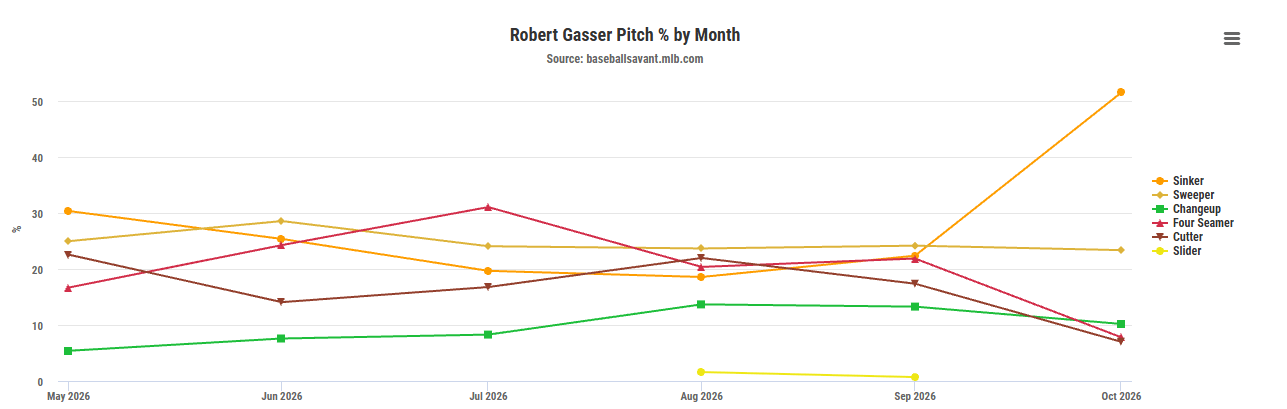
Against the San Diego Padres, Gasser threw just five four-seam fastballs on 56 pitches, his first time with a single-digit usage rate in 2026. He threw three cutters and 27 sinkers, good for 48% of his offerings. That was his highest sinker rate this season, only to be topped in his next outing against the Los Angeles Dodgers. In his lone NLCS start, Gasser pitched five shutout innings while throwing sinkers at a 54% clip. Once again, he threw just five four-seamers.
Part of what made this change so surprising was the current state of his arsenal. By our Stuff+, Gasser’s sinker (81) isn’t much different than his four-seamer (84); the two are 25th- and 26th-percentile pitches, respectively. And while it racks up called strikes at an absurd 27.2% rate, neither its in-zone potency nor damage suppression suggested this change was needed.
Similarly, his four-seamer is the more interesting pitch. Despite throwing it at just 92.9 mph, Gasser creates 13.4 inches of induced vertical break from a 24° arm angle, yielding a height-adjusted vertical approach angle of 1.4°, an 86th-percentile mark.
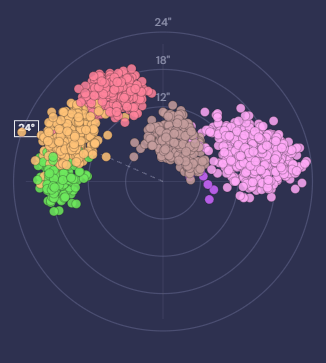
Throwing two-thirds of them up in the zone, Gasser racked up swings-and-misses (28.9% whiff rate) and did a good job manufacturing weak contact. It was an out pitch for him this season, and he still hasn’t thrown one to a left-handed batter in October.
Gasser’s cutter has found itself in a similar spot, eschewed for the sinker, even though our Stuff+ and PLV+ models think it’s his best fastball. He was happy to throw it in the zone, even with average damage statistics, and it may have acted as a bridge from his other fastballs to his sweeper. If Milwaukee feels the sinker is his best fastball, this kind of usage might be a downstream effect of shorter hooks and playoff intensity. Why get beat on your third or fourth best pitch?
Perhaps the Brewers are just Aaron Ashby-maxxing, getting another lefty to spam sinkers and an assortment of secondaries. To their credit, it’s working.
Potential Explanations
One reason why Milwaukee might be emphasizing this kind of pitch selection is the long ball. For all the small-ball talk surrounding these franchises (fair or not), home runs win playoff games, which means preventing them does, too.
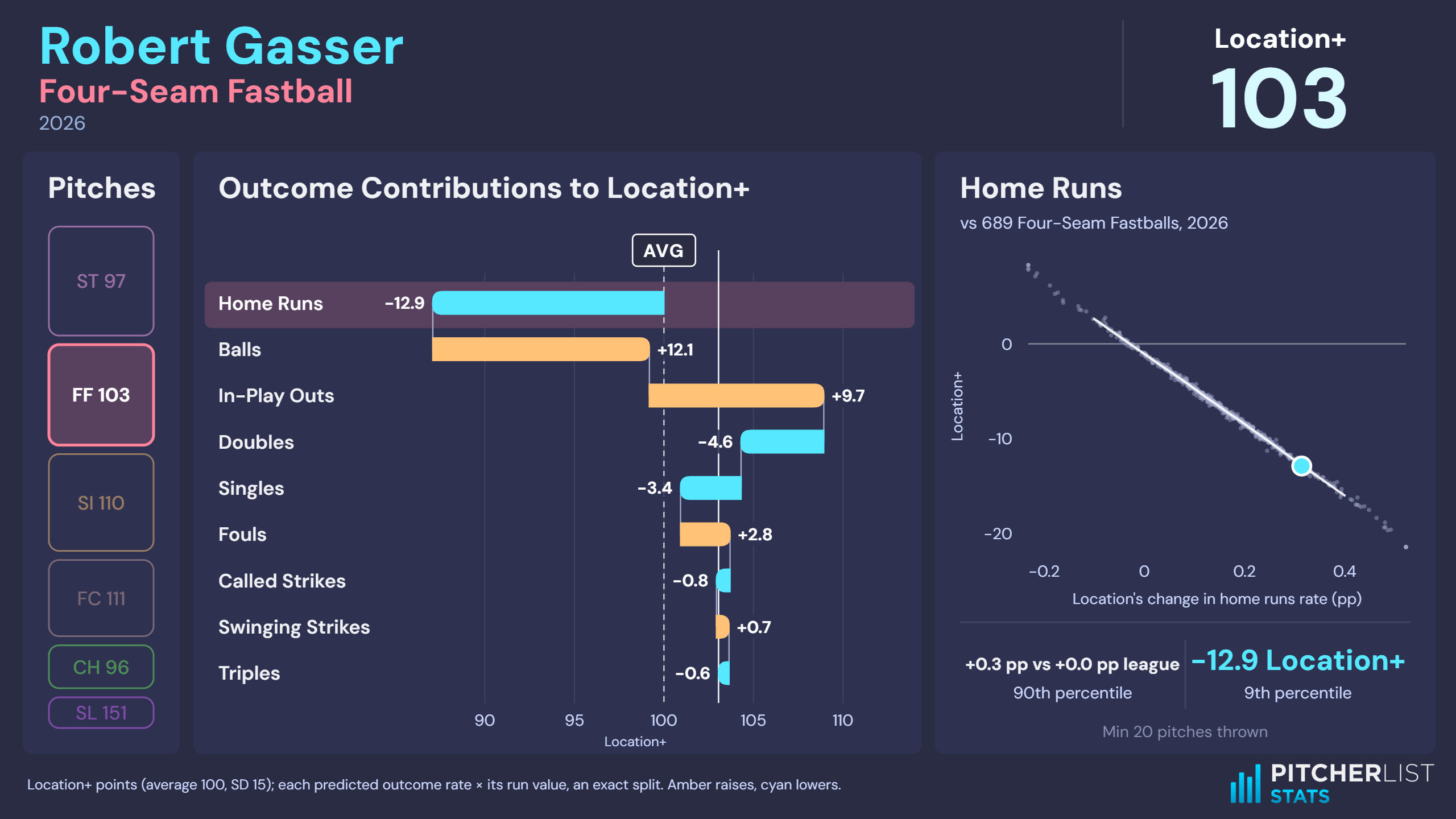
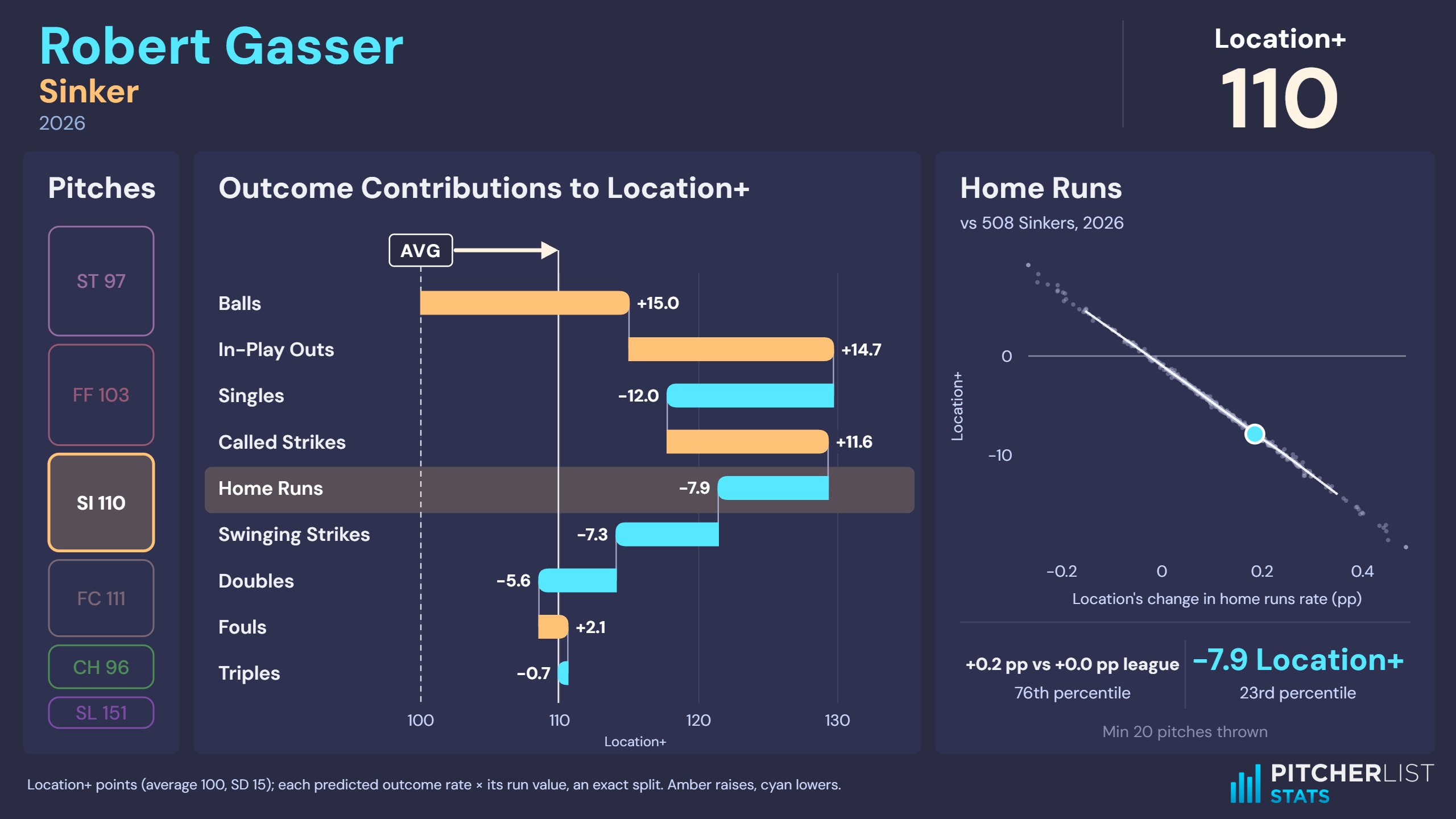
Location metrics don’t entirely agree on his fastballs. In my estimation, he commands them at a league-average rate, with his sinker coming out on top. Fearing the homer, though, the Brewers may have identified his four-seam fastball as a bigger risk factor. After all, it’s a slower fastball that rarely generated ground balls; against good enough competition, the door is open for damage.
Our plvLoc+ model would agree, citing homers as a bigger issue for the four-seamer (9th percentile) than the sinker (23rd percentile).
Likewise, Gasser got burned on one of the few four-seamers he served this postseason, when Fernando Tatis Jr. sent this not-so-poorly executed fastball to Tijuana. In a 1-2 count, pitching up in the zone was meant to generate a whiff, and with October adrenaline, he even got it up to 94.4 mph. But Tatis is a star, and his fastball shape still has limitations.
Super El Niño 🔥 https://t.co/K5ev3Y1CDA
— San Diego Padres (@Padres) October 8, 2026
It is also possible that Milwaukee made this decision based on matchups. Subsequently, we can think of this small sample size in two ways: a distinct adjustment for the indefinite future or two games that happened to lend themselves to a heavy uptick in sinkers.
If it’s the latter, it might have something to do with San Diego whiffing at a rate 30% worse than the league average against 90-95 mph lefty sinkers. The Padres were also below average by xSLG and xwOBA on contact against that same cohort.
Los Angeles, meanwhile, offered a different challenge, given the platoon-neutral stalwarts in the left-handed batter’s box. It makes some amount of sense for him to avoid a potentially homer-prone fastball against the likes of Shohei Ohtani, Freddie Freeman, and Kyle Tucker, especially after getting taken deep in his prior start. If anything was going to wake the Dodgers up, it was their power, and Gasser completed his start unscathed.
Evidence to the contrary—that the Brewers are thinking bigger picture with their southpaws—belongs to DL Hall and his pitch mix.
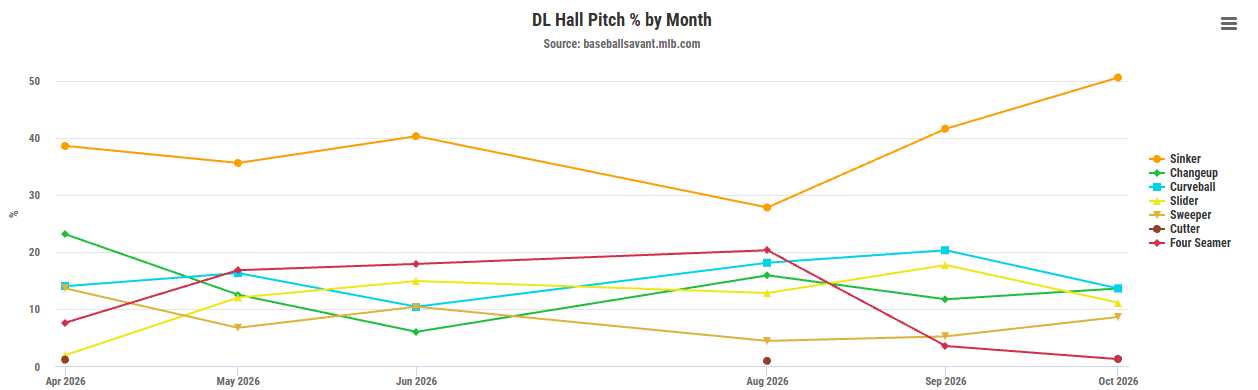
In August, Hall’s sinker was used on a plurality of his pitches (27.8%), and his four-seamer (20.3%) followed suit. A month later, those usage rates diverged to 41.6% and 3.5%, respectively. Through Game 1 of the World Series, Hall is throwing his sinker on half of his pitches. He’s thrown his four-seamer and cutter once each. It’s possible this change started earlier due to the quality of Hall’s four-seamer.
While his sinker has mixed reviews, mostly ranging from below average to average, it’s much harder to find optimism for the four-seamer. By Eno Sarris’ Stuff+ (93), it’s far from a plus pitch, and its Location+ (73) is untenable. Our PLV+ (62) calls it a first-percentile four-seamer, largely due to bottom-decile command and a shape that needs significant seam-shifted wake to sniff average.
Having allowed just one run in 15.1 September innings, Hall provided Milwaukee with some extra cover to tinker with Gasser down the stretch.
Projecting Game 3
Of course, all of this leads up to Game 3, where Gasser is penciled in to start against Tampa Bay in the first World Series game at Tropicana since 2008. Armed with a 2-0 series lead, the Brewers have every reason to let Gasser sink his way to another acceptable start.
Whether this trend continues could come down to whiffs, and if Milwaukee feels it’s worth it to chase them against a Rays lineup hell-bent on not striking out.
Tampa struggled to do damage against lefty fastballs, specifically from the velocity band that Gasser operates in. Their quality of contact didn’t waver much on pitch type, and they whiffed slightly more often against four-seamers than Los Angeles and San Diego.
If the four-seamer returns on Monday, we should expect to see it against the lower half of the Rays’ lineup. The Brewers still can’t afford to get beat by the long ball, but after Junior Caminero’s turn in the lineup, there’s little pop to speak of. That creates an opportunity for Gasser to get the whiffs his fastball provided in the regular season without putting the ball in harm’s way.
Ultimately, I don’t expect the four-seamer to be featured heavily. Milwaukee is nothing if not intentional with its player development and strategy. After all, Pat Murphy is planting early-game bunts to set up David Hamilton dingers. It seems like the Brewers have found something with their lefties’ pitch selections, and while the reasons remain uncertain, Gasser’s sinker command and recent results make a compelling case for sticking to that plan.
Milwaukee didn’t get here by accident. And at the pinnacle of their success, two steps away from immortality, it’s probably best to trust that perhaps the smartest team in baseball found another trick up its sleeve as the calendar turned to October.
Photos by Icon Sports Wire | Graphic by Carlos Leano
