





Only one of the four division series ended in a sweep this year, and it happened to be the one that featured the top 2 teams in the American League.
The 98-win Tampa Bay Rays, who held a comfortable lead over the rest of the AL East for most of the year, quickly did away with the 93-win New York Yankees, popping champagne in the visiting clubhouse at Yankee Stadium for the second time in the past month after completing the sweep on Wednesday night. These teams could be considered the antithesis of the other. New York led the majors in barrel% and exit velocity on balls hit in the air while finishing top 5 in home runs, xwOBA, and team bat speed, but they continued to strike out too much and were a decidedly below-average offense once Aaron Judge first hit the injured list.
Tampa Bay, meanwhile, does not hit the ball hard as a lineup. They make a ton of contact and avoid strikeouts. They hit the ball on the ground and use the whole field. They led the league in bunt hits and were tied for second in infield hits and steals, although they didn’t trounce the Yankees in any of those categories in the ALDS. Statcast saw them as an average defensive team (+6 outs above average, 15th in MLB) but they were 2nd in defensive runs saved with 87. Over 162 games, it was the Rays that had the league’s 6th-best offense by wRC+ (104) while the Yankees lagged behind at 14th (101).
This isn’t going to be one of those Old-Man-Yells-At-Cloud dissertations about how the Rays won because they focused on fundamentals more than analytics. Did you really think you’d read something like that at Pitcher List of all places? The whole point of using analytics is to find and exploit competitive advantages, which the Rays have successfully done all season. They remain one of the most innovative teams in sports.
Toward the beginning of baseball’s sabermetrics era, it was easy to argue that the postseason was a total crapshoot. There are certainly elements of randomness to a 3, 5, or 7-game series that pose a contrast to the ground truth of a 162-game marathon. The fact is, however, that with proper game planning and strategy, there can be effective solutions for the powder keg that is October baseball. The Rays’ dugout personnel made a handful of crucial analytical decisions that allowed them to outsmart their division rivals and sweep their way to the ALCS without trailing at any point during these past 3 games. Here are the numbers behind them.
27.7%: Drew Rasmussen’s Changeup Usage in Game 1
This was the highest percentage of changeups we’ve seen from Rasmussen in a single start in 2026 and it’s safe to say the Yankees were not ready for it. Rasmussen’s changeup is one of the many kick-changes we’ve seen emerge over the past couple years, and it’s worth mentioning its spin rate was noticeably down in this outing which killed its induced vertical break and some arm-side run (1″ iVB/9″ HB vs 3″ iVB/12″ HB year average).
Still, there were signs that he might lean on it more than usual. The Yankees loaded their lineup with 8 lefties and while Rasmussen was a four-seam-cutter guy nearly 60% of the time to lefties this season, he boosted his changeup usage down the stretch. It was his most-used pitch against lefties in September. In Game 1, the results were something else.
Yankee hitters had a negative Z-O Swing% against it. It was a strike 86% of the time, including 5-for-5 on first-pitch strikes. I find it ironic that Freddy Peralta, who famously doubled down on his changeup after getting traded from the Mets, didn’t throw it any more in Game 2 than he usually did since joining the Rays. Instead, he chose to throw his fastball nearly two-thirds of the time as it was sitting at 97 MPH, buoyed by a classic postseason adrenaline velocity bump. The guy who everyone thought was going to throw a ton of changeups to the Yankees threw a ton of fastballs. Instead, the ace known for his 3-fastball approach was the one who gave them a healthy dose of the cambio.
This game provided shades of last year, when Kevin Gausman and Trey Yesavage flummoxed the Yankees with their splitters to start the ALDS. Since the start of 2025, New York lefty hitters have a .268 wOBA against off-speed pitches from righty pitchers. That’s 18th in the majors. Against fastball types in that same platoon matchup, they’re 10th in wOBA and 3rd in xwOBA. Changeups and splitters have been a relative weakness for them recently and their postseason foes have had no problem pitching to it.
100%: Rays’ Hard Hit Rate on the First Pitch vs Cam Schlittler in Game 2
Among the 271 pitchers in baseball with at least 1000 pitches thrown in 2026, Cam Schlittler was in the zone on the first pitch more than about 53% of them. That doesn’t make him a tremendous outlier in terms of first-pitch command, but the Rays, 13th in team-wide first-pitch swing% during the season, decided they were going to be more aggressive on Monday night. Schlittler is a powerful strikeout pitcher, but the Rays do a good job of avoiding strikeouts and making contact on pitches both in and out of the zone (out-of-zone contact generally isn’t a good thing unless the opposing defense is having a bad day, which absolutely was the case here). As such, they planned to get to Schlittler early to reduce his strikeout totals. Here’s how they did against his 23 first pitches in Game 2:
- 11 swings (47.8%)
- .273 AVG
- 4 singles
- 2 doubles
- 4 balls in play
- 4 hard-hit balls with an average exit velocity of 106.8 MPH
The team that doesn’t hit the ball hard took their A-swings in 0-0 counts against Schlittler. Those 4 batted balls include a 112 MPH double by Junior Caminero against a sinker running up and in on his hands and Jonathan Aranda’s sizzling single into center field in the 1st inning amidst the error parade. What’s truly impressive about this is Schlittler greatly mixed his usage in these situations. He’s normally four-seam-heavy on the first pitch, but in Game 2, he threw it just 30% of the time while using his other 3 pitches at least 20% of the time. He hadn’t diversified his arsenal this much to start at-bats since Opening Day. It didn’t matter. The Rays were ready to hit from the jump.
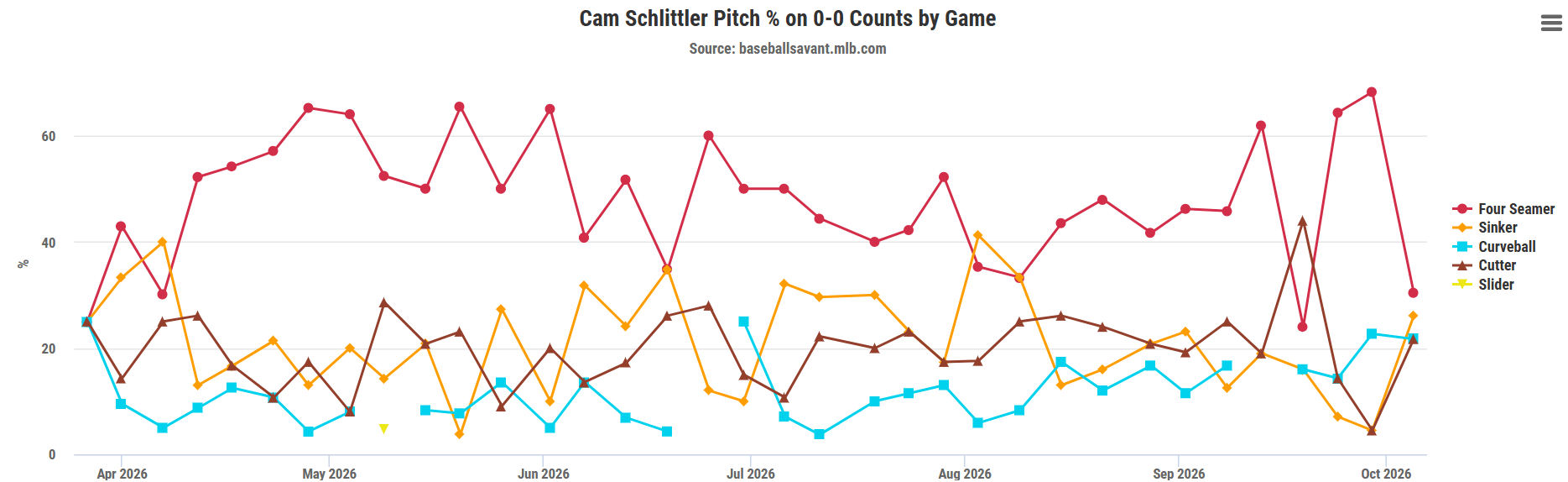
Schlittler put forth a valiant effort considering the numerous defensive miscues that went on behind him but was ultimately neutralized by some very good first-pitch swings from a Rays team that isn’t always aggressive in those spots. He changed his game plan with each trip through the order as well, throwing his four-seamer at a 60% clip the first time through, 34% the second, and just 7% the third (he only faced 5 batters three times), but Tampa Bay saw that coming as well.
28.1%: Griffin Jax Fastball Group Usage vs NYY in Game 3
The Yankees did a better job against Nick Martinez than either of the 2 starters they saw at Tropicana Field, chasing him in the 4th inning after scoring 2 runs on 5 hits with 6 hard-hit balls against him. One of those was an RBI double by Spencer Jones, one of the better lefty-lefty hitters on the team, off Ian Seymour, who entered in relief with runners who reached against Martinez. Next was Jax, who nearly coughed up the Rays’ lead but escaped after the fan interference fiasco. Ultimately, Jax’s day looked pretty good after retiring 3 lefties in order in the top of the 7th via 2 strikeouts and a popup. He finished with 4 strikeouts while allowing 1 hit and 1 walk in 2 innings, paving the way for the high-leverage trio of Booser, Kevin Kelly, and Bryan Baker to finish the job.
Jax’s changeup was his primary pitch against lefties this year, but he still made frequent use of his four-seamer, sinker, and sweeper. Not on Wednesday. Jax had a whopping 84% combined usage rate on his changeup, sweeper, and curveball against Yankee lefties in Game 3. Overall, his combined four-seam-sinker-cutter usage was a mere 28%, down from 44% in the regular season.
In the bottom of the 7th, Chisholm (who was pinch-hitting for Jose Caballero), Grisham, and Rice saw 11 total pitches. 0 of them were fastball types. Chisholm took a hanging curveball for strike 1 and popped a changeup in a hittable location harmlessly into Jonathan Aranda’s glove in foul territory. Grisham stared at 2 curveballs and a changeup he initially thought was going to hit him, all in the zone, to strike out looking. Rice chased a 2-2 curveball in the dirt for strike 3 right after that.
It was a fitting encapsulation of the Rays’ consistent exploitation of the Yankees’ inability to make offensive adjustments throughout the series. Their lefties showed vulnerability against soft stuff from righties in Game 1 before getting a steady diet of fastballs from the guy they thought was going to be Mr. Changeup in Game 2. Jax, a pitcher whose HR/9 rose slightly this year pitching at the homer-friendly Yankee Stadium in Game 3, had no reason to show these hitters his fastballs, so he barely did. Bumping Grisham to the leadoff spot was a questionable call to begin with, and the fact that his 3rd strikeout of the night ended the game with the tying run on 2nd and Rice on deck will only magnify that. Still, this bottom of the 7th was a giant missed opportunity for New York. Chisholm, who put up gaudy power numbers against non-fastballs this year, got his chance to pinch-hit against a righty, but Jax, even though he left the ball up against all 3 hitters he faced, successfully pulled the string.
Questions are rightfully mounting in Yankee Land. This is the second year in a row they’ve been trounced in a division series matchup with an AL East rival that was evidently more prepared than they were. At the same time, the Rays deserve plenty of credit for having an extraordinarily sound plan of attack against them, not being afraid to deviate even from their usual tactics to give themselves a well-earned shot at the pennant.
