Hello and welcome to Pitcher List’s latest series: Using PLA to Evaluate Pitchers! Every week, I will examine various pitchers and break them down using PLA. There will be various themes and topics each week, which will range from topics such as waiver wire picks, to buy or sell, to awards races, to lefties/righties only, etc. I hope to mix it up as much as possible to keep you all on your toes.
Now, you might be asking, what is PLA?
PLA is an ERA estimator that was created in tandem with Pitch Level Value, which we refer to as PLV. PLV is essentially an all-encompassing stat that measures individual pitches and rates them on a 0-10 scale. The elements that factor into PLV include velocity, movement, release point, location, count, and handedness of the batter. We have an excellent primer on this by the one and only Nick Pollack that you can find right here! PLA takes this 0-10 score and translates it to an estimated ERA, which makes it easier to understand and more useful for those looking for help with their fantasy teams.
It’s important to note that PLA isn’t necessarily a catch-all estimator, just as xERA, FIP, SIERA, and pCRA aren’t either. These stats ultimately still measure outcomes, which are largely dependent on how a player is executing that day. ERA estimators are not crystal balls; however, they can provide some insight if taken with a grain of salt. For the purpose of this series, we are going to use PLA as the main factor to evaluate pitchers (hence the series title), but again, no stat is perfect, especially in the complex world of pitching.
Also, stay tuned for other PLV evaluation article series, such as one that will look at individual pitches and another that will use Process+ to evaluate hitters!
Today, we will be looking at relievers who have slotted into the closing role this year. Whether it be due to injury or investigation, these guys have slotted in and have performed, shutting the door for their teams. But how good are they really?
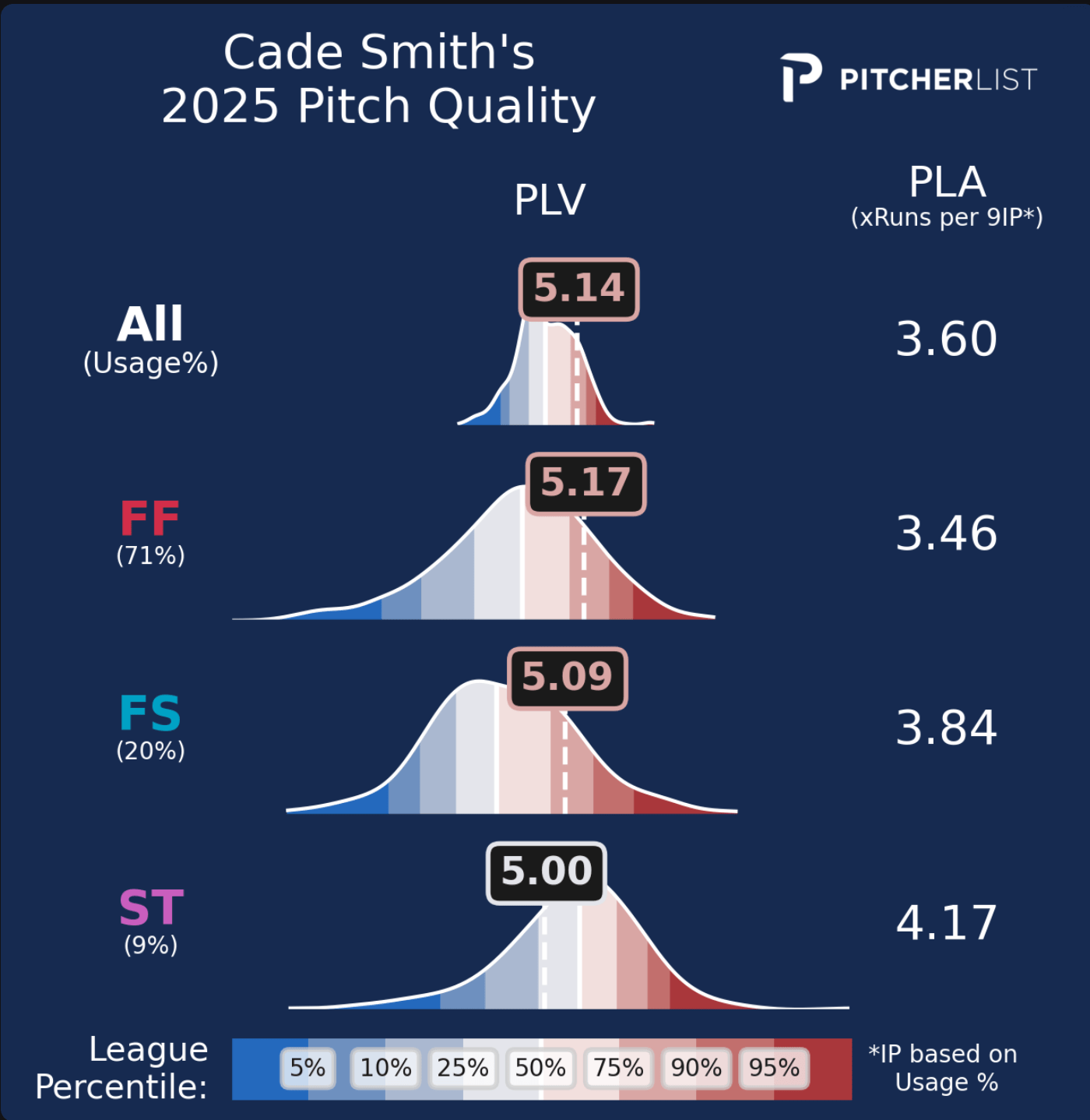
Cade Smith – 3.60 PLA
I’ve always wanted to see Cade Smith in the closing role, but not like this. The pride of Abbotsford took over as closer in Cleveland following Emmanuel Clase going on administrative leave due to a gambling investigation. It isn’t how you dream it up as a kid, but he’s now the guy for the Guardians.
Smith began his time as a closer looking really sharp; however, he has stumbled a little bit as of late. His mainstream ERA estimator-type stats show that he is likely to regress positively, due to his high strikeout rate and low walk/home run rates. PLA, however, seems to fall more in line with his recent performance, painting him as a good but not excellent reliever. It is of note that PLA isn’t as accurate with relievers, due to sample size and normalization
Smith is a master of the four-seam fastball, as he throws it a whopping 71% of the time. Its best trait is its extension, which is one of the best marks in baseball. This makes his fastball look a couple of ticks faster and allows him to tunnel well with his other pitches. Extension is an important trait to look for in pitchers, as a good-to-elite extension can be the straw that stirs the drink for an arsenal.
Smith’s main secondary is a splitter, a pitch type that can often be wild and can be the source of non-competitive pitches. Well, Smith is one of the rare pitchers who actually has an above-average grade on the splitter. While it’s in the zone a lot less than most pitches, he still has a good strike rate, and he avoids the dreaded middle-middle location like the plague. His last pitch is a sweeper exclusively to righties that grades out pretty much exactly average. It’s not one of the better sweepers, but it’s not one of the weak ones either. It’s pretty much dead average.
Smith’s arsenal overall grades out above-average, which is why his PLA is in that slightly above-average range. I do think he’s going to bounce back and be better than this, especially with splitters and other offspeed pitches often getting graded below their results. Smith will be a great closer for the Guardians, and for Team Canada at the World Baseball Classic.
Abner Uribe – 4.14 PLA
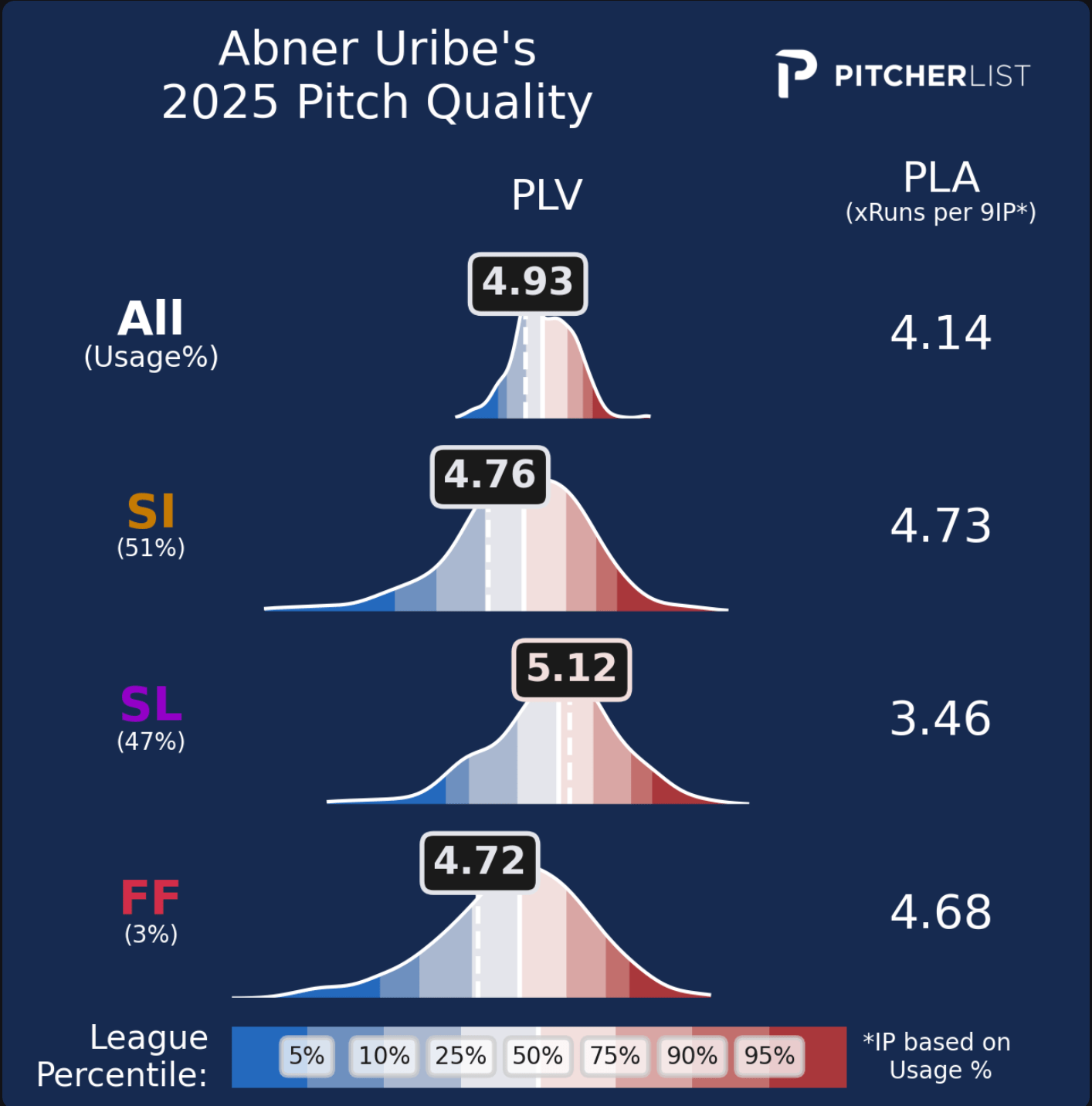
With the Brewers’ recent success and the injury to Trevor Megill, Abner Uribe has become the poster child for pitchers new to the closing role. He certainly has looked the part, with elite numbers across the board. However, those of you who are eagle-eyed stat nerds (or those who just read the big blue text above) might notice his PLA is higher than all of the other estimators. Why is this the case?
A lot of it has to do with location. Uribe is not really a control freak when it comes to location. This is evident with his sinker, as he sprays pitches all over the zone, including middle-middle nearly 10% of the time. His sinker grades out poorly largely because of this, as velocity-wise it certainly isn’t a problem, hitting 100+ on the gun routinely.
The slider is Uribe’s best pitch, which is par for the course with closers. This slider has a lot of sweeping motion, with plenty of horizontal break adding to its unhittability. While it has a lower-than-average strike rate for sliders, he makes up for it with an insanely high CSW rate, as he can use the pitch to effectively put batters away in 0-2 counts.
Part of what brings Uribe’s PLA up is his four-seamer, which, while he only uses it 3% of the time, our pitch-modeling stats say that’s 3% too much. It’s a high-velocity offering, but compared to the sinker, the shape and command aren’t there. He again, rarely ever throws it, and when he does, it gets too much zone or isn’t close at all.
Don’t be worried about Uribe’s poor PLA grade; command doesn’t matter as much for relievers, and his two main pitches both have off-the-charts stuff.
Trevor Megill – 2.36 PLA
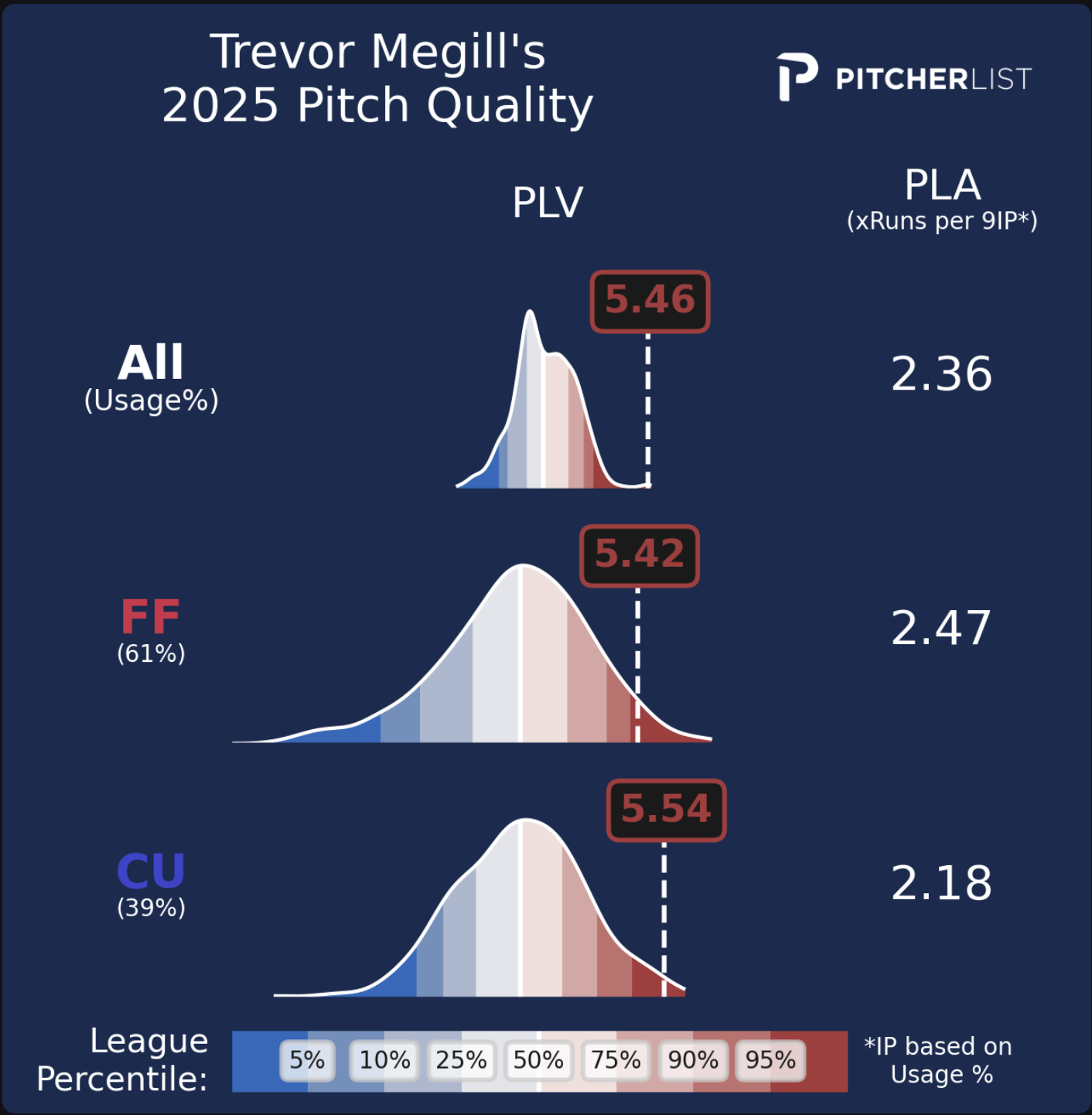
Okay, so I know he went down with the injury that put Uribe in the closing role, but I want to highlight one of the year’s biggest PLA/PLV darlings, as he really was one of the stat’s favorite players this year AND he technically fits the criteria for this article, as he slotted into the closer role with Devin Williams leaving.
Megill is a two-pitch reliever, and those two pitches are NASTY. Seriously, this is about as fun of a two-pitch mix that a reliever can have. He has a four-seam fastball with elite velocity, solid vertical movement, and elite iVB. I’m honestly surprised that it isn’t a huge whiff pitch, but either way, it gets the job done and gets strikes like it’s nobody’s business. The demon curveball is even more fun, though. Hammer curves with great velocity are among my favorite pitches. Shane Baz, Tyler Glasnow, Jhoan Duran, Jacob Misiorwoski, Trevor Megill baybee. They all have that awesome high-speed curve. Megill gets tons of whiffs with his, especially as he gets it low in the zone (or below for the chase). A 41% CSW rate is just ridiculous.
Megill has an awesome two-pitch arsenal that has carried him to success this year, and while injury has led to him forfeiting the closer job for the time being, I see him returning as a nasty high-leverage option who will shut the door many more times in his career.
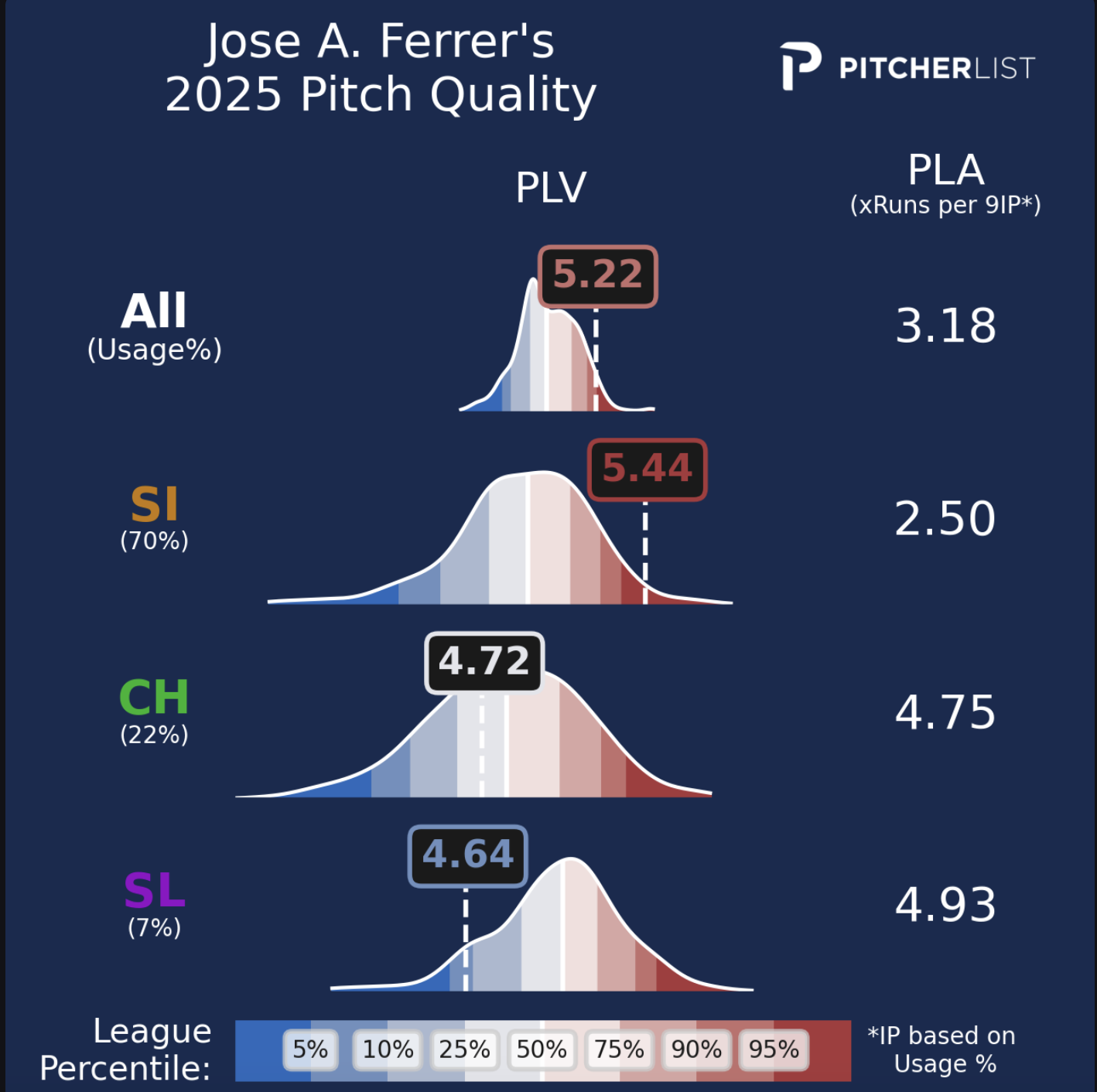
Jose A. Ferrer – 3.18 PLA
The Nationals’ bullpen has looked pretty thin this year, and with the trade of Kyle Finnegan, it looks like the guy to take the closer helm is Jose A. Ferrer. Not to worry though, Ferrer has shown that he is plenty good enough to be a closer, despite the basic ratios not looking amazing.
Ferrer comes from the sinkerballer school of high-leverage relievers. He uses his sinker over 70% of the time, and for good reason. The pitch is nasty. It’s a high-velocity offering with tons of horizontal break. It’s the classic gif-able slider that makes its way on social media platforms after a top batter is caught looking silly as the sinker dots the outside corner. Its location may not be the best, and the extension doesn’t add to the already high velocity, but this is still an excellent pitch to build an arsenal around.
While the sinker is thrown most of the time, Ferrer also has a changeup and slider. These two get tons of swings-and-misses but grade out poorly, unfortunately, due to Ferrer’s struggle locating them. The slider also doesn’t move a ton, making it that true football-style bullet slider.
Closers are hard to come by on the wire this late in the season, but Ferrer is up for grabs in plenty of leagues. He’s in a good situation and grades out better by PLV than some of the bigger-name options. I suggest grabbing him if you can.
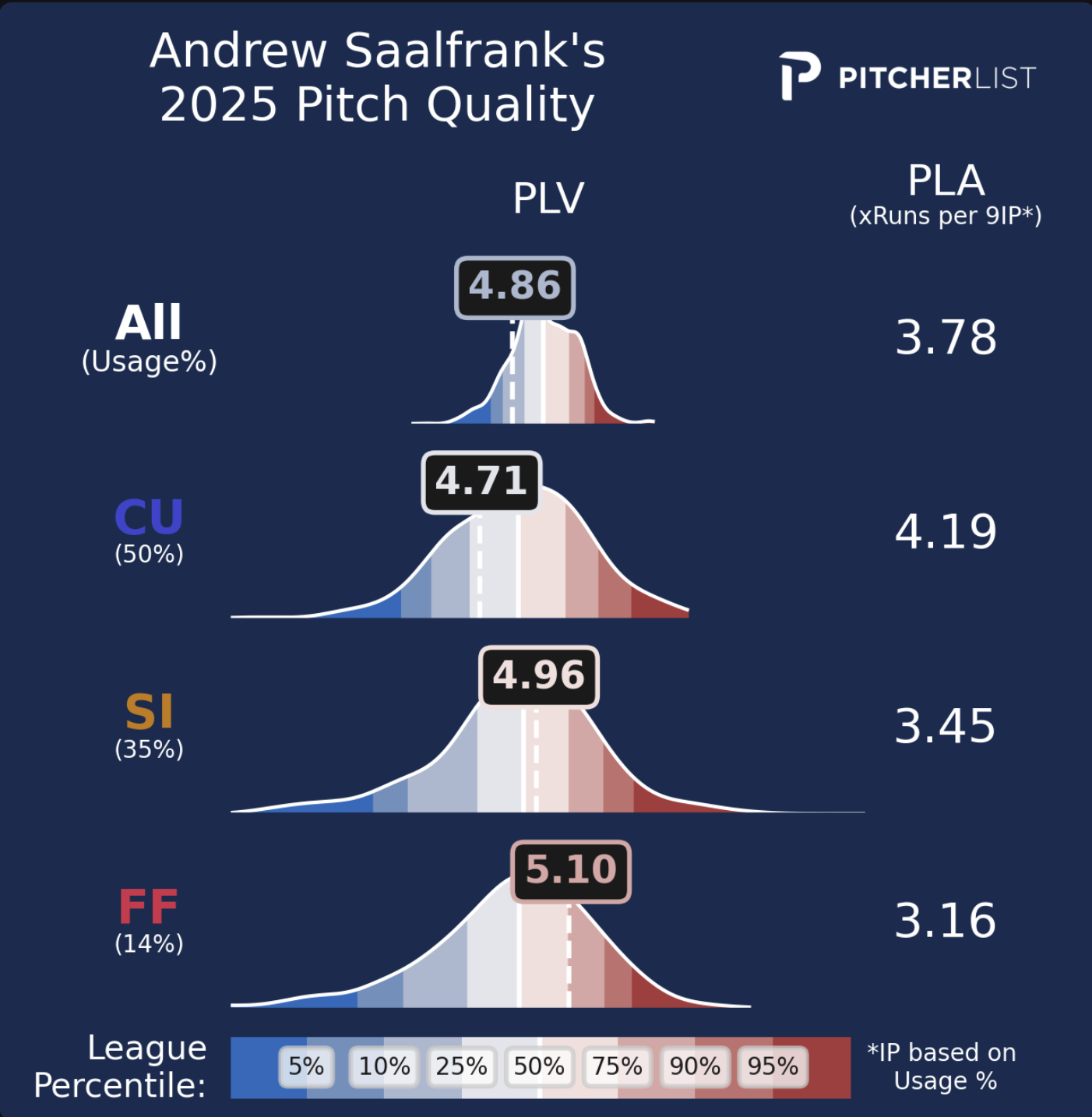
Andrew Saalfrank – 3.78 PLA
Well, it appears that Andrew Saalfrank is next up as the Diamondbacks’ closer. Injuries struck Justin Martinez and A.J. Puk, and Shelby Miller saw his return to Arizona cut short with a trade to Milwaukee, so there’s a new sheriff in town.
Saalfrank is a fun closer, even if the estimators say he may not be the elite guy that other teams have. His ratios have been nuts so far, even if it’s only been 21 innings, that’s more than enough to be viewed as impressive.
Saalfrank’s main pitch is a curveball. These are some of the more fun pitchers out there, those with a good secondary that becomes a primary pitch. With that said, there’s nothing too special about this pitch aside from its usage. It isn’t a particularly fast curveball or slow one, and it doesn’t have elite movement. Though, the pitch gets strikes and swings and misses, which can be attributed to the fact that he gets low with it, which helps set up his other pitches.
Saalfrank features two fastballs that round out his arsenal. Both are of much lower velocity than can be seen from other relievers. He has a sinker that grades out below average and a four-seamer that grades out well, though he hasn’t thrown it too much.
It is of note that since Saalfrank hasn’t thrown 500 pitches yet, the mark that we use as the point where PLA starts to stabilize.