





Picture this: a sweet swinging Cal Raleigh blasts a pitch that catches too much of the plate deep over the right field wall for yet another home run. We’ve seen that so often this year — 47 times to be exact — you can create that image in your mind almost perfectly. The swing, the flight path of the baseball, and fans clamoring over each other for the chance at a souvenir.
That may be an easy scene for your mind to create, but it’s not so easy to happen in reality. A multitude of factors must occur to create that exact scenario: a hittable pitch, generous bat speed, an ideal attack angle, etc. Before any of those things even come into play, the batter must choose to swing.
Swing decisions are something I’ve been covering all season long, and to measure them, I’ve been using PLV’s Decision value, one of our very own metrics here at Pitcher List. If you’re unfamiliar with Decision Value, it helps us measure a hitter’s ability to recognize which pitches he should and shouldn’t attack. It’s similar to plate discipline metrics, but it goes deeper than they do. If a batter takes a nasty slider that dots the corner of the strike zone in a 0-0 count, that’s a good take. A great pitch with precise placement is not going to produce good outcomes on contact very often. In that scenario, the batter is better suited to take that pitch and fall behind in the count 0-1 rather than making weak contact for an easy out.
That scenario is a prime example of what Decision Value is measuring. It’s more than whether a hitter can recognize the strike zone. It’s whether he can correctly identify the pitches that he has a good chance of turning into favorable contact. We can also break this down further by looking at pitches both in (zDV) and out (oDV) of the strike zone.
Like many metrics, Decision Value is graded on a scale where 100 represents the league average. Every 15 points above or below 100 is one standard deviation.
I’ve used Decision Value to measure all kinds of hitters — rookies (part 1 & part 2), sophomores (part 1 & part 2), and All-Stars. In this piece, we’ll focus on some of the game’s best power bats to see if their swing decisions are adding or subtracting from their gaudy home run totals.
You can support Pitcher List and get access to full leaderboards for Decision Value and other PLV statistics by joining PL Pro.
Cal Raleigh, Seattle Mariners — 91 Decision Value
The MLB home run king makes below-average swing decisions. That’s not what I was expecting to find, but Raleigh’s aggressive approach at the plate, combined with opposing pitchers’ unwillingness to attack him in the strike zone, is causing his overall Decision Value score to suffer.
Raleigh swings an awful lot. His 51.8% swing rate ranks in the 78th percentile of qualified big-league hitters, and he hasn’t done a good job of limiting his aggression to pitches in the strike zone. His 30.7% chase rate ranks in just the 29th percentile, which is particularly important for the Mariners’ backstop, considering he sees so few strikes. For good reason, pitchers try to work around the free-swinging Big Dumper, tossing only 43.7% of their pitches in the strike zone — that zone rating falls in the 9th percentile.
That kind of swing-first approach bears out if we break down his Decision Value a little further. Raleigh has an above-average 107 zDV since he attacks so many offerings in the strike zone, but a below-average 89 oDV since he continues to offer at those pitches as they get further and further off the plate.
While Raleigh’s Decision Value doesn’t jump off the page, it is at a career best. We have Decision Value scores dating back to the shortened 2020 season, but if we only look at full seasons, Raleigh’s Decision Value has increased in each consecutive year from 84 in 2021 up to his current 91.
As a switch hitter, it’s worth taking a look at Raleigh’s approach from each side of the plate to see if there are any noticeable differences. Here’s a look at his rolling Decision Value charts from both sides of the plate.
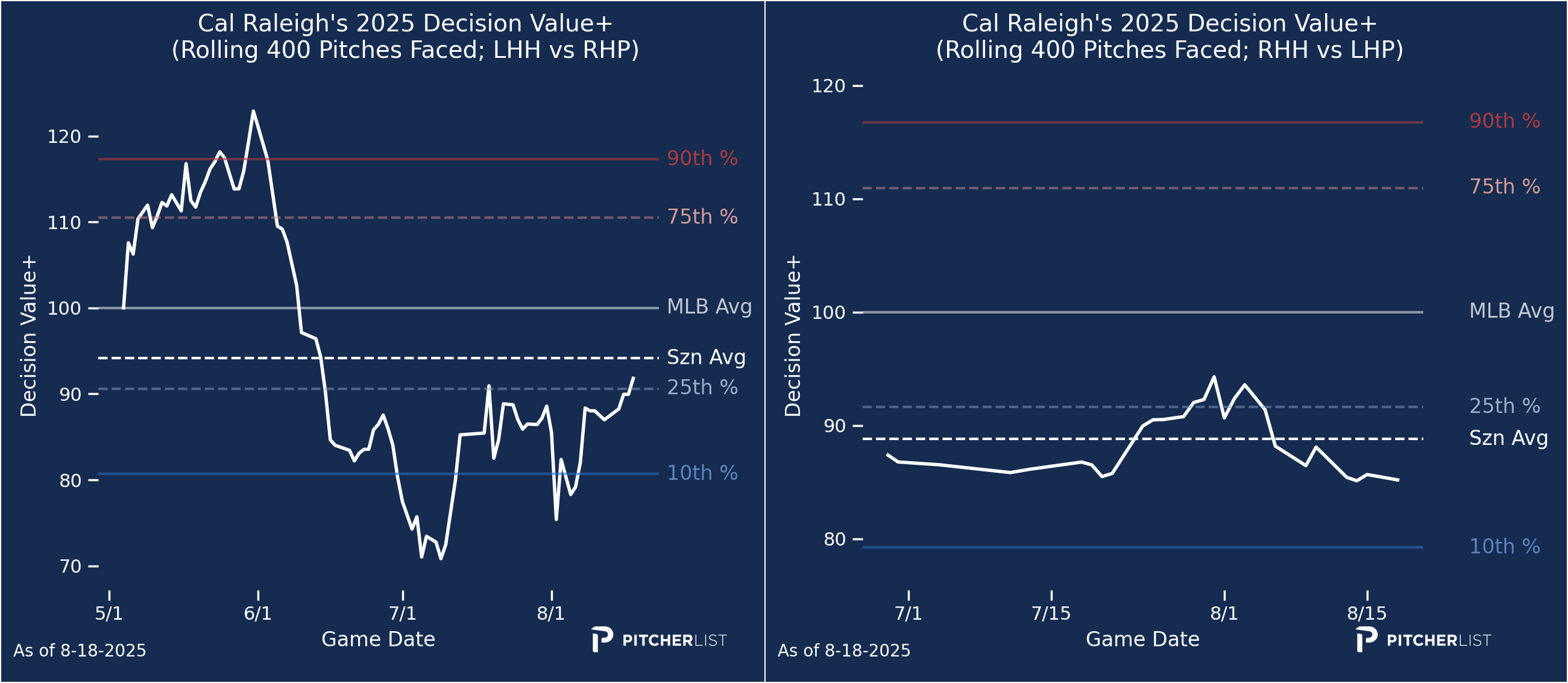
For the season as a whole, Raleigh has made slightly better decisions when hitting left-handed, but it’s been a bumpier ride to get there. You can see in that left-handed chart that he started the season among the ranks of the best decision makers in baseball, but has bottomed out since the start of June. On the other side, as a righty, Raleigh has been consistently bad.
So how do we get from poor swing decisions to 47 home runs? It’s pretty simple. As we covered earlier, Raleigh swings often, and when he makes contact, it’s loud. His barrel rate is 98th percentile, hard-hit rate 90th, and bat speed 89th. Those high-ranking metrics result in impressive results, both actual and expected. Of course, Raleigh leads the majors in home runs, but he’s also top-three in RBI, SLG, and ISO. Statcast expected statistics love what he’s doing, too. His xwOBA and xSLG are 88th percentile and 94th percentile, respectively.
Kyle Schwarber, Philadelphia Phillies — 101 Decision Value
Schwarber’s red-hot second half has him threatening Raleigh’s home run lead. Since the All-Star break, Schwarber’s 15 home runs, .697 SLG, and .426 ISO all rank fourth or better among qualified big league hitters. For the season as a whole, Schwarber’s up to his usual antics, slashing .253/.373/.584 with 45 big flies.
While the power matches Raleigh swing for swing, what Schwarber does better than almost every other hitter in baseball is take his base. He’s walking at a 14.5% clip this year, and has posted a double-digit free pass rate in every single season of his big league career.
With power and a good eye, naturally, Schwarber’s had strong showings in Decision Value. While his overall 101 Decision Value is just a single point above the average mark this season, it’s the lowest number we’ve ever seen from the Phillies’ slugger. Before this year, his 108 Decision Value in 2021 was his career low, and it’s not like he’s been making worse decisions as he’s aged. He posted a career-best 116 Decision Value just one season ago.
The power has been plentiful in the second half, but it’s come with a Decision Value swoon. Just about when the calendar flipped to July, Schwarber started making worse swing choices. If it weren’t for that decline, we’d likely be looking at a fifth consecutive season with Schwarber posting a Decision Value in the 110-115 range.
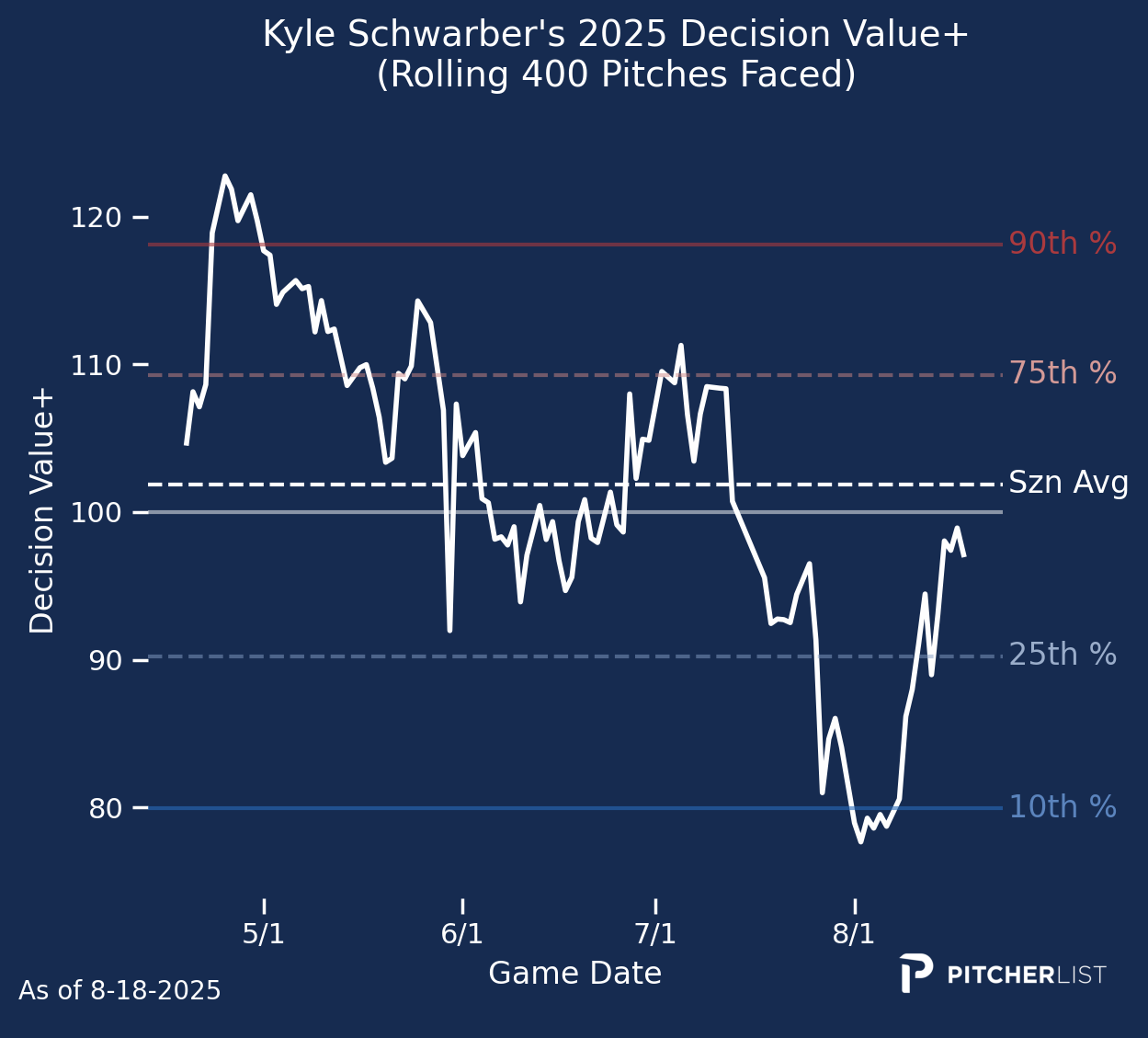
Looking at Schwarber’s approach at the plate, we see he’s a much more passive swinger than Raleigh is. Schwarber only offers at 41.3% of the pitches he sees, a clip that ranks in the lowly 9th percentile. When you combine his patience with opposing pitchers’ fear of throwing him strikes — only 44.9% of the pitches he sees are located inside the zone — you get his sky-high walk rate.
PLV approves of Schwarber’s passivity on pitches out of the zone, grading him at a 105 oDV, but in the zone, it dislikes that he lets hittable pitches go by more often than the average hitter. Schwarber has just an 86 zDV.
Regardless of whether PLV gives him a passing grade or not, it’s safe to say that Schwarber’s approach is working wonders. He’s been bashing baseballs out of Citizens Bank Park while consistently working walks since he signed in Philadelphia in 2022, and one lucky team will ink him to a large deal when he reaches free agency this winter.
Shohei Ohtani, Los Angeles Dodgers — 100 Decision Value
Hey! We finally found something that Ohtani isn’t the best in the world at! I’m sure Ohtani is absolutely torn up knowing that he’s only an average hitter in terms of Decision Value, but his otherworldly skill in pretty much everything else will probably help him get over it.
On a serious note, both Ohtani’s Decision Value profile and approach at the plate are nearly identical to what we just covered with Schwarber. Ohtani isn’t overly aggressive with a swing rate that falls in the 20th percentile of hitters, and that’s in some part due to the fact that his opponents don’t want to attack him for obvious reasons. Just 43.5% of the pitches that Ohtani sees are in the strike zone. Only 7% of hitters see fewer strikes than he does.
With his passive approach in the batter’s box, Ohtani watches a lot of pitches go by. PLV views that positively for pitches outside of the strike zone (103 oDV) but negatively for pitches in the strike zone (87 zDV).
Delving a bit deeper, if we look at Ohtani’s PLV heatmaps, we can see a good breakdown of where he makes good and bad swing decisions. Take a look at his Decision Runs chart in the upper right of the image below. 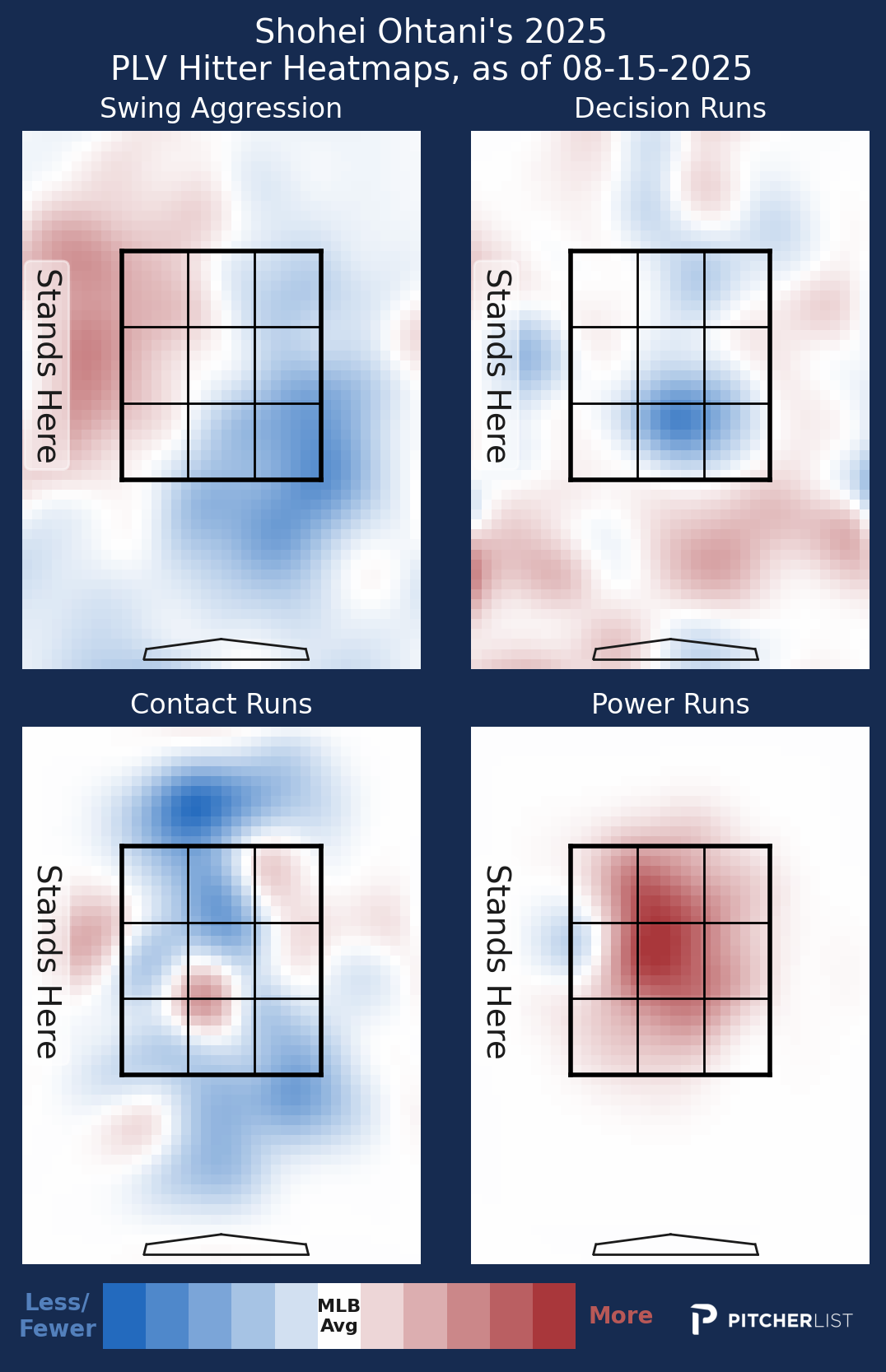
Do you see that massive blue circle in the bottom middle of the strike zone in the Decision Runs heatmap? That corresponds almost perfectly with an area where he just doesn’t swing as often as he should. (Note: the PLV heatmap above and Statcast chart below have the home plate perspective flipped)
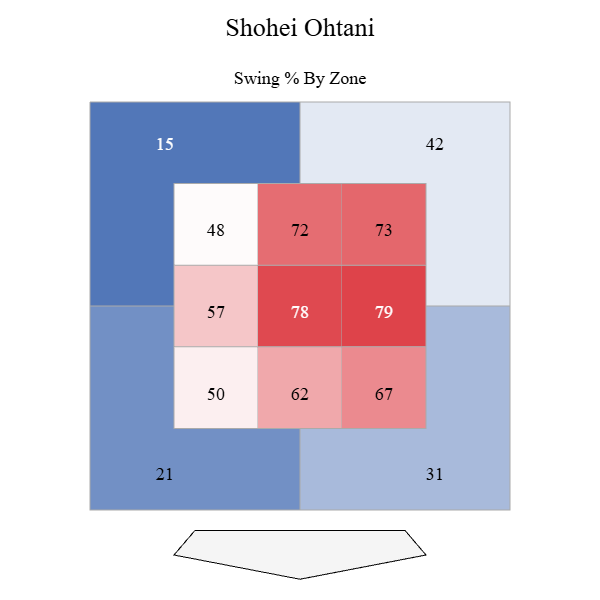
Pitches low and away just don’t interest Ohtani much, and for good reason. It’s pretty much the only hole he has in the strike zone. If an opposing pitcher can’t strike Ohtani out, his next best option is to target that low and away corner in the hopes that he’ll generate poor contact.
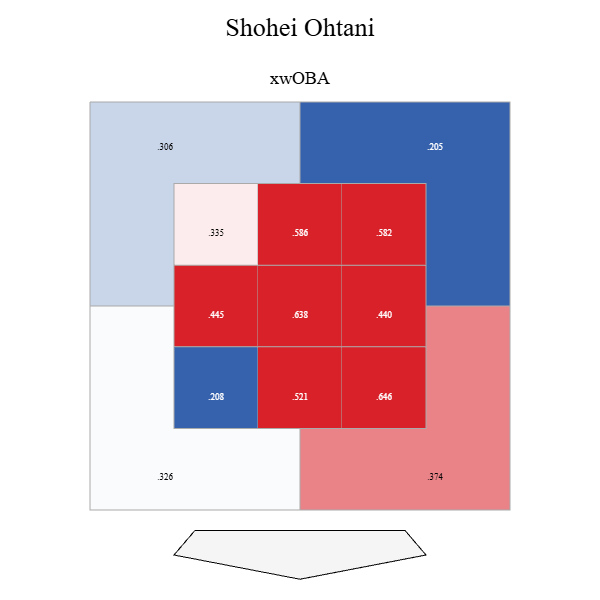
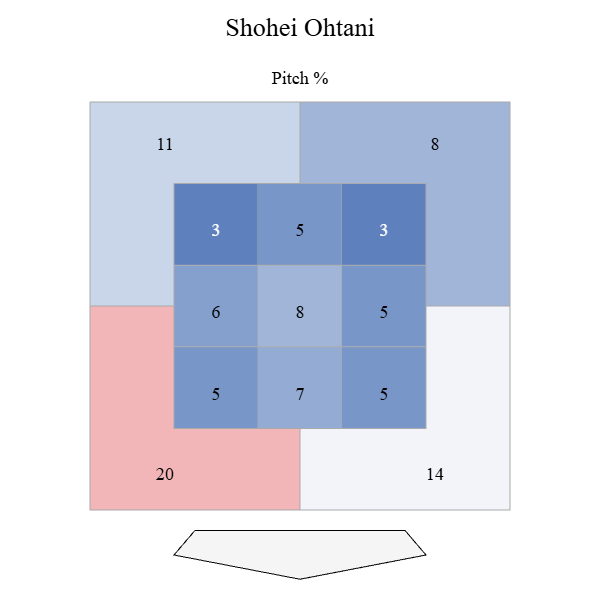
If you’re wondering why more pitchers don’t exclusively attack him in that area, it’s simple: it’s really hard to paint a specific location so precisely. If you aim for that low and away corner, you have a good chance you’re either going to leave something in the middle of the plate, which Ohtani is going to destroy, or you’ll just waste a pitch off the plate. Ohtani’s pitch% chart shows just that.
Aaron Judge, New York Yankees — 112 Decision Value
We’ll close things out by analyzing the best hitter in the sport. Judge does just about everything well, and his swing decisions are no exception. His 112 Decision Value is actually a significant step back from where he’s been the last several years. Beginning in 2022, he posted marks of 127, 129, and 131, but despite the downturn in swing decisions in 2025, he hasn’t missed a step at the plate. The Yankees’ captain is slashing a ridiculous .330/.445/.684 with 40 home runs and a 199 wRC+.
Looking at a rolling Decision Value graph, Judge was up to his usual tricks, posting one of the best Decision Values in the league up until early July. Unfortunately, the Decision Value slump coincided with his flexor strain injury, and he hasn’t been able to return to his elite Decision Value ways since returning from the IL.
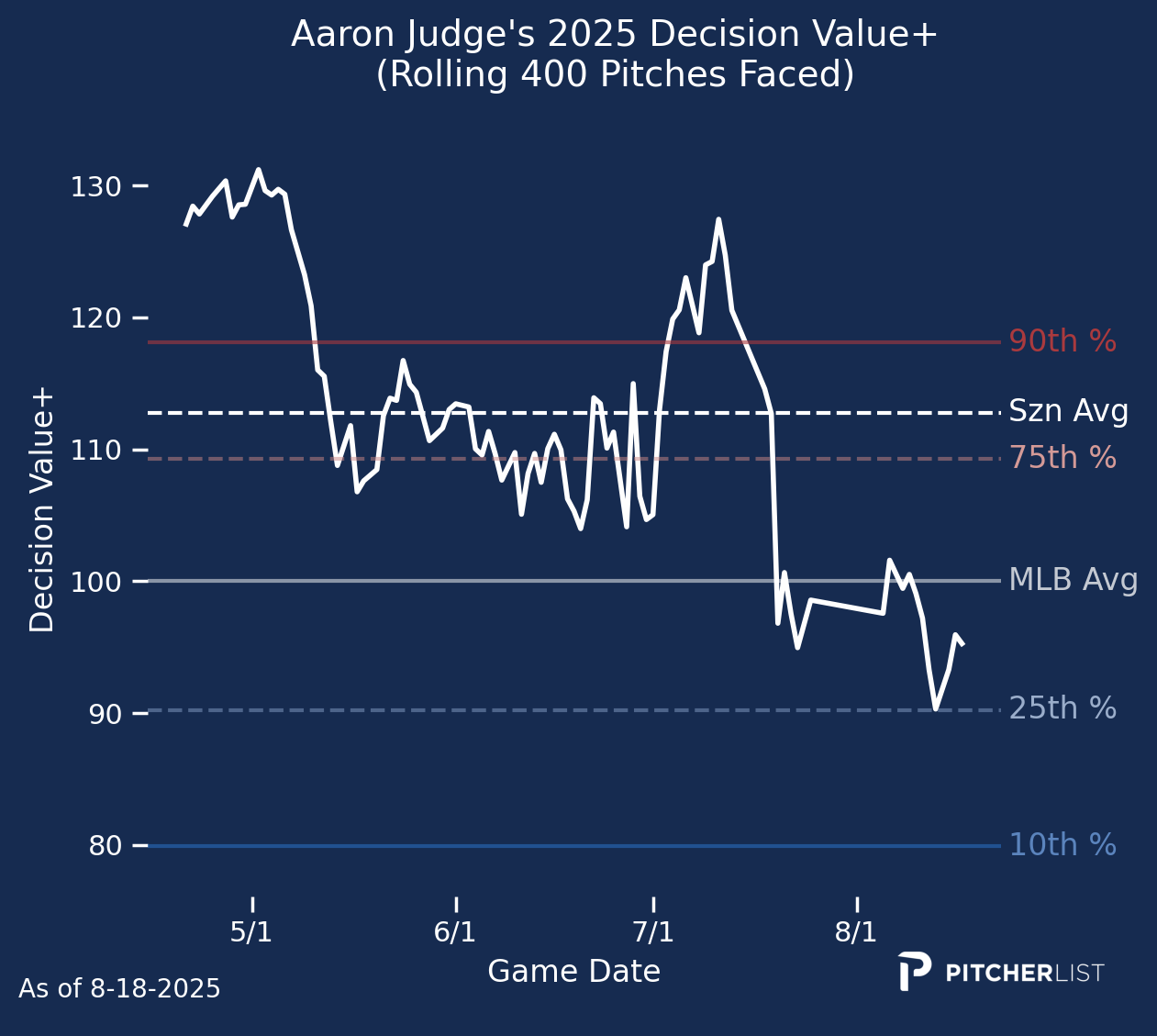
Judge’s Decision Value profile and approach at the plate are very similar to what we’ve already discussed with Schwarber and Ohtani. Judge swings more often than those two do — his 45.6% swing rate is in the 30th percentile — but he’s the best of those three at identifying the strike zone. While his swing rate is well below the league average, his zone swing rate of 68.9% is almost two full percentage points higher than the MLB average. Of course, pitchers don’t want to throw to Judge. Only 13% of hitters see fewer strikes than he does, and honestly, I’m surprised that percentage is even that high. With a patient approach and plenty of pitches out of the strike zone, PLV gives Judge grades of a 96 zDV and a 112 oDV.
Here are Judge’s PLV heatmaps for the season. You can see that from a Decision Value standpoint, he’s good just about everywhere in the zone except the bottom middle and very top edge.
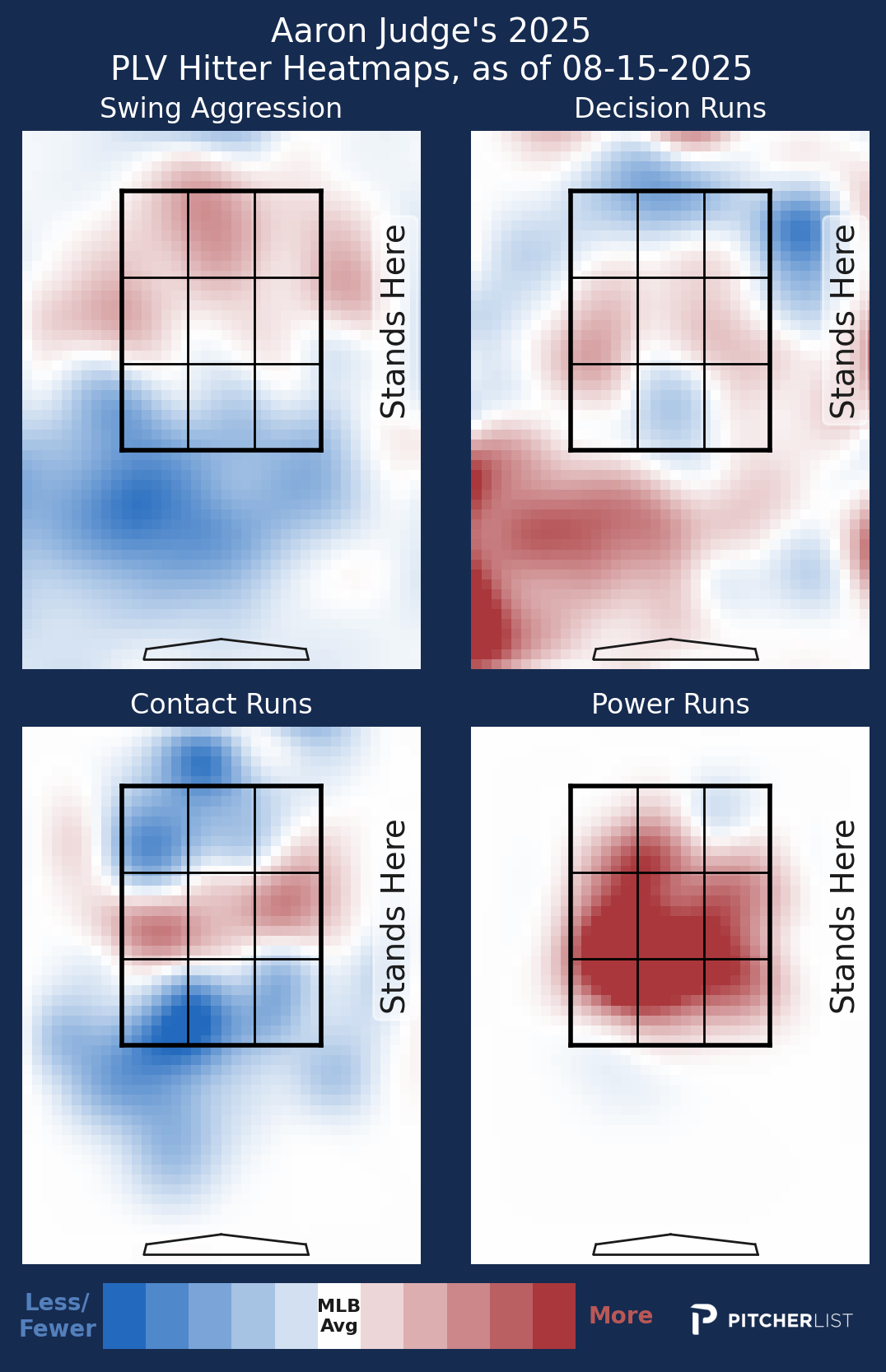
There’s a nice contrast between that Swing Aggression heatmap on the upper left of the above image and the Decision Runs heatmap on the upper right. He’s a little too swing happy up, and a little less so down. You have to wonder if his gargantuan frame plays a role in that.
Every hitter would like to optimize their swings as much as possible, and while I’m sure Judge is no different, it’s a little hard to nitpick the approach of a man with a league-leading .457 wOBA and 199 wRC+.
Adapted by Kurt Wasemiller (@kurt_player02 on Instagram & Threads, @kuwasemiller.bksy.social on BlueSky)
