





Adjusting to the big leagues is no easy feat. Some rookies make it look easy, others struggle through multiple chances against MLB pitching before they get it right. Some never find their stride even after finding success at every other level.
One of my favorite ways to analyze hitters is through our very own stat here at Pitcher List, Decision Value. If you’re unfamiliar, Decision Value grades a hitter’s ability to recognize the pitches he can turn into favorable contact and then make the appropriate swing decision. It’s measured on a scale where 100 is the league average, and every 15 points above or below 100 is one standard deviation. We can even break Decision Value down a little bit further to specifically look at pitches thrown inside (zDV) and outside (oDV) the strike zone.
Decision Value seems particularly valuable in the analysis of young hitters. When a rookie has to face the best pitching on the planet day in and day out, we expect he’ll struggle a bit in making his swing choices, and Decision Value can help show us how he’s faring in that regard. We analyzed a handful of rookie hitters in early June — check it out here — but there are plenty of notable players who have made their debut this season, so I wanted to run it back and take another look at some of the rookies that weren’t included in the first article. Let’s dive in.
For a more in-depth description of Decision Value, check out the intro to this piece. You can support Pitcher List and get access to full leaderboards for Decision Value and other PLV statistics by joining PL Pro.
Isaac Collins, Milwaukee Brewers — 119 Decision Value
Collins has been a revelation for the red-hot Brewers. He arrived in the big leagues with virtually zero prospect pedigree, but came off a stellar Triple-A campaign in 2024 in which he slashed .273/.386/.475 with 14 homers and 24 steals. Collins has done a great replication act for the Brew Crew, turning in a .269/.373/.404 slash line as a switch-hitter who’s earned an everyday spot in the middle of the lineup.
Collins’ game may not be flashy, but he gets results, particularly with his strong eye at the plate. His 13% walk rate is the top among rookies with at least 240 plate appearances. Collins’ 119 overall Decision Value is a great mark, and is just another data point showcasing his strong eye at the dish. That 119 score is largely thanks to his ability to sit on pitches outside the strike zone as evidenced by his 121 oDV.
One of the more impressive things in Collins’ Decision Value data is that he’s making fantastic decisions from both sides of the plate. As both a righty and lefty swinger, Collins ranks in the 90th+ percentile for Decision Value. His batting splits are about equal as well. He has a .767 OPS against righties and a .754 OPS against lefties. His approach is a little different from each side, though. Collins’ hits for more power swinging as a righty (.436 SLG vs. .373 SLG), but he gets on base more as a lefty (.394 OBP vs. .318 OBP).
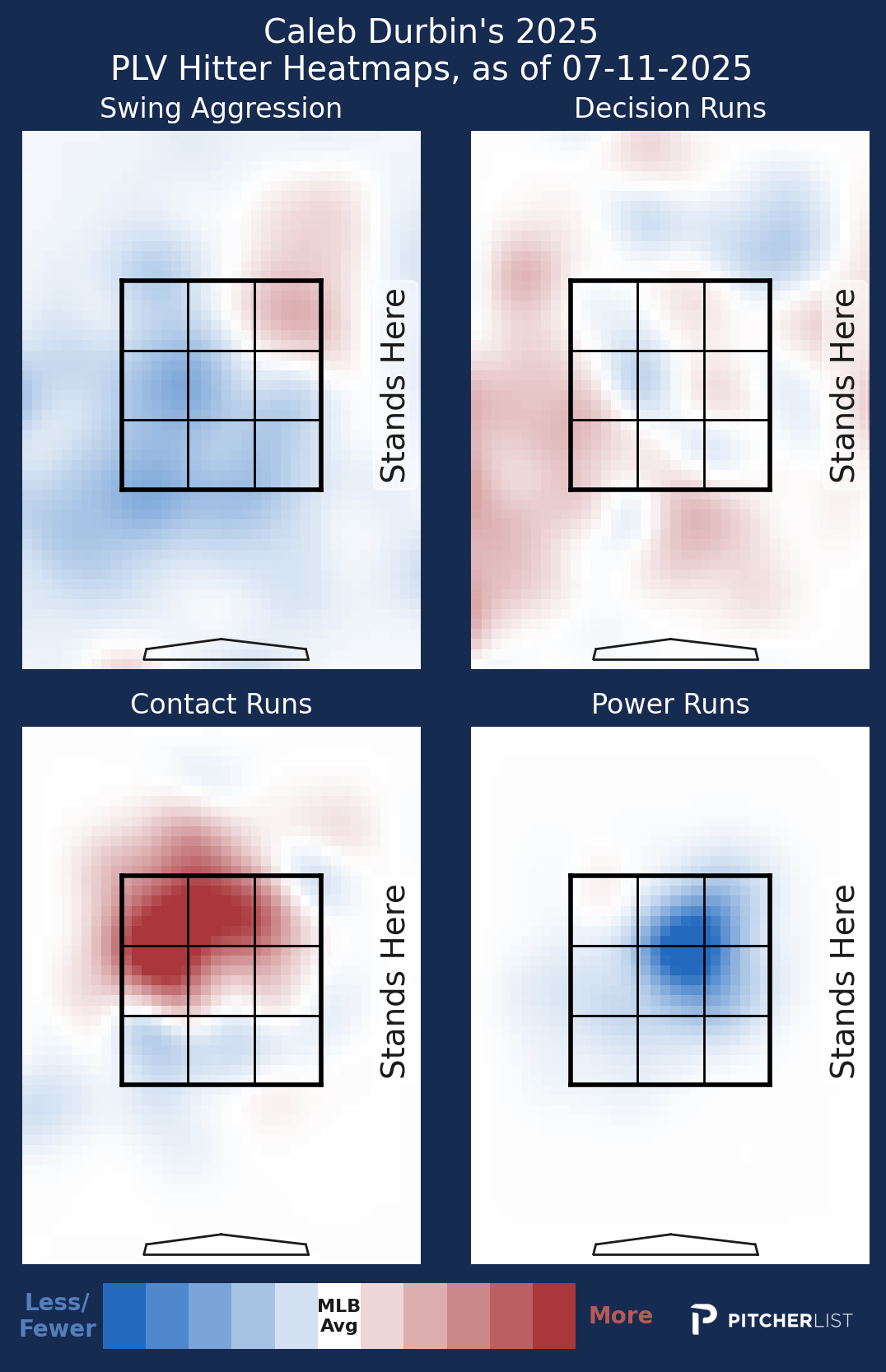
Caleb Durbin, Milwaukee Brewers — 112 Decision Value
There must be something in the water beer in Wisconsin, because Collins isn’t the only Milwaukee rookie making strong swing decisions. Durbin doesn’t trail too far behind him on the Decision Value leaderboard, sitting nearly a full standard deviation better than the league average hitter. These two first-year players are fitting right in with the Brewers’ culture of being patient in the batter’s box and waiting for a good pitch to attack — the Brewers ranked third in our Decision Value team rankings, after all.
Durbin, like Collins, has been good at laying off pitches that land outside of the strike zone. He has a 111 oDV, which is aided by his general swing passivity. Durbin ranks in just the 20th percentile in swing rate, and he pairs that with great bat-to-ball skills. Both his contact (86.1%) and whiff rates (13.9%) are better than all but 5 percent of hitters.
Durbin isn’t a carbon copy of his rookie teammate, though. Unlike Collins, Durbin is also making above-average swing decisions at pitches inside the strike zone. His 104 zDV is just a tad above the average mark, but seeing a rookie with fewer than 300 plate appearances under his belt have both a strong grasp of the strike zone and a good ability to discern which strikes he should swing at makes me think that even if Durbin doesn’t turn into a star, he has a reasonably high floor at the plate. It won’t come with much power, but good AVG and OBP skills can help a player keep a job for a long, long time.
Roman Anthony, Boston Red Sox — 110 Decision Value
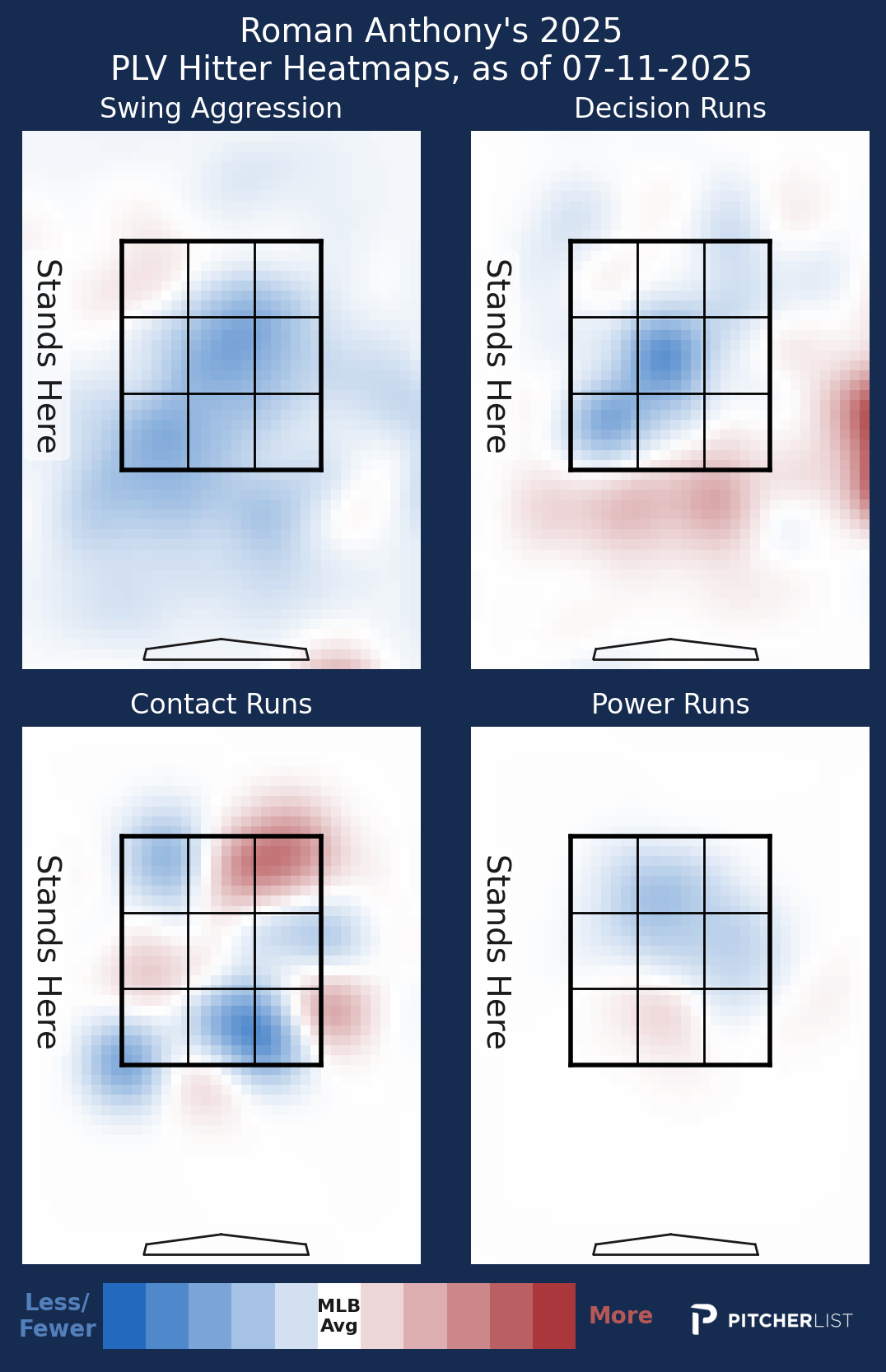
As one of the top prospects in baseball, Anthony’s debut generated much fanfare. The 21-year-old outfielder had an unremarkable start to his career, slashing .210/.329/.339 through 73 plate appearances in June, but since the calendar flipped to July, he’s become a strong producer at the plate. Since July 1st, also over the course of 73 plate appearances, which is mighty convenient for comparison’s sake, Anthony’s hitting .302/.397/.444. His monthly wRC+ went from 88 in June to 136 in July. That’s a pretty quick turnaround for the youngest player in the American League.
Anthony’s success extends beyond his slash line. His 110 Decision Value is one of the better marks among rookie hitters, but it’s not without its warts. Among hitters I’ve analyzed in these PLV Decision Value columns, the difference between Anthony’s in-zone and out-of-zone decisions is one of the most stark. He has a 69 zDV and a 120 oDV, creating one of the biggest Decision Value gaps among all MLB position players.
The reason for the giant gap is actually rather simple. Anthony doesn’t swing much. He offers at just 38.3% of the pitches he sees, a rate that falls in the 2nd percentile of big-league bats. Anthony’s patience at the plate may be a response to pitchers just not attacking him much. You’d think MLB arms would be happy to attack the youngest player in the AL, but only 46% of the offerings he’s seen have been in the zone. Anthony’s extreme propensity to keep the bat on his shoulder is nearly equal in and out of the strike zone, and that’s what’s creating the polarizing zDV and oDV numbers. PLV loves that he watches out-of-zone pitches go by, but it’s severely downgrading him for taking hittable pitches in the zone. His 21.2% called strike rate is higher than all but six percent of batters, and you have to wonder if he’ll turn the aggression up just a bit as he continues to adjust at the game’s highest level.
Chandler Simpson, Tampa Bay Rays — 94 Decision Value
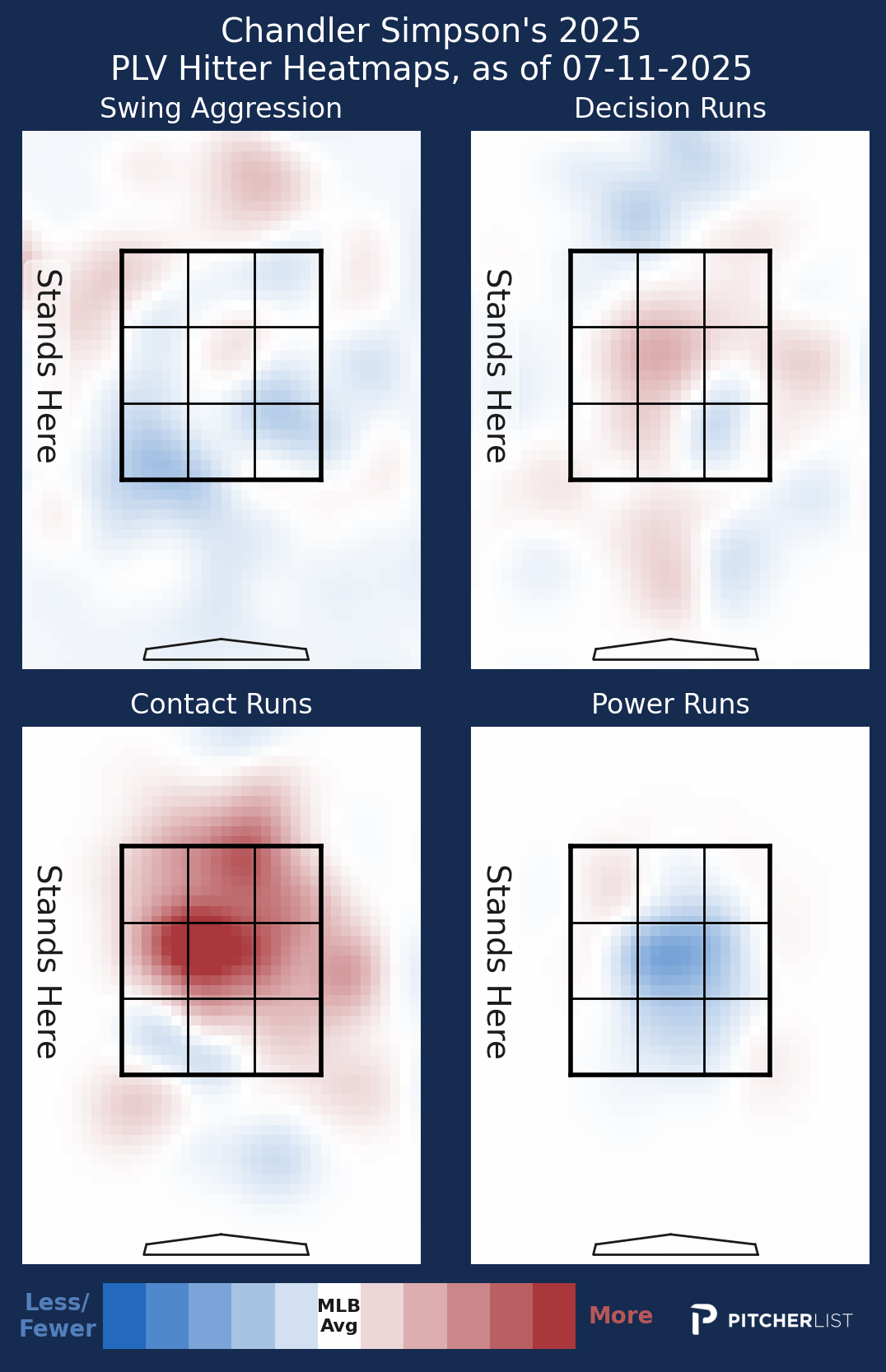
Decision Value may be a more important stat for Simpson than most players. He’s not going to launch many balls out of the park, but he can create havoc with his 99th percentile sprint speed and impeccable acumen for knowing when he can nab an extra base. In just 58 games, Simpson has swiped 30 bases, and generated 4.3 Base Running Runs, the 12th most in the league. All 11 players ahead of him on the leaderboard have a good deal more plate appearances, so on a rate basis, he’s one of the most dangerous players in baseball if he can reach base safely.
With that kind of profile, it’s paramount that Simpson make good swing decisions. He can’t regularly offer at bad pitches knowing that every now and then he’ll run into one and generate value via the long ball. He has to stay disciplined in the box, attack good pitches to hit, and spray the ball all over the field.
Overall, Simpson’s 94 Decision Value is a little below average. Breaking it down further, he’s been better in the strike zone (107 zDV) than out of it (90 oDV), and it’s a good thing because pitchers are attacking him incessantly. Simpson’s 54% zone rate is among the highest in baseball. Pitchers just aren’t scared of him, and it makes sense given that he hasn’t created a single barrel over 189 batted ball events. With so many strikes thrown his way, Simpson has had to be good in the zone. If he weren’t, his results (.301/.333/.345, 91 wRC+) would certainly look a lot worse than they do.
Not only is Simpson posting good in-zone results, but he’s pairing those swing decisions with a great contact ability. If he offers at a pitch, he’s almost certainly making contact. His 88.4% contact rate is 98th percentile, and his 5.5% swinging strike rate isn’t far behind in the 97th. That bat-to-ball ability has kept his strikeout rate low (9%, 98th percentile). Simpson could benefit greatly by working more walks since he’s so dangerous when he’s on the basepaths, but his profile just doesn’t lend itself well to working deep counts. He chases a little more than the average hitters, and his constant contact keeps him from extending at-bats.
Agustín Ramírez, Miami Marlins — 92 Decision Value
We’re nearing the first anniversary of the Marlins acquiring Ramírez from the Yankees in the Jazz Chisholm Jr. trade, and Miami fans have to be happy with how he’s panned out so far.
Ramírez got the call to the show in late April and has hit .244/.287/.459 over his first 327 career plate appearances. He’s also bombed 14 homers while holding down a prime spot in the Marlins’ lineup. Not bad for a catcher, let alone a 23-year-old getting his first taste of the big leagues.
The production at the plate has been good, but he’s had to get to those results despite mediocre swing decisions. His 92 Decision Value breaks out almost equally in and out of the zone – he has a 93 zDV and a 94 oDV. Ramírez actually started his time in the show making above-average swing decisions, but as pitchers have adjusted to him, he’s seen his Decision Value plummet.
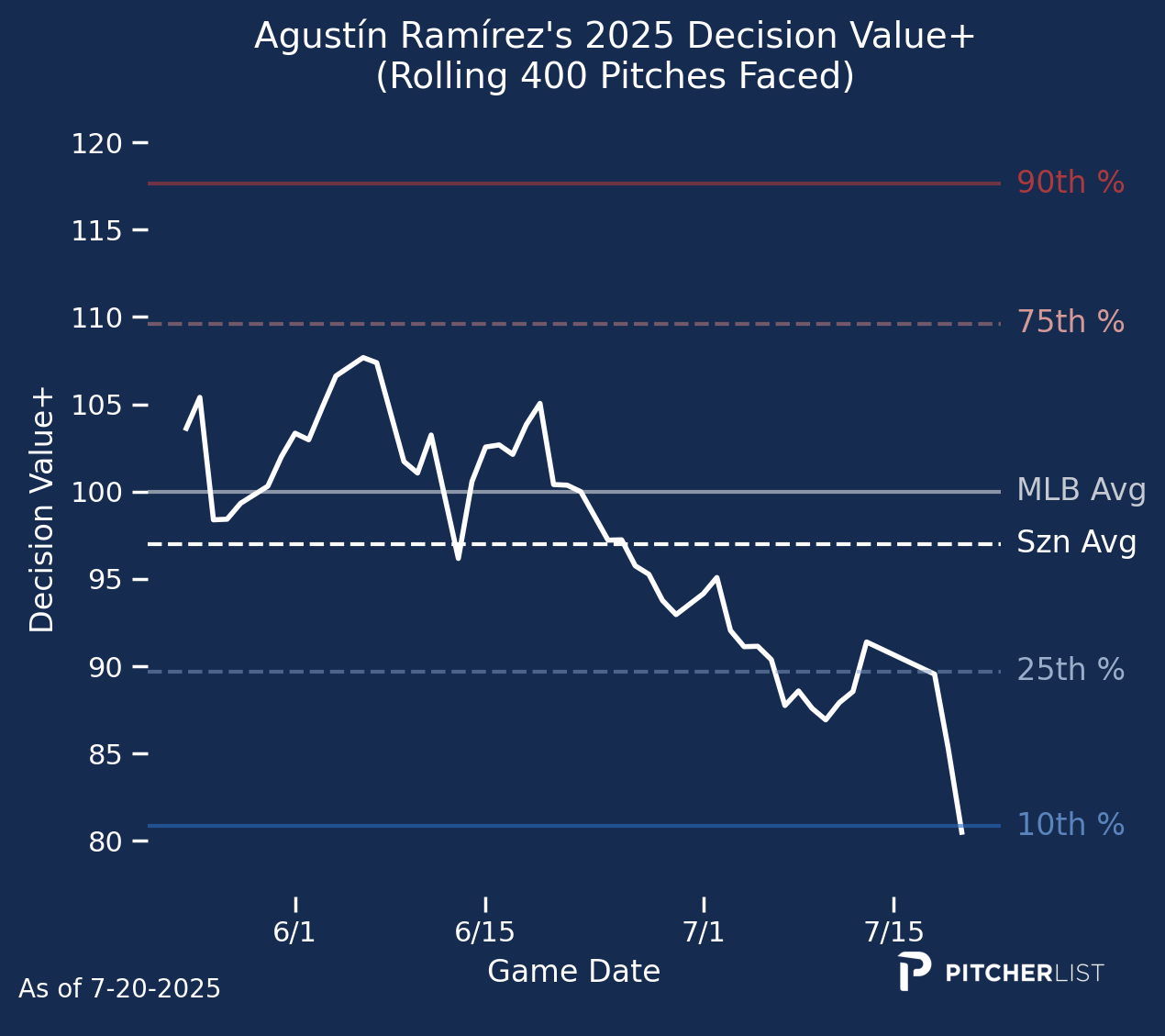
Baseball is a game of adjustments, and it looks like Ramírez has one to make if he wants to get back to being an above-average decision maker at the dish. Although he’s been able to maintain his production while the Decision Value has slipped – he has a 100 wRC+ since June 15th – there could be another level to unlock if the Marlins’ rookie backstop can improve his pitch recognition.
Jac Caglianone, Kansas City Royals — 68 Decision Value
The sixth overall pick from the 2024 draft has been one of the most disappointing rookies. Caglianone absolutely raked in the minors, posting a combined 160 wRC+ across Double-A and Triple-A in abbreviated action before getting the call to the big-league club in early June. That elite run production has all but disappeared in his 160 MLB plate appearances – Caglianone is hitting an almost unbelievably poor .148/.206/.282 to go along with five homers and a 31 wRC+. That’s the lowest wRC+ among all qualified hitters during that stretch.
Caglianone’s Decision Value is following closely behind his actual results. With a measly 68, only 10 hitters have a worse Decision Value than the Royals’ rookie right fielder, and it’s easy to see why.
Pitchers aren’t throwing Caglianone strikes. Only 41.7% of the pitches he’s seen have been in the strike zone, and that’s because he’s not forcing them to throw it there. Caglianone is chasing way too often. His 40.1% O-Swing% is in the 6th percentile. As a whole he’s been rather aggressive with an 85th percentile swing rate. Perhaps a more patient approach would help the former first-round draft selection. With the Royals looking like deadline sellers, they don’t have much to lose in letting Caglianone have a long runway to try to find his stride, but a demotion to get his confidence back certainly isn’t out of the question.
