





Imagine baseball without injuries. No more careers cut short. No more “what could’ve beens”. The best talent on the field every single day. It’s a fantasy, sure, but a fun one.
Unfortunately, we can’t just turn off injuries like you can in MLB The Show. They’re a huge part of the game, and your willingness to bet on a player bouncing back after an injury-marred season can make or break your fantasy season.
One of my favorite ways to analyze players is with PLV’s Decision Value, so in this article, we’ll take a look at players who had their 2024 seasons ended by injury and see how they’re doing in their return to the diamond. If you’re unfamiliar, Decision Value is one of our very own metrics here at Pitcher List and grades a hitter’s ability to recognize the pitches he can turn into favorable contact and then make the appropriate swing decision. It’s measured on a scale where 100 is the league average, and every 15 points above or below 100 is one standard deviation.
For a more in-depth description of Decision Value, check out the initial piece in this series. You can support Pitcher List and get access to all of our PLV statistics by joining PL Pro.
Ronald Acuña Jr. — 121 Decision Value
As Acuña has aged, he’s made better and better swing decisions, and his lengthy absence from the second torn ACL of his career hasn’t hampered that growth. Dating back to 2021, Acuña had a 108 Decision Value, but that rose steadily to a peak of 122 in 2024, and it’s almost at an identical level in his return to the field so far this season.
There was some understandable trepidation that Acuña would take a while to get back to his elite levels of production, but the Acuña we’ve seen in 2025 looks an awful lot like the guy who posted 9.1 fWAR in 2023. He’s slashing an unsustainably great .392/.495/.696 with 7 home runs through 95 plate appearances, and like with any slash line that high, it will come down once his .480 BABIP returns to Earth.
Acuña’s better swing decisions have come with a less aggressive approach. His 43.9% swing rate is the lowest it’s been since 2021, and is a noted step back from the 47% mark he carried in the previous three seasons. As you’d expect, less aggression means he’s swinging at fewer pitches outside of the strike zone, but that doesn’t mean he’s making more contact; in fact, it’s the opposite. Acuña’s contact rate of 71.8% is almost three points below his career mark. Less contact isn’t always a bad thing, though, because in Acuña’s case, although there’s less bat on ball, when he’s making that contact, it’s louder than we’ve seen from him in recent seasons.
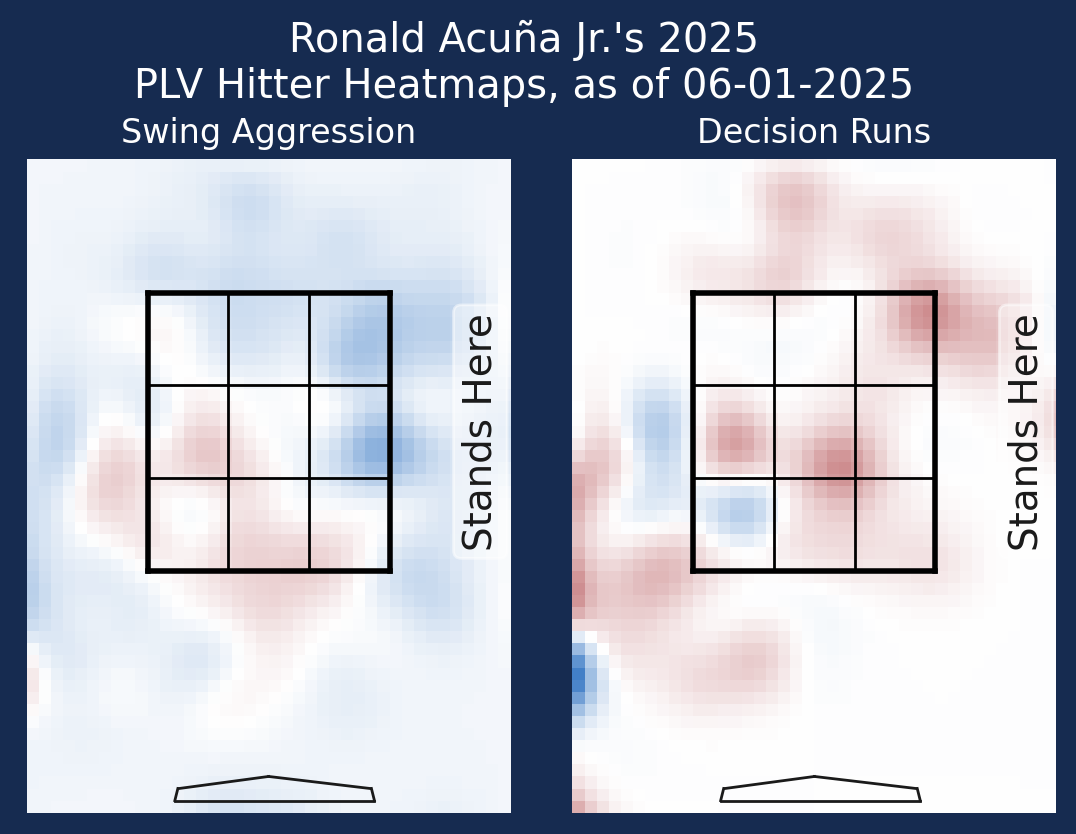
Last year was an uncharacteristic step back in contact results for Acuña. He’d always been one of those players who lived in the elite tiers of batted ball statistics to the point that his Savant page was a sea of bright red percentiles, but last year he moved from the upper echelons of hitters (90th+ percentile across the board) to being merely good (70th+ percentile). This year, although he doesn’t have enough plate appearances to qualify for leaderboards, early returns are once again grouping him with the best hitters in the sport. The former National League MVP has posted better maximum and fly ball exit velocities than he did in 2024, and his 19.3% barrel rate is the best we’ve seen from him outside of the pandemic-shortened 2020 campaign.
It’s not just one particular pitch type that Acuña’s punished. He’s hitting pretty much everything pitchers throw at him. All of his Statcast Run Values are positive against all pitch types, save for changeups and split-finger offerings, but even those aren’t notably bad. He’s posted -1 and 0 Run Values against them, respectively. On the flip side, the pitch he’s crushing the most is the four-seamer. His 8 Run Value marks the fourth-best production he’s ever had against the pitch during a season, which is especially impressive given that he’s seen just 108 of them so far.
Baseball is better with Acuña on the field, so it’s been so fun to see him not just be back in action, but so quickly regain his previous form. I’m not sure we’ll ever see him get back to his ludicrous base-stealing ways of the past, but I’d rather see a healthy Acuña crushing baseballs than risk continued injuries for some stolen base upside.
Mike Trout — 116 Decision Value
It’s becoming all too common for Trout to have to be included in a “players returning from injury” article. The now 33-year-old future Hall of Famer only appeared in 29 games last season before a torn meniscus sidelined him. This year, although he missed 25 games due to another knee injury, his swing decisions have stayed relatively consistent. Since 2021, he’s hovered largely in the 110-120 Decision Value range, posting marks of 110, 113, 121, 123, and now 116 in 2025. With a lot of season left to play (that Trout will hopefully be healthy for), it’ll be interesting to keep tabs on this to see if Trout can beef up his Decision Value and continue that upward trajectory.
With PLV’s Decision Value, we’re able to break results into in-zone and out-of-zone, and that lets us see that Trout is doing a phenomenal job of laying off balls. His 121 oDV is doing a lot of heavy lifting for his overall 116 Decision Value. He’s actually been a tad below average on his choices in the zone with a 97 zDV. With heatmaps, we can analyze things even further and see that a lot of his good decisions have come from laying off pitches thrown above the strike zone.
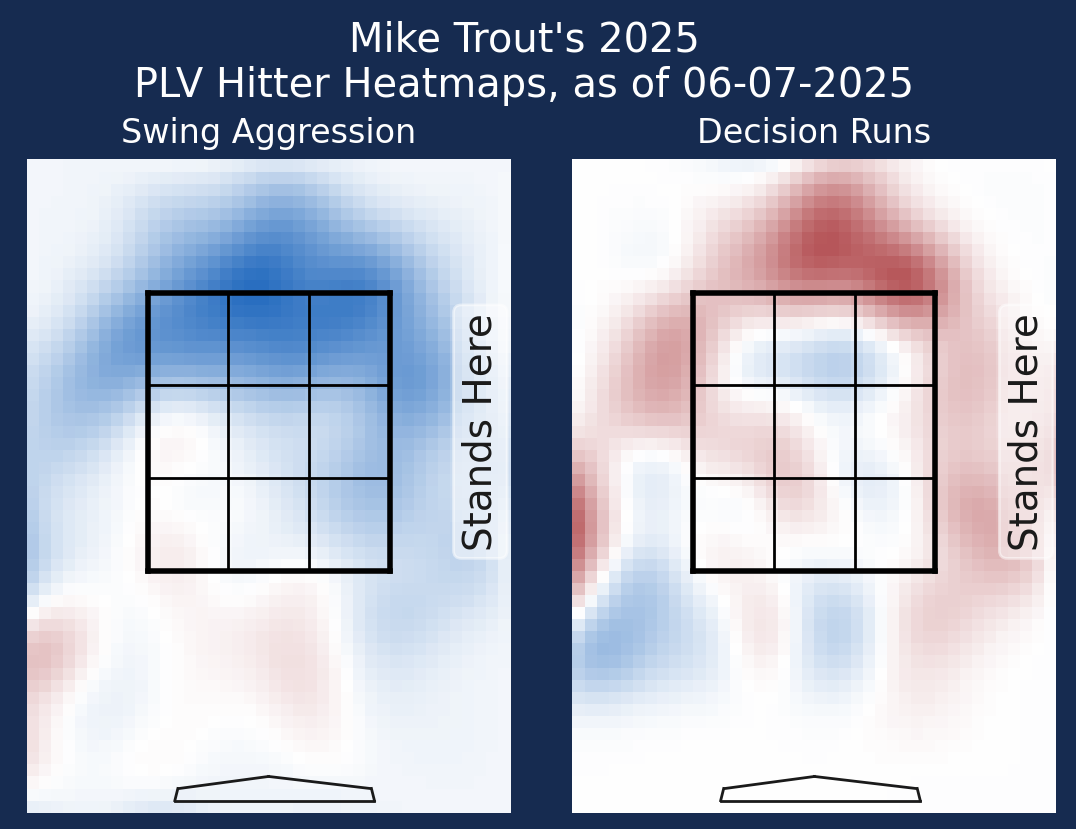
Trout’s strong Decision Value also appears in more traditional metrics as well. His 22.6% chase rate is 80th percentile and has helped keep his walk rate high. He’s taking his free passes at an 11.5% clip, 78th percentile among big league hitters.
With good swing decisions, Trout’s once again putting together his typical best-in-class batted ball metrics. Each of his xwOBA, xSLG, Barrel%, Hard-Hit%, and LA Sweet-Spot% is 93rd percentile or better. Those numbers are especially encouraging because Trout’s .229/.318/.452 slash line comes out to a very non-Troutian 109 wRC+, but those expected statistics think he deserves better. His .452 SLG is well below his .581 xSLG, and it’s the same story with his .327 wOBA compared to his .394 xwOBA.
If you’re willing to stomach the injury risk, Trout seems like a great buy-low candidate. With his typically great swing decisions and batted ball tendencies right in line with what we’ve come to expect from the three-time MVP, I’d consider making a trade offer, especially if you’re in a league with IL slots.
Matt McLain – 104 Decision Value
A 127 wRC+ and 3.1 fWAR rookie season in 2023 had McLain looking like a franchise cornerstone in Cincinnati, but he had to wait over a full year to try to build on that success. McLain underwent surgery in late March 2024 to repair a torn labrum in his left shoulder, and he never recovered enough to retake the field that season. Thankfully, he’s finally back in action and has started 68 of the Reds’ 73 games this season, but he hasn’t been able to replicate the success he had as a rookie.
Through 257 plate appearances this year, McLain’s managed just a .196/.293/.326 slash line, which equates to a measly 71 wRC+. Although the overall results leave a lot to be desired, PLV thinks he’s done a fine job at choosing which pitches to attack.
As a rookie, McLain was almost exactly league average with a 101 Decision Value. In his 2025 return to play, he’s gotten slightly better, improving to a 104 mark.
Under the hood, McLain’s Decision Value is being buoyed by his passivity at the plate. He doesn’t swing much – at either strikes or balls – with his 42% swing rate falling in just the 13th percentile. His choice to let those pitches go by is a net positive to his Decision Value since he’s not offering at bad pitches to hit outside of the strike zone (110 oDV), but it’s also hampering his production since he’s taking good pitches to hit inside the strike zone (81 zDV).
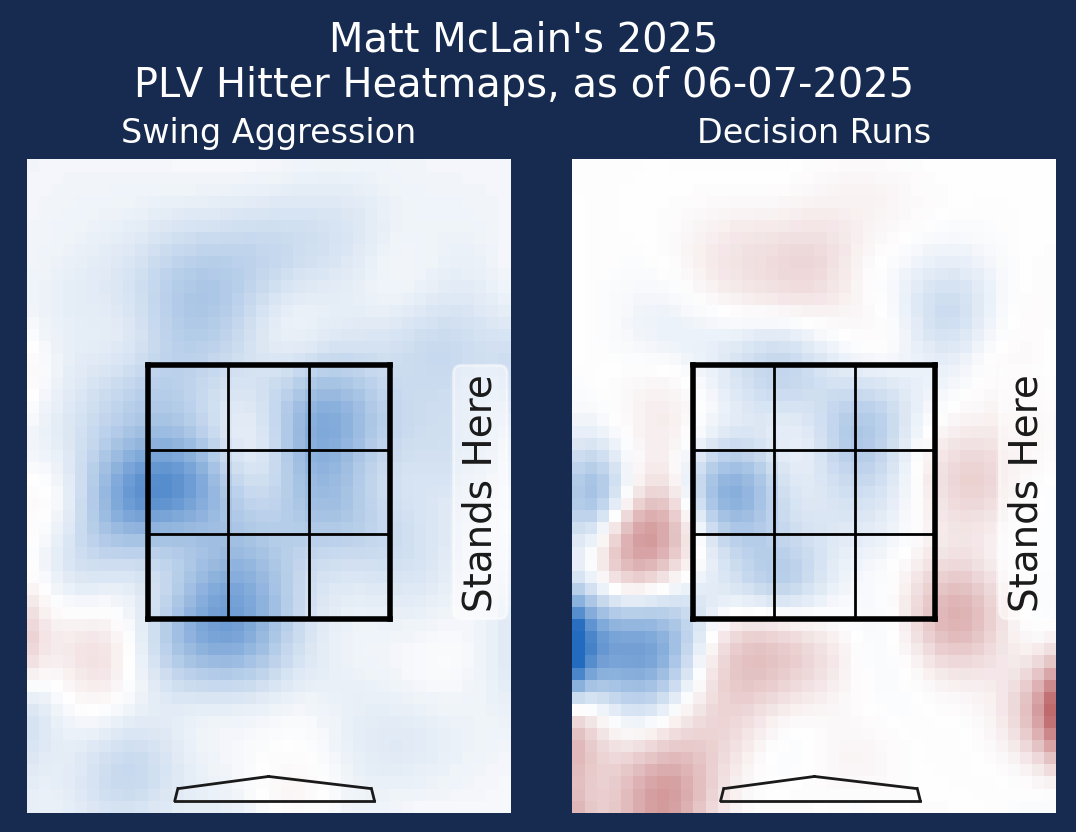
When McLain does decide to go after a pitch, his results on contact aren’t stellar. His xwOBA, xBA, and xSLG are all in the bottom quartile of big league batters this season, and with his 2023 numbers falling right around league average, I have to wonder if the worsened results have a lot to do with lingering issues from his shoulder injury.
These numbers don’t paint a great picture for McLain’s fantasy value in redraft leagues, and in those formats, I don’t see any issue choosing to move on from the Reds’ second baseman. In dynasty leagues, I’d like to hold McLain longer if possible. He makes an interesting trade target if you’re managing a rebuilding team looking for future value.
Jung Hoo Lee – 108 Decision Value
A dislocated shoulder and torn labrum kept Lee out of the lineup for most of his rookie season, but although Giants’ fans had to wait an extra year to really enjoy their new centerfielder, his production has been worth the wait. Lee’s hitting a strong .265/.328/.430 with six home runs and six stolen bases from the leadoff spot while providing strong defense in Oracle Park’s spacious center field. It’s no wonder Lee already has his own fan club – the Hoo Lee Gans.
Lee has a fantastic hit tool – his contact rates on pitches both in and out of the zone are 93rd and 94th percentile, respectively – but that doesn’t necessarily translate to similarly strong swing choices. Lee’s 108 Decision Value is still good, but it isn’t an elite tool in his skill set like his contact ability.
Pitchers throw Lee a lot of strikes. Maybe they’re not scared of his contact-centric bat, or perhaps they’d rather go after him than the heart of the Giants’ lineup waiting behind him. Either way, he sees a lot of pitches in the zone (86th percentile) but has a more passive approach in the box. Lee’s 45.1% swing rate is 28th percentile, so he sees more strikes go by than most hitters. This approach may seem a bit counterintuitive, but Lee’s elite contact ability allows him to take more strikes than the average hitter, since he can be confident in his ability to make contact even as he works deeper into the count.
Taking hittable pitches is often a surefire way for a hitter to struggle in the zDV department, but Lee’s been able to maintain his passivity while posting a strong 111 zDV. Essentially, he might take a lot of strikes, but the ones he chooses to swing at are pitches that he should do damage against. We can only dig so far into PLV data, so I unfortunately can’t break this down to a granular level, but my hypothesis here is that because Lee works deeper counts and sees more pitches in the zone, his zDV is inflated a bit because he gets a good grade for swinging at piches he has to offer at to keep at-bats alive (swinging at a two-strike pitch anywhere in the zone is going to be viewed favorably by PLV since the alternate is a called third strike and an out).
Lee performed as advertised in the early going of his stateside career. His incredible bat-to-ball skills make him an ideal old-school leadoff hitter, but I think there’s a chance his approach at the plate may overvalue his actual Decision Value.
Adapted by Kurt Wasemiller (@kurt_player02 on Instagram & Threads, @kuwasemiller.bksy.social on BlueSky)
