





Regardless of your league format, it’s commonplace to be looking at your options after pick 300 and feel completely unenthused. While most players you select this late could easily find themselves on the waiver wire in April, one or two sharp selections can pay off big. Last year when I covered this topic, it was definitely a mixed bag. My biggest win was Jo Adell, who finally broke out and is now going close to pick 100. Trevor Larnach and Dylan Moore also had weeks where they were serviceable. On the other hand, Thairo Estrada and Chas McCormick hardly played all season, and Carlos Santana finally faded from fantasy relevance. I like to focus on players with a clear path to playing time and the capability to produce when given that opportunity.
Average draft position (ADP) data used in this article comes from two sources. First, I looked at the 28 RotoWire Online Championship drafts completed on the National Fantasy Baseball Championship (NFBC) platform from February 16 to March 1. If a player was selected in fewer than half of those drafts, where 360 players are taken, I instead used their ADP from 27 NFBC 50s drafts completed during the same period. In that format, 600 players are drafted, and teams cannot add or drop players. Bear in mind that managers in both of these formats must start two catchers, five outfielders, one player at each infield one middle infielder, one corner infielder, and nine pitchers. With that being said, let’s dive in!
1. Jung Hoo Lee (SFG, OF, ADP 306.9)
Lee hasn’t quite delivered from a fantasy perspective since coming over from Korea in 2024. He missed almost his entire rookie season with a dislocated shoulder and then hit .266 with eight homers and 10 steals last year across 150 games. Lee’s .265 career average, expected to be his carrying fantasy tool, has been disappointing thus far after he batted comfortably over .300 for each of his seven seasons in the KBO.
I’m bullish on Lee’s chances to right the ship and push a .280 average, as his strikeout rate (11.5% in ’25, 10.8% career) remains elite. He also underachieved in this area a bit last year if you look at both his Statcast (.277) and PL (.278) xAVG. With the Giants bringing in Luis Arraez, Lee is poised to slide down the Giants order instead of hitting leadoff. But if he bats fifth, that should come with more RBI opportunities than he’s used to. Lee is a good late target for a team that feels comfortable in power and speed but is in need of some average stability.
2. Andrés Giménez (TOR, 2B, 328.5)
No matter how you slice it, Giménez was a disaster last year offensively. He slashed .210/.285/.313 (70 wRC+) with seven long balls and 12 steals in 369 PA in his first season north of the border, not exactly making a favorable impression on Blue Jays’ fans. Giménez has always been a better fantasy hitter than real-life one, but last year, he was neither. I think some of the blame should be placed on a high-ankle sprain that cost him over a month and continued to nag Giménez even after he returned from the IL. Aside from that, the .239 BABIP was easily a career low (.294 career) despite minimal changes in Giménez’s batted ball quality or profile, though the quality has admittedly never been impressive. Even average luck should help the batting average positively regress towards .250, especially if the career-low swinging strike rate sticks.
I also believe that projections are too bearish in forecasting Giménez’s playing time at 130-140 games. Health permitting, he will be the everyday shortstop on one of the league’s best teams, as he hits lefties well enough (92 career wRC+) to not be forced into a platoon role. While second base is much shallower than shortstop, gaining eligibility at another position early in the season can only boost Giménez’s value. Even with the relatively low volume, Ariel Cohen’s ATC projection system has Giménez as the 150th ranked hitter this year, while ADP has him at 189th. With more volume and a resurgence in the stolen base department, Giménez could push into the top 100 batters with a 10-HR, 30-SB line.
3. Jeff McNeil (A’s, 2B/OF, 343.6)
McNeil is the last player on this list whose OC ADP we are using, as he has been selected in just over half of these drafts recently. I like him as a target in your last couple rounds of an OC for several reasons. First, and most importantly, his path to playing time is crystal clear. McNeil will start and hit in the heart of a strong A’s lineup against every righty and some southpaws. Andy Ibañez will get some looks against lefties too, but he could just as easily take time from third baseman Max Muncy, as McNeil is an above average hitter for his career against lefties (109 wRC+) as well as righties (121 wRC+). The A’s also lack compelling minor league options at the keystone, so McNeil is locked in. He also has positional flexibility, so we can play him in the outfield even if the A’s won’t be doing so very often.
As for the skills, McNeil’s profile isn’t as fantasy-friendly as it used to be, but that’s baked into the price. As he’s aged, McNeil has continued to lift the ball more and more, with last year’s 15.9 degree launch angle being a career high. This has been a somewhat puzzling change for a guy who is consistently below average in barrel rate, hard-hit rate, or any of your power metrics of choice. But, one area where he excels is pulled flyballs. McNeil was elite in that area last year at 26.9%. For context, the MLB average is 16.7%. This change helped McNeil post an ISO of .168, his highest aside from the “rabbit ball” year of 2019. Now that he calls Sutter Health Park home, I love McNeil’s chances of pushing 15+ long balls while not hurting you in any one category. That might seem like mild praise, but it’s rare to find that after pick 300. I would give McNeil a bump in OBP league, where he’s worth a look inside the top 300 after posting a double-digit walk rate and .335 OBP last season.
4. Nolan Schanuel (LAA, 1B, 335)
Just when you thought it couldn’t get any more boring, Nolan Schanuel enters the chat. Sorry Nolan, it’s nothing personal, but I feel justified in saying that about a first baseman who hit .264 with 12 homers, five steals, and 117 combined runs and RBI last season over 132 games. Schanuel was basically the same player in 2024 as well, though he had twice as many steals and hit for a slightly worse average. Like McNeil, he excels at getting on base (career .353 OBP), rarely strikes out (career 14.8% K%), and gained over two MPH of bat speed from 2024 to 2025. Unfortunately for Schanuel, improving to a 67.5 MPH swing speed still has him in the 4th percentile!
So, what is it that makes Schanuel worth targeting? For one, he’s an everyday player and the Angels’ best left-handed hitter, meaning that he’s projected to hit second between Zach Neto and Mike Trout. Volume like this is nearly impossible to find after pick 225, much less 325. Additionally, Schanuel spent the offseason working to build on the bat speed gains we saw last season, so there’s reason to believe he can squeeze a few more homers out of his bat. Because Schanuel is entering his third full big-league season and was drafted as a college hitter, it’s easy to forget that he’s only 24 and still developing as a player. The Angels essentially threw him into the deep end at the major league level, and now that he’s stayed afloat, Schanuel is looking for ways to unlock more upside in his game, and bat speed is definitely the lowest hanging fruit. I expect Schanuel to hit .260 with 15 homers, 5-10 steals, and 130 combined runs and RBI. That’s a serviceable back-up first baseman and utility bat, with more upside in OBP formats.
5. Bo Naylor (CLE, C, 343.5)
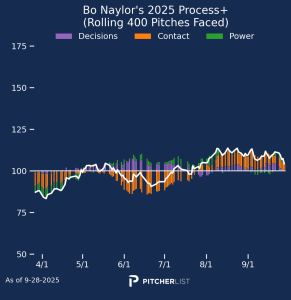
Naylor is only relevant in two-catcher, deep dynasty, or AL-only leagues, but I believe he’ll have some value there. As a solidly above average defensive catcher, his playing time remains secure on the strong side of a platoon with Austin Hedges. This seems like one of those cases where the platoon is actually helping Naylor given how dreadful he is against lefties; his career OPS against them is .558 compared to .700 against righties. Last season, Naylor made drastic improvements in his contact rate, which helped push his strikeout rate down to a much more palatable 23.9% compared to the 31.4% rate we saw in 2024. His strikeout rate also continued to fall throughout the season, which led to an improvement of nearly 100 points in his OPS from the first half to the second half. His rolling 400-pitch Process+ chart backs up these improvements, giving me confidence that Naylor can push 20 long balls in 2026, providing power upside for teams that can afford to take a batting average hit.
6. J.P. Crawford (SEA, SS, 400.5)
Crawford is the type of guy who could be included in an article like this every season. In a day and age where shortstop is a premier fantasy position that’s no longer manned by slender glove-first players, Crawford’s fantasy utility is limited to middle infield depth. But, he continues to volume his way to deep-league relevance, especially in OBP formats, as he had a borderline elite .352 OBP in 2025. Crawford’s value has taken a hit with Seattle’s addition of Brendan Donovan, as he’ll now hit in the back half of the order instead of the leadoff spot. This will mean more RBI opportunities but fewer runs as well as less volume overall. His fantasy profile is strikingly similar to Schanuel’s, just at a more premium position. I would only keep Crawford on your radar in leagues that have MI spots, as shortstop is deep enough that he will almost never be needed there.
7. Tyler O’Neill (BAL, OF, 405)
Despite going outside the top 400, O’Neill may just have the highest upside of any player on this list. He’s looking to bounce back from a disastrous debut season in Baltimore where he hit below the Mendoza line with nine home runs in 209 PAs. As a result, O’Neill is now a fantasy afterthought, but the hate has gone too far. He was comically unlucky last year, with his .218 BABIP ranking fifth-worst among players with at least 200 PAs and nearly 100 points below his career mark of .303. O’Neill also posted a career-best strikeout rate of 24.4% while maintaining an elite barrel rate. Statcast and PL disagree on the extent to which his .297 wOBA was unlucky, but both believe he deserved to be league average (.333 xwOBA for PL, .360 for Statcast).
With that being said, there are several reasons why O’Neill is going so late, chief among them being injuries. He only played in 54 games last year for the Orioles and has only cleared 100 twice in his career. O’Neill slimmed down this offseason as part of his effort to be on the field more in 2026. The depth chart is crowded in Baltimore, particularly in the outfield, but O’Neill will play against every lefty and his fair share of righties even if he’s not out there on Opening Day. Given that the O’s are paying him $16.5 million per season this year and next, he will be out there at least five days per week if he’s producing, and a healthy Tyler O’Neill is a four-category contributor with a palatable batting average when he’s firing on all cylinders.
8. Mike Yastrzemski (ATL, OF, 424.9)
After spending his whole big-league career with the Giants, Yaz was traded to Kansas City at the deadline last season. Though the Royals ultimately missed the playoffs, it wasn’t because of Yastrzemski, who clocked nine long balls and posted an OPS of .839 across 186 PA with his new team. Yastrzemski has found himself on the move again this offseason, joining Atlanta on a multi-year deal to be the strong-side platoon left fielder. The park and lineup upgrades here are also pretty significant, as lefty power goes to die in Oracle Park and thrives at Truist Park. According to Statcast’s rolling three-year park factors, Oracle is among the bottom five with a 78 park factor for left-handed home runs while Truist is 7th at 109, or nine percent above league average.
Yastrzemski also made some notable improvements last year that you wouldn’t expect from a hitter in their age-34 season. In 2025, he easily posted career bests in swinging strike rate (8%, 87th percentile), strikeout rate (19.5%, 65th percentile), and contact rate (80.9%, 82nd percentile). Even if the improvements don’t completely stick, Yaz is still a consistently productive bench outfielder in deeper leagues who you can plug into your starting lineup during righty-heavy scoring periods. This is yet another guy who gets a small boost in OBP leagues because of a career double-digit walk rate. Also, it can’t hurt that he’s already gone yard three times in spring training in 10 ABs, can it?
9. Jake McCarthy (COL, OF, 460.9)
If you’re looking to throw a dart at a stolen base merchant late in your draft, look no further than Jake McCarthy. An offseason intra-divisional trade has brought McCarthy to the Mile High City, where he’s poised to lead off against right-handed pitching as the Rockies’ left fielder. Last season was dreadful for McCarthy, but he now finds himself in the land of opportunity after falling out of favor with Arizona. McCarthy has three 20-steal seasons to his name in the big leagues, and he averages nearly 30 bags per 500 PAs, a reasonable projection for a platoon leadoff hitter. His .233 BABIP last year was his only season below .300, and a spacious outfield in Colorado should provide plenty of space for him to dink and dunk. I would avoid using McCarthy on the road whenever possible, but he should provide a good average and tons of speed in Coors Field.
10. Blaze Alexander (BAL, 3B, 509.4)
At the risk of being called a homer, I’ve included a second Oriole on this list. Alexander, who’s going after pick 500, is likely to be the O’s second baseman on Opening Day because Jackson Holliday is recovering from hamate surgery. Even if Holliday returns quickly, Alexander will remain in the mix at third base and compete for playing time with Coby Mayo, who is filling in for an injured Jordan Westburg. Westburg will miss at least all of April with an elbow injury, and there is no clear timeline for his return, with Tommy John Surgery or an internal brace procedure in the realm of possibilities. Even if Mayo earns an everyday role and Holliday returns in April, Alexander will continue to draw starts in the outfield against left-handed pitching. He profiles as a 15-homer, 10-steal bat over 600 plate appearances, and Baltimore saw enough in him to trade for him prior to the injuries to Holliday and Westburg.
