







When it comes to using PLV data to evaluate hitters for Fantasy Baseball Drafts, Process+ is a great tool for getting a comprehensive look at a hitter’s profile.
Created in 2024 by Pitcher List’s Director of Analytics, Kyle Bland, Nate Schwartz wrote a piece on Process+ and explained what it encompasses and how it can be utilized. Here is a brief snippet from Schwartz’s article.
With Process+, you can see all facets of a hitter conjoined into one—not a results-based stat, but an underlying one, showing how well one’s process is.
Consider it per-pitch “xwRC+”: who is creating the most runs with the aspects of hitting they have the most control over on each pitch? These aspects include swing decisions, contact ability, and exit velocity/launch angle, all relative to the quality of the pitches they’ve faced.
Thus, Process+ can help fantasy baseball managers not only identify which hitters are solid overall but also identify any strengths or weaknesses in one skill that could lead to improvement or regression the following season. That can be quite useful when it comes to selecting hitters who could be sleepers in drafts while avoiding ones who may be tumblers.
In this piece, I will look at five hitters who have strong Process+ profiles last season, and why they should be targeted in drafts, especially based on their ADP data, as of March 8th. All ADP data is utilized from NFBC.
Ben Rice, NYY
Rice is coming off a solid season with the Yankees in 2025. In 530 plate appearances, he hit 24 home runs, scored 74 runs, collected 65 RBI, and hit .255 with a 133 wRC+. He also got a boost in fantasy due to having catcher eligibility, which has boosted his ADP stock in leagues.
As a result, Rice ranks 49th overall in NFBC with an average ADP of 52.95 and is the third-ranked catcher overall in NFBC, behind only the Mariners’ Cal Raleigh (no surprise there) and the Brewers’ William Contreras. The Yankees slugger ranks ahead of catchers like the Athletics‘ Shea Langeliers, Rockies’ Hunter Goodman, and Marlins’ Agustín Ramírez.
When it comes to his Process+, his 138 overall mark ranked sixth overall in baseball. He ranked ahead of Vladimir Guerrero Jr. (131), Nick Kurtz (131), and Kyle Schwarber (130). Thus, Rice isn’t just valuable in fantasy drafts as a catcher, but overall hitter, based on Process+.
When it comes to his skills within his Process+ rolling chart data, Rice succeeds with exceptional power (124) and strong contact (116). His decision value ranks the lowest of the three (110), but it showed positive trends for the most part last year, except for a stretch in May. That can be seen in his Process+ rolling chart data below.
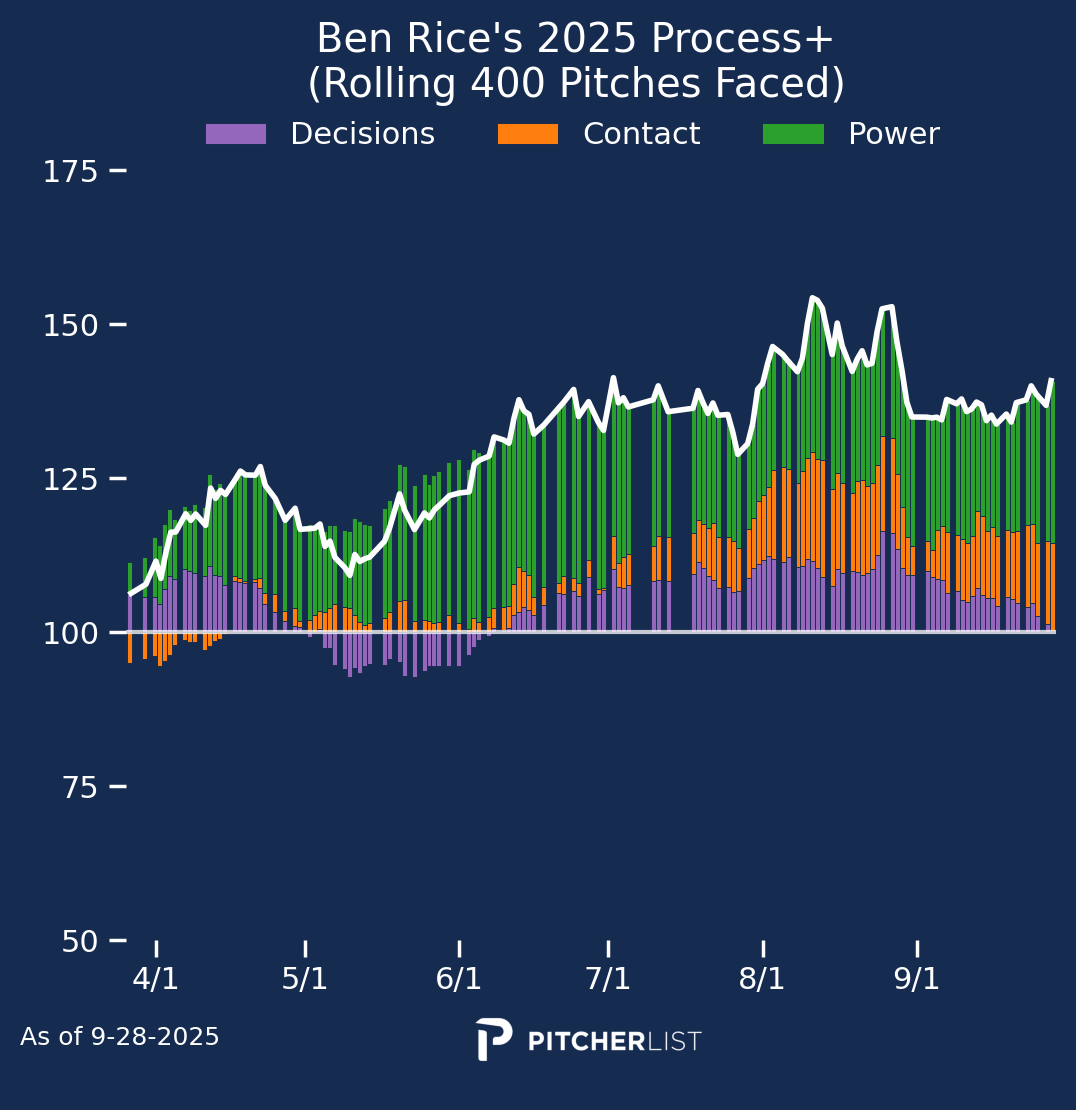
Rice is already highly valued, seemingly going in the fourth to fifth rounds in drafts, based on ADP data. I would argue that Rice may be a second- or third-round-caliber player.
In fact, Rice may be more valuable than Raleigh, the consensus top catcher in fantasy, especially since Rice’s contact and decision value are more dependable than the 2025 AL MVP runner-up. Last year, Raleigh posted a 91-contact and 90-decision value, according to Hitter Ability data.
Jo Adell, LAA
Adell has long been seen as a fantasy breakout candidate. Well, last year it finally happened.
In 573 plate appearances, the Angels outfielder hit 37 home runs, scored 63 runs, collected 98 RBI, and stole five bases. He didn’t hit for high average (.236), which hurt his value in traditional 5×5 leagues. That said, he posted a .333 wOBA and 112 wRC+, and his .365 xwOBA hints that he may have been capable of more last season.
In terms of his hitting ability, the 26-year-old was slightly below average in contact (95) and decision value (99). However, he was off the charts in power (126), especially HR power (134). His power was his most consistent tool, as it stayed not only above-average throughout the year but also touched as high as 150 at certain points in the season, as seen in the rolling Process+ chart below.
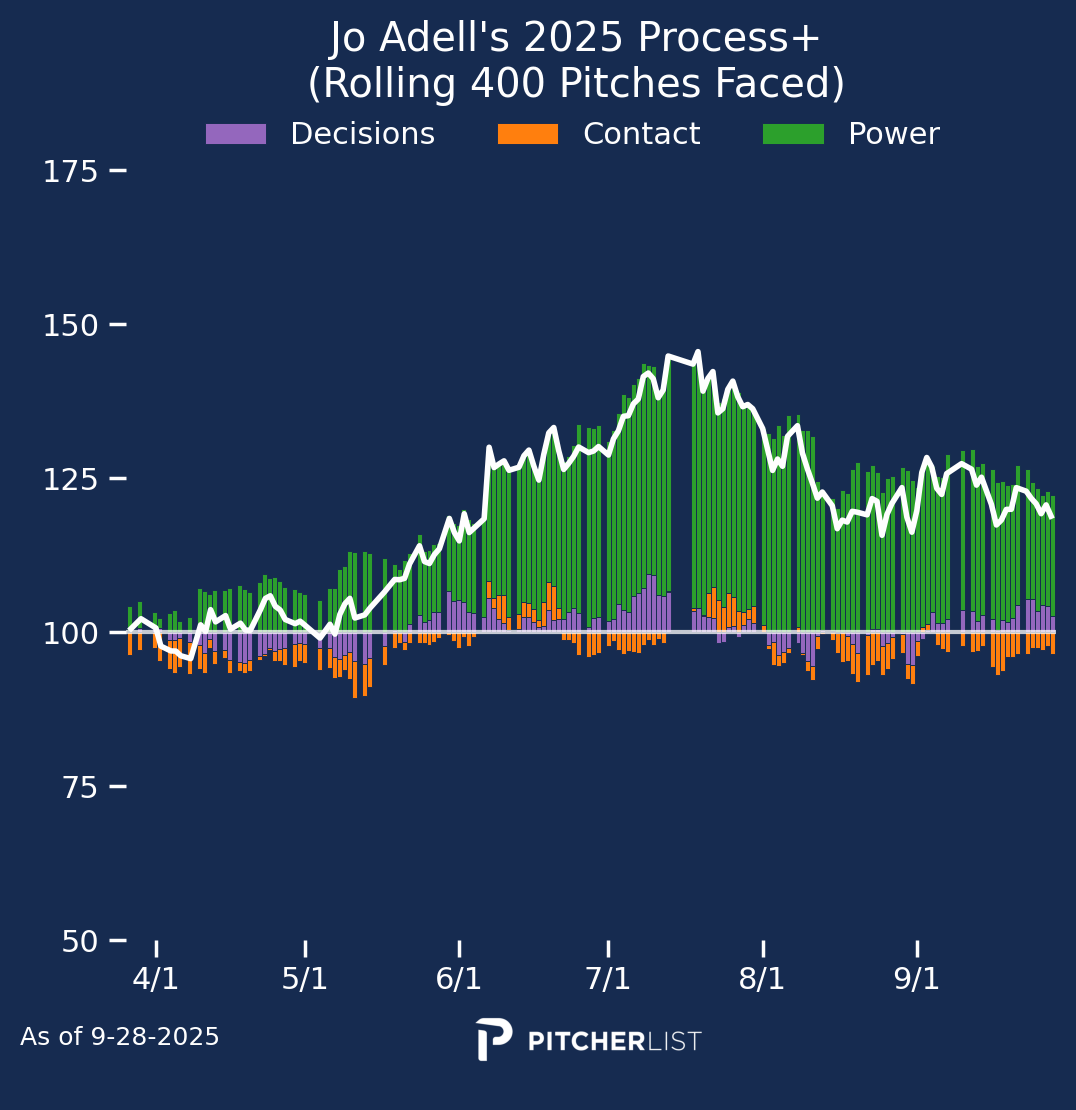
As a result, he posted an overall Process+ of 124, putting him on par with hitters like Giancarlo Stanton, Alejandro Kirk, and Jonathan Aranda, and ahead of hitters like Manny Machado (123) and Kyle Stowers (122). In NFBC, Adell ranks 116th with an average ADP of 125. He ranks behind Milwaukee’s Christian Yelich (122.08 ADP) and Luis Robert Jr. (120.84).
For context, Robert had a 104 Process+, and Yelich had a 112 mark. That is 20 and 12 points behind Adell, respectively. Fantasy managers can get a hitter with much more offensive upside in Adell for around the same draft value as roughly Robert and Yelich.
Ivan Herrera, STL
Herrera has always been a hitter with some fantasy upside, especially as a catcher.
In 452 plate appearances with the Cardinals last year, he hit 19 home runs, scored 54 runs, collected 66 RBI, and stole eight bases (great for a catcher). He also posted a .284 average as well as a .365 wOBA, .371 xwOBA, and 137 wRC+.
And yet, his average ADP in NFBC is 163.19, putting him behind players like Brenton Doyle and Matt Chapman. Something doesn’t feel right, even if he doesn’t hold that catcher position anymore in most fantasy formats.
When looking at his hitting abilities, Herrera should be targeted earlier than his ADP by fantasy managers.
In addition to his 123 Process+, he posted a 112 decision value, a 109 contact, and 112 power. When looking at his Process+ rolling chart from last season, the 25-year-old remained above league average in all three categories throughout the season, with his power and contact ranking as his best categories.
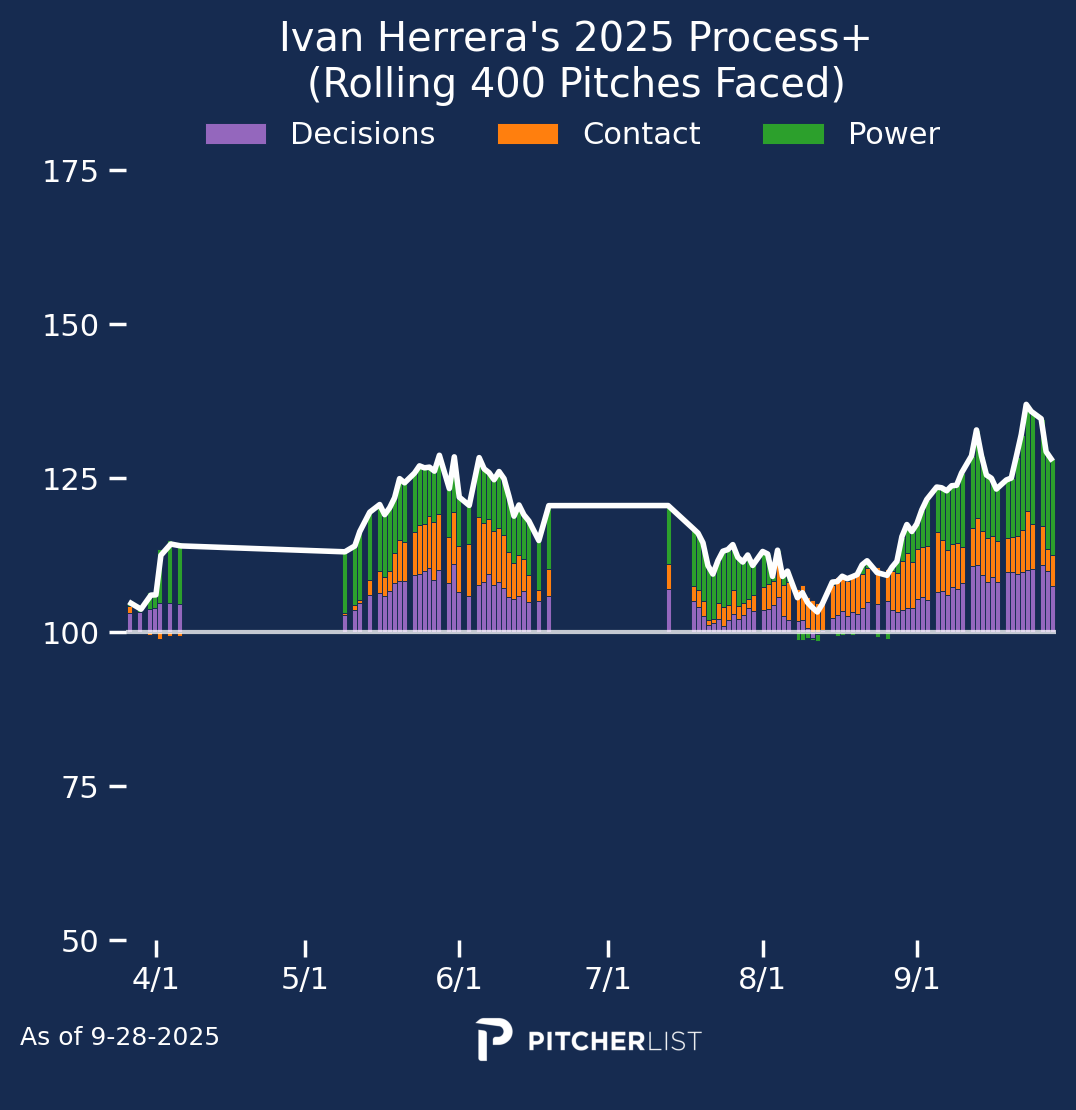
The main issue for Herrera is health. He played in only 107 games last year and missed time on the IL due to knee inflammation and a hamstring injury (which explains the gaps in his Process+ rolling chart data).
That said, when healthy, Herrera has been a top hitter, based on Process+. Furthermore, he may get more production opportunities with a likely higher spot in the batting order after the departures of Willson Contreras and Nolan Arenado this offseason.
Andrew Vaughn, MIL
Vaughn has been an interesting fantasy player because he started his career languishing with such a bad White Sox team. However, after hitting .206 with a .601 OPS in the first half with the White Sox, he ended up hitting .300 with an .826 OPS with the Brewers.
Credit the new surroundings or the coaching staff for his turnaround. Regardless, Vaughn looked like a rejuvenated player with the Brew Crew.
When it comes to fantasy numbers, the 27-year-old first baseman didn’t wow. He hit 14 home runs, scored 35 runs, collected 65 RBI, and hit .254 in 447 plate appearances. However, his Process+ numbers hint that Vaughn could benefit in the more competitive environment in 2026.
According to Hitter Ability data, Vaughn posted a 102 decision value, 107 contact ability, and 112 power. He also posted a 116 mark in gap power and a 107 mark in HR power. Thus, it’s not a surprise that he had a 120 Process+ in 2025, which was better than players like Brent Rooker and Taylor Ward, who had 119 Process+ marks.
Looking at his Process+ rolling chart data, the former Cal product always showcased above-average power and contact. That said, the power in Milwaukee spiked, and the decision value actually became above-average, which wasn’t a trend when he was playing in the South Side of Chicago.
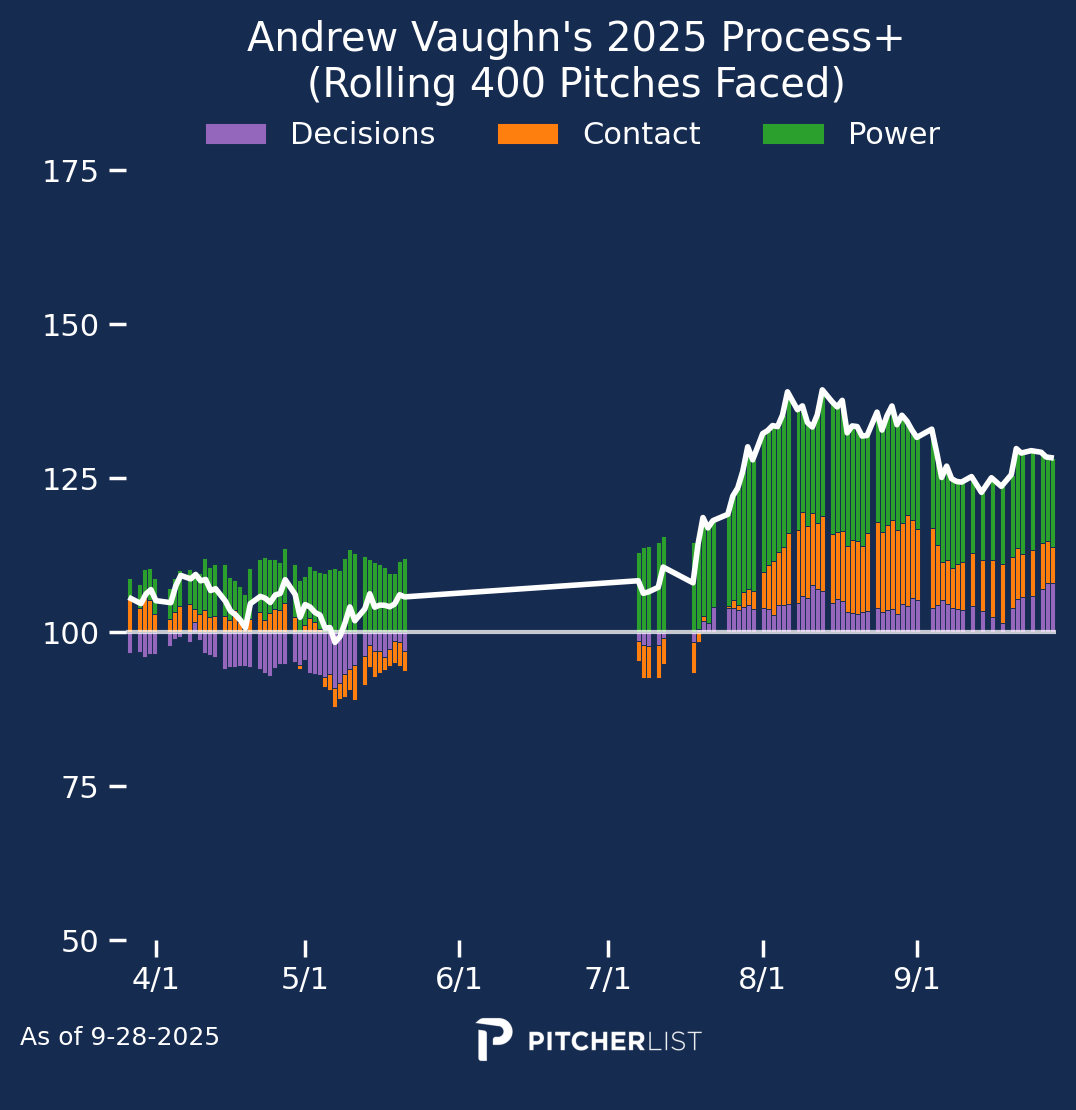
The Brewers’ hitting coaches have been known for developing and prioritizing swing decisions among their hitters at both the Major and Minor League levels. Vaughn obviously benefited from that approach last year. While his power did regress a little at the end of the season, his contact and decision trends remained stable, which is a good sign for 2026.
With an average ADP of 290.82 in NFBC, Vaughn could be a late-round flier who could provide some nice upside for the upcoming season. It wouldn’t be surprising to see his Process+ materialize into better production with the Brewers, especially in categories like batting average, home runs, and RBI.
Will Benson, CIN
Benson has been a fun, but risky player in fantasy. He’s seen more as a hitter who can only hit against righties (career 36 wRC+ against lefties), and his playing time is in flux for 2026, especially with other outfielders such as JJ Bleday, Dane Myers, Spencer Steer, and Noelvi Marte all competing for time in the corner outfield positions.
Thus, it isn’t surprising that Benson has an average ADP of 501.29, making him an NL-only or deep league option.
However, Benson’s Process+ hints that the outfielder could be due for a breakout if given the opportunity. The 27-year-old posted a 118 Process+ with a 107 decision value, 120 power, and 119 HR power. The main blemish on his profile is his contact ability, which was 86 last year, according to Hitter Ability data. That’s pretty subpar, and his contact ability trend didn’t fare too hot at any point last year either.
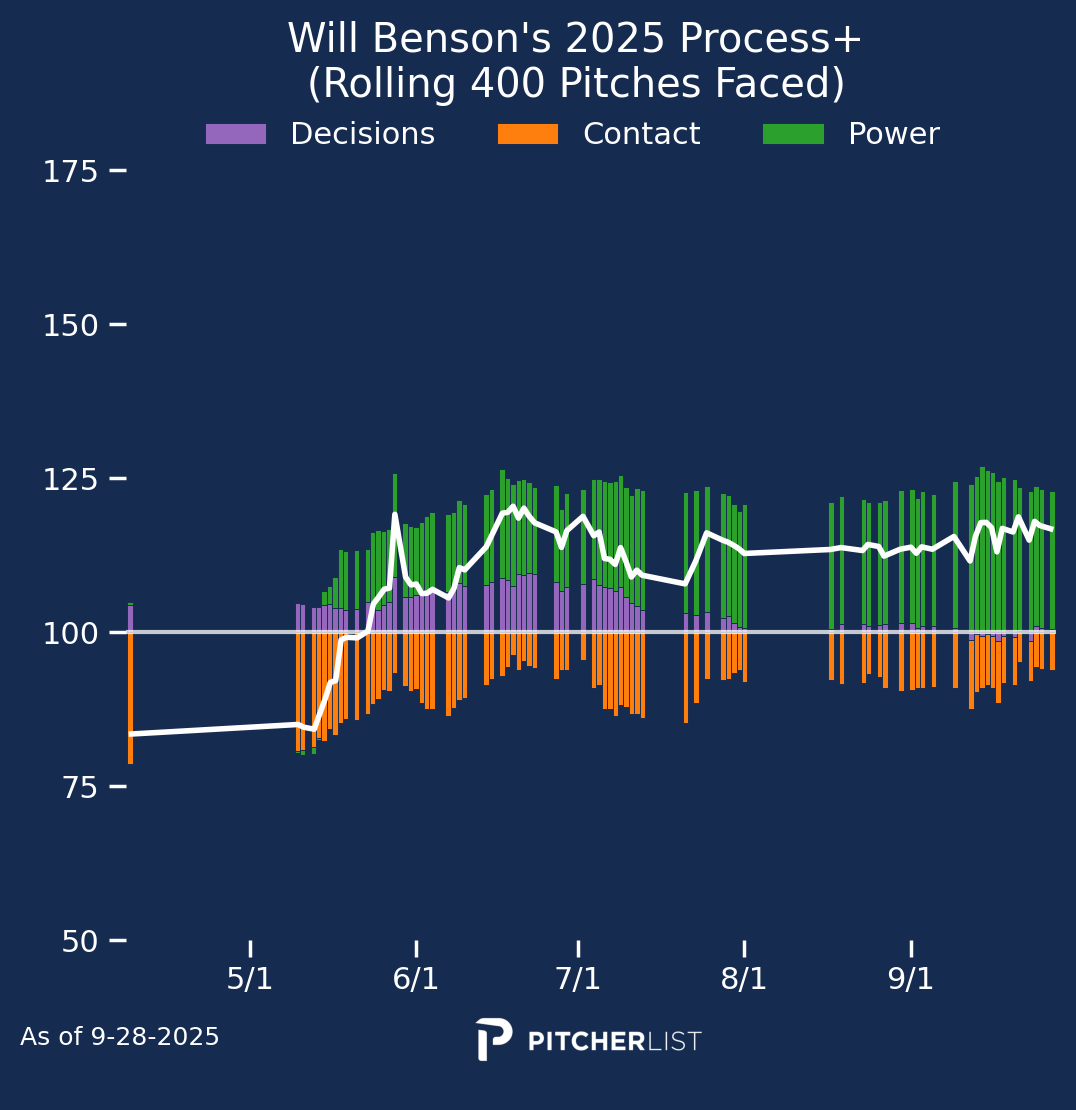
Thus, I don’t think Benson should be drafted too early in most formats, simply because he may be who he is in terms of making contact with the ball. His 69.2% contact rate and 79.3% Z-Contact% confirm his lackluster contact ability score.
That said, for a late-round flier, especially in 12 to 15-team formats, Benson could be a nice pickup who could provide some much-needed power upside for fantasy managers. His Process+ is better than Marte’s (95), Bleday’s (84), Myers’ (103), or Steer’s (93).
Thus, for fantasy managers looking at Cincinnati outfield targets in drafts, Benson should be the preference, based on Process+.
