





The best performance by the shortstop position in the history of Major League Baseball happened in 2024. That means, as they play the first month of the major-league season here in 2025, the best group of shortstops ever to play the game are doing it right now, in front of our eyes.
From top to bottom, we live in MLB’s golden age of shortstops.
“I’d say we are,” Minnesota Twins manager Rocco Baldelli said. “All you have to do is look around. If you appreciate great players and special players, there are a number of them.”
In ’24, Bobby Witt Jr., Gunnar Henderson, Francisco Lindor and Elly De La Cruz were the elite. The best of the best. Just like the man said in that scene from “Top Gun.” But they were not the only hot-shot shortstops in the briefing room. Also standing by: Willy Adames, Corey Seager, Mookie Betts (yes, he counts), Carlos Correa, Dansby Swanson and Trea Turner followed. That’s 10 great shortstops, a third of the starters in the league, only one of whom (Adames) has never been to an All-Star Game. The top tiers alone have never been deeper.
Images of Alex Rodriguez, Derek Jeter and Nomar Garciaparra still come in clearly for Correa, but the prolific number of great players at the position today, along with those who come after, also have his attention.
“It’s tough for me to say,” Correa said, “considering there was an era where you had A-Rod, Jeter and Garciaparra, but I will say it’s a very healthy age for shortstops right now. Everywhere you look, there’s a superstar manning shortstop.”
This is not to say that the single best shortstop of all time is an individual playing right now. Not necessarily. So all of the Honus Wagner obsessors can stand down. T-206, baby! The same goes for you A-Rod truthers. Jeter should have been the one to move to another position. And if you consider the best to be Cal Ripken Jr., the O.G. Junior if you will, it can be argued reasonably.
Any assertion like this is, in large part, a collective one. It would be an overstatement to say that every team fills out a lineup that includes a great shortstop; they don’t. But most teams at least have a pretty good one. The 30th-ranked starting shortstop in 2024 would have slotted in the middle of the pack in 2000. Sorry/congratulations, Paul DeJong.
To agree with this contention, beyond having a gut feeling or making a “know it when you see it” observation, you first must accept WAR. Wins above replacement — as calculated by the baseball analytics website Fangraphs, to keep it simple.
WAR contains imperfections, but it’s a decent thumbnail way to address these types of questions. Here’s a dictionary definition of WAR, regardless of where it originates:
WAR measures a player’s value in all facets of the game by calculating how many more wins they’re worth than a replacement-level player at the same position.
The most fWAR in any single season for all shortstops, 117.5, was recorded in 2024. Shortstops accounted for 20.6% of the total fWAR among all non-pitchers (569.8), the highest percentage in history aside from the 1904 season. The spike continued an upward trend for shortstops: Six of the 13 best seasons for highest percentage of fWAR for shortstops have occurred since 2018. The other top shortstop seasons in that span come from the first two decades of the 20th century, when they played with a dead ball, and rosters were whites only.
Top seasons fWAR% by position since integration (1947-present)
The top individual shortstops by fWAR in ’24 were Witt (10.4) and Henderson (8.0), the first duo to reach at least 8 fWAR in the same season since Honus Wagner and Terry Turner in 1906. Not far behind was Lindor (7.8), giving 2024 three of the top 21 shortstop seasons since Jackie Robinson re-integrated MLB in 1947. Even if you included all of American League history since 1901 so you could make Wagner relevant again, Witt-Henderson-Lindor in ’24 put three individuals in the top 36. No other season does that. They weren’t playing the same game in 19-oh-whatever, but you could say that many of the best players were shortstops. That part has come around again.
Six more shortstops in ’24 produced at least 4.3 fWAR, including De La Cruz at 6.4, which would have led the league from 2010-2017. A total of 17 shortstops produced at least 3.0 fWAR, and 26 produced at least 2.0. It wasn’t always like that. It used to be that teams would settle for someone with strong defensive ability at short, but who also almost certainly hit below league average. Or, if they had someone who could hit a little, just don’t be horrendous on defense. The proof is in the fWAR pudding.
Just 10 years ago, shortstops accounted for 10.5% of fWAR for all non-position players. It hadn’t slipped under 10% since 1994-2000, but from 1966-2000 it fell below 10% for all but five seasons, the exceptions being 1987-1989, 91-93. The late ’80s and early ’90s were still prime years for Hall of Famers like Ripken, Barry Larkin, Ozzie Smith and Alan Trammell.
Witt’s prime has just begun. In a game against the Baltimore Orioles recently, Witt showed off on both sides of the ball. He made a diving stop on a grounder up the middle by Jordan Westburg in the first inning that required a full extension by Witt of his glove arm. Still prone, Witt rose just enough to make a flip to Michael Massey at second for a force on Adley Rutschman. Massey’s relay was not in time to turn a double play on Westburg, who had an expected batting average of .450 on the grounder. The play seemed like one where Statcast didn’t give enough credit to the defense.
Witt won the AL Gold Glove at shortstop in ’24, but had room for improvement on balls to his left, Kansas City Royals manager Matt Quatraro said, and his training showed up on the play. Massey expected Witt to get there, just because he usually expects Witt to get there.
“I’ve seen him do that before,” Massey said. “That’s a play that not many guys get to. Whether it’s off-season, spring training or before a game, he’s out there working on first steps and doing things like that trying to find an advantage.”
Witt also finished with three hits, missing the cycle by a home run after being caught looking for a strikeout in the seventh. In ’24 against the Arizona Diamondbacks, an earlier chance for the cycle came down to Witt’s final plate appearance, but he was hit by a pitch. Witt said at the time he was hoping to hit for the cycle for the fans, but downplayed the significance this time.
“Sometimes you feel like the cycle is luck,” Witt said. “It’s not something you want to think about ahead of time. Instead, just enjoy the moment and if it happens, it happens.”
Baldelli appreciates what Witt in particular can do, even though he’s just starting his fourth season in the majors.
“He’s one of the best players in the game,” Baldelli said. “He’s an athletic dynamo and it’s not just athleticism. He’s young, but he’s already right in the middle of his prime — a prime that can last a while.”
Correa said he remembers watching Witt as a rookie and telling him he was going to be the best player in the game soon. The conversation came during a moment where Witt asked Correa for an autographed bat.
“I told him that I’m going to be the one asking for signed bats and jerseys soon,” Correa said. “Now both of my kids have his jersey, and they love to watch him play. Right now, I feel like he’s the best shortstop in the game, hands down, and I just enjoy playing against him and watching him do work. He’s incredible.”
A year younger that Witt, Henderson naturally reminds some of a tall Orioles shortstop from 40 years ago who also had a booming bat. Henderson put up ridiculous offensive numbers in 2024, ranking as the fifth-best hitter in the league, just a shade behind Juan Soto. But some scouts and analysts have tried to nudge Henderson over to third base, for reasons that start with his size. Henderson said he does not spare prep time on defense.
“I work hard at it each and every day because, as a bigger shortstop, the biggest thing for me is getting my legs conditioned for that position,” Henderson said. “It’s a lot of moving parts, and you’ve got to be ready for all kinds of weird hops. So just doing that, and really just working on making the right decisions each day. And I feel like I do that, then I play pretty well out there.”
Henderson doesn’t have a defensive reputation like Witt’s, and Statcast puts him toward the middle of the pack in fielding run value. Conversely, rankings at Fielding Bible tie Henderson with Seager, Jeremy Peña and Zach Neto for eighth in total runs saved among all shortstops since the start of 2023. He pays zero attention to either set of defensive metrics. So how does he know he’s getting better on defense?
“By the way I feel, because I’m my biggest critic,” Henderson said. “And I feel like if I hold up to those standards, then they’re a lot better than what any little numbers somebody can put down on me.”
It’s hard to imagine now, but Ripken had doubters that he could play shortstop well enough to last when he broke in. Ripken stood 6-foot-4, which was deemed too tall to play short, especially in those days with so many slick artificial turf fields. Only nine others to that point who played short listed at least 6-3, and none taller. Ripken certainly proved that he could do it, and probably planted a seed that someone standing 6-4 could handle shortstop, but only four others have played at least 162 games at short at that height since Ripken debuted.
Today, six shortstops list at 6-3 or taller, starting with Henderson, Seager and Correa, and rising to De La Cruz at 6-5.
“They come in all shapes and sizes, which makes it all the more enjoyable when you watch what they can do,” Baldelli said. “You don’t have to look too far right now in the game to see not only All-Star-caliber players, but really memorable baseball players out there playing that position.”
In another time, and maybe not all that long ago, most of them probably would have been moved to other positions, a longtime front-office person asserted. For example: The Pirates moved Oneil Cruz from short to center, in part because his 6-7 frame was just, well, too tall to play short.
“We’ve got a lot of guys playing shortstop nowadays that simply would not have been allowed to do so in the past. Seager chief among them,” said Voros McCracken, who worked as a data analyst for the Boston Red Sox when they won the World Series in 2004. Until recently, he had a similar position with the Chicago White Sox for more than a decade.
Seager has outperformed a lot of expectations at short, and ranked in the 89th percentile in outs above average at Statcast in 2024. He might have been given the benefit of the doubt because of his bat, but the defensive demands on shortstops also aren’t what they used to be. For example, all but four ballparks use natural grass in 2025. Forty years ago, there were 10 such stadiums. There are other factors, McCracken said.
“The lack of artificial turf and the general widespread reduction of balls in play makes the necessities for being an MLB shortstop less strict,” said McCracken, a pioneer in creating what became the advanced analytic called fielding independent pitching.
A widespread attitude adjustment in MLB front offices is to anyone’s benefit who enjoys complete ballplayers playing shortstop. In the past and even today, teams often draft shortstops from high schools and colleges without any expectation, or even an intention, of playing them there as professionals — at least once they advance beyond the low minors.
“Usually, really good athletes start in the middle of the field and they work their way off and play in other spots,” Baldelli said. “But there are a lot of guys not working their way to a corner or moving at all. They are holding onto their athletic ability, holding onto their high-end skills and they’re playing right in the middle at shortstop.”
Correa posits that sports science improving training methods has something to do with bigger humans being better able to excel at a demanding position like shortstop. That, along with the allure of being a complete player, has given young ballplayers a broader path to greatness.
“The young kids are focused on being five-tool players,” Correa said. “Now we have the knowledge, the understanding and the science to accomplish that. A lot of people have great training programs, and parents are aware of that, and they put their kids in them at a young age. Younger kids are more likely to learn how to play the shortstop position the right way.
“And hitting mechanics have transcended to levels that, right now, we have so much data that can back up the training, and that breeds success. A lot of players are not only putting in work, but specific work to make it happen.”
Carlos Correa’s Top 5 Current Shortstops
The major-league game has grown beyond the all-field, no-hit days of the rank-and-file shortstops who came after the wave of stars at the top. It’s not good enough anymore to play one dimensionally.
“If you are good defensively, but you cannot hit league-average OPS — if you have a .600 OPS — then you’re not playing short for very long in this game,” Correa said. “If you can do both, then the game is going to reward you.”
Even if it’s an easier defensive spot to play than it was in Ripken’s or Ozzie’s day, it makes sense for a team to put and keep its best athletes at shortstop, given what still is required to play there. Twins right-hander Pablo López long ago took note of what Correa can do on defense, and what he is responsible for above all others on the infield.
“He makes hard things look easy,” López said. “He gets to so many balls that look like they’re going to be knocks off the bat. You turn and you see him gliding or floating and — poof! — he makes a play. He knows exactly where to be, when to be, and he’s always involved with every play.”
Of his defensive skills, Correa is proudest of his throwing accuracy, especially when the play puts him off balance or in another kind of tight spot. López seconded this, recalling a play Correa made to throw out Bo Bichette at the plate in the 2023 postseason.
Correa is better than most, but having to be anywhere and everywhere has to be in every shortstop’s plan.
“When we practice team defense, team fundamentals in spring training, the shortstops are involved in every single play,” López said. “Bunt plays, they’re running the plays. First-and-thirds. Pickoffs and rundowns. Cutoffs and relays. Pop-fly priority. They have a lot of responsibilities, and you have to be a pretty good athlete to play shortstop.”
López just turned 29 years old, so his memory goes back as far as Rodríguez, Jeter and Garciaparra leading the shortstop pack two decades ago. Fairly, he would lean toward those guys as being the best of recent history. But the depth at shortstop today makes him wonder about who should come next.
“At that time, maybe other teams didn’t have, like, a superstar at short, maybe they had someone that was incredibly good defensively,” López said. “But now the shortstops are not just good defensively, they’re good base runners, they can produce at the plate. Look at Francisco Lindor, who can hit 30-plus homers, and is having such a great career. Bobby Witt with Kansas City. I think it’s a position that you want your best athlete to be in.”
Correa turned 30 this past season, but a decade ago used to be where Witt and Henderson are now: regarded as the apparent future of the position. Playing for the Houston Astros, Correa left the chute averaging just over 6 fWAR in his first three seasons. It didn’t take long for injuries to start eating at his time on the field, notably with chronic back problems beginning in 2018. Correa also had a surgically repaired ankle that prompted the San Francisco Giants and New York Mets to back out of free-agent contract offers. The ankle hasn’t seemed to bother him since joining the Twins in 2022, but Correa either lost effectiveness (in 2023) or lost time (in 2024) due to plantar fasciitis in both feet. It’s why he frequently trains wearing nothing on his feet.
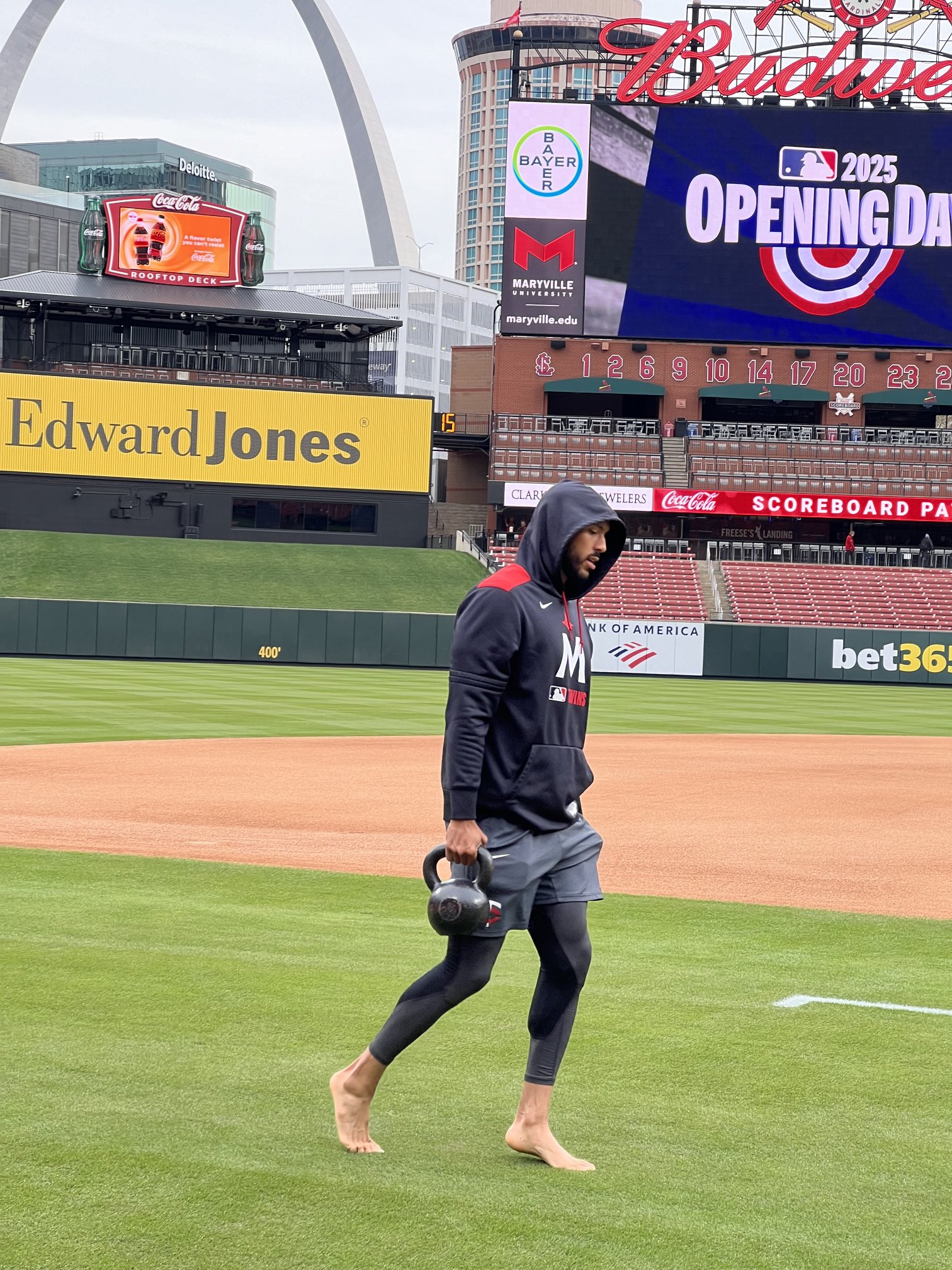
Carlos Correa takes great lengths, including training barefoot, to keep his heels healthy after bouts with plantar fasciitis in both of his feet. Photo by David Brown.
Correa takes extensive precautions to keep his heels ready to play, but he’s also an abject example in how playing the game can beat you up physically. Correa would love to play long enough to be considered for the Hall of Fame, but doesn’t know if he could stand (emotionally) to be away from his family that long to make Cooperstown a more realistic possibility.
He ranks 31st on Jay Jaffe’s JAWS list of shortstops and probably needs 20-25 more WAR to slide into the best position. Four or five great seasons could do it. Four or five is a lot when you’re 30 years old and have Correa’s injury history.
Still, he’s younger than Seager, younger than Lindor,younger than Mookie and younger than Trea.
“If I were to play to 40, I think it would be a great conversation to have,” Correa said. “The process and grind are what excites me about the game, right? Results will come, but the grind is what keeps me going. At the same time, how long do you want to play where you’re sacrificing your family, right? And for me, family is the one thing that I have at the top of my list.”
Henderson’s journey is closer to the beginning, but he appreciates being in the company of some of the best shortstops of all time. Henderson is working to be mentioned with them.
“Yeah, it’s a lot of great guys, great players with different methods of preparing,” Henderson said. “That’s one of the neatest things about getting to know them all, is seeing the different ways they train to be the best. Different ways of going about it, but the same goal to be one of the best.”
