







Catcher is always a tough position to draft in fantasy. In some ways, it’s a premium position, especially with how the dropoff in fantasy catcher production can get after a certain round.
At the same time, catchers tend to be a position fantasy managers hit late, especially since they are typically a lost cause in one important category (stolen bases). Many hope that other managers overlook the position in drafts and that catcher value can be found in the later rounds. If that doesn’t happen, managers will look for sleepers who may not be All-Stars or premium names, but can still produce in fantasy.
While catcher won’t be a priority for some managers in upcoming drafts, it’s definitely a position that can win a team a league title or sink them really fast, especially in two-catcher leagues. The reality is that it’s hard to find catcher help on the waiver wire or in FAAB, mostly because those available are likely not getting regular playing time and/or defensive first catchers who provide little to no value offensively. A good framing catcher with no bat may help a team in real life, but provides zero value on a fantasy roster, regardless of scoring format.
Thus, let’s take a look at three sleeper catchers who could provide sneaky value later in drafts and two catcher busts who should be avoided in the earlier rounds. While these five catchers could be sleepers or busts in most leagues or formats, the focus will be on 12-team, traditional 5×5 category leagues. All ADP data comes from NFBC, as of February 24th.
Sleepers
Logan O’Hoppe, LAA (ADP: 241.29)
O’Hoppe is slated to be the Angels’ Opening Day catcher once again, but he is coming off an uneven 2025 campaign after a stellar 2024 one.
Two seasons ago, in his first full healthy season with the Angels, he hit .244 with 20 home runs, 64 runs scored, and 56 RBI in 522 plate appearances. This was a nice progression after his 14-homer, 29-RBI season in 199 plate appearances in 2023, a season that started strong but was cut short due to injury.
However, the 26-year-old catcher saw some regression last year. In 451 plate appearances, he hit .231 with 19 home runs, 35 runs scored, and 43 RBI. His wRC+ went from 102 in 2024 to 72 in 2025, and his OPS went from .712 to .629. Thus, it makes sense that O’Hoppe has an ADP behind catchers such as Austin Wells (241.29) and Dillon Dingler (217.09).
While it wasn’t the best season, there could be some opportunity for a rebound for O’Hoppe in 2026. His 13.3% barrel rate was 1.3% better last year than his 2024 mark, and his 46.9% hard-hit rate was 0.6% better as well. His .425 xSLG was 54 points higher than his actual slugging, and his .267 BABIP was 51 points lower than in 2024. Lastly, O’Hoppe performed well on his power-rolling chart via Process+ last season and was affected by a horrid stretch at the tail end of the year, as shown in the chart below.
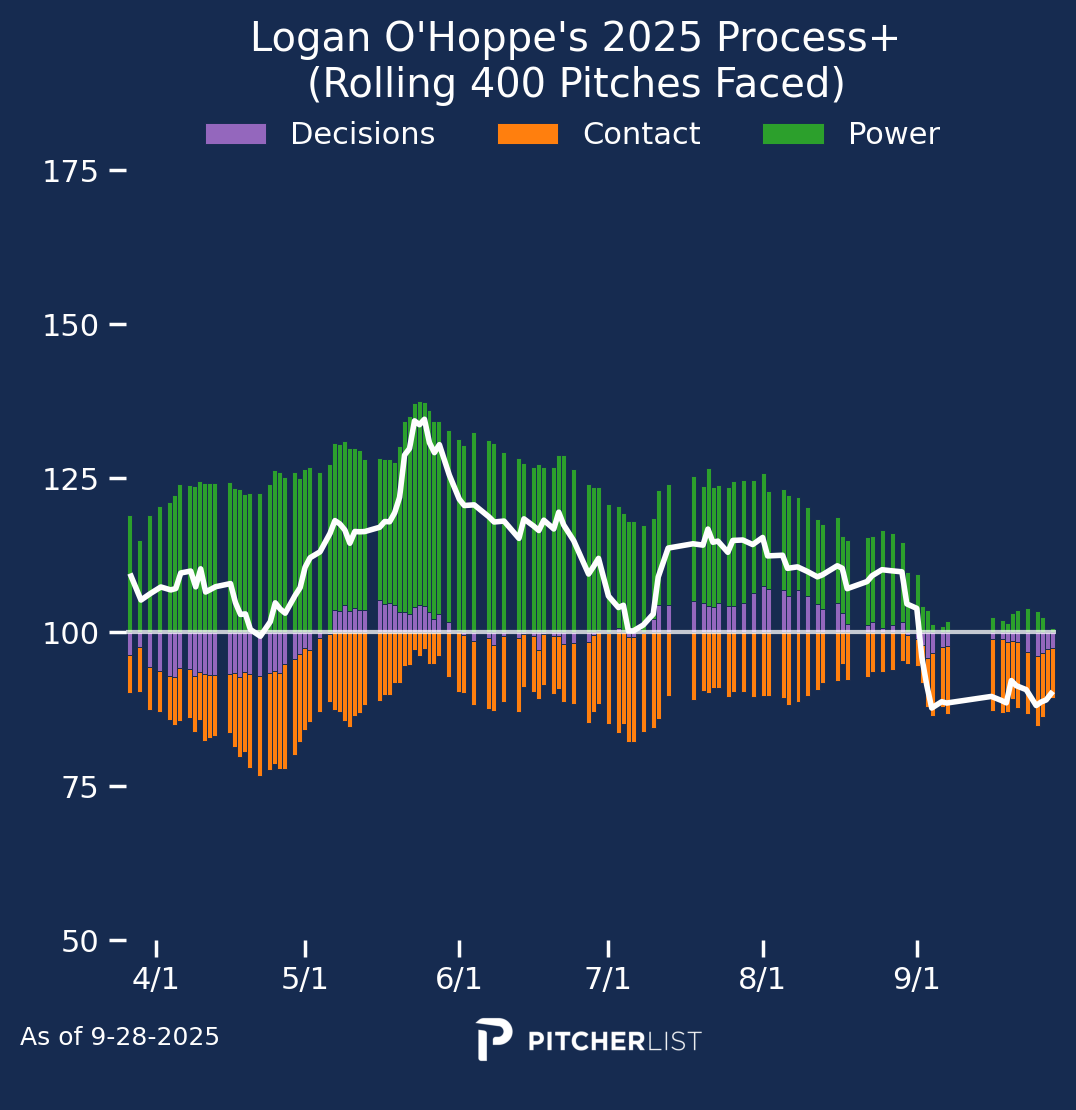
For a late-round catcher pick, O’Hoppe provides 20 home run potential with room for run and RBI improvement, as long as the Angels’ lineup can improve a bit in 2026 (which may or may not happen due to the inconsistency of this roster).
Tyler Stephenson, CIN (ADP: 245.59)
Stephenson has never been a sexy catcher in fantasy, but he’s been a pretty steady contributor over the past three seasons. In 2023 and 2024, he received over 500 plate appearances and hit 13 and 19 home runs, respectively. He only played in 88 games last year and had just 342 plate appearances. That said, he still hit 13 home runs and had 40 runs scored and 50 RBI, not bad considering the decline in at-bats.
The 29-year-old has good power and benefits from playing home games in the hitter-friendly Great American Smal…I mean Ballpark. Stephenson produced a 14.4% barrel rate, 49.2% hard-hit rate, and 18.5% home-run-per-fly-ball rate last year, all career-highs. His ground-ball rate was also 38%, his lowest mark since his rookie year in 2020 (when it was 37.5%). He also pulled the ball 42.2%, which was 3.6% higher than his pull rate in 2024.
Additionally, his Process+ was solid, with his power rating well above average and his decision-making rating slightly above average. The contact was below-average, unfortunately. That said, fantasy managers can live with the inconsistent contact and strikeouts (33.9%) if the power is there, as illustrated by his Process+ rolling chart below.
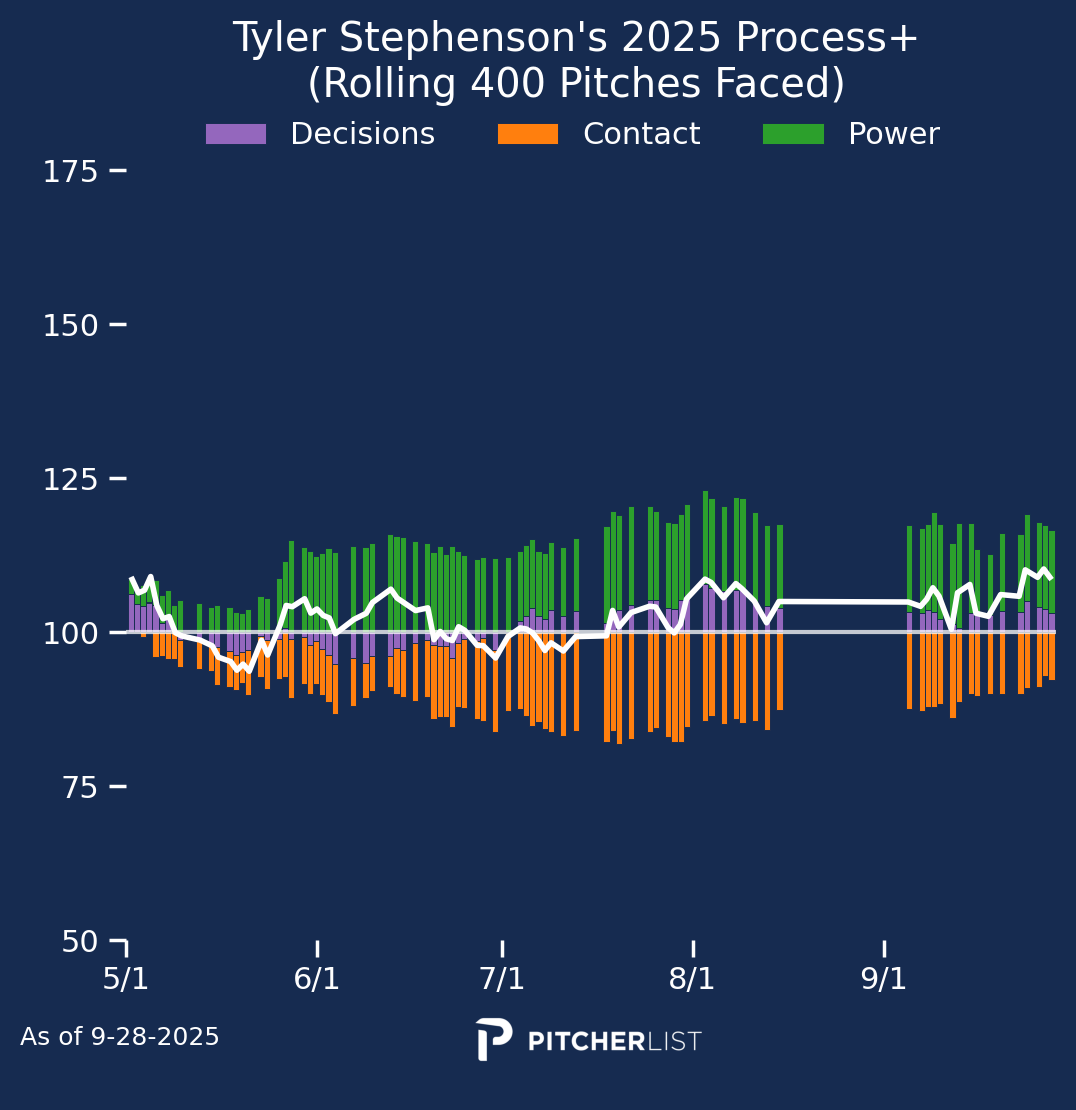
Thus, all the signs point to a surge in fantasy performance in 2026, especially if he can stay healthy, which wasn’t the case last year. He also shouldn’t be challenged in Cincinnati, as backup Jose Trevino profiles as a more defensive-oriented catcher. The Bat X is projecting 15 home runs for Stephenson in 2026, and I think he could be a 20+ home run catcher if he can stay healthy and if he continues to maintain his solid barrel and hard-hit rates.
Edgar Quero, CHW (ADP: 353.99)
All the hype on the South Side is surrounding the White Sox’s other young catcher, Kyle Teel, whose ADP is 180.29, according to NFBC. That said, fantasy managers shouldn’t totally dismiss the 22-year-old Cuban product, who’s expected to get some DH duties with the White Sox in 2026, according to Roster Resource.
Quero’s rookie debut was a bit of a mixed bag. In 403 plate appearances, he hit .268, which is nice, but he only had five home runs, 31 runs scored, and 36 RBI. The Bat X isn’t projecting much improvement, envisioning a .252 average, eight home runs, 44 runs scored, and 42 RBI in 430 plate appearances. Thus, Quero is going around the same rounds as other catchers like the Cubs’ Carson Kelly (347.99 ADP) and Cleveland’s Bo Naylor (362.28 ADP).
That said, fantasy managers should target Quero as a later-round option, especially in two-catcher leagues. He showcased a solid approach with a 0.45 walk-to-strikeout ratio last year, and his hard-hit rate was solid at 46.3%. His 6.8-degree average launch angle is a big reason he struggled to produce barrels (3.7%) last season, which hurt his slugging (.356) and expected slugging (.346). However, his contact and decision-making were both solid via Process+, and any kind of tick in launch or power could help him fully tap into his potential on the offensive end.
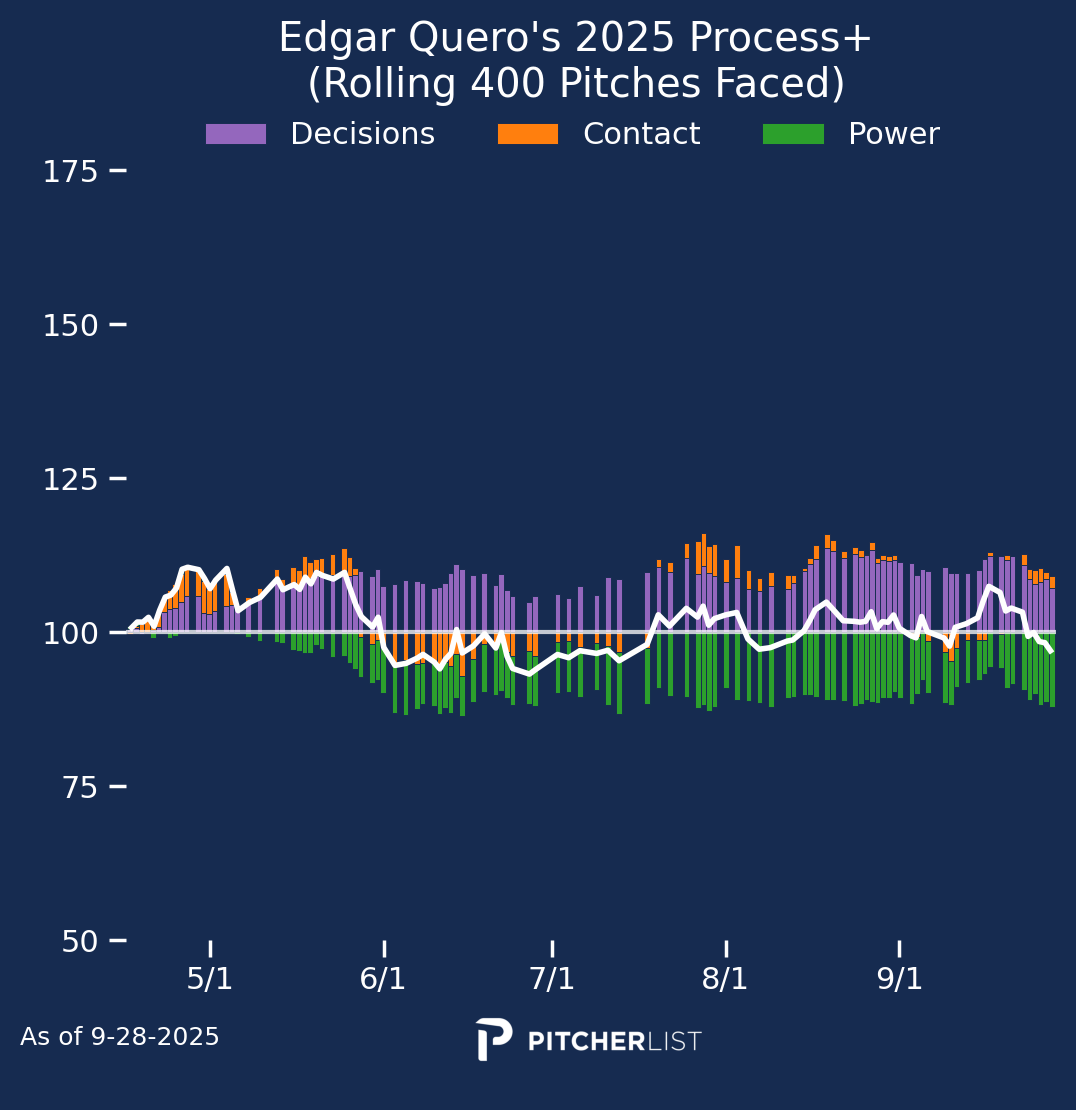
Quero may be a 10-15 home run hitter next year, and 15 may be on the overly optimistic end. That said, fantasy managers should trust Quero’s approach and the contact ability, with the hope that power can mature a bit now that he has an MLB season under his belt. Furthermore, if anything should happen to Teel, whether injury or performance-wise, Quero should be able to fill in seamlessly.
Busts
Hunter Goodman, COL (ADP: 67.61)
Goodman had a breakout season in 2025 with the Rockies, hitting 31 home runs and collecting 91 RBI in 571 plate appearances. When it came to home runs by a primary catcher, the 26-year-old Colorado backstop tied the Athletics‘ Shea Langeliers for second (of course, both lagged behind Seattle’s Cal Raleigh, who had 60).
As a result of his solid season, managers are seemingly high on Goodman, as he is sporting a top-70 ADP value in NFBC formats. However, fantasy managers should approach Goodman with some caution in drafts.
First off, Goodman strikes out a lot. He struck out 26.3% of the time in 2025 and had a 28.6% strikeout rate in 2024 in 224 plate appearances. His career contact rate is under 70% (69.7% to be specific), and his career O-Swing rate is 36.8%, including a 36.2% mark last year. For context, his O-Swing rate was 8.1% higher than the league-average. That’s not good, even for a power-hitting catcher who plays his home games in hitter-friendly Coors Field.
When looking at his Process+ from 2025, it looked similar to O’Hoppe’s: great power trends, but lackluster contact trends.
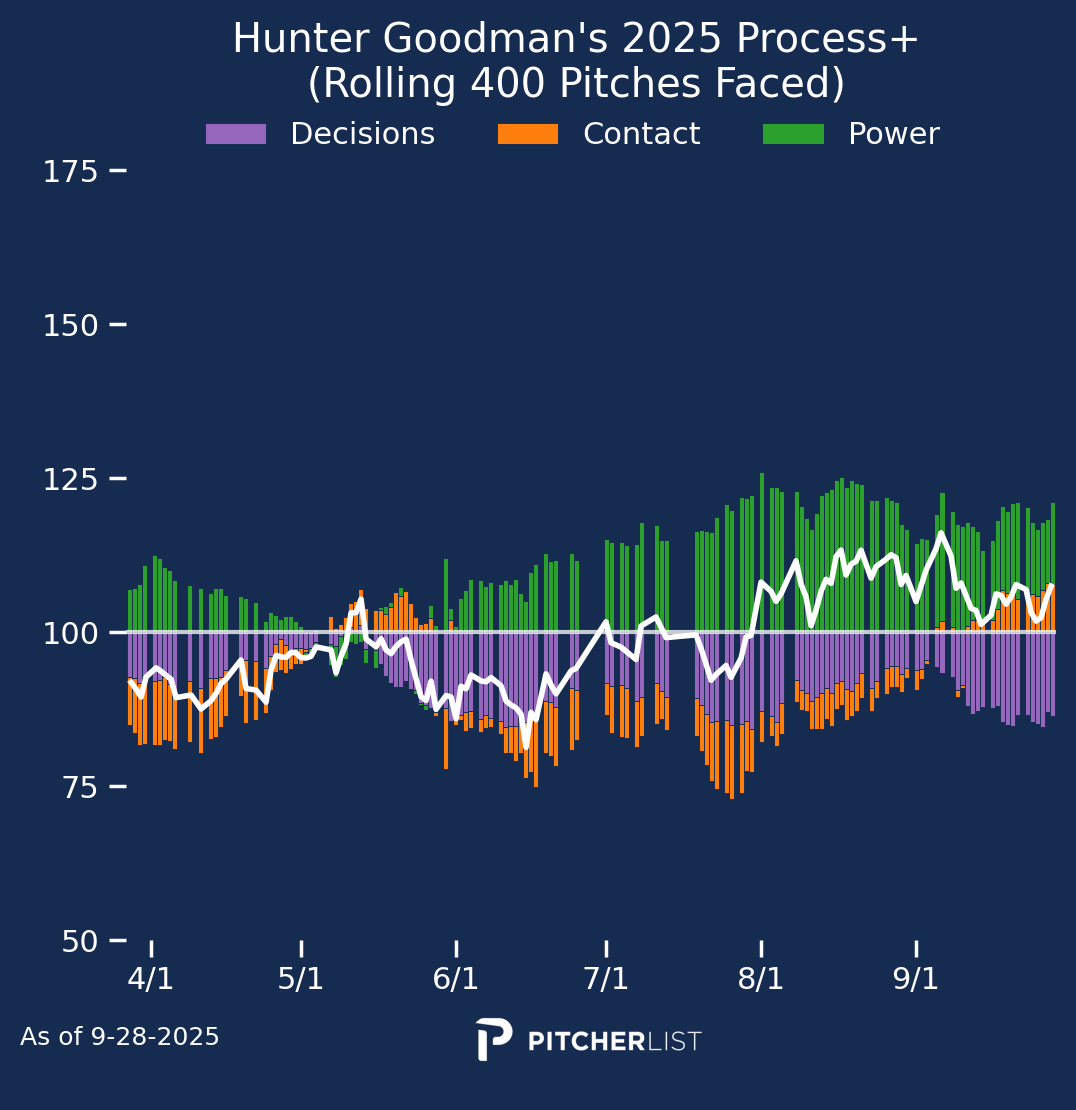
The bigger concern with Goodman compared to an O’Hoppe or even Stephenson is that Goodman’s decision-making trend was much worse than theirs. It’s one thing to be a low-contact power hitter who can draw a walk, as Stephenson or O’Hoppe can do (though O’Hoppe not as well as Stephenson). However, to be a low-contact power hitter who swings at bad pitches? That’s going to correct itself eventually, and not in a positive fashion in fantasy. Goodman’s career 0.19 walk-to-strikeout ratio is only another strike against him and his ability to match his gaudy 2025 numbers.
Now, Goodman isn’t terrible, and at the right price or round, he’s valuable. The power is legit, and the 12.8% barrel rate and 46.9% hard-hit rate from last year demonstrate that. However, fantasy managers would be better off getting an O’Hoppe or Stephenson later in drafts than spending a premium pick on Goodman.
Samuel Basallo, BAL (ADP: 170.27)
An Orioles prospect that’s all the rage in the minors but struggles in his rookie debut? I can’t believe it.

Okay, I am not trying to diss Basallo, but it’s becoming a trend with top Baltimore prospects. After all, Jackson Holliday looked unstoppable in Triple-A and then, well… stoppable in the majors initially. Holliday is looking like he’s figuring it out, so it’s certainly possible that Basallo can, too, in 2026.
One can understand the Basallo hype. At 20 years old in Triple-A Norfolk, he hit .270 with 23 home runs and posted a max exit velocity of 115.9 MPH and a hard-hit rate of 56.9%. And he did this even though he couldn’t buy a case of beer at the local Wawa in Baltimore. However, the max exit velocity regressed to 112.1 MPH, as did the hard-hit rate to 43% with the Orioles in 118 plate appearances. It was still good, but not quite as awe-inspiring as what he did in the minor leagues earlier in the year.
The Process+ trends were a bit mixed, too. He wasn’t necessarily terrible in anything (though the decision-making wasn’t trending in the right direction), but he didn’t quite stand out in one particular category either, which makes sense considering how small a sample his MLB debut was last season.
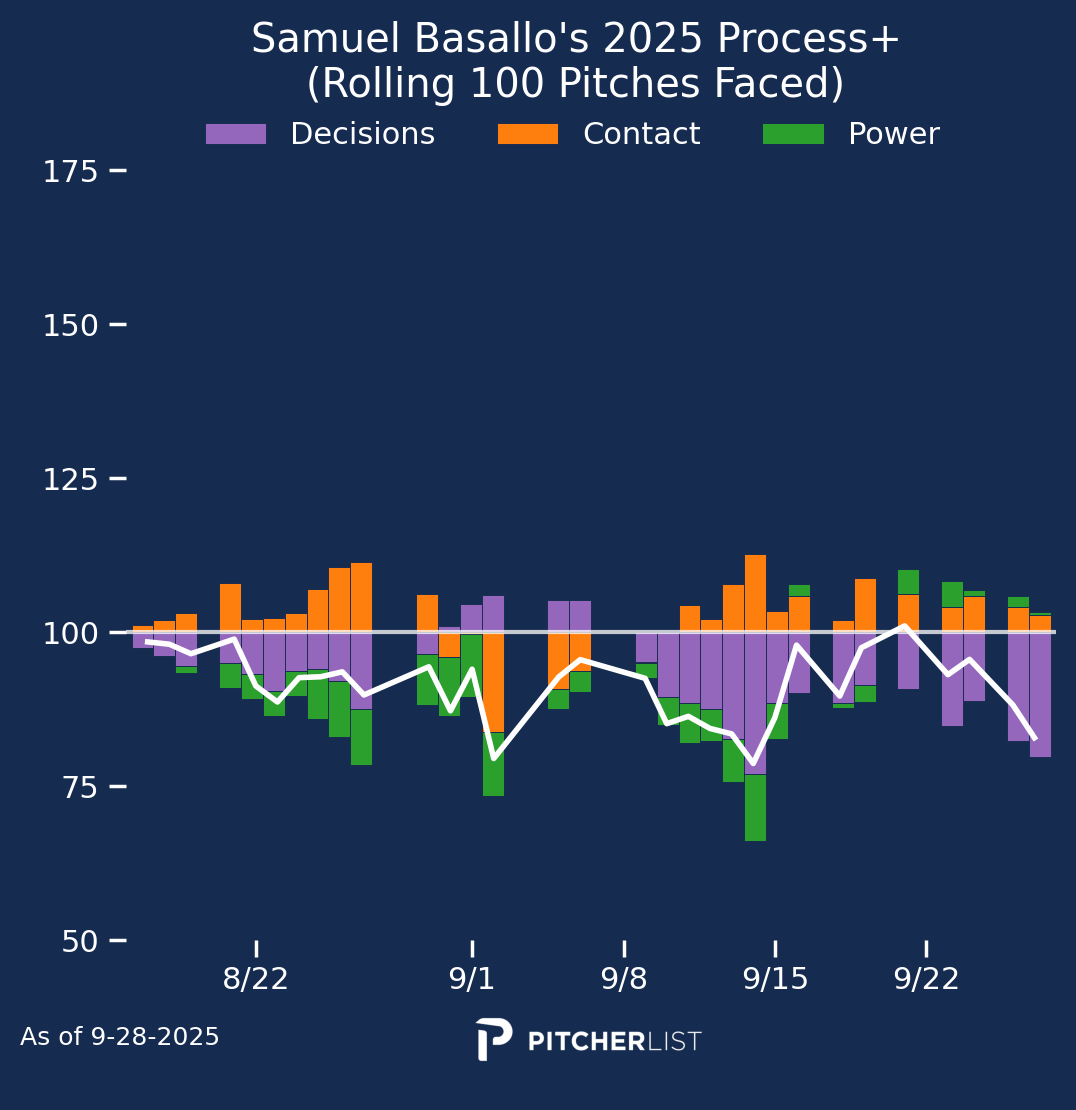
It’s not that fantasy managers SHOULDN’T believe in Basallo. Rather, they should exercise caution and not get caught up in the “prospect hype” that has carried former Orioles top position player prospects in previous drafts. It’s totally plausible that Basallo can learn from his rough debut, put things together, and transition that Triple-A mashing from 2025 to the major leagues in 2026. That said, this is an Orioles team trying to win and already has an everyday catcher in Adley Rutschman. One has to wonder if a slow start could banish Basallo to Triple-A sooner rather than later, though the backup catching options in Orioles camp this spring aren’t great (Sam Huff may be their best NRI option).
It’s not that fantasy managers should avoid Basallo in drafts. That said, his 170.27 ADP puts him ahead of more established catchers like the Diamondbacks’ Gabriel Moreno (173.95), the Mets’ Francisco Alvarez (176.05), and the Philies’ J.T. Realmuto (206.62). Those three catchers would be my preference over Basallo in drafts, mostly because their playing time is clear for 2026, while Basallo’s is less so, especially with Rutschman listed as the Orioles’ primary catcher.
