





Few rookies are able to blend plate discipline and power together easily in their first shot against big league pitching. Much of the adjustment is showing one or the other, and growing into their other tools as they spend more time in the league.
JJ Wetherholt is showing a blend of power and discipline rarely seen in a rookie. Among qualified rookies this year, his 120 wRC+ ranks sixth, and his nine home runs rank fourth. The .250/.362/.407 slashline doesn’t look as impressive, but the walk and strikeout figures indicate how advanced the approach is. His 11.3% walk rate and 17.5% strikeout rate are both 70th percentile figures league-wide.
Since 2010, there have been 841 rookies with at least 150 plate appearances. Just 14 have been able to recreate Wetherholt’s sub-20% strikeout rate, an above-10 % walk rate, and at least 9 home runs. There is a clear archetype of players in this grouping: ones who can get on base, put the ball in play, and have variable power.
You’re probably thinking that this is an underwhelming list. There’s probably more misses than hits on this list, in terms of longevity, but there are some productive big leaguers. If anything, it shows how hard it is to do this and be successful. Among all rookies to have these numbers, Wetherholt is in the middle of the pack by wRC+. However, his .250 average is the worst of the group and his .265 BABIP is second-worst.
Wetherholt is slumping despite the strong overall performance. His prospect reports all discussed how good the hit tool is, and yet the actual bat-to-ball has been lagging. He’s producing and getting on base while clearly looking like things aren’t bouncing the right way, which is why he looks like an established veteran.
The Decision-Making
Wetherholt’s decision-making is what allows him to have such a high floor. The ability to control the zone in both directions makes it hard to pitch to him and allows him to take his shots early in the count.
He’s a passive hitter — his 44% swing rate is a 27th percentile figure — and has relatively pedestrian contact rates. It’s about when he makes contact. Wetherholt has an above-average 22% whiff rate, but he’s able to leverage that based on when he’s in a place to do damage. His whiff rate ticks up to 26.1% in non-two-strike situations, and goes down 17.2% in two-strike situations. The nine percentage point difference in whiff rate is a 92nd percentile figure.
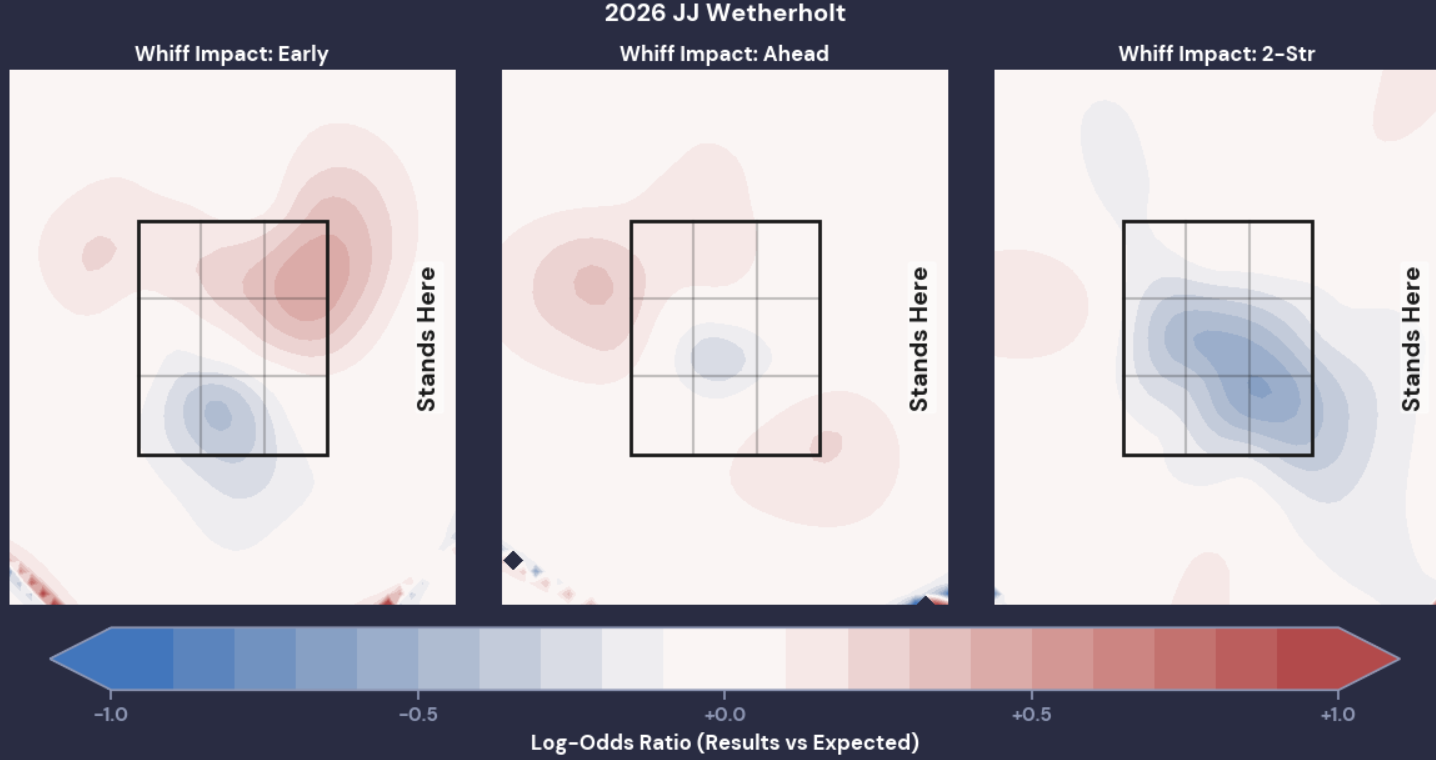
He’s taking bigger swings when he knows it’s okay to miss, because it’s hard to punch him out if he does get to two strikes. His swing speed is up 1.8 mph when not in two-strike counts, compared to the 1.3 mph league-average. For a guy with below-average top-end power, Wetherholt is able to max out the profile with swings before two strikes.
Six of his nine home runs this year have come early in the count, with two coming in full counts — where he is likely swinging harder.
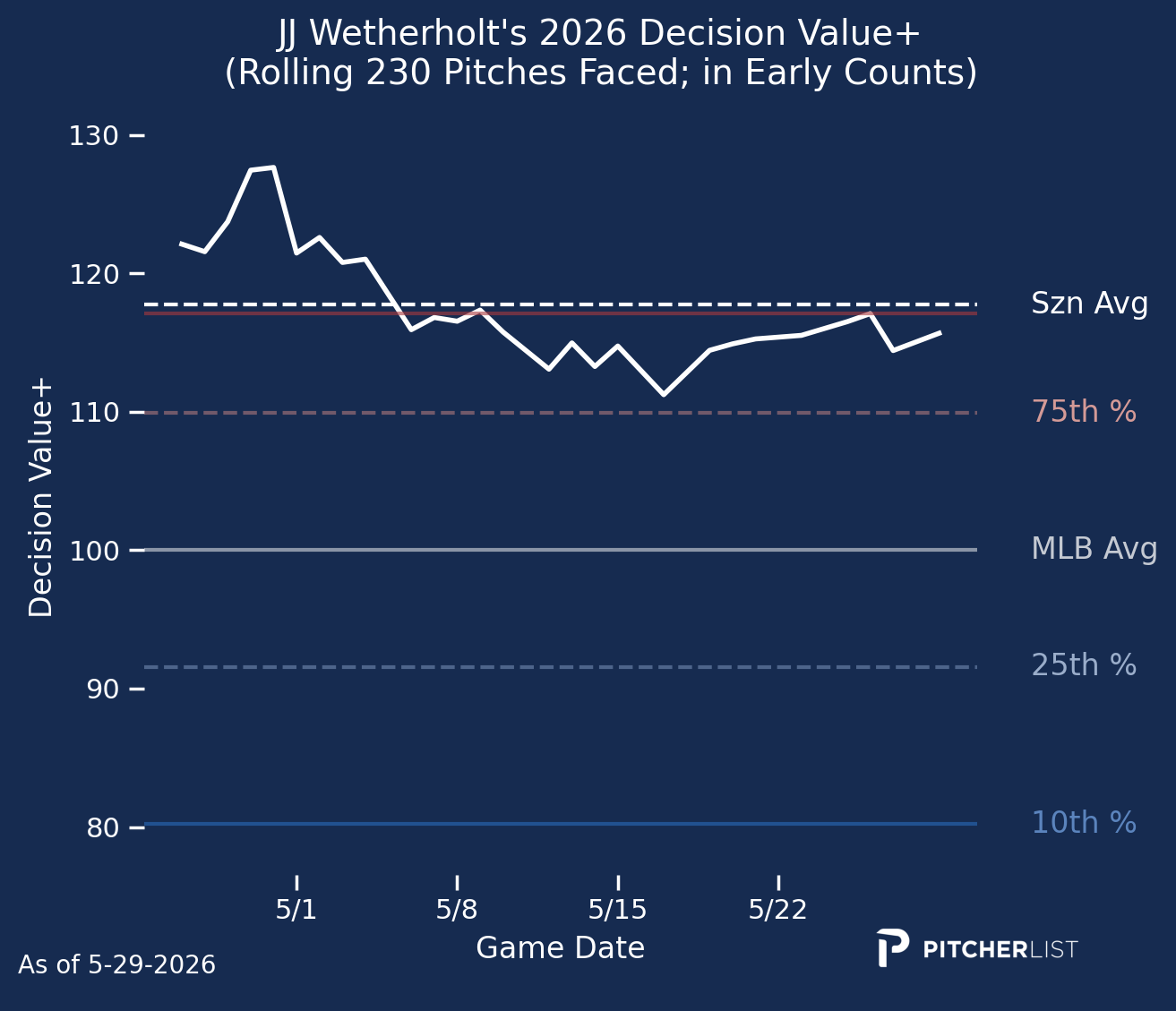
Part of this is passivity, but he’s not getting taken advantage of at the plate. But the good swing decisions in good situations drive batted ball quality, even if it isn’t spectacular.
Wetherholt’s 108.7 mph max velocity is the fourth lowest among hitters with at least nine home runs this season. Instead, he consistently hits the ball hard.
He’s better across the board when it comes to consistent contact quality, specifically in the solid contact arena — batted balls 95 mph or above, but not barrels. All of this good contact eventually turns into results, whether (holt) it’s clearing the fence or turning into extra bases. Hit the ball hard and good things happen, right?
Wetherholt is making the right swing decisions and consistently hitting the ball hard, yet it isn’t working out as it should. His .274 BABIP shouldn’t be the reality that Wetherholt is facing.
The Bad “Luck”
This article started with a list of players that doesn’t inspire a ton of confidence. This next list will. Wetherholt’s 12% solid contact rate is nearly double the league average. He’s hit 22 balls in play that qualify as solid contact, second-most in baseball.
Only superhuman hitter Yordan Alvarez has more, but everyone else also has significantly better averages, BABIPs, and xwOBAs than Wetherholt. No one is getting less out of their solid contact, despite the consistency.
The first thought is that Wetherholt is an extreme flyball hitter — his 31% flyball rate is 87th percentile — and few groundballs will suppress BABIP. He’s hitting just .091 with a .785 xSLG on solid contact flyballs, but that’s generally in line with the .236 AVG/.835 xSLG league performance. Especially in Busch Stadium, some of these flyballs are just going to die at the warning track. So while this is part of the underperformance, it’s not the main story.
On line drive solid contact, Wetherholt is hitting .364 with a .839 xSLG. Seems better, right? Nope, the league is hitting .547 with a .936 xSLG on these line drives. Line drive rates and performances are notoriously fickle, and my guess is that this will work itself out over time. However, he’s hit 11 of these solid line drives, 10 of which have gone up in the middle or opposite field. Usually, this is a great approach: spray line drives all over the field and hit for a good average. Wetherholt is also pulling overall batted balls in the air 18.5% of the time, an above-average figure.
The pulled batted balls in the air help keep his early power numbers sustainable, and the line drives should be keeping the average up. Instead, it’s a lot of this:
What’s Next
The most impressive part of Wetherholt’s rookie season is that it’s still a 120 wRC+ despite these struggles. Compared to many of the rookies on the list at the top of the article, Wetherholt has a bat-to-ball tool that is underperforming, even as he looks competent against big league pitching.
It took him a few weeks to adjust, but everything came online for the top prospect pretty quickly.
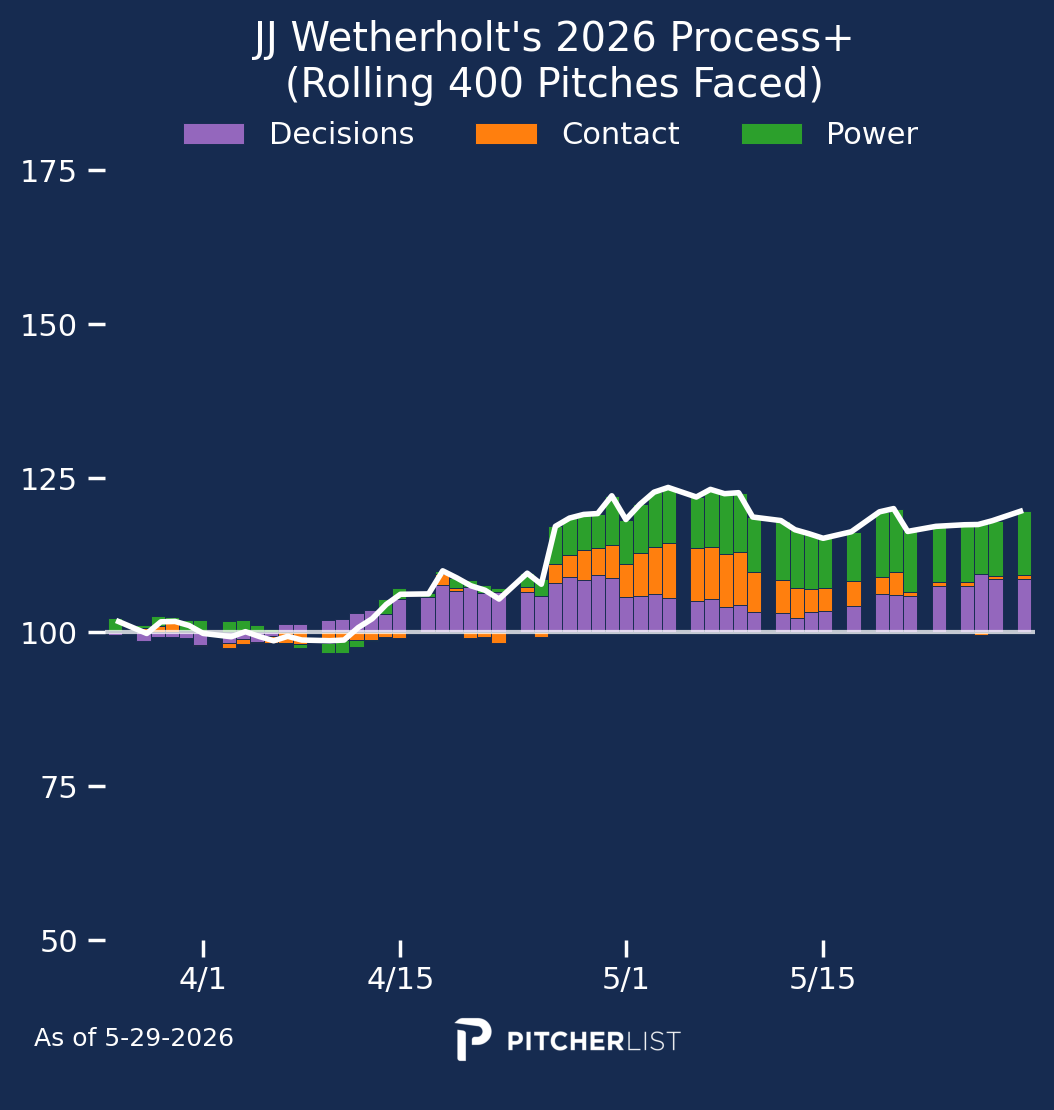
The potential topline output could be similar to that of a player like Yandy Diaz — a high average, good strikeout & walk numbers, and an optimized batted-ball profile that can get him to 20+ home runs consistently. There isn’t much that needs to change for Wetherholt to get there.
As long as he keeps controlling the zone and making good contact, everything else will fall into place. He’s a good hitter without good luck, and it’s only a matter of time before the latter comes around.
