





Let’s take a look at the first week (and some change) of minor-league baseball, shall we? We are already seeing starting pitching depth be tested, and if you told me a month ago that Cam Schlittler and José Soriano would be some of the highest-scoring pitchers in the PL Community Dynasty League, I would have had a chuckle. Not that those are below-average fantasy starters, but hardly who I expected to be leading the pack early in 2026.
It just goes to show that, like the real-life product, fantasy baseball production can come from several different places. I am sure that there will be some Triple-A arm that is far off the radar that ends up being a fantasy factor, or a prospect who tries to duplicate the rise of Trey Yesavage last season. It is still plenty early in the season, and that even impacts our processes here at Pitcher List.
No matter what your definition of a small sample is, data models are certainly still in that realm for minor-league baseball. While this series last season leaned heavily on PLV scores from Triple-A and fastball grades from a litany of prospects, few pitchers have enough pitches logged to register in the current models. That is fine! I would certainly put more weight behind the PLV score of Jaxon Wiggins’ curveball after a handful of starts rather than it popping after one outing.
With that in mind, let’s take a look at some Triple-A standouts from the season so far, and check in on some consensus Top 100 arms.
Triple-A Standouts
Brendan Beck, New York Yankees
2026 Stats: 2 GS, 9.1 IP, 1.93 ERA, 3.09 FIP, 40.5% K%, 0.0% BB%, 37.7% CSW%
Right now, the New York Yankees have an embarrassing amount of riches in the starting rotation. The unit has the best team ERA in the American League, led by the aforementioned Schlittler and Max Fried. The club is still waiting on some of its best arms to return from injury, while prospects Elmer Rodríguez and Carlos Lagrange remain in Triple-A awaiting their eventual opportunity. Still, an often-forgotten arm in Brendan Beck has forced his way into the conversation, leading the International League with 15 strikeouts this season.
Beck’s second start was not quite as dominant as his season debut, when he punched out nine batters over 5.0 innings, but the overall impression remains the same. Pitching in two frigid games, Beck has looked excellent to open the year. Now 27 years old, the missed 2022 and 2024 seasons severely dampened his dynasty value. It also does not help that he fits more of a control-over-stuff profile, one that can sometimes land in Quad-A territory instead of becoming truly fantasy relevant. Even so, Beck has flashed three plus-plus bat-missing pitches so far, posting 40%-plus whiff rates on his slider, split-finger, and curveball. His four-seamer remains the foundation, operating as the workhorse pitch that sets up the secondaries, and it is averaging 91.2 MPH this season, right in line with his professional norms.
Beck is not on the 40-man roster and, according to FanGraphs, is actually the oldest starting pitcher on the Triple-A Scranton/Wilkes-Barre RailRiders staff. He may not be the next arm the Yankees turn to, but he is making a resounding first impression in 2026.
Brendan Beck, the @Yankees‘ No. 22 prospect, starts the season with a stingy outing for the Triple-A @swbrailriders:
5 IP
1 H
0 R
0 BB
9 K (ties career high)
18 swing & misses pic.twitter.com/NipxcfIWd4— MLB Pipeline (@MLBPipeline) March 27, 2026
His 2025 season was a strong comeback campaign after missing all of 2024, as he logged 131.1 innings across Double-A and Triple-A with a 3.36 ERA, 123 strikeouts, and 36 walks. If anything, dynasty managers should be watching how Beck is working with what looked like a limited arsenal entering the season. The split-finger looks markedly better, and that is the pitch I am most interested in seeing grade out through public and team models. Prospect Savant giving it a 131 psStuff+ mark suggests Beck may finally have the kind of dominant weapon he needs to push his way to the majors.
Robert Gasser, Milwaukee Brewers
2026 Stats: 1 GS, 5.2 IP, 0.00 ERA, 1.22 FIP, 47.8% K%, 13.0% BB%, 34.5% CSW%
Robert Gasser is trying to do something that can get lost in a hurry for pitching prospects: remind people that he still matters after a lost development year. The Milwaukee Brewers’ system is full of arms, and that alone can bury a pitcher returning from injury in the public dynasty conversation. Still, Gasser’s first impression in 2026 was hard to ignore. The lefty missed bats at a 40.9% clip in his opening outing, and for a pitcher whose stock stalled more because of health than talent, that kind of return puts him back on the radar.
Gasser has never been built like a traditional overpowering left-hander. His profile works because the mix is deep and he knows how to use it. He now works with both four-seam and two-seam fastballs in the low-to-mid 90s, while his best pitch remains a low-80s sweeper. His cutter gives him another look against right-handed hitters, even if it is only a so-so offering right now. The changeup sits in a similar bucket, more usable than dominant, but it had volatile results in his first outing, with a 40% whiff rate on the pitch and a .463 xwOBA allowed. That is why Gasser has always looked more like a polished back-end starter than a pure bat-missing monster, even if the slider can occasionally make the whole package look bigger.
His 2025 season was more about survival than performance. He threw only 30.2 innings across the minors and majors after returning from Tommy John rehab, posting a 2.64 ERA in the minors before struggling in limited MLB time. That is the right lens for dynasty managers to use here. Gasser does not need to become a new pitcher to matter. He just needs to be healthy enough for the slider-led mix and strike-throwing foundation to reestablish him as viable rotation depth. If the whiffs from that 2026 debut are real, he could become relevant again much faster than the market expects.
Miguel Ullola, Houston Astros
2026 Stats: 2 GS, 9.2 IP, 1.86 ERA, 1.77 FIP, 36.8% K%, 5.3% BB%, 23.8% CSW%
Miguel Ullola has been one of those dynasty arms who always seemed one adjustment away from becoming much more interesting. The raw ingredients were never the problem. Houston’s right-hander has long had the kind of fastball-slider combination that can embarrass upper-level hitters, but the control issues kept the profile from feeling stable enough for a real breakout. So far in 2026, though, the opening line is exactly what dynasty managers wanted to see. The strikeouts are still there, but the far more important number might be the 5.3% walk rate. If that part is even somewhat real, Ullola’s entire profile changes. Add on top of that, he is only 23, there is plenty of upside left for him both in the real and dynasty world.
The stuff has never needed much of a sales pitch. Ullola is a fastball-slider arm first, with the heater sitting 92-95 mph and reaching 97, playing up because of carry and deception. The slider is the real separator, and it is easy to see why Baseball America tagged him as the Astros system’s owner of the best fastball and best slider entering 2025. In previous seasons, he mixed in a curveball and a changeup, but that is not the case in 2026. His only other pitch has been a cutter, tossing that 14.7% of the time. It is his highest spin pitch, and it is obviously working so far, thanks to a 44.4% whiff rate this season. Reducing that mix down to three pitches is scary for the starter label, but his fastball command looks much better so far. If he polishes that offering and retains that slider shape, he should get run as a starter.
His 2025 season was a near-perfect example of the Ullola experience. He threw 113.2 innings at Triple-A with a 3.88 ERA and 131 strikeouts, while he held opponents to a .186 average. The catch, of course, was the 78 walks, which kept him from forcing the issue for a full-time MLB shot. Houston still added him to the 40-man roster in November, a sign that the organization clearly believes the arm talent is worth protecting. Dynasty managers do not need Ullola to become a command artist. They just need him to throw enough strikes for the fastball-slider package to carry him into a starter’s workload. Early 2026 is at least hinting at that possibility.
Top Prospect Pulse
Jonah Tong, New York Mets
2026 Stats: 2 GS, 5.2 IP, 6.35 ERA, 6.34 FIP, 20.7% K%, 17.2% BB%, 24.8% CSW%
Jonah Tong is probably the easiest arm on this list to stay patient with, even if the surface line looks ugly out of the gate. Two starts is not nearly enough to change the longer-term story here, especially for a 22-year-old coming off one of the best minor-league pitching seasons in baseball. The more important thing for dynasty managers is that Tong is still operating with the same core traits that made him so helium-heavy in the first place: unusual fastball life, deceptive shape, and multiple secondaries that can miss bats when he is around the zone. The 2026 line is rough. The overall profile is still very much alive.
Tong’s arsenal has gotten more interesting, not less. His four-seam fastball is still the carrying offering, with the pitch averaging 94.3 MPH so far this season, playing especially well because of his over-the-top slot and riding life. His Vulcan changeup took a major step forward in 2025 and became his best secondary pitch, while his overhand curveball remained a useful weapon underneath the heater. The new wrinkle is a cutter, which the Mets have encouraged him to develop so he is not living in a purely north-south attack all the time. That matters because his 2025 MLB look showed that upper-level hitters could punish a two-plane approach when they sat on it. It does confuse me though why he has abandoned the slider thus far this season, after it being an above-average pitch for all of his professional career.
His 2025 performance is why the dynasty market is still going to give him plenty of runway. Tong posted a 1.43 ERA with 179 strikeouts in 113.2 minor-league innings between Double-A and Triple-A, and he won MiLB Pitching Prospect of the Year honors. He did reach the majors and get hit around in a small sample, but that does not change the developmental trajectory much. The fantasy takeaway is simple: Tong still has the arsenal and strikeout upside to matter in a big way, but whether he becomes a real starter for dynasty purposes may depend on how quickly the cutter and overall strike-throwing catch up.
Seth Hernandez, Pittsburgh Pirates
2026 Stats: 1 GS, 3.0 IP, 3.00 ERA, -1.73 FIP, 66.7% K%, 0.0% BB%, 61.5% CSW%
Seth Hernandez is the upside swing on this list, and the early line only reinforces why dynasty managers are going to dream on him aggressively. There is almost no professional track record here yet, so every good outing will be magnified, but that comes with the territory when the industry already viewed him as one of the best prep pitching prospects in recent draft history. The Pirates took him sixth overall in 2025, and everything about the profile screams frontline ambition. That does not mean the road will be quick or linear. It just means the talent bar here is much higher than it is for the typical teenage arm.
The arsenal is why the hype is so loud. MLB Pipeline graded his fastball at 70, his curveball at 60, his changeup at 60, and his slider at 55, with control already projecting as above-average for a pitcher this young. The fastball can reach triple digits, but the changeup is often described as the bread-and-butter pitch because of how well it plays off the heater. That is rare territory for a high school right-hander, and it is what separates Hernandez from the usual teenage projection bets. He is not just a big arm. He is a big arm with a real starter’s mix and the athleticism to potentially hold it together.
We are only looking at 39 pitches from Hernandez thus far, with the cutter, sinker, and curve showing 28.2%, 25.6%, and 20.5% usage, respectively. I went into this outing expecting more of his changeup, but it feels like Hernandez is focusing on pitches he was more uncomfortable with. Don’t worry, his changeup had a 100% CSW% on six pitches; four whiffs and two called strikes. It was the sinkerand four-seam that the opposition did their damage on, while they swung and missed 80% of the time on Hernandez’s cutter.
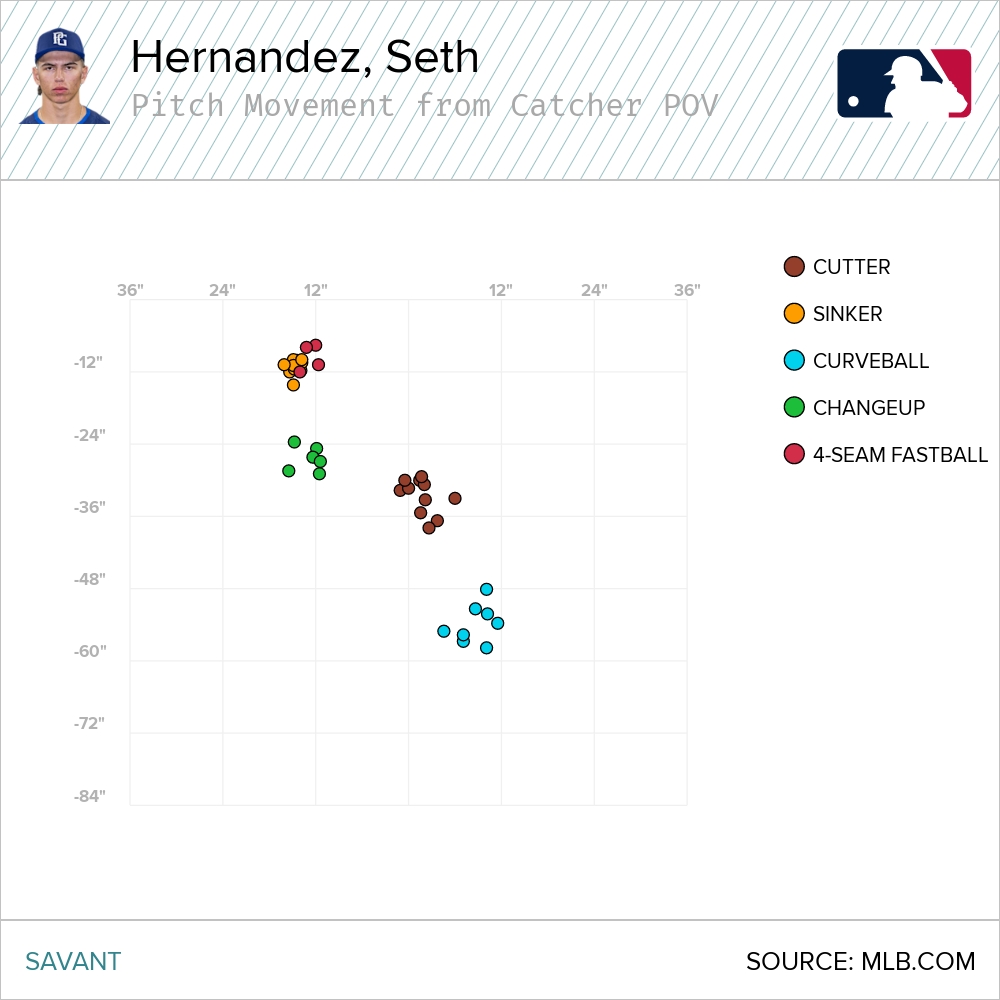
Dynasty managers should understand the risk here. Prep arms are still prep arms. But this is the kind of talent level where patience can be rewarded in a major way. The main takeaway is not that his first 2026 line is dominant. It is that the broader skill set gives him a chance to become one of the most valuable pitching prospects in fantasy if the development stays on track.
Payton Tolle, Boston Red Sox
2026 Stats: 2 GS, 10.0 IP, 4.50 ERA, 3.08 FIP, 30.0% K%, 10.0% BB%, 31.0% CSW%
Payton Tolle is the kind of left-handed prospect dynasty managers can get attached to in a hurry because the ingredients look so loud. The ingredients include an 80-grade moustache and one of the most imposing mound presences in baseball. Even with the ugly ERA in his first 2026 start, there is not much here that should scare anyone off. If anything, the gap between the ERA and FIP is a good reminder that one rough box score does not tell the whole story. Tolle’s appeal was never going to come from perfect surface stats. It comes from having one of the most explosive fastballs in the minors and a starter’s arsenal that is getting deeper by the year.
Tolle’s four-seam fastball is the carrying pitch, averaging 95 mph in 2025 and playing even harder because of his massive extension from a 6-foot-6 frame. He is up a tick in 2026 so far, averaging 96.4 MPH in his first two starts. MLB Pipeline called it arguably the most effective fastball in the minors last season, and the whiff data backs up the idea. He has also become less of a one-pitch monster as a pro, mixing in a cutter, kick change, and curveball. Boston has even worked with him on a sinker this spring, another sign the organization wants a more complete starter’s shape around the heater. That is the pitch opposition has done damage on the most ironically this season, with a 50% hard-hit rate this season.
His 2025 season is why the fantasy market is going to keep leaning in. MLB Pipeline reported a 3.04 ERA, 0.99 WHIP, and 133 strikeouts in 91.2 minor-league innings across three levels, and FanGraphs shows that translated to a 36.5% strikeout rate with only a 6.3% walk rate in the minors. He did reach the majors and get hit around, but Boston’s own reporting made clear the organization still views him as a starter, not just a short-burst weapon. I know managers were disappointed when he did not make the Opening Day roster, but I think that speaks to Boston’s commitment to him as a starter rather than shoehorn him into a bullpen/long relief role. Tolle already has the fastball to matter. If the secondaries round out, namely the cutter and changeup, Tolle will be back in The Show before long.
