





Welcome to Week 25 of our Patience or Panic series! This is it. The end. If you’ve somehow clicked on this article and the title doesn’t make its premise clear, then I fear you may have to keep reading.
Jackson Holliday, 2B, Baltimore Orioles
Can’t miss. Stand-out. As good as it gets. These were some of the sentiments surrounding Baltimore Orioles second baseman Jackson Holliday ahead of his first overall selection in the 2022 MLB Draft. Holliday was heralded. He’d sign an $8.19 million signing bonus to signify such a fact, the largest ever for a high schooler.
Holliday earned every bit of that praise. In 2024, his first full season of professional baseball, the then 19-year-old hit .323/.442/.499 with a .941 OPS, 12 home runs, and 75 RBIs. He’d made Triple-A by season’s end. And by Spring Training of 2025, most hoped Holliday might break camp with the team. He didn’t. Yet faith was high. CBS Sports, in its write-up of Holliday’s dismissal, said, “All of Holliday’s indicators, statistical and otherwise, are neon green.”
Holliday eventually got his promotion. And when he did, no one wavered. ESPN’s Jeff Passan followed the news of his promotion with an addendum: “For those wondering: Yes, the Orioles are still eligible to receive a first-round draft pick via the Prospect Promotion Incentive if Jackson Holliday wins AL Rookie of the Year.” He’d yet to play an MLB game, and baseball’s best insider was already clarifying Holliday’s eligibility to win Rookie of the Year.
Holliday did not win the 2024 AL Rookie of the Year. He didn’t even finish in the top 7. Largely because Holliday couldn’t even finish the season in the Majors. He’d go 2-for-34 10 games into his debut season before his demotion to Triple-A. The light turned yellow. And now it’s bright red. A sharp, unmistakable hue, the color of Mars.
This season, before ending it prematurely due to left wrist inflammation, Holliday hit .229/.300/.340 with a .640 OPS and 81 wRC+. The prospect who once had the highest floor didn’t even come near the play of your average MLB player. What the hell happened?
What happened first, before 2026, was 2025. The season promised to be Holliday’s first full MLB season. He made the Opening Day roster and was penciled in as an everyday infielder. It was go, go, go on the Orioles’ end. They were flashing the checkered flag. Yet Holliday hit just .242 with a .690 OPS and 96 wRC+. The former was the 21st-worst among all 145 qualified hitters in baseball. The latter had Holliday tied for the 31st-worst. What went wrong with Holliday this season is what’s gone wrong in every season: underachievement. It’s as simple as that.
But what’s the cause of this inability? That’s a little trickier to answer.
Perhaps the most obvious of Holliday’s maladies is his problems making contact the way he needs to. This season, Holliday ranked in the 36th and 20th percentile in Barrel Rate and Hard-Hit Rate, respectively. This, well, doesn’t lend itself to success. Nor do Holliday’s previous placements, seeing him rank in the 39th percentile in Barrel Rate and the 40th in Hard-Hit Rate in 2025. His recent woes are the same as the old ones. And to some extent, that’s still shocking.
In 2024, when Holliday had a .908 OPS in 73 Triple-A games, he finished in the 70th percentile in Barrel Rate and the 90th in Hard-Hit Rate, per Prospect Savant. It doesn’t get much better than that. Actually, scratch that. It hasn’t. This is perhaps the most troubling sign. Holliday can’t handle Major League pitching. He can’t drive balls at high speeds. He can’t barrel balls. These are the pillars of success. Even if actual success remains elusive, strong rankings here provide hope. They show a semblance of a tool. But Holliday’s belt is empty.
Among other empty loops is, unsurprisingly, a struggle to hit balls with any real velocity. He ranked in the 18th percentile in Average Exit Velocity this year at 87 MPH, tied for the 45th-slowest in all of baseball. Holliday also doesn’t create any advantages for himself. He’s a little above-average walker with a somehow career-best 9.6% Walk Rate. He’s also striking out more than average, with a 23.7% K Rate, placing him in the 34th percentile. In other words, he doesn’t make loud contact. Nor does he help himself get on base despite that. Instead, he keeps himself off the infield dirt because he’s punching out almost a quarter of the time. He’s sputtering.
Like some rickety Oldsmobile, he also can’t handle top speeds. Against fastballs this season, Holliday is only hitting .263 and slugging .398. And he’s lucky to be doing that well. His xBA against all fastballs is .247, and his xSLG is .377. Even worse, Holliday can’t handle four-seamers most of all. He’s hitting .238 on your standard, non-variety fastball and slugging .366 with a .308 wOBA. That’s despite seeing the pitch 34.9% of the time. The next closest pitch he saw this season is a sinker at 15.7%. In layman’s terms, Holliday is seeing four-seamers twice as often as he’s seeing any other pitch, and he’s still stuck in neutral.
None of these are things that can be wiped away like rain on a windshield wiper. These are the basics. He can’t drive the ball, and he can’t hit four-seam fastballs. It’s a bad match for anyone, let alone the former best prospect in baseball.
The Verdict: Obey the red light. Don’t go. Holliday could be an interesting buy-low dynasty add. He is, after everything, just 22. One can look to July of this year for hope. But August and September brought back that old, shameful shade, and it’s not neon green.
Mickey Moniak, OF, Colorado Rockies
In Colorado Rockies outfielder Mickey Moniak, one could see Holliday’s ghost of Christmas Yet to Come. A former first-overall pick, Moniak himself had high expectations. But like Holliday, he failed to realize them. He’d fizzle out in Philadelphia, get shipped to Los Angeles to play for the Angels in 2022, and be released by them early in 2025. All seemed lost for Moniak. But one day after his release, on March 25, 2025, he’d sign a one-year contract to play with Colorado’s island of misfit toys.
It was here that Moniak finally found his step. In 135 games, Moniak hit .270/.306/.518 with an .824 OPS and 111 wRC+. He’d sock 24 home runs, a new career-best, collect 68 RBIs, another career-high, and 20 doubles. After years in the cold, Moniak seemed to find a home. The chill was gone. The frost stayed thawed in 2026, with Moniak hitting .278/.321/.560, good enough for an .881 OPS and 123 wRC+ in his first 72 games of the season. For his efforts, the Rockies extended him to a two-year, $16.25 million contract extension on August 4.
Everything seemed settled. Moniak seemed salvaged. But over the last 30 games, the old Moniak’s leapt back out like some Jack-in-the-box. Over this last month or so, Moniak’s hit .168/.202/.310. His 22 wRC+ over this span is second-worst in baseball, trailing only Detroit’s Dillon Dingler. Likewise, his .511 OPS is eighth-worst. One of the few players with a worse OPS is Holliday. The present keeps the company of the future. Maybe. We’ll see.
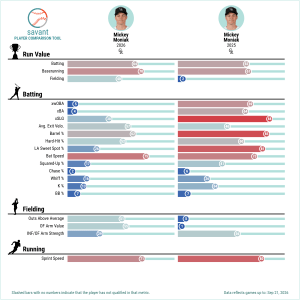
What’s gone wrong for Moniak isn’t much of a mystery. Three ghosts aren’t needed to illuminate his woes. For starters, he’s having very little luck just putting contact on the ball. His BABIP since August 12, eight days after signing his extension, is .222. That’s tied for 19th-worst in all of baseball. Good players can have bad BABIP numbers. It’s not prohibitive. But when in conjunction with a .168 average, well, it doesn’t bode well.
Part of this is Moniak keeping himself from making contact. Earlier this season, he only had a 25.4% K Rate. For a player who’s transitioned to a power-first hitter, it’s not a restrictive number. Over the last 30 games, however, Moniak has a 32.8% K Rate. September is to blame for most of this. Moniak has struck out 18 times in just 51 plate appearances, equating to a 35.3% K Rate. Accompanying this is a 57% Chase Rate in September and a 36.1% Swing & Miss Rate. He’s as blind as Santa without a red-bulbed reindeer.
All of this makes Moniak’s life impossible. He’s set himself as a slugger. That is his part to play. As such, he needs to make just some contact. Instead, he’s making none. It’s costing him not just his average and K Rate but his Barrel Rate, one of the few stats Moniak truly needs to care about. From the start of the season through July, Moniak had a 10.9% Barrel Rate. It’s partly what led him to club 17 homers in his first 17 games. Since August 12, he has a 5.3% Barrel Rate, more than half his previous mark. His ISO has also fallen to the wayside, from .282 through July to .142 over his last 30 games.
Despite all these staggering falls, some freeze seemed destined. Even when Moniak was hot this season, something underneath haunted him like three otherworldly spectres: His expected numbers. Moniak’s xBA over the first half of the season was .226, .052 points worse than his then .278 average. That +.052 difference was the greatest in baseball. That’s not where it ends. The +.131 difference between Moniak’s slugging percentage and his xSLG was also the greatest in baseball. As was the +0.71 difference between his wOBA and xWOBA. No one was luckier than Moniak. Not even a kid on Christmas.
The Verdict: One cannot say humbug here. Moniak, for all his warts past and present, is a no-go. Not unless he re-learns the meaning of Chris– baseball.
Jung Hoo Lee, OF, San Francisco Giants
The San Francisco Giants were desperate for a star heading into the 2023-2024 offseason. The team was aging. Caught between its past and its inevitable future. Something needed to change. The Giants were not ignorant of that. They’d already chased after then-free-agent Bryce Harper in the 2019 offseason. They’d inked Carlos Correa to a megadeal before medicals intervened. And most recently, they’d whiffed on bringing Aaron “Arson” Judge back to the Bay Area. It was miss after miss for a team steadily on the decline.
Perhaps because of all this, the Giants turned their eye across the Pacific. More accurately, towards Kiwoom Heroes outfielder Jung Hoo Lee. San Fran snagged the 2022 KBO MVP and six-time All-Star thanks to a six-year, $113 million contract. Lee was not Harper. Nor was he Correa. He especially wasn’t Judge. But he was a fish reeled in. Something new. Something added.
Three years into Lee’s tenure, the Giants aren’t only closer to escaping purgatory. The team has finished fourth twice and third once. They’ve yet to make the playoffs and have not finished above .500. They are as they were, which is the last thing the Giants, or their fans, wanted. Lee started to be, however. Through his first 88 games of the season, he hit .302/.333/.429, with a .762 OPS and 111 wRC+. He provided an updraft while the air of almost everyone else was headed downstream. It was a fitting change of fate for the Grandson of the Wind.
But the air’s stopped moving. The hits have stopped falling. Since August 15, Lee’s hitting .223/.298/.295 with a .593 OPS and a 68 wRC+. Lee’s OPS and wRC+ over that time are the worst among any qualified Giants hitter. Think about that. The Giants are 14-20 in this time. Their offense is 23rd in runs scored this season. Yet players like Jonah Cox, Turner Hill, and Christian Koss have been more productive and valuable than Lee. It’s as damning as it is telling.
What’s most noticeable about Lee’s play is his decreased power. Before the All-Star Break, Lee had a .429 slugging percentage and a .127 ISO. Five home runs, yes, but 21 doubles and three triples. He got his extra-bases without hitting the ball over the fence. Over his last 31 games, Lee’s slugging .295, down 0.134 points. Of the 168 qualified players in that span, Lee’s slugging percentage is 158th. He has just one home run, five doubles, and an ISO of .071.
Unlike Moniak, this doesn’t have to be crippling. As is evident, Lee is not a power hitter. That’s not his game. For instance, his Barrel Rate and Hard Hit Rate pre-All-Star were 2.3% and 28.3%, respectively. He didn’t, hasn’t, and won’t lend himself to that sort of style. That said, he cannot be one of the least powerful players in the game. He may not need to be a turbine, but being a mill would more than suffice. Instead, he’s a window fan.
More concerning, though, is Lee’s inability to make contact. That is his game. It always has been. He never hit under .300 in any of his seven seasons in the KBO. And in the Majors, he’s always hit above .260. Respectable numbers. As stated before, his batting average during this slump is .223. Of that aforementioned pool of 168 players, that .223 average ranks 133rd. As for BABIP, Lee went from a .322 BABIP, 37th-best in baseball pre-All-Star, to a .240 BABIP. The latter is 144th in baseball.
Stranger than this is how Lee’s replaced his contact. He’s not grounding more balls into the dirt. It’s the opposite. He’s gone from a 45.1% Groundball Rate to 31.7%. He’s also, oddly, got a higher Line Drive Rate now than he did then. It’s gone from 23.9% to 27.7%. It’s up. So, where is Lee putting all his balls? Into the air. He’s gone from a pre-All-Star Fly Ball Rate of 31% to 40.6% over his last 31 games. Jake Bauers has a Fly Ball Rate of 40.8%. Spencer Jones has a 40.9%. Lee should not be sharing the air with them. It’s not who he is.
One more stat showcasing Lee’s misguided change in approach, or happenstance of it, is his Hard Hit Rate. Lee has a Hard-Hit Rate of 39.4% since August 15. It’s 38.2% in August and 36.8% in September. These are not season highs for Lee. These are the highest Hard-Hit Rates he’s had in any month of his entire career. It’s incredibly strange.
Amidst all the turbulence is one steadying patch. Lee is perhaps the most unlucky hitter post-All-Star. His xBA is .282, .046 points higher than his .236 batting average. Only five hitters in all of baseball have been unluckier than Lee in that regard. Five. The hitter of old still exists inside Lee. He may be lost in the sky, but he’s somewhere amongst the clouds.
The Verdict: Watch Lee fly away somewhere else. It’s late in the season. Hitters in this sort of tailspin don’t pull out of it. Especially when an injury’s cut his season short.
